
BuddhistCatholicContemplativeEvangelicalGeneral ChristianHinduJewishLatter-day SaintMuslimNew VisionsProgressive Christian
Beliefs
- Buddhist
- Catholic
- Contemplative
- Evangelical
- General Christian
- Hindu
- Jewish
- Latter-day Saint
- More Voices
- Muslim
- New Visions
- Pagan
- Progressive Christian
Topics
- Religion News
- Food and Religion
- Sports and Religion
- Religious Art
- Religious Music and Entertainment
- Religious Events
- History and Religion
- Style and Religion
- Politics and Religion
- Women in Religion
- Recreation Outdoors and Religion
- Business Finance and Religion
- Careers Workplace and Religion
- Education and Religion
- Family Parenting and Religion
- Health Fitness and Religion
- Home and Religion
- Relationships and Religion
- Technology and Religion
- Travel and Religion
Columnists
- Buddhist Columnists
- Business Finance and Religion Columnists
- Careers Workplace and Religion Columnists
- Catholic Columnists
- Contemplative Columnists
- Education and Religion Columnists
- Evangelists Columnists
- Family Parenting and Religion Columnists
- General Christian Columnists
- Health Fitness and Religion Columnists
- Hindu Columnists
- History and Religion Columnists
- Home and Religion Columnists
- Jewish Columnists
- More Voices Columnists
- Latter Day Columnists
- Muslim Columnists
- New Visions Columnists
- Nonreligious Columnists
- Pagan Columnists
- Politics and Religion Columnists
- Progressive Columnists
- Recreation Outdoors and Religion Columnists
- Relationships and Religion Columnists
- Religion News Columnists
- Religious Art Columnists
- Religious Events Columnists
- Religious Music and Entertainment Columnists
- Sports and Religion Columnists
- Style and Religion Columnists
- Technology and Religion Columnists
- Travel and Religion Columnists
- Women in Religion Columnists
Resource Library
- 2026 Calendar
- Library of World Religions
- The 100 Most Holy Places on Earth
- Patheos Answers
- Podcasts
- Videos
- Faith Leaders Database
- Anglican Episcopalian
- Bahai
- Baptist
- Buddhism
- Christianity
- Confucianism
- Eastern Orthodoxy
- Hinduism
- Holiness and Pentecostal
- ISKCON
- Islam
- Judaism
- Lutheran
- Methodist
- The Church of Jesus Christ of Latter-day Saints
- New Age
- Paganism
- Presbytarian and Reformed
- Protestantism
- Religion Behind the Scenes
- Roman Catholic
- Scientology
- Shia Islam
- Sikhism
- Sufism
- Sunni Islam
- Taoism
- Zen
- See all religions
Research Tools
 Ad-Free & Subscriber Log-In Subscription Support
Ad-Free & Subscriber Log-In Subscription Support
Follow Patheos 

- Trending:
- Forgiveness
- |
- Marriage
- |
- Consciousness
- |
- Death Penalty
- |
- Election
- |
- Halloween
 Teaching Nonviolent Atonement
- Home
- Progressive Christian
- We Are One: Unity in Christ with Victims, Scapegoats, and Enemies – Easter 7 Year C
We Are One: Unity in Christ with Victims, Scapegoats, and Enemies – Easter 7 Year C
Last updated on: May 31, 2019 at 1:38 pm by Lindsey Paris-Lopez
We Are One: Unity in Christ with Victims, Scapegoats, and Enemies – Easter 7 Year C 2019-05-31T13:38:29-05:00 Lindsey Paris-Lopez
Patheos Explore the world's faith through different perspectives on religion and spirituality! Patheos has the views of the prevalent religions and spiritualities of the world.
Welcome to the Girardian Virtual Bible Study! Each week we explore the lectionary passage with the help of René Girard’s insights into human relationships. You can join the GVBS at 10:30 am Central on the Raven Foundation Facebook page. This episode explores John 17: 20 – 26.
Before we begin, check out Adam’s amazing tatoo!
Show Notes:
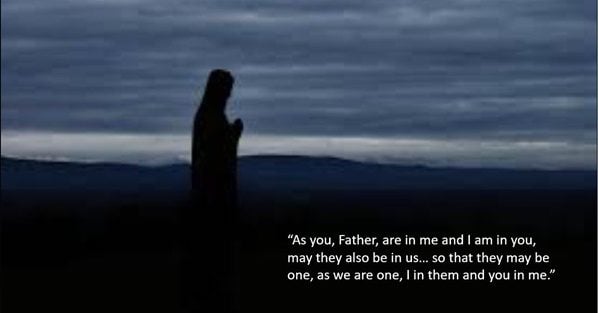
“Righteous Father, the world does not know you, but I know you; and these know that you have sent me. I made your name known to them, and I will make it known, so that the love with which you have loved me may be in them, and I in them.” — Jesus
The final words of the Easter season are a prayer for unity in a world of division. The world has its own way of creating unity through division, where identity is formed over and against and at the expense of others. “We know we are us because we are not them.” This “unity” has been forged at the expense of the marginalized, the outcast, the designated “enemy.” It is the violent unity of racism, homophobia, and religious bigotry, the formation of communities and cultures and nations with borders that not only shape those inside, but keep others outside. But the shape of the cruciform unity that Jesus gives reaches to the depths and across the breadth of the earth, drawing everyone in.
Violence: Human Division
Why does the world – the world of broken, messy humanity – form unity at the expense of others? Paradoxically, René Girard teaches, it is because we are so interconnected that we learn how to act, who to be, and what to desire from one another. We are formed not in isolation from but in relationship with one-another. This means we need each other.
Unfortunately, it also means that we compete, not only for the things we refuse to share, but to be the people we wish to claim exclusively to be. From the beginning of time, competition for mutual desire has set brother against brother, sister against sister. Proto-humanity would have dissolved in the conflagration of its own escalating violence had it not found a means of coming together. And from the beginning of time, that means has been the scapegoat – the victim whom people – blinded by and to their own violence – blamed as the source for their problems and misery. Girard theorizes that people formed unity out of chaos and violence by spontaneously coming together against a scapegoat and killing the scapegoat together. In the act of cooperation and the relief of purging their violence out of themselves and onto a victim, people felt such a transcendent catharsis that they ascribed divine power to violence.
The false god of violence is a broken relationship – a creation of people seeking to assert and sustain themselves over and against others and finding community by expelling a victim. Humans unite by cutting off a part of themselves. This is brokenness.
Trinity: Divine Unity
Jesus, in his prayer, expresses that the True God is whole, unbroken Relationship. God is Love. This is what the Trinity means.
The Trinity is difficult to understand if we try to parse abstract, metaphysical language. It need not be that complicated! It is a mystery, because God’s love is greater than our limited minds can fathom, but it is also a firm truth and a solid foundation on which we may stand and build our lives.
The “I-You” language that Jesus uses draws distinction, but not separation. Jesus’s Oneness with God the Father, the Source of Love, is reiterated over and over. What this means is that those outside of ourselves are not “other.” I, in my unique body, am not you in your unique body, and yet I am not me without you, and you are not you without me. We are formed in relationship. There is no “them.” There is only “us.”
God the Father has loved Jesus from “before the foundation of the world” – before human culture was born in the violence. Humanity was formed in God’s own image – humanity was formed in Love – to come to know one another.
Because we are formed in relationship, we have mutual desires and needs that lead to competition for possessions and exclusive claims of “firstness” and superiority. But Love is still forming us, transforming our competition into cooperation and our enmity into empathy.
The Glory of God
In a world built on victims, God steps in to become the victim and build a new world on Love.
And how does God build this world? On the cross.
Once again, the world is coming together and asserting itself over and against an enemy. Enemies – Herod and Pontius Pilate – are becoming friends in the mutual condemnation and execution of a victim. People are drawn together in their fear and hatred, destroying a man in whom they see their own destruction. An empire built on violence is killing again.
And God is building a whole new world by taking that hatred into himself and swallowing it in mercy.
“Father, I desire that those also, whom you have given me, may be with me where I am, to see my glory…”
When we think of glory, we might envision a ruler on a throne. Someone we look up to, who is above us. Majesty. Power. But the glory of God draws our eyes upward not to a fearsome deity, but to a condemned man on a cross.
This is not a glorification of suffering itself.
Rather, God shows us God’s glory by becoming One with those whom humanity has excluded and executed.
Every time we have marginalized, exploited, and killed others, we have marginalized, exploited, and killed God. “Whatever you do to the least of these, you do to me.”
All the violence done in God’s name has been the perpetuation of deception. A lie. God is never the author but ever the victim of violence.
But God transforms our violence by suffering it. Exposing our violence, unveiling the truth, ending the cycle of hate with forgiveness, transforming death into life. This is the glory of God.
Living In Love
We know the old way of finding unity in division.
We see it when people come together by casting others out. We still participate in this false unity.
It’s in the cheering of our team while jeering at the other.
It’s in the drumbeats of war.
It’s in the dehumanization of bigotry; the literal casting others out of the fold of humanity because of their difference.
This is the way of death.
And God calls us to a new Way.
The Truth God shows the world is not contained in any one religion. When Christians weaponize the cross to draw divisions, we are living by the old ways of death.
But people of other faiths and no faith at all know and show God’s loves. Jewish brothers and sisters who still bear the brunt of anti-Semitism teach and practice the liberating love that leads the world from slavery to freedom. Muslim sisters and brothers know the love of God that says “I have created humankind from a single pair and divided you into nations that you may know one another.” They show this love as they enter into solidarity with the hungry and give generously especially during Ramadan. People of other religions, people who have walked away from religion, people who reject the idea of God because God has so long been associated with violence – all who love live in God’s truth. God is Love.
And as we head into Pride Month, we recognize God in the LGBTQ community so long shunned and brutalized by violence committed in God’s name. Around the world, nations and religious communities have built false unity over and against our LGBTQ siblings. But the God whose name is invoked in condemnation against them stands not against but with and for them. God’s universal love can only be found in particular love, especially in love for those whom the world claims God hates.
Once again this year, Adam will represent his church in the Gay Pride parade as an ally. In the video, Adam expresses how in the parade, there is no sense of over-and-againstness, so sense of excluding others. People march not over and against those who hate them, but for a world where all may love freely.
The God who suffers with the suffering rejoices in their joy, and revels in their love. We only know the fullness of God’s love when we see it shining through all people, especially through those against whom the world has falsely claimed God’s hate. After all, the world crucified God thinking it was serving God! And God resurrects and transforms the world though love that is deeper and broader than we can ever imagine.
Conclusion
The difference between the world humanity has built and the world God is building is that a world built by violence excludes, where a world built by the Forgiving Victim includes all. The violent world, where we know ourselves by our divisions from others, eventually expels us all. We who live by the sword die by the sword. God’s world, built on mercy, is where we find our true selves in connection to each other. No exclusion, no hate, no death. This is eternal Life in Love into which we are all called, in which we fully live by loving all.
Image: https://pxhere.com/en/photo/707075
Next Post

June 3, 2019 The Unity of All Things: How to Be One with Jesus, God, and All Humanity
Browse Our Archives
Select a Category Atonement and Current Events Curriculum Faith and Families Interviews Jesus the Forgiving Victim Lent Montessori politics Reviews The Bible Explained Uncategorized Valentine's Day Wednesday Sermon Who is God?
Select a Month July 2020 November 2019 October 2019 September 2019 August 2019 July 2019 June 2019 May 2019 April 2019 March 2019 February 2019 January 2019 December 2018 November 2018 October 2018 September 2018 August 2018 July 2018 June 2018 May 2018 April 2018 March 2018 February 2018 January 2018 December 2017 November 2017 October 2017 September 2017 August 2017 July 2017 June 2017 May 2017 April 2017 March 2017 February 2017 January 2017 December 2016 November 2016 October 2016 September 2016 August 2016 June 2016 May 2016 April 2016 March 2016 February 2016 January 2016 December 2015 November 2015 October 2015 September 2015 August 2015 July 2015 June 2015 May 2015 April 2015 March 2015 February 2015 January 2015 December 2014 November 2014 October 2014 September 2014 August 2014 July 2014 June 2014 May 2014 April 2014 March 2014 January 2014 December 2013 September 2013 August 2013 July 2013
Follow Us!
TAKE THE
Religious Wisdom Quiz
Who spoke to the burning bush?
Select your answer to see how you score.
Aaron Miriam Moses Joseph
Related posts from Teaching Nonviolent Atonement

Forgiveness in the Time of COVID-19 by Julia...

Reflections on Indigenous Wisdom For Healing A Wounded...

How Forgiveness Can Transform Our Violence and Build...

Jesus Unmasked: God's Economy and How to Cheat...
TRENDING AT PATHEOS Progressive Christian

What Being a Modern-Day Apostle Means to Me
In my last column, I discussed the ins and outs of modern-day...

Did Ancient China Once Worship the God of...
Across human history, a common thread weaves through the origins of the...

Love Your Neighbor – Including Earth-Kin: Lev. 19,...
God’s command to love your neighbor means acting in an ethical and...

Lead a Church Study of “Jesus and Lao...
Guest writer Jack Thomas (The Irreverent Reverend) reflects on leading his church...

Pastoral Wisdom for Responding to Sermon Pushback
Getting sermon pushback on your social justice sermon? Learn practical, Proverbs-based strategies...

Principles for Understanding the Apostolic Ministry Today
Whenever people discover that my formal ministry title is "apostle," as in...
view all Progressive Christian blogs
Ad-Free & Subscriber Log-In Subscription Support
- About Us
- 2026 Calendar
- Videos
- Podcasts
- Library of World Religions
- Faith In Media Tracker
- Advertise With Us
- Write for Us
- Privacy Policy
- Terms of Service
- Do Not Sell My Data
- Contact Us
- Radiant Digital
- Manage Newsletter Subscriptions
- Unsubscribe From Notifications
- Sitemap
Copyright 2008-2026, Patheos. All rights reserved.
Subscription Support Ad-Free & Subscriber Log-In
Follow Patheos