
BuddhistCatholicContemplativeEvangelicalGeneral ChristianHinduJewishLatter-day SaintMuslimNew VisionsProgressive Christian
Beliefs
- Buddhist
- Catholic
- Contemplative
- Evangelical
- General Christian
- Hindu
- Jewish
- Latter-day Saint
- More Voices
- Muslim
- New Visions
- Pagan
- Progressive Christian
Topics
- Religion News
- Food and Religion
- Sports and Religion
- Religious Art
- Religious Music and Entertainment
- Religious Events
- History and Religion
- Style and Religion
- Politics and Religion
- Women in Religion
- Recreation Outdoors and Religion
- Business Finance and Religion
- Careers Workplace and Religion
- Education and Religion
- Family Parenting and Religion
- Health Fitness and Religion
- Home and Religion
- Relationships and Religion
- Technology and Religion
- Travel and Religion
Columnists
- Buddhist Columnists
- Business Finance and Religion Columnists
- Careers Workplace and Religion Columnists
- Catholic Columnists
- Contemplative Columnists
- Education and Religion Columnists
- Evangelists Columnists
- Family Parenting and Religion Columnists
- General Christian Columnists
- Health Fitness and Religion Columnists
- Hindu Columnists
- History and Religion Columnists
- Home and Religion Columnists
- Jewish Columnists
- More Voices Columnists
- Latter Day Columnists
- Muslim Columnists
- New Visions Columnists
- Nonreligious Columnists
- Pagan Columnists
- Politics and Religion Columnists
- Progressive Columnists
- Recreation Outdoors and Religion Columnists
- Relationships and Religion Columnists
- Religion News Columnists
- Religious Art Columnists
- Religious Events Columnists
- Religious Music and Entertainment Columnists
- Sports and Religion Columnists
- Style and Religion Columnists
- Technology and Religion Columnists
- Travel and Religion Columnists
- Women in Religion Columnists
Resource Library
- 2026 Calendar
- Library of World Religions
- The 100 Most Holy Places on Earth
- Patheos Answers
- Podcasts
- Videos
- Faith Leaders Database
- Anglican Episcopalian
- Bahai
- Baptist
- Buddhism
- Christianity
- Confucianism
- Eastern Orthodoxy
- Hinduism
- Holiness and Pentecostal
- ISKCON
- Islam
- Judaism
- Lutheran
- Methodist
- The Church of Jesus Christ of Latter-day Saints
- New Age
- Paganism
- Presbytarian and Reformed
- Protestantism
- Religion Behind the Scenes
- Roman Catholic
- Scientology
- Shia Islam
- Sikhism
- Sufism
- Sunni Islam
- Taoism
- Zen
- See all religions
Research Tools
 Ad-Free & Subscriber Log-In Subscription Support
Ad-Free & Subscriber Log-In Subscription Support
Follow Patheos 

- Trending:
- Forgiveness
- |
- Marriage
- |
- Consciousness
- |
- Death Penalty
- |
- Election
- |
- Halloween
 Teaching Nonviolent Atonement
- Home
- Progressive Christian
- The Radical Nonviolence of Mother’s Day: From a God of Wrath to a God of Love
The Radical Nonviolence of Mother’s Day: From a God of Wrath to a God of Love
Last updated on: May 13, 2019 at 1:44 pm by Adam Ericksen
The Radical Nonviolence of Mother’s Day: From a God of Wrath to a God of Love 2019-05-13T13:44:27-05:00 Adam Ericksen
Patheos Explore the world's faith through different perspectives on religion and spirituality! Patheos has the views of the prevalent religions and spiritualities of the world.

The following is a sermon I preached at Clackamas United Church of Christ, near Portland, Oregon. The primary scripture text was John 10:22-30. You can read the text or watch the video below.
Julia Ward Howe was an important American author and poet during the mid-1800s. She was also a social activist who struggled to abolish slavery and who worked for a woman’s right to vote.
She met Abraham Lincoln in 1861 at the beginning of the Civil War. After meeting Lincoln, she was inspired to write her most enduring and influential piece, “The Battle Hymn of the Republic.” The song instantly became a hit among Union soldiers during the war and its influence in patriotism and war continues today. The first stanza goes like this:
Mine eyes have seen the glory of the coming of the Lord;
He is trampling out the vintage where the grapes of wrath are stored;
He hath loosed the fateful lightning of His terrible swift sword:
His truth is marching on.
Glory, glory, hallelujah!
Glory, glory, hallelujah!
Glory, glory, hallelujah!
His truth is marching on.
Howe hoped that these words would inspire Union soldiers to defeat the Confederacy. The words unite God and war and they continue to be sung with patriotic fervor today.
But what we don’t know about Julia Ward Howe and her Battle Hymn of the Republic is that she had a change of heart. She watched the devastation of the Civil War with horror. She saw young men on both sides blown apart. Or, if they were lucky, they survived but were maimed for the rest of their lives.
At the beginning of the Civil War, Howe wrote that her “eyes have seen the glory of the coming of the Lord.” But as the gruesome war continued, her eyes were opened to seeing the horrors of the coming of the war.
And here’s the big secret that our culture doesn’t tell about Julia Ward Howe’s life: After her eyes saw the horrors of war, she became a radical pacifist and fought for an end to all war. And she did so by calling for a national day dedicated to mothers. Julia Ward Howe wanted Mother’s Day to be a reminder of the daily struggle to end all war.
A few years after the Civil War and its brutal carnage on both sides sank in, Howe wrote what we know today as her “Mother’s Day Proclamation.” This time, Howe invoked the name of God in a way that was fundamentally different from the Battle Hymn of the Republic. Instead of a battle, she now called for peace. She called for women around the world to unite in refusing to allow their children to fight one another. She argued that women held great power and hoped that the power of mothers would inspire the world.
In her proclamation for Mother’s Day, instead of writing about God’s wrath and “terrible swift sword” she wrote “Disarm, disarm! The sword of murder is not the balance of justice.” God does not have a “terrible swift sword.” The terrible swift sword doesn’t belong to God. It belongs to us. Wrath doesn’t belong to God; for God is love. Wrath belongs to us. And Howe called for us all to disarm our wrath and our weapons.
She also hoped that mothers could unite so that, as she wrote, “the great human family [could] live in peace, man as the brother of man, each bearing after his own kind the sacred impress, not of Caesar, but of God.”
The impress of Caesar is the impress of war. Caesar thought that the way to make peace was to destroy your enemies. But war and violence don’t make for peace; they just make for more enemies.
As Jesus reveals, the impress of God is radical, nonviolent love. Julia Ward Howe began to see that truth during the Civil War. Instead of seeing the glory of the coming of the Lord in war and violence, she saw the glory of the Lord in women like Ann Jarvis. Jarvis created a group called “Mother’s Day Work Clubs” in West Virginia. During the war, the Union Army requested that these work clubs act as nurses to wounded Union Army soldiers. Ann Jarvis agreed, but with a stipulation – the women of the Mother’s Day Work Club would care for any soldier in need, whether from the North or the South. Ann Jarvis thought that God’s love extended to all of God’s children, and so should theirs
Howe and Jarvis worked to abolish slavery. In doing so, they worked for a more just world. But their faith led them to see the image of God in all people. So, while they struggled for justice, they knew their fight was not with flesh and blood, but with the powers and principalities. Glory, Glory, Hallelujah.
I tell you this story because Mother’s Day isn’t just about Hallmark Cards. It has a subversive political history of nonviolence and it is rooted in the Gospel of Jesus.
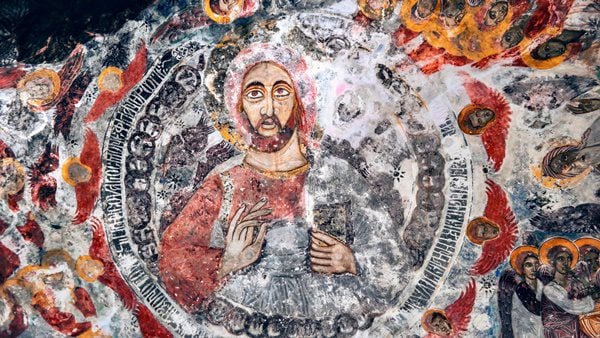
We see this in out passage this morning. Today is not only Mother’s Day; for the church it is also called Good Shepherd Sunday. Jesus calls himself the Good Shepherd.
What’s so important about shepherds? The most important King in Israel’s history was a man named David. David was the youngest of seven brothers, so David had to do all the dirty grunt work in his family, including acting as the family shepherd. David was tending the family sheep when a prophet came to his house to anoint him as the next king of Israel.
Ever since David, the kings of Israel were referred to as Shepherds. Like a shepherd, the kings were supposed to care for their flock, especially those who were most vulnerable. But most of the Shepherds of Israel were not good. In fact, before Israel ever had a king, a prophet warned the people that they did not really want a king, because a king would take their daughters as his wives and take their sons into his army to fight his battles. But the people insisted on having a king.
Unfortunately, that prophet’s warning came true. The kings of Israel were mostly bad Shepherds. David was known as the best of the Shepherds.
The people during Jesus’ day were looking for a new Shepherd. They hoped for a new
Son of David, a new Messiah to Shepherd them into a better world.
In our passage, Jesus was walking in the Temple, in an area called Solomon’s Porch. Now at this point, we should ask, “Who was Solomon?” Solomon was the son of David who became king when David died. Solomon was known for building the first Temple of Jerusalem, but he made some big mistakes.
You may remember that when Israel was enslaved in Egypt, the Egyptians forced the people to build their temples to the Egyptian gods. Israel cried out to God for deliverance. God heard their cry and led them out of slavery. God led them into the promised land and warned them to never go back to Egypt.
When it came time for Solomon to build the Temple in Israel, he did so by imitating Egypt – the Bible tells us that he used forced labor. Solomon was a shepherd who enslaved the people. Solomon also became rich through buying and selling weapons from Egypt! Solomon was an arms dealer who amassed great amounts of wealth for himself.
Solomon was not a great Shepherd. And the Shepherd’s of Israel followed his lead. They were generally bad because they didn’t care for their sheep. Instead, they sacrificed their sheep. They sent men as sacrificial offerings in war, but they also sacrificed their sheep by hoarding wealth for themselves and their friends and refusing to share that wealth with the poor and the vulnerable.
And so when some of his opponents come to Jesus at Solomon’s Porch and ask him if he is the Messiah, they ask him a loaded question. Jesus didn’t answer outright, but he says that his works testify to his true identity. He healed people, he included those who were marginalized, he became one with the poor, he forgave people, and he loved even his enemies.
In other words, Jesus was the Good Shepherd, who refused to sacrifice his sheep, but instead gave them eternal life. This eternal life is not primarily about someplace you go after you die. It’s about the here and now. It’s about receiving the care that the Good Shepherd has to offer us and sharing that with other.
In fact, Jesus even says that he is the Shepherd who lays down his own life for his sheep. Like Julia Ward Howe and Ann Jarvis, Jesus loved even his enemies so much that he refused to harm them. Instead he worked to heal them by going to the cross and offering forgiveness.
Jesus is the Good Shepherd, but I have experiences in my life when I realize that I am most definitely not the Good Shepherd. I also frequently realize that I have a long way to go before I live out the Mother’s Day Proclamation of Peace.
I’ll give you an example. Friday was my brother’s birthday and we celebrated by going out for dinner. I have no idea why this is the case, but our favorite place to celebrate birthdays are nasty dive bars. You know, it has to have those video gambling machines, pool tables, and it should take the wait staff a couple of minutes to find a clean pint glass.
I picked up my brother and, I don’t know, I must have been feeling sassy, because as I drove us to our dive bar, there was a sticker for a presidential candidate in 2020 on the bumper of the car in front of us. Now, I think this presidential candidate is a really bad shepherd and there are times when I wonder why anyone would follow and listen to his voice. So I decided to change lanes and pass the car. As we drove along, I told my brother to give the driver a not so friendly hand signal.
Yes, sometimes I’m a pretty bad shepherd! I’m often a disappointment unto myself. You’ll be happy to know that my brother did not follow through on my request. Jesus warns in our passage that his opponents are not his sheep because they don’t listen to his voice. It’s easy to divide the world into us and them at this point. But that’s simplistic. There are moments like that when I wonder if I’m really listening to Jesus’ voice. Because so often when I try to fight the hatred that I see in the world, I end up mirroring it. I respond to what I think is hate with hatred of my own. And the older I get the more I realize how toxic that is to my own soul. That response does not lead me to eternal life. And it shows that there are times when I do not listen to the Good Shepherd’s voice.
Julia Ward Howe wrote the Battle Hymn of the Republic that glorifies violence and war. At that time, she was not listening to the Good Shepherd’s voice. She was listening to the voice of human wrath. Later she listened to God’s voice and realized that violence and war don’t do us any good, so she dedicated her life to peace. Ann Jarvis listened to the Good Shepherd’s voice and realized that the image of God resides in all of God’s children, no matter what color uniform they wore, so she cared for all of God’s wounded sheep.
And Jesus himself, he is our Good Shepherd, who does not lead us with a sword into war, but he leads us with a staff so that we can drink from the springs of eternal life.
The danger of Good Shepherd Sunday is that we merely emphasize Jesus as the Good Shepherd. But Jesus wants us to follow him in the ways of being good shepherds to one another. You are not merely sheep. You are also shepherds. You have cared for one another. You have led one to the springs of eternal life. In various ways, you remind one another that our true identity is that we are sons and daughters of the living God who has Mothered us into being and Shepherds us into eternal life.
So on this Mother’s Day, may we celebrate its original meaning as a day of peace.
May we share that peace with one another.
And may follow the Good Shepherd as he leads us to the rivers of eternal life. Glory, Glory, Hallelujah. Amen.
Image: 123rf.com

Browse Our Archives
Select a Category Atonement and Current Events Curriculum Faith and Families Interviews Jesus the Forgiving Victim Lent Montessori politics Reviews The Bible Explained Uncategorized Valentine's Day Wednesday Sermon Who is God?
Select a Month July 2020 November 2019 October 2019 September 2019 August 2019 July 2019 June 2019 May 2019 April 2019 March 2019 February 2019 January 2019 December 2018 November 2018 October 2018 September 2018 August 2018 July 2018 June 2018 May 2018 April 2018 March 2018 February 2018 January 2018 December 2017 November 2017 October 2017 September 2017 August 2017 July 2017 June 2017 May 2017 April 2017 March 2017 February 2017 January 2017 December 2016 November 2016 October 2016 September 2016 August 2016 June 2016 May 2016 April 2016 March 2016 February 2016 January 2016 December 2015 November 2015 October 2015 September 2015 August 2015 July 2015 June 2015 May 2015 April 2015 March 2015 February 2015 January 2015 December 2014 November 2014 October 2014 September 2014 August 2014 July 2014 June 2014 May 2014 April 2014 March 2014 January 2014 December 2013 September 2013 August 2013 July 2013
Follow Us!
TAKE THE
Religious Wisdom Quiz
How beautiful on the mountains are the feet of those who bring good news and proclaim what?
Select your answer to see how you score.
Deliverance Peace Salvation Victory
Related posts from Teaching Nonviolent Atonement


St. Francis Preaches on Violence

God Doesn’t Smite Anyone - Reflections on Sodom,...
Jesus Unmasked: Episode 2 – Pride and the...
TRENDING AT PATHEOS Progressive Christian

What Being a Modern-Day Apostle Means to Me
In my last column, I discussed the ins and outs of modern-day...

Did Ancient China Once Worship the God of...
Across human history, a common thread weaves through the origins of the...

Love Your Neighbor – Including Earth-Kin: Lev. 19,...
God’s command to love your neighbor means acting in an ethical and...

Lead a Church Study of “Jesus and Lao...
Guest writer Jack Thomas (The Irreverent Reverend) reflects on leading his church...

Pastoral Wisdom for Responding to Sermon Pushback
Getting sermon pushback on your social justice sermon? Learn practical, Proverbs-based strategies...

Principles for Understanding the Apostolic Ministry Today
Whenever people discover that my formal ministry title is "apostle," as in...
view all Progressive Christian blogs
Ad-Free & Subscriber Log-In Subscription Support
- About Us
- 2026 Calendar
- Videos
- Podcasts
- Library of World Religions
- Faith In Media Tracker
- Advertise With Us
- Write for Us
- Privacy Policy
- Terms of Service
- Do Not Sell My Data
- Contact Us
- Radiant Digital
- Manage Newsletter Subscriptions
- Unsubscribe From Notifications
- Sitemap
Copyright 2008-2026, Patheos. All rights reserved.
Subscription Support Ad-Free & Subscriber Log-In
Follow Patheos