
BuddhistCatholicContemplativeEvangelicalGeneral ChristianHinduJewishLatter-day SaintMuslimNew VisionsProgressive Christian
Beliefs
- Buddhist
- Catholic
- Contemplative
- Evangelical
- General Christian
- Hindu
- Jewish
- Latter-day Saint
- More Voices
- Muslim
- New Visions
- Pagan
- Progressive Christian
Topics
- Religion News
- Food and Religion
- Sports and Religion
- Religious Art
- Religious Music and Entertainment
- Religious Events
- History and Religion
- Style and Religion
- Politics and Religion
- Women in Religion
- Recreation Outdoors and Religion
- Business Finance and Religion
- Careers Workplace and Religion
- Education and Religion
- Family Parenting and Religion
- Health Fitness and Religion
- Home and Religion
- Relationships and Religion
- Technology and Religion
- Travel and Religion
Columnists
- Buddhist Columnists
- Business Finance and Religion Columnists
- Careers Workplace and Religion Columnists
- Catholic Columnists
- Contemplative Columnists
- Education and Religion Columnists
- Evangelists Columnists
- Family Parenting and Religion Columnists
- General Christian Columnists
- Health Fitness and Religion Columnists
- Hindu Columnists
- History and Religion Columnists
- Home and Religion Columnists
- Jewish Columnists
- More Voices Columnists
- Latter Day Columnists
- Muslim Columnists
- New Visions Columnists
- Nonreligious Columnists
- Pagan Columnists
- Politics and Religion Columnists
- Progressive Columnists
- Recreation Outdoors and Religion Columnists
- Relationships and Religion Columnists
- Religion News Columnists
- Religious Art Columnists
- Religious Events Columnists
- Religious Music and Entertainment Columnists
- Sports and Religion Columnists
- Style and Religion Columnists
- Technology and Religion Columnists
- Travel and Religion Columnists
- Women in Religion Columnists
Resource Library
- 2026 Calendar
- Library of World Religions
- The 100 Most Holy Places on Earth
- Patheos Answers
- Podcasts
- Videos
- Faith Leaders Database
- Anglican Episcopalian
- Bahai
- Baptist
- Buddhism
- Christianity
- Confucianism
- Eastern Orthodoxy
- Hinduism
- Holiness and Pentecostal
- ISKCON
- Islam
- Judaism
- Lutheran
- Methodist
- The Church of Jesus Christ of Latter-day Saints
- New Age
- Paganism
- Presbytarian and Reformed
- Protestantism
- Religion Behind the Scenes
- Roman Catholic
- Scientology
- Shia Islam
- Sikhism
- Sufism
- Sunni Islam
- Taoism
- Zen
- See all religions
Research Tools
 Ad-Free & Subscriber Log-In Subscription Support
Ad-Free & Subscriber Log-In Subscription Support
Follow Patheos 

- Trending:
- Forgiveness
- |
- Marriage
- |
- Consciousness
- |
- Death Penalty
- |
- Election
- |
- Halloween
 Teaching Nonviolent Atonement
- Home
- Progressive Christian
- Love One Another As I Have Loved You: Girardian Virtual Bible Study – Easter 5 Year C
Love One Another As I Have Loved You: Girardian Virtual Bible Study – Easter 5 Year C
Last updated on: May 17, 2019 at 4:47 pm by Lindsey Paris-Lopez
Love One Another As I Have Loved You: Girardian Virtual Bible Study – Easter 5 Year C 2019-05-17T16:47:57-05:00 Lindsey Paris-Lopez
Patheos Explore the world's faith through different perspectives on religion and spirituality! Patheos has the views of the prevalent religions and spiritualities of the world.
Welcome to the Girardian Virtual Bible Study! Each week we explore the lectionary passage with the help of René Girard’s insights into human relationships. You can continue to join the GVBS at 10:30 am Central on the Raven Foundation Facebook page during the month of May. This episode explores Acts 11: 1-18 and John 13: 31-35.
Revisiting The New Commandment
“I give you a new commandment, that you love one another. Just as I have loved you, you also should love one another. By this everyone will know that you are my disciples, if you have love for one another.”
This week we revisit these words of Jesus, spoken at the Last Supper. The new commandment, the mandate from whence the name “Maundy Thursday” derives, is that we love one another not only as we love ourselves, but as Love’s own Self loves us. Love Embodied, Jesus, perfects our love and bids and empowers us to follow through in loving one-another.
What is perfect love? It is love that sees through all the violence and brokenness and separation of humanity from God and from one another. It is love that endures all of this and forgives, heals, renews. It is love that finds us through fear and hatred and burns through the cruelty, bitterness and brutality and melts away anxiety and shame, restoring us to our true nature as children of Love. This is a love that Jesus embodies in concrete acts of embracing the outcasts, healing the suffering, and breaking bread with the broken. It is fully revealed on the cross and vindicated and magnified and dispersed throughout the universe in the resurrection.
Thus, though the lectionary has recently explored this text during Holy Week, it is fitting to revisit the new commandment to love one another on this side of the resurrection, when we can see more clearly its breadth and its depth. The breadth of this commandment is explored in Acts 11, to which we now turn before returning to the Gospel.
Acts 11: 1-18: The Breadth of God’s Love
Whom are we to love?
“Why do you go to uncircumcised men and eat with them?”
Peter patiently explains to these followers at Judea why he keeps company with the uncircumcised. He has patience because it wasn’t so long ago that he would have balked at the thought of eating with such “unclean” people himself. He is in the process of overcoming his own prejudices and biases, which do not just vanish once exposed but take time to be thoroughly extricated from the human heart. So he recalls a vision that helped him see everything in a new light:
“There was something like a large sheet coming down from heaven, being lowered by its four corners; and it came close to me. As I looked at it closely I saw four-footed animals, beasts of prey, reptiles, and birds of the air. I also heard a voice saying to me, ‘Get up, Peter; kill and eat.’ But I replied, ‘By no means, Lord; for nothing profane or unclean has ever entered my mouth.’ But a second time the voice answered from heaven, ‘What God has made clean, you must not call profane.’”
Peter goes on to make the obvious connection of this metaphor to people. “What God has made clean, you must not call profane.” Peter had looked upon the animals that violated his dietary restrictions with disgust, until God tells him not to. God has made all things, and God makes all things clean. God made the whole world and declared it good. The uncircumcised, those raised with different customs and traditions… they were people Peter, too, once considered unclean. But God tells him to “make no distinction” between them and himself. God has made these people. God loves these people. Who is Peter not to love them too?
There is a common anti-Semitic reading of this passage that entirely misses the point. Some have used this text to mock or feel superior to Jewish people who keep dietary laws. To use this passage over and against anyone is to miss the point completely. This is about God’s universal love and blessing on all of humanity. It is, quite simply, not about expanding our diets but our hearts.
Rituals and traditions by which people may know one-another are not necessarily bad. But the mark of who we are should be how we include others, not how or who we exclude. We should seek to be known as followers of Love by our love.
Peter is following Jesus and learning what it means to love. He knows his own weaknesses and knows he has a long way to go. He speaks to those who have chastised him, not with anger or condescension or arrogance, but with humility. And his critics are moved, I think as much by his attitude as his words. They praise God, saying, “Then God has given even to the Gentiles the repentance that leads to life.”
So whom are we to love? God has blessed even them. Is there anyone against whom we have set ourselves? Are we prepared now to not merely accept but rejoice in God’s love for them? Are we prepared to recognize that God calls us not to make distinctions between them and us?
John 13: 31-35: The Depth of God’s Love
So whom are we to love? Everyone. Without exception. And how are we to love?
As Jesus has loved us.
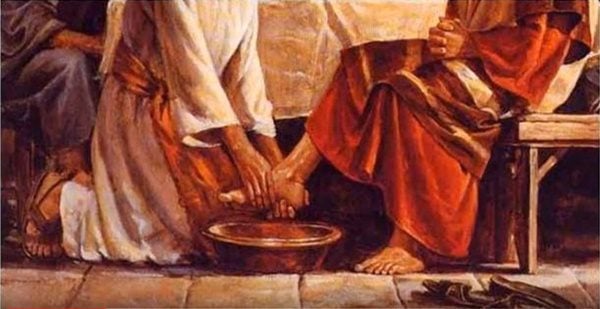
This is the new commandment given to the disciples after Jesus has washed their feet.
This is our new commandment.
We are to love with a love that makes us vulnerable. As Fr. James Alison explains, you cannot wash someone’s feet without putting yourself physically beneath them in a position in which you can be kicked down. So this is a love that trusts, a love that takes risks. It is a love that can open others to love, a love that can bring out the best in others and ourselves, but also a love that is scary. It is a love that looks to the needs of others despite the cost. It is a love we can give because it is a love we are given.
We are to love with a love that is messy and bold. We are to love with a love that draws us to the people and places and situations we may have wanted to avoid.
Jesus washes the dirty, smelly, desert-trodden feet of his disciples. He tends to the places we try to hide, sees the sides of us we try to cover. We are called to attend to the mess, the brokenness, the unlovely. What may have triggered us to recoil or back away, we are called to approach and see that God is there. We are called to tend to the anxieties and shames of others with gentleness and care.
And moreover, we are called to open ourselves to the love that exposes us, that lays bare all of our own anxieties and shames. Our call to be Christ to each other is also a call to allow others to be Christ to us, to be Love to us. It’s a love that calls us to let our guards down enough to be loved.
What wondrous love is this?!
This is the love that is fully displayed in the cross and resurrection. The love that absorbs, exposes, forgives and heals our violence. The love that reveals God in those we have victimized, so that we may change the harmful ways we relate to others. This is the love that shines through us that may reach the eyes of those who cause us harm. This is the love that glorifies God, the love in which God’s glory is magnified to the world.
Jesus gives the new commandment to his disciples after Judas has left. Frederick Niedner, of the Institute for Liturgical Studies at Valparaiso University, asks if any of the disciples took this commandment to heart and went to look for Judas, to gently listen to him, to help him in his brokenness, to extend this love to him. Maybe not. Maybe they didn’t because they did not realize that Judas was included in this love. Maybe because they did not yet realize the extent of this love to which they were called. Maybe they didn’t reach out to Judas because they didn’t realize how much they themselves needed this boundless, merciful love. At the last supper, Jesus tells them to love as he loved, but the fullness of his love wouldn’t appear until he comes to them after his crucifixion and forgives them for their own abandonment and even denial of him.
Peter denied Jesus. Peter saw how Jesus forgave even him. And that helped him understand that God’s mercy reaches to all, even those he would have excluded.
That’s why it’s so important to revisit this Gospel this side of the resurrection. That’s why it’s important to keep revisiting this Gospel over and over, to keep ourselves ever amazed with the breadth and depth of God’s love, to remember that this love is our calling. Because we never know how much we ourselves will need it in this lifetime of mistakes that lies ahead of us. So whenever we find ourselves claiming our identity by drawing distinctions against those we are not, we can remember that God calls us to love even them, with a love that calls us to see the vulnerability of others with a vulnerability of our own. We must revisit these passages so we can look to our own dirty feet, our own brokenness, and recognize that God loves even us.
As we are loved, so we are called to love. May we listen and follow. Amen.
Image: Screenshot from Youtube: “Washing Feet Explained (Bible)” by Preparing the Bride.
Next Post

May 20, 2019 Why You Should Run from Religion that Emphasizes Being Right
Browse Our Archives
Select a Category Atonement and Current Events Curriculum Faith and Families Interviews Jesus the Forgiving Victim Lent Montessori politics Reviews The Bible Explained Uncategorized Valentine's Day Wednesday Sermon Who is God?
Select a Month July 2020 November 2019 October 2019 September 2019 August 2019 July 2019 June 2019 May 2019 April 2019 March 2019 February 2019 January 2019 December 2018 November 2018 October 2018 September 2018 August 2018 July 2018 June 2018 May 2018 April 2018 March 2018 February 2018 January 2018 December 2017 November 2017 October 2017 September 2017 August 2017 July 2017 June 2017 May 2017 April 2017 March 2017 February 2017 January 2017 December 2016 November 2016 October 2016 September 2016 August 2016 June 2016 May 2016 April 2016 March 2016 February 2016 January 2016 December 2015 November 2015 October 2015 September 2015 August 2015 July 2015 June 2015 May 2015 April 2015 March 2015 February 2015 January 2015 December 2014 November 2014 October 2014 September 2014 August 2014 July 2014 June 2014 May 2014 April 2014 March 2014 January 2014 December 2013 September 2013 August 2013 July 2013
Follow Us!
TAKE THE
Religious Wisdom Quiz
Who said, "My God, my God, why have you forsaken me?"
Select your answer to see how you score.
Isaiah David Job Jesus
Related posts from Teaching Nonviolent Atonement

Forgiveness in the Time of COVID-19 by Julia...

Jesus Unmasked: On Being Lost And Found: Sheep,...

Jesus Unmasked: Humility Is Not A Competition [Video]

Perfect Love Casts Out Fear, But Can It...
TRENDING AT PATHEOS Progressive Christian

What Being a Modern-Day Apostle Means to Me
In my last column, I discussed the ins and outs of modern-day...

Did Ancient China Once Worship the God of...
Across human history, a common thread weaves through the origins of the...

Love Your Neighbor – Including Earth-Kin: Lev. 19,...
God’s command to love your neighbor means acting in an ethical and...

Lead a Church Study of “Jesus and Lao...
Guest writer Jack Thomas (The Irreverent Reverend) reflects on leading his church...

Pastoral Wisdom for Responding to Sermon Pushback
Getting sermon pushback on your social justice sermon? Learn practical, Proverbs-based strategies...

Principles for Understanding the Apostolic Ministry Today
Whenever people discover that my formal ministry title is "apostle," as in...
view all Progressive Christian blogs
Ad-Free & Subscriber Log-In Subscription Support
- About Us
- 2026 Calendar
- Videos
- Podcasts
- Library of World Religions
- Faith In Media Tracker
- Advertise With Us
- Write for Us
- Privacy Policy
- Terms of Service
- Do Not Sell My Data
- Contact Us
- Radiant Digital
- Manage Newsletter Subscriptions
- Unsubscribe From Notifications
- Sitemap
Copyright 2008-2026, Patheos. All rights reserved.
Subscription Support Ad-Free & Subscriber Log-In
Follow Patheos