
BuddhistCatholicContemplativeEvangelicalGeneral ChristianHinduJewishLatter-day SaintMuslimNew VisionsProgressive Christian
Beliefs
- Buddhist
- Catholic
- Contemplative
- Evangelical
- General Christian
- Hindu
- Jewish
- Latter-day Saint
- More Voices
- Muslim
- New Visions
- Pagan
- Progressive Christian
Topics
- Religion News
- Food and Religion
- Sports and Religion
- Religious Art
- Religious Music and Entertainment
- Religious Events
- History and Religion
- Style and Religion
- Politics and Religion
- Women in Religion
- Recreation Outdoors and Religion
- Business Finance and Religion
- Careers Workplace and Religion
- Education and Religion
- Family Parenting and Religion
- Health Fitness and Religion
- Home and Religion
- Relationships and Religion
- Technology and Religion
- Travel and Religion
Columnists
- Buddhist Columnists
- Business Finance and Religion Columnists
- Careers Workplace and Religion Columnists
- Catholic Columnists
- Contemplative Columnists
- Education and Religion Columnists
- Evangelists Columnists
- Family Parenting and Religion Columnists
- General Christian Columnists
- Health Fitness and Religion Columnists
- Hindu Columnists
- History and Religion Columnists
- Home and Religion Columnists
- Jewish Columnists
- More Voices Columnists
- Latter Day Columnists
- Muslim Columnists
- New Visions Columnists
- Nonreligious Columnists
- Pagan Columnists
- Politics and Religion Columnists
- Progressive Columnists
- Recreation Outdoors and Religion Columnists
- Relationships and Religion Columnists
- Religion News Columnists
- Religious Art Columnists
- Religious Events Columnists
- Religious Music and Entertainment Columnists
- Sports and Religion Columnists
- Style and Religion Columnists
- Technology and Religion Columnists
- Travel and Religion Columnists
- Women in Religion Columnists
Resource Library
- 2026 Calendar
- Library of World Religions
- The 100 Most Holy Places on Earth
- Patheos Answers
- Podcasts
- Videos
- Faith Leaders Database
- Anglican Episcopalian
- Bahai
- Baptist
- Buddhism
- Christianity
- Confucianism
- Eastern Orthodoxy
- Hinduism
- Holiness and Pentecostal
- ISKCON
- Islam
- Judaism
- Lutheran
- Methodist
- The Church of Jesus Christ of Latter-day Saints
- New Age
- Paganism
- Presbytarian and Reformed
- Protestantism
- Religion Behind the Scenes
- Roman Catholic
- Scientology
- Shia Islam
- Sikhism
- Sufism
- Sunni Islam
- Taoism
- Zen
- See all religions
Research Tools
 Ad-Free & Subscriber Log-In Subscription Support
Ad-Free & Subscriber Log-In Subscription Support
Follow Patheos 

- Trending:
- Forgiveness
- |
- Marriage
- |
- Consciousness
- |
- Death Penalty
- |
- Election
- |
- Halloween
 Teaching Nonviolent Atonement
- Home
- Progressive Christian
- When In Doubt, We Are Blessed: Girardian Virtual Bible Study Preview
When In Doubt, We Are Blessed: Girardian Virtual Bible Study Preview
Last updated on: April 23, 2019 at 12:54 pm by Lindsey Paris-Lopez
When In Doubt, We Are Blessed: Girardian Virtual Bible Study Preview 2019-04-23T12:54:43-05:00 Lindsey Paris-Lopez
Patheos Explore the world's faith through different perspectives on religion and spirituality! Patheos has the views of the prevalent religions and spiritualities of the world.
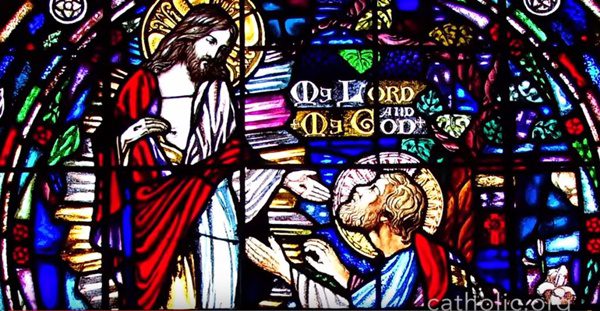
Editor’s Note: Every Wednesday at 10:30 am CT, Adam and Lindsey host a live Girardian Virtual Bible Study following the Sunday lectionary on the Raven Foundation Facebook page. We invite our listeners to join the conversation with comments and questions. I take some notes to help me prepare… and share them with you to help you do the same! This is the Girardian Virtual Bible Study preview!
Okay, I’ll just admit it right now. These words from Jesus to Thomas have, in the past, been among my least favorite in scripture.
I grew up anxious – sometimes downright fearful – about matters concerning faith.
As the daughter of an atheist, I grew up knowing that the God in whom most of my family and friends believed was rejected by the man I loved most. And so, before I understood much of anything, I had to question why. I couldn’t take faith in God for granted – ever.
Nevertheless, I wanted to believe. I am not only the daughter of an atheist; I’m also the daughter of a devout Christian and the granddaughter of two former ministers. I grew up going to church and hearing stories about the Creator of heaven and earth who became human, healed the sick, embraced the poor and lame, raised the dead, and loved the little children. I wanted to know that this God was, is, real. I wanted to embrace this God with my whole heart. But if I did, I worried that I would be leaving my father behind.
And I soon understood the reasons he rejected faith. The Bible told me that the same God who healed the sick and embraced the poor also wiped out the entire world in a flood. (I don’t know if I ever thought about the story of Noah’s ark as a story of cute animals. I mean, maybe two of every kind got on the boat, but the rest died. Along with most of the people in the world!) The same scripture that spoke of a God of freedom also talked about angels killing first-born babies. I may not have felt much for the soldiers who chased the Israelites as they fled Egypt (okay, truth be told, I did feel for them, because they are people too.) But I certainly felt for their poor horses who were supposedly swallowed up in the Red Sea. And on top of all of that, I thought I was supposed to believe that God, in human form, died for our sins so that we could live because the penalty of sin and disbelief is death… and hell. I couldn’t wrap my head around it morally or intellectually.
But so many people I loved seemed to be able to embrace God, without fear and without a sense of superiority to others who may have taken different paths. There was a disconnect between the scripture I tried to understand and (1) a lectionary that seemed to leave out the most gruesome aspects, but more importantly (2) friends and family members who attributed their understanding of love and compassion to their faith in Jesus. I recognized that they had found a way to love God without embracing the exclusion and damnation to others that the Bible seemed to suggest.
If my doubts and spiritual wrestlings had only been the product of fear, I probably would have given up the journey to find faith years ago. Fear was certainly mingled in, but there was also desire and yearning, an aching for an understanding of and faith in a God who would love and embrace not only me, but also my father and everyone else who struggled with doubt or gave up faith entirely out of a firm and emphatic “No!” to violence and exclusion and damnation.
Now I understand that Jesus is God’s “No!” to violence, exclusion, and damnation.
But it has taken me a journey through doubts and fears and questions to get here, and there are often times when I still wonder and doubt.
I would hear the words of Jesus to Thomas as a child and try to suppress my questions and doubt. I wanted to be part of the “in” club that was “blessed” with faith beyond sight, beyond proof. I imagined others hearing these words and feeling a sense of superiority over and against those who doubt the resurrection. I imagined that if they really knew all the questions of my heart and mind, they would realize that I don’t belong among them. I worried that I would be looked down upon. I knew that if anyone was a “doubting Thomas,” it was truly me. I worried that I wasn’t be blessed.
But here’s the thing: Jesus appeared to all the disciples because he knew that they needed to see him. It is unfortunate that the Gospel seems to single Thomas out, because everyone had fears and doubts… so much so that they all (except for Thomas) huddled in a little room away from the crowds. (Why wasn’t Thomas there? Was he in less fear than the others? Did he actually have a faith and hope that he couldn’t recognize or name?) Jesus didn’t single out those who were not blessed from those who were. He instead blesses everyonewith love and forgiveness.
He returns to show us all the vindication of love and life over hate and death. Because he knows we must see to truly believe. We are made to learn from that which we can see, touch, taste, smell and hear. We are sensory, incarnate beings. God so loved us as to live among us and share our human nature because that is what we needed to see and know and understand the fullness of Love. I don’t believe that Jesus ever chastises or blames those who must see to believe.
Why, then, does he say “Blessed are those who have not seen, and yet have come to believe?”
Because there is blessing, indeed, in faith beyond what the eyes can see. There is blessing in hope for that which is yet to be.
The truth is, the only extent to which we now see the risen Lord is the extent to which we embody Love to each other.
We still live in a world of brokenness and sorrow. We still live in a world of bigotry and hate. We still live in a world of violence and vengeance. God’s kindom has not fully come on earth as it is in heaven.
To believe that there is life for this fragile and delicate world, that those who are crushed by forces of hate and apathy and death can still be embraced by love even when they no longer breathe and their hearts no longer beat, that a world dying of climate change can be made new… this requires faith that there is a power that is stronger than human destruction.
Not everyone calls that power “God.” I don’t think that is the point. I think the point is to live beyond the nihilism of resignation; to persist, knowing that “better” is possible and we can be a part of it. I think the point is to recognize the humanity in every living person even when it is so obscured by fears and prejudices; to know that there is still a heart of love beyond hate. I think the point is to recognize that there is hope for the world if we recognize that we are all a part of each other, and if we live our lives not over and against but for one another and the home that we all share. I call that driving force, that persistence in the face of all the danger and negativity in the world, that embrace of one-another for the sake of finding our true wholeness and restoring the world we share… I call that God.
The persistence of living and striving in a world where bigotry and fear and danger may otherwise hold us back — that persistence requires minds that question and seek answers. It requires curiosity and skepticism that tests everything. It requires moving beyond the comfort of the familiar, which so often keeps us from knowing one-another. It requires doubt. Thank God for Thomas and the scientific mind that seeks empirical knowledge! Without that doubt and need to question, we would not be able to learn and advance forward, intellectually or spiritually.
Doubt works hand-in-hand with a faith in that which is yet to be. It is the companion to, not enemy of, faith.
Do you have questions or doubts? You are far from alone! A Girardian reading of scripture can help us appreciate how doubt and questions can stem the tide of negative contagions that come when people are all too willing to believe the worst in and of others. My own personal journey would not have gone nearly as far without my doubts. How has doubt worked hand-in-hand with your faith?
One thing I never doubt, however, is the fact that we have so much to learn with and from each other! So please join Adam and me for the Girardian Virtual Bible Study on the Raven FB page tomorrow (4/24) at 10:30 am CT.
Whether you’re a minister preparing your Sunday sermon or a lay person trying to better understand the Bible, whatever you believe, question, or doubt, we warmly invite you to participate with comments and questions as we seek to grow our virtual community. Your presence is more than an honor and a blessing – it’s a necessity! Since we are interdividual beings, growing in relationship with one-another, we need each other! Your participation is an integral part of the Girardian Virtual Bible Study!
Image: Screenshot from Youtube: “St. Thomas HD,” by Catholic Online.
Previous Post

April 22, 2019
Ancient Resurrection Stories: How Jesus Is Transforming the World
Next Post
April 23, 2019 Role Model: A Tribute To My Mother In Honor Of Her Retirement
Browse Our Archives
Select a Category Atonement and Current Events Curriculum Faith and Families Interviews Jesus the Forgiving Victim Lent Montessori politics Reviews The Bible Explained Uncategorized Valentine's Day Wednesday Sermon Who is God?
Select a Month July 2020 November 2019 October 2019 September 2019 August 2019 July 2019 June 2019 May 2019 April 2019 March 2019 February 2019 January 2019 December 2018 November 2018 October 2018 September 2018 August 2018 July 2018 June 2018 May 2018 April 2018 March 2018 February 2018 January 2018 December 2017 November 2017 October 2017 September 2017 August 2017 July 2017 June 2017 May 2017 April 2017 March 2017 February 2017 January 2017 December 2016 November 2016 October 2016 September 2016 August 2016 June 2016 May 2016 April 2016 March 2016 February 2016 January 2016 December 2015 November 2015 October 2015 September 2015 August 2015 July 2015 June 2015 May 2015 April 2015 March 2015 February 2015 January 2015 December 2014 November 2014 October 2014 September 2014 August 2014 July 2014 June 2014 May 2014 April 2014 March 2014 January 2014 December 2013 September 2013 August 2013 July 2013
Follow Us!
TAKE THE
Religious Wisdom Quiz
Who doubted Jesus' resurrection until he saw His wounds?
Select your answer to see how you score.
James Peter Thomas Philip
Related posts from Teaching Nonviolent Atonement

The Secret of Life: An Interview with Audrey...

Forgiveness in the Time of COVID-19 by Julia...

Reflections on Indigenous Wisdom For Healing A Wounded...

How Forgiveness Can Transform Our Violence and Build...
TRENDING AT PATHEOS Progressive Christian

What Being a Modern-Day Apostle Means to Me
In my last column, I discussed the ins and outs of modern-day...

Did Ancient China Once Worship the God of...
Across human history, a common thread weaves through the origins of the...

Love Your Neighbor – Including Earth-Kin: Lev. 19,...
God’s command to love your neighbor means acting in an ethical and...

Lead a Church Study of “Jesus and Lao...
Guest writer Jack Thomas (The Irreverent Reverend) reflects on leading his church...

Pastoral Wisdom for Responding to Sermon Pushback
Getting sermon pushback on your social justice sermon? Learn practical, Proverbs-based strategies...

Principles for Understanding the Apostolic Ministry Today
Whenever people discover that my formal ministry title is "apostle," as in...
view all Progressive Christian blogs
Ad-Free & Subscriber Log-In Subscription Support
- About Us
- 2026 Calendar
- Videos
- Podcasts
- Library of World Religions
- Faith In Media Tracker
- Advertise With Us
- Write for Us
- Privacy Policy
- Terms of Service
- Do Not Sell My Data
- Contact Us
- Radiant Digital
- Manage Newsletter Subscriptions
- Unsubscribe From Notifications
- Sitemap
Copyright 2008-2026, Patheos. All rights reserved.
Subscription Support Ad-Free & Subscriber Log-In
Follow Patheos