
BuddhistCatholicContemplativeEvangelicalGeneral ChristianHinduJewishLatter-day SaintMuslimNew VisionsProgressive Christian
Beliefs
- Buddhist
- Catholic
- Contemplative
- Evangelical
- General Christian
- Hindu
- Jewish
- Latter-day Saint
- More Voices
- Muslim
- New Visions
- Pagan
- Progressive Christian
Topics
- Religion News
- Food and Religion
- Sports and Religion
- Religious Art
- Religious Music and Entertainment
- Religious Events
- History and Religion
- Style and Religion
- Politics and Religion
- Women in Religion
- Recreation Outdoors and Religion
- Business Finance and Religion
- Careers Workplace and Religion
- Education and Religion
- Family Parenting and Religion
- Health Fitness and Religion
- Home and Religion
- Relationships and Religion
- Technology and Religion
- Travel and Religion
Columnists
- Buddhist Columnists
- Business Finance and Religion Columnists
- Careers Workplace and Religion Columnists
- Catholic Columnists
- Contemplative Columnists
- Education and Religion Columnists
- Evangelists Columnists
- Family Parenting and Religion Columnists
- General Christian Columnists
- Health Fitness and Religion Columnists
- Hindu Columnists
- History and Religion Columnists
- Home and Religion Columnists
- Jewish Columnists
- More Voices Columnists
- Latter Day Columnists
- Muslim Columnists
- New Visions Columnists
- Nonreligious Columnists
- Pagan Columnists
- Politics and Religion Columnists
- Progressive Columnists
- Recreation Outdoors and Religion Columnists
- Relationships and Religion Columnists
- Religion News Columnists
- Religious Art Columnists
- Religious Events Columnists
- Religious Music and Entertainment Columnists
- Sports and Religion Columnists
- Style and Religion Columnists
- Technology and Religion Columnists
- Travel and Religion Columnists
- Women in Religion Columnists
Resource Library
- 2026 Calendar
- Library of World Religions
- The 100 Most Holy Places on Earth
- Patheos Answers
- Podcasts
- Videos
- Faith Leaders Database
- Anglican Episcopalian
- Bahai
- Baptist
- Buddhism
- Christianity
- Confucianism
- Eastern Orthodoxy
- Hinduism
- Holiness and Pentecostal
- ISKCON
- Islam
- Judaism
- Lutheran
- Methodist
- The Church of Jesus Christ of Latter-day Saints
- New Age
- Paganism
- Presbytarian and Reformed
- Protestantism
- Religion Behind the Scenes
- Roman Catholic
- Scientology
- Shia Islam
- Sikhism
- Sufism
- Sunni Islam
- Taoism
- Zen
- See all religions
Research Tools
 Ad-Free & Subscriber Log-In Subscription Support
Ad-Free & Subscriber Log-In Subscription Support
Follow Patheos 

- Trending:
- Forgiveness
- |
- Marriage
- |
- Consciousness
- |
- Death Penalty
- |
- Election
- |
- Halloween
 Teaching Nonviolent Atonement
- Home
- Progressive Christian
- The Resurrected Jesus and the Destruction of Hell
The Resurrected Jesus and the Destruction of Hell
Last updated on: April 29, 2019 at 3:13 pm by Adam Ericksen
The Resurrected Jesus and the Destruction of Hell 2019-04-29T15:13:16-05:00 Adam Ericksen
Patheos Explore the world's faith through different perspectives on religion and spirituality! Patheos has the views of the prevalent religions and spiritualities of the world.
The following is a sermon I preached at Clackamas United Church of Christ, near Portland, Oregon. The primary scripture texts was John 20:19-31.
Doubting Thomas.
That’s his nickname. That’s what we know him as. We know Thomas for his doubts.
And he’s been used as a negative example throughout much of Christian history. As in, “Don’t be a Doubting Thomas.”
But I wonder if there are things that religion teaches that we should doubt. I wonder if some doctrines within Christian history have very little to do with Jesus and are actually quite harmful to our soul.
I have been through a process of doubting some of those teachings. And in this sense, I love Doubting Thomas. And I think he’s actually an excellent example of faith.
Here is what I mean: throughout much of my life, I was given the impression that religion was primarily about trying to be a good person. The larger Christian culture taught me this lesson. I had to believe the right things and behave the right way and if I didn’t, God’s wrath would descend upon me and God would send me to the fiery pit hell.
So, the teaching said, “Don’t be a Doubting Thomas. Squelch all of your doubts. Keep your life in order. Obey God and God’s commandments. Because if you turn against God, God will turn against you.”
There were times I lived in fear and anxiety about this God of hell. I was not at peace with God. God seemed much more like a violent and angry Tyrant to be feared than a patient and compassionate Parent to be loved.
Did you notice in our passage today that when the resurrected Jesus appeared to the disciples, they were also living in fear? Their master was just killed, and they feared that those who killed Jesus might now come after them. And, to make matters worse, suddenly the man that they just abandoned and betrayed, the man who was killed on the cross, was somehow standing right in front of them.
And then Jesus says what I think are four of the most important words in the entire Bible. The resurrected Jesus gently says to the Disciples, “Peace be with you.”
He doesn’t just say those words once. He repeats them three times. “Peace be with you. Peace be with you. Peace be with you.”
Why did Jesus have to repeat these words three times? I think it’s because the disciples had a hard time believing his words of peace. The disciples lived in fear. Fear that other people were out to get them. And, more immediately at this time, fear that the resurrected Jesus was out to get them for revenge. The disciples acted badly. They all abandoned Jesus. So, they feared that they had turned against God and now God would turn against them.
If Jesus followed the script of the wrathful God of hell that I grew up with, he would not have offered them peace. According to that script, Jesus should have said something like, “Hey you jerks!” And then he would have done his best Arnold Schwarzenegger impersonation and say, “I’m back. And I’m sending you all to hell because you lack faith and you abandoned me. Now I will abandon you.”
But that’s not at all what he says. He says to them, “Peace be with you.” Jesus doesn’t abandon them. In fact, even though the disciples lacked faith in him, Jesus had faith in his disciples. He didn’t give up on them. Rather, he sent them on a mission by saying, “As the Father sent me, so I send you.”
We should ask, “How did the Father send Jesus?” The Father sent Jesus into the world to offer forgiveness, not judgment. To offer healing, not harm. To include those deemed as “other,” not exclude them.
Which leads us back to Doubting Thomas. When Jesus came to Thomas, he told Thomas to put his hand in his side where the Roman soldier pierced Jesus with a spear as Jesus hung on the cross. Have you seen the Caravaggio painting of this moment with Thomas? It’s beautiful. Jesus takes Thomas by the hand and places his finger at his side. Jesus says, “See, this is the wound. This happened. You had a part to play in it because you abandoned me. But I don’t hold it against you. I love you and I believe in you.”
After Thomas put his hand in Jesus side, Thomas responds, “My Lord and my God.” Now, I don’t know exactly what that means, but at the very least it means this: The resurrected Jesus reveals who God is at the most fundamental level. And there is no hint of wrath within the resurrected Jesus. There is no hint of revenge. God is not out to get anyone by sending people to hell. You can doubt any of those depictions of God because Jesus reveals that God seeks to restore us back to the fullness of life by offering radical forgiveness and love.
I want you to know that I’m not making this up. Doubts about hell are actually really old. We often think the idea that God sends people to hell after they die was the only teaching of the ancient church. Thus, we tend to think that universal salvation is a modern heresy.
But that’s false. There were countless ancient theologians who taught universal salvation. For example, around the year 375 lived a man named Gregory of Nyssa. Gregory was one of the most important theologians of early Christianity. He was ultra-Orthodox. You may be surprised to know that he claimed that after Jesus was killed on Good Friday, he descended into hell. Gregory essentially tells this story about Jesus and hell: The ruler of hell was the devil. But the devil thought the dead Jesus was just another human being and so the devil opened the gates of hell and let Jesus into his domain. But Jesus brought the light of God with him as he entered hell. The light of God was so bright that it acted as a cleansing and purifying agent. “Incapable of enduring the divine presence, [the devil] was overcome and defeated, and hell was destroyed.”[1]
Many ancient Christians believed that the resurrected Jesus conquered hell. And so I am convinced that we don’t have to be like the disciples in our story this morning. We don’t have to live in fear of hell when we die.
And yet, even though Jesus conquered hell, it’s true that Jesus talks about hell more than anyone else in scripture. It’s true that Jesus warns us about hell.
But here’s the point: When Jesus talks about hell he used the word Gehenna. It’s important to know that Gehenna was a literal, physical place just outside the city of Jerusalem. Gehenna was the place where the ancient Kings of Judah sacrificed their children in ritual pits of fire to the god Moloch.
Gehenna was a literal place of fire and death. Gehenna was not a place that God created. It was created by people.
And so when Jesus talked about hell, he was not talking about a place we go after we die. He was talking about a literal place created by people. He was talking about the countless ways that we create hell on earth right here, right now.
The war in Syria is hell.
Racism is hell.
Economic injustice is hell.
Political corruption is hell.
Treating immigrants and refugees as subhuman is hell.
Homelessness is hell.
Lack of health-care is hell.
Drone strikes are hell.
Gun violence is hell.
Continued lack of clean drinking water in places like Flint, Michigan is hell.
Abusive clergy is hell.
Abusive parents are hell.
An abusive spouse is hell.
Believing the lie that God has turned against us is hell.
The lack of political will to do anything about climate change will lead us and God’s good earth straight into a hell of our own making.
These are all examples of the hells that we create here on earth. I’m sure we could come up with many more. But there is Good News. Amid all the hells that we create, we are not alone. For Jesus descends with us. Jesus has been to hell and he knows the way out.
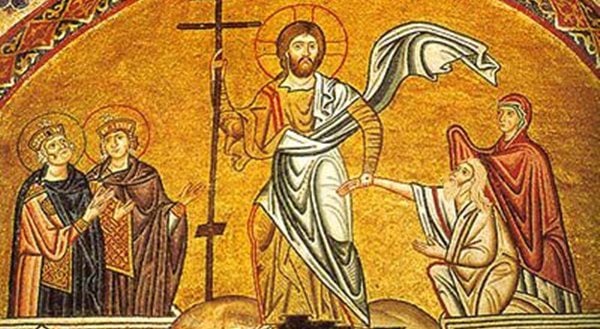
My favorite image of Jesus is a tenth-century painting. It shows Jesus descending into hell. Jesus broke down the gates of hell, conquered it, and he takes the first man Adam by the hand and pulls him out. All of humanity follows.
The resurrected Jesus took Doubting Thomas by the hand so that he would believe the real-flesh-and-blood peace and love of God. In the same way, the resurrected Jesus comes to us. He takes us by the hand. Sometimes Jesus might sit with us in our hells and holds our hand. Sometimes he takes us by the hand and drags us out of hell.
And sometimes Jesus needs a little help. That’s where we come in. Jesus needs us to be his hands and feet for one another. And you have been that for me during the last year and a half. I’ve been through my own little hells and you have reminded me that I’m not alone. When I first came here, two of my best friends died within 3 months of each other. You entered that hell with me. I’ve had family members suffer from physical and mental health issues. You entered that hell with me. And extended family members have turned their backs on me, calling me blasphemous. You entered that hell by laughing at that comment with me. And I am forever grateful for you because you have shown me the love and light of Christ. You have entered into my hells, and you have taken me by the hand, and you have brought heaven with you.
And so may we continue to be Christ’s hands and feet for one another.
May we extend a hand to each other when we experience our hells.
And may we bring the light of Christ with us wherever we go. Amen.
[1] See Hilarion Alfeyev, Christ the Conqueror of Hell, () page
Previous Post

April 27, 2019
The Blessing Of Doubt
Next Post
May 3, 2019 Peter, Paul, and Redemption - Girardian Virtual Bible Study
Browse Our Archives
Select a Category Atonement and Current Events Curriculum Faith and Families Interviews Jesus the Forgiving Victim Lent Montessori politics Reviews The Bible Explained Uncategorized Valentine's Day Wednesday Sermon Who is God?
Select a Month July 2020 November 2019 October 2019 September 2019 August 2019 July 2019 June 2019 May 2019 April 2019 March 2019 February 2019 January 2019 December 2018 November 2018 October 2018 September 2018 August 2018 July 2018 June 2018 May 2018 April 2018 March 2018 February 2018 January 2018 December 2017 November 2017 October 2017 September 2017 August 2017 July 2017 June 2017 May 2017 April 2017 March 2017 February 2017 January 2017 December 2016 November 2016 October 2016 September 2016 August 2016 June 2016 May 2016 April 2016 March 2016 February 2016 January 2016 December 2015 November 2015 October 2015 September 2015 August 2015 July 2015 June 2015 May 2015 April 2015 March 2015 February 2015 January 2015 December 2014 November 2014 October 2014 September 2014 August 2014 July 2014 June 2014 May 2014 April 2014 March 2014 January 2014 December 2013 September 2013 August 2013 July 2013
Follow Us!
TAKE THE
Religious Wisdom Quiz
What does the Bible say about using one's gifts or talents?
Select your answer to see how you score.
Hide them Use them for God's glory Waste them Brag about them
Related posts from Teaching Nonviolent Atonement

Forgiveness in the Time of COVID-19 by Julia...

Reflections on Indigenous Wisdom For Healing A Wounded...

How Forgiveness Can Transform Our Violence and Build...

Jesus Unmasked: God's Economy and How to Cheat...
TRENDING AT PATHEOS Progressive Christian

What Being a Modern-Day Apostle Means to Me
In my last column, I discussed the ins and outs of modern-day...

Did Ancient China Once Worship the God of...
Across human history, a common thread weaves through the origins of the...

Love Your Neighbor – Including Earth-Kin: Lev. 19,...
God’s command to love your neighbor means acting in an ethical and...

Lead a Church Study of “Jesus and Lao...
Guest writer Jack Thomas (The Irreverent Reverend) reflects on leading his church...

Pastoral Wisdom for Responding to Sermon Pushback
Getting sermon pushback on your social justice sermon? Learn practical, Proverbs-based strategies...

Principles for Understanding the Apostolic Ministry Today
Whenever people discover that my formal ministry title is "apostle," as in...
view all Progressive Christian blogs
Ad-Free & Subscriber Log-In Subscription Support
- About Us
- 2026 Calendar
- Videos
- Podcasts
- Library of World Religions
- Faith In Media Tracker
- Advertise With Us
- Write for Us
- Privacy Policy
- Terms of Service
- Do Not Sell My Data
- Contact Us
- Radiant Digital
- Manage Newsletter Subscriptions
- Unsubscribe From Notifications
- Sitemap
Copyright 2008-2026, Patheos. All rights reserved.
Subscription Support Ad-Free & Subscriber Log-In
Follow Patheos