
BuddhistCatholicContemplativeEvangelicalGeneral ChristianHinduJewishLatter-day SaintMuslimNew VisionsProgressive Christian
Beliefs
- Buddhist
- Catholic
- Contemplative
- Evangelical
- General Christian
- Hindu
- Jewish
- Latter-day Saint
- More Voices
- Muslim
- New Visions
- Pagan
- Progressive Christian
Topics
- Religion News
- Food and Religion
- Sports and Religion
- Religious Art
- Religious Music and Entertainment
- Religious Events
- History and Religion
- Style and Religion
- Politics and Religion
- Women in Religion
- Recreation Outdoors and Religion
- Business Finance and Religion
- Careers Workplace and Religion
- Education and Religion
- Family Parenting and Religion
- Health Fitness and Religion
- Home and Religion
- Relationships and Religion
- Technology and Religion
- Travel and Religion
Columnists
- Buddhist Columnists
- Business Finance and Religion Columnists
- Careers Workplace and Religion Columnists
- Catholic Columnists
- Contemplative Columnists
- Education and Religion Columnists
- Evangelists Columnists
- Family Parenting and Religion Columnists
- General Christian Columnists
- Health Fitness and Religion Columnists
- Hindu Columnists
- History and Religion Columnists
- Home and Religion Columnists
- Jewish Columnists
- More Voices Columnists
- Latter Day Columnists
- Muslim Columnists
- New Visions Columnists
- Nonreligious Columnists
- Pagan Columnists
- Politics and Religion Columnists
- Progressive Columnists
- Recreation Outdoors and Religion Columnists
- Relationships and Religion Columnists
- Religion News Columnists
- Religious Art Columnists
- Religious Events Columnists
- Religious Music and Entertainment Columnists
- Sports and Religion Columnists
- Style and Religion Columnists
- Technology and Religion Columnists
- Travel and Religion Columnists
- Women in Religion Columnists
Resource Library
- 2026 Calendar
- Library of World Religions
- The 100 Most Holy Places on Earth
- Patheos Answers
- Podcasts
- Videos
- Faith Leaders Database
- Anglican Episcopalian
- Bahai
- Baptist
- Buddhism
- Christianity
- Confucianism
- Eastern Orthodoxy
- Hinduism
- Holiness and Pentecostal
- ISKCON
- Islam
- Judaism
- Lutheran
- Methodist
- The Church of Jesus Christ of Latter-day Saints
- New Age
- Paganism
- Presbytarian and Reformed
- Protestantism
- Religion Behind the Scenes
- Roman Catholic
- Scientology
- Shia Islam
- Sikhism
- Sufism
- Sunni Islam
- Taoism
- Zen
- See all religions
Research Tools
 Ad-Free & Subscriber Log-In Subscription Support
Ad-Free & Subscriber Log-In Subscription Support
Follow Patheos 

- Trending:
- Forgiveness
- |
- Marriage
- |
- Consciousness
- |
- Death Penalty
- |
- Election
- |
- Halloween
 Teaching Nonviolent Atonement
- Home
- Progressive Christian
- The Blessing Of Doubt
The Blessing Of Doubt
Last updated on: April 28, 2019 at 6:58 am by Lindsey Paris-Lopez
The Blessing Of Doubt 2019-04-28T06:58:47-05:00 Lindsey Paris-Lopez
Patheos Explore the world's faith through different perspectives on religion and spirituality! Patheos has the views of the prevalent religions and spiritualities of the world.
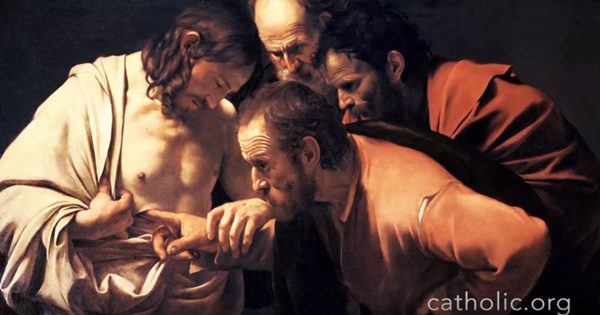
Welcome to the Girardian Virtual Bible Study! Each week we explore the lectionary passage with the help of René Girard’s insights into human relationships. We hope you enjoy this installment of the GVBS. Join us next week at 10:30 am Central on the Raven Foundation Facebook page for the live show. The show notes and video recording are below. This week’s episode explores Easter 2, Year C, John 20:19-31. A Well-Disguised Blessing Doubt doesn’t always feel like a blessing. Questioning faith, questioning tradition, questioning the perspective and understanding of those around you, especially those who seem to have it all together, who seem so confident in their words and actions… this can be scary and gut-wrenching. To doubt what others seem to take for granted can be unnerving, like walking on shaky ground that could give way any second. I have already shared how the story of “Doubting Thomas” once made me feel small, lost, and alone. As a child who struggled with her faith but loved her church, I found it hard to voice my doubts. I know I asked questions and took genuine interest in the stories. But the nagging feeling that perhaps this was all wrong, that I really could not wrap my head around a Triune God who died and rose for the sake of love but would eternally burn those who failed to accept this baffling premise… that feeling lingered like a weight on my chest. People in the church, including my mother and grandmother and pastors and friends I dearly loved, reinforced the love of this God who sets the captives free, who guides us by still waters and bids us to lie down in green pastures and restores our souls. This God who so loved us as to be born human, heal the sick, feed the hungry, embrace the lepers and sinners, and welcome the children… this was the God I was taught to believe in as Creator and Sustainer of all. But this was also the God who, according to scripture, destroyed the world in a flood, killed firstborn sons of Egypt, and ordered the deaths of entire peoples to make room for others or as punishment for infractions or disbelief. This was that God my father rejected. I was supposed to feel this God’s love for me. My love for this God was not supposed to be a question. But oh, I had my doubts! My mind was constantly spinning, my thoughts spilling over the contradictions, running through the maze of intertwined paradoxes. I felt trapped, between belief and doubt, between fear and longing, between people I loved. I wondered what was wrong with me, that I couldn’t be confident in that which I couldn’t see… one way or another. I thought I was the only one who lacked that confidence. Too afraid to share my own struggle, I didn’t know the struggle of others. It seemed like everyone else had found their footing, found their place. I was a “Doubting Thomas,” neither rejecting nor affirming… just wondering, questioning, trying to make sense of it all. I tried to be the good girl I knew my church thought me to be; I tried to believe. Struggling with doubt is like thrashing around in quicksand; the more you try to escape your confusion and anxiety, the deeper you sink. I was so afraid I would disappoint so many people if they only knew the truth of my doubts. I felt small, lost, and alone. The Doubt of Thomas I wonder if Thomas felt small, lost, and alone as well. He was away from the others when Jesus first appeared. The disciples were huddled away in fear, but Thomas wasn’t with them. Did he have his own sorrows and anxieties that made him want to retreat from his friends? Was he trying to put on a brave face and get back to his life? Did he feel that his mission was over, that his years of dedication to Jesus for a purpose he must not have understood as well as he thought he did had all come to nothing? I wonder, because I empathize with Thomas. I don’t know what he was going through in those days after Jesus’s death. But the scripture seems to single him out, and certainly culture singles him out. “Doubting Thomas” is said with a note of accusation, as if those who doubt are aberrations who don’t belong among a community of faith. Of course, nothing could be further from the truth! The truth is that everyone has doubts. The other disciples were huddled in a room for fear. They had to see the risen Jesus appear through the locked door. They needed to hear the words of reassurance “Peace be with you” to calm their anxieties and feel the comfort for which they had ached. If Jesus had never come to them, they never would have understood that Love had broken the boundaries of death and ascended to power. They needed to see to believe. God’s Embrace to Us in our Doubt In fact, just as Jesus comforted his disciples in the midst of their doubt, Jesus is God’s embrace to us in our doubts. All that time I struggled to wrap my mind around the Trinity and reconcile the violence of scripture with the loving God of my church tradition… In my journey through my doubts, I came to the understanding that the incarnation is not a test for us to wrap our minds around. It is the embodiment of Love in a world of desperate need. A world that believed that violence is its strongest power, that confused God with violence and worshiped the sword, needed to see and feel and hear a deeper truth. It needed to taste and see that the Lord is good. So in the fullness of time, God came to us in flesh. If you struggle to believe those words, you are not alone. They seem incredible, and we crave to know with our full selves — our bodily senses taking in the information for our minds to process. This, I believe, is the very reason God came among us and shared our human nature. Because by sharing in the human experience, God could teach us more about God’s own nature, and consequently what it means to be human made in God’s image, in the language we best understand: experience. Jesus came at a time when the existence of God was hardly questioned as it is now. But the nature of God was widely misunderstood. Because people found transcendent power coming together over and against victims and enemies. God was the power that sustained them over and against their enemies… or punished them with defeat. The Hebrew scriptures pushed back against the idea of “God with the winners” by revealing a God who liberates the oppressed. The scriptures are a text-in-travail, a wrestling between the human misunderstanding of God and God’s self-revelation. Jesus is the fullness of God’s self-revelation. And Jesus comes to show that God is always with the victims of violence, and has indeed been the victim of our violence from the foundation of the world. In the resurrection, Jesus shows that Love overcomes the power of death. Who would believe this without seeing? Death circumscribes all our lives. We live under its shadow, fearing that which will cut our lives short. We fear poverty and illness. We begin to fear each other — wondering if others are out to get us. We build up defenses against designated enemies. So it has been from the beginning; so it is now. Can there be a greater power than fear? Can there be a power which can vanquish the weapons of hate and prejudice that fear wields, serving death while promising protection from it? Jesus became the victim of the fear and hate of the world and let it utterly destroy him. And then he broke death’s chains. He set those who had fallen victim to death free. He rose with healing and forgiveness, and blessed the very people who had abandoned him. The disciples did not believe in the love that overpowers death and transforms hate and competition into healing and cooperation… until they saw it for themselves. The Blessing of Thomas Thomas needed more than to see. He needed to feel the wounds in Jesus’ hands and place his own hand in Jesus’ side. He needed to be sure that this Jesus standing before him was not an illusion of either despair or of hope. Feeling the wounds of Jesus, Thomas could understand, with his whole heart, soul, and body, not only that Jesus stood before him, but what Jesus had suffered… and forgiven. Feeling the vulnerable flesh that all of us share, touching the fragile but resurrected body, Thomas could grasp something profound. His doubts, his refusal to be satisfied without going deeper, made him reach out and touch that which might make others recoil. That is exactly what Jesus did for the lepers and the wounded and marginalized. Jesus invites Thomas to touch him — not in an I told you so kind of way, but in an intimate, loving way. He once again makes himself vulnerable by offering himself to be touched. He says “Do not doubt, but believe,” in a very particular context. The context is to reassure Thomas in his anxiety. It is to show Thomas that he is solid and real… and that he comes in peace and not vengeance. He comes in Love. Thomas, also vulnerable, reaches out and touches the wounds. In doing so, he recognizes God in a wounded and forgiving human body. He knows the power of Love that suffers and transforms death. “My Lord and my God!” he cries. The sense of doubt that leads to wonder and discovery. The sense of doubt that needs embodied, empirical experience. Did not Jesus embrace that doubt within us and even within himself? All his life, he learned words of scripture that he questioned. His own experience of God guided him to a deeper understanding, but first he had to wonder, to doubt. “You’ve heard it was said… but I say unto you…” He could not have come to that knowledge without a journey. Doubt is the beginning. Doubt as the Companion of Faith Where would we be without doubt? Without inquisitive minds and searching hearts? Wouldn’t this world be a smaller, more closed-in place? Jesus invites us to journey through our doubts. “Blessed are those who have not seen, and yet have come to believe,” he says. This is not an admonition of doubt, but a blessing for a journey that begins in doubt and… never ends. Belief comes through doubt, and I’m not sure that it will ever displace it fully. The world is in a process of transformation. Hate and fear and bigotry still bring suffering and pain and death. We do need faith in a world that we cannot yet see. But we also need doubt in what may seem obvious — doubt that violence is in control, doubt that things must stay as they are. There is doubt that can lead to closing ourselves in and shutting down. But there is also doubt that pulls us forward out of nihilism and despair, doubt that keeps us searching and experimenting. Doubt that refuses to believe a status quo that says others are our enemies. Doubt that challenges a world of violence. Doubt that keeps us searching for better. Doubt that opens to us a spirit of forgiveness, because in spite of a world built on bigotry and hierarchy and enmity, a little voice inside makes us question if things have to be this way. In my experience, doubt has been a blessing, though I have not always recognized it as such. It has kept me searching, kept me exploring. Doubt for me has been a doorstop that keeps the door of resignation from slamming shut and keeps pathways of hope open. It is a gift of the Holy Spirit. Doubt is the companion to, not enemy of, faith. Editor’s Note: Many thanks to those who listened to and participated in the podcast recorded above. Friends listening recommended the documentary Fearless and the song “Sing to You” by KB. We appreciate those recommendations and will explore them when we have the chance. If you would like to participate in the next Girardian Virtual Bible Study, please join us on the Raven Foundation FB page on Wednesday morning at 10:30 CT. Image: “The Incredulity of Saint Thomas,” by Caravaggio. Reproduced in Screenshot from Youtube: “St. Thomas HD,” by Catholic Online.
Next Post

April 29, 2019 The Resurrected Jesus and the Destruction of Hell
Browse Our Archives
Select a Category Atonement and Current Events Curriculum Faith and Families Interviews Jesus the Forgiving Victim Lent Montessori politics Reviews The Bible Explained Uncategorized Valentine's Day Wednesday Sermon Who is God?
Select a Month July 2020 November 2019 October 2019 September 2019 August 2019 July 2019 June 2019 May 2019 April 2019 March 2019 February 2019 January 2019 December 2018 November 2018 October 2018 September 2018 August 2018 July 2018 June 2018 May 2018 April 2018 March 2018 February 2018 January 2018 December 2017 November 2017 October 2017 September 2017 August 2017 July 2017 June 2017 May 2017 April 2017 March 2017 February 2017 January 2017 December 2016 November 2016 October 2016 September 2016 August 2016 June 2016 May 2016 April 2016 March 2016 February 2016 January 2016 December 2015 November 2015 October 2015 September 2015 August 2015 July 2015 June 2015 May 2015 April 2015 March 2015 February 2015 January 2015 December 2014 November 2014 October 2014 September 2014 August 2014 July 2014 June 2014 May 2014 April 2014 March 2014 January 2014 December 2013 September 2013 August 2013 July 2013
Follow Us!
TAKE THE
Religious Wisdom Quiz
Which parable teaches about praying persistently, like a widow before a judge?
Select your answer to see how you score.
The Talents The Sower The Persistent Widow The Mustard Seed
Related posts from Teaching Nonviolent Atonement

The Secret of Life: An Interview with Audrey...

Forgiveness in the Time of COVID-19 by Julia...

Reflections on Indigenous Wisdom For Healing A Wounded...

How Forgiveness Can Transform Our Violence and Build...
TRENDING AT PATHEOS Progressive Christian

What Being a Modern-Day Apostle Means to Me
In my last column, I discussed the ins and outs of modern-day...

Did Ancient China Once Worship the God of...
Across human history, a common thread weaves through the origins of the...

Love Your Neighbor – Including Earth-Kin: Lev. 19,...
God’s command to love your neighbor means acting in an ethical and...

Lead a Church Study of “Jesus and Lao...
Guest writer Jack Thomas (The Irreverent Reverend) reflects on leading his church...

Pastoral Wisdom for Responding to Sermon Pushback
Getting sermon pushback on your social justice sermon? Learn practical, Proverbs-based strategies...

Principles for Understanding the Apostolic Ministry Today
Whenever people discover that my formal ministry title is "apostle," as in...
view all Progressive Christian blogs
Ad-Free & Subscriber Log-In Subscription Support
- About Us
- 2026 Calendar
- Videos
- Podcasts
- Library of World Religions
- Faith In Media Tracker
- Advertise With Us
- Write for Us
- Privacy Policy
- Terms of Service
- Do Not Sell My Data
- Contact Us
- Radiant Digital
- Manage Newsletter Subscriptions
- Unsubscribe From Notifications
- Sitemap
Copyright 2008-2026, Patheos. All rights reserved.
Subscription Support Ad-Free & Subscriber Log-In
Follow Patheos