
BuddhistCatholicContemplativeEvangelicalGeneral ChristianHinduJewishLatter-day SaintMuslimNew VisionsProgressive Christian
Beliefs
- Buddhist
- Catholic
- Contemplative
- Evangelical
- General Christian
- Hindu
- Jewish
- Latter-day Saint
- More Voices
- Muslim
- New Visions
- Pagan
- Progressive Christian
Topics
- Religion News
- Food and Religion
- Sports and Religion
- Religious Art
- Religious Music and Entertainment
- Religious Events
- History and Religion
- Style and Religion
- Politics and Religion
- Women in Religion
- Recreation Outdoors and Religion
- Business Finance and Religion
- Careers Workplace and Religion
- Education and Religion
- Family Parenting and Religion
- Health Fitness and Religion
- Home and Religion
- Relationships and Religion
- Technology and Religion
- Travel and Religion
Columnists
- Buddhist Columnists
- Business Finance and Religion Columnists
- Careers Workplace and Religion Columnists
- Catholic Columnists
- Contemplative Columnists
- Education and Religion Columnists
- Evangelists Columnists
- Family Parenting and Religion Columnists
- General Christian Columnists
- Health Fitness and Religion Columnists
- Hindu Columnists
- History and Religion Columnists
- Home and Religion Columnists
- Jewish Columnists
- More Voices Columnists
- Latter Day Columnists
- Muslim Columnists
- New Visions Columnists
- Nonreligious Columnists
- Pagan Columnists
- Politics and Religion Columnists
- Progressive Columnists
- Recreation Outdoors and Religion Columnists
- Relationships and Religion Columnists
- Religion News Columnists
- Religious Art Columnists
- Religious Events Columnists
- Religious Music and Entertainment Columnists
- Sports and Religion Columnists
- Style and Religion Columnists
- Technology and Religion Columnists
- Travel and Religion Columnists
- Women in Religion Columnists
Resource Library
- 2026 Calendar
- Library of World Religions
- The 100 Most Holy Places on Earth
- Patheos Answers
- Podcasts
- Videos
- Faith Leaders Database
- Anglican Episcopalian
- Bahai
- Baptist
- Buddhism
- Christianity
- Confucianism
- Eastern Orthodoxy
- Hinduism
- Holiness and Pentecostal
- ISKCON
- Islam
- Judaism
- Lutheran
- Methodist
- The Church of Jesus Christ of Latter-day Saints
- New Age
- Paganism
- Presbytarian and Reformed
- Protestantism
- Religion Behind the Scenes
- Roman Catholic
- Scientology
- Shia Islam
- Sikhism
- Sufism
- Sunni Islam
- Taoism
- Zen
- See all religions
Research Tools
 Ad-Free & Subscriber Log-In Subscription Support
Ad-Free & Subscriber Log-In Subscription Support
Follow Patheos 

- Trending:
- Forgiveness
- |
- Marriage
- |
- Consciousness
- |
- Death Penalty
- |
- Election
- |
- Halloween
 Teaching Nonviolent Atonement
- Home
- Progressive Christian
- Jesus Still Weeps: Palm Sunday, War Horses, and Asses
Jesus Still Weeps: Palm Sunday, War Horses, and Asses
Last updated on: April 15, 2019 at 3:29 pm by Adam Ericksen
Jesus Still Weeps: Palm Sunday, War Horses, and Asses 2019-04-15T15:29:41-05:00 Adam Ericksen
Patheos Explore the world's faith through different perspectives on religion and spirituality! Patheos has the views of the prevalent religions and spiritualities of the world.
The following is a sermon I preached at Clackamas United Church of Christ, near Portland, Oregon. The primary scripture texts was Luke 19:28-44.
Palm Sunday is also called Triumphal Entry Sunday. It’s the day we celebrate Jesus riding triumphantly into Jerusalem on a colt, a young donkey.
You might be wondering, what’s the deal with the palms? In the ancient Roman world, which included Israel, the palm tree was a symbol of victory. A palm branch was awarded to Olympic athletes who were victorious.
The gods of ancient Rome were often depicted as holding palm branches. The god Apollo was supposedly born under the palm tree, which became his sacred symbol. Politically, when an emperor, king or a general won a battle, they had a parade where the people waved palm branches. When Julius Caesar gained power over Rome, people claimed that a palm tree miraculously sprung up at the Temple of Nike in honor of his political success.
Jesus and his first followers lived under the rule of the Caesars of the Roman Empire. They were aware of the political power of the palm tree. So when they waved the palm branches on that first Palm Sunday, they were making a bold statement.
And when we wave these branches today, we make a bold statement, too. We claim what Christians have claimed throughout the centuries – Jesus is Lord, which means Caesar is not. Jesus is the victorious King of Kings and Lord of Lords. In this sense, Palm Sunday is an intensely subversive political proclamation.
But let’s take a little step back. Caesar Augustus conquered much of the known world of the time, from Britain to India. And he brought the Pax Romana with him. The Pax Romana, or the Peace of Rome, was a phrase that was part of Rome’s military propaganda. Another phrase the Rome used in their propaganda was “Peace through strength,” which really meant, “Peace through victory, conquest, and military might.”
But Caesar’s empire was massive. He couldn’t be everywhere at once, so he appointed local kings in certain nations within the Empire, such as King Herod in Israel. He also appointed Roman generals to be governors of those areas, just to keep the kings in line. Pontius Pilate, the man who put Jesus to death, was the Governor of Judea. The King and the Governor of these nations were appointed to “keep the peace” of Rome. And of course, they kept the peace through the power of violence.
Jesus entered Jerusalem near the time of Passover. For our Jewish siblings, Passover is a celebration of the Exodus. It recalls that the Jewish people were oppressed by the Egyptian Empire. They cried out and God heard their cry.
God worked through Moses to set the Israelites free because this God is different from the other gods. This God is not primarily the God of the powerful – The gods Zeus or Apollo or Pharaoh or Caesar. This God is the God of the oppressed. This is the God who gives freedom. This is the God who works against the status quo for the freedom and prosperity of all people.
And so when the Romans conquered Israel, the Jews looked for God to act through a new Moses-like figure to free them from the Roman Empire. And many thought Jesus was just the King to do it.
Passover was a time of hope that God was on the move. The whole Passover festival was charged with political expectation and the possibility of rebellion. The people waved palm branches in hopes that Jesus would lead them to victory.
Rome wanted to squelch that hope. And so every year just before the Passover festival, Pilate led a parade for Rome. A legion of the Roman army followed him through the city of Jerusalem.
Pilate and his army entered through the gates of the city on giant military war horses and chariots. Whether they liked it or not, the people would come and wave palm branches. War horses and chariots were the tanks and fighter jets of the ancient world. The message was simple. Pilate said to the Jews, “Don’t even think about rebelling. Rome will crush you.”
And then we have Jesus, the one Christians claim to be the true Messiah, the true King. Jesus didn’t ride into Jerusalem on a war horse. He rode into Jerusalem on a young donkey that had never been trained. And the people waved palm branches in hopes that this new king would bring victory.
One rode a giant warhorse. The other rode a young donkey. The contrast between Jesus and Rome couldn’t be more evident.
When the early Christians claimed that Jesus was Lord over Caesar, they claimed that the world is not made better through the power of Roman military victory against others. Rather, they claimed that the world is made better through the nonviolent power of Jesus’ healing love.
Notice that the Roman Empire owned horses that it trained for victory in war. Jesus didn’t own a horse. He didn’t even own the colt. He had to borrow it. Why? Because he didn’t have one. As the story says, he told his disciples to tell the owner that, “The Lord needs it.”
Here’s what strikes me about this passage. Jesus is the Lord, the King, the Son of God who openly admits he is in need. The Caesars of the world typically see this admission as a sign of weakness, but Jesus was dependent upon his disciples to get the donkey. Jesus was dependent upon the owner to let him borrow the donkey. Jesus needed a donkey to carry him into Jerusalem.
Palm Sunday reveals that Jesus is in need. In the same way Jesus needed the donkey to carry him into Jerusalem, he needs you and me to help him. Jesus doesn’t need a war horse to carry him into Jerusalem. He needs a young donkey.
Now, I would never compare any of you to a donkey, let alone an ass … except on today. We often want to identify with a character in the Bible stories. Today I want to invite you to see yourself as the donkey character.
Because the contrast between the Roman Empire and the Kingdom of God can be seen in the difference between a Roman war horse and a young donkey.
There are two ways to be in this world, you can be like a war horse or you can be like a young donkey that’s never been trained for war. There are two ways to be with your neighbors. There are two ways to be with your coworkers. There are two ways to be with your boss. There are two ways to be in your marriage. There are two ways to be with your children. There are two ways that a nation can be in the world.
You can be like a war horse or you can be like a humble donkey. Jesus needs us to carry him into the world. But we need to know this, according to the Gospels, Jesus refuses to be carried on a war horse. He will only be carried by a donkey.
Now, donkeys are not passive. This donkey carries Jesus right into a dangerous and politically subversive act into the heart of Jerusalem. Jesus rides the donkey in order to reveal that this King is not like the Pharaohs or Caesars or Kings who seek victory through the power to dominate others. No, Jesus, the King of Kings and Lord of Lords invites us to follow him in the ways of nonviolent love.
But Palm Sunday tells us that our job isn’t just to follow Jesus. Our job is to be like the donkey and carry Jesus into the world. Jesus is in need of people like you and me to do just that.
But did you notice that the donkey needed to be untied? The donkey Jesus rode was tied up and tethered and needed to be untied. This leads me to wonder, What am I tied to? What are you tied to? What are we as a church community tied to? What is our nation tied to? What might be holding us back?
Could part of the answer be that we are tied to a desire to be giant war horses rather than humble donkeys?
That was the problem the political leaders had during Jesus’ day. Jesus wept over Jerusalem because many of the people did not recognize “the things that make for peace.” Instead, many insisted on being war horses. Like their Roman oppressors, many thought violence was the only method that could ever bring peace. At the end of our passage, Jesus delivers a prophetic warning – that because Jerusalem refused his way of peace, the day will come that Rome would surround the city and destroy it.
Unfortunately, that’s exactly what Rome did in the year 70 CE because the city refused to follow the nonviolent Jesus. They refused to recognize the things that make for peace.
I cringe as I make that statement. As a Christian, it smacks of anti-Semitism. For too long, Christians have blamed our Jewish siblings for just not getting Jesus, but I wonder if many of our Jewish friends might get Jesus better than we do.
Here’s what we need to grasp – 2,000 years later, American Christians must ask ourselves if we understand Jesus – if we recognize the things that make for peace. Do the vast majority of American Christians trust the way of Jesus and his donkey? Or do we trust the way of Caesar and his war horse? Do we trust in the power of drones and warplanes and guns? Or do we trust in the nonviolent power of Jesus?
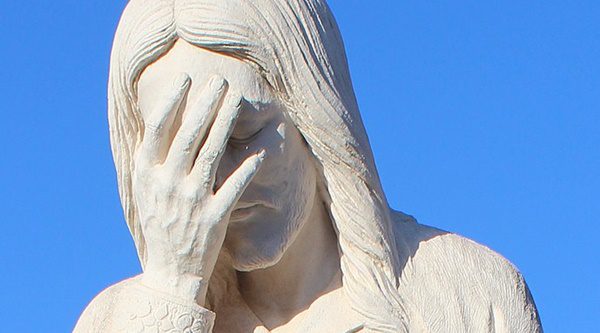
I fear that in the same way Jesus wept over the great city of Jerusalem, Jesus weeps over Washington DC because as a nation we refuse to recognize the things that make for peace.
Our Palm Sunday passage ends on a note of despair and destruction, but we have hope. Because as holy week unfolds, we will go through the despair of betrayal and abandonment of Jesus on Maundy Thursday and we will go through the violent death of Jesus on Good Friday.
But a week from today we will celebrate that betrayal, violence, and death do not have the last word. For God is fully alive and active in the world, inviting us to carry Jesus into the world as we work for peace, justice, and love for all people.
Because there are two ways of being in the world. And my friends, the Lord is in need of people like us to carry him into a world desperate for God’s healing love.
May we choose to be like the humble donkey and resist the way of the war horse.
May we carry Jesus with us into the world.
And may we recognize the things that make for true peace. Amen.
Image: Wikimedia Commons.


Browse Our Archives
Select a Category Atonement and Current Events Curriculum Faith and Families Interviews Jesus the Forgiving Victim Lent Montessori politics Reviews The Bible Explained Uncategorized Valentine's Day Wednesday Sermon Who is God?
Select a Month July 2020 November 2019 October 2019 September 2019 August 2019 July 2019 June 2019 May 2019 April 2019 March 2019 February 2019 January 2019 December 2018 November 2018 October 2018 September 2018 August 2018 July 2018 June 2018 May 2018 April 2018 March 2018 February 2018 January 2018 December 2017 November 2017 October 2017 September 2017 August 2017 July 2017 June 2017 May 2017 April 2017 March 2017 February 2017 January 2017 December 2016 November 2016 October 2016 September 2016 August 2016 June 2016 May 2016 April 2016 March 2016 February 2016 January 2016 December 2015 November 2015 October 2015 September 2015 August 2015 July 2015 June 2015 May 2015 April 2015 March 2015 February 2015 January 2015 December 2014 November 2014 October 2014 September 2014 August 2014 July 2014 June 2014 May 2014 April 2014 March 2014 January 2014 December 2013 September 2013 August 2013 July 2013
Follow Us!
TAKE THE
Religious Wisdom Quiz
According to Titus, what did God do when his kindness and love appeared?
Select your answer to see how you score.
He established his church He destroyed his enemies He saved us through the washing of rebirth and renewal by the Holy Spirit He sent his Son
Related posts from Teaching Nonviolent Atonement

Forgiveness in the Time of COVID-19 by Julia...


Reflections on Indigenous Wisdom For Healing A Wounded...

How Forgiveness Can Transform Our Violence and Build...
TRENDING AT PATHEOS Progressive Christian

What Being a Modern-Day Apostle Means to Me
In my last column, I discussed the ins and outs of modern-day...

Did Ancient China Once Worship the God of...
Across human history, a common thread weaves through the origins of the...

Love Your Neighbor – Including Earth-Kin: Lev. 19,...
God’s command to love your neighbor means acting in an ethical and...

Lead a Church Study of “Jesus and Lao...
Guest writer Jack Thomas (The Irreverent Reverend) reflects on leading his church...

Pastoral Wisdom for Responding to Sermon Pushback
Getting sermon pushback on your social justice sermon? Learn practical, Proverbs-based strategies...

Principles for Understanding the Apostolic Ministry Today
Whenever people discover that my formal ministry title is "apostle," as in...
view all Progressive Christian blogs
Ad-Free & Subscriber Log-In Subscription Support
- About Us
- 2026 Calendar
- Videos
- Podcasts
- Library of World Religions
- Faith In Media Tracker
- Advertise With Us
- Write for Us
- Privacy Policy
- Terms of Service
- Do Not Sell My Data
- Contact Us
- Radiant Digital
- Manage Newsletter Subscriptions
- Unsubscribe From Notifications
- Sitemap
Copyright 2008-2026, Patheos. All rights reserved.
Subscription Support Ad-Free & Subscriber Log-In
Follow Patheos