
BuddhistCatholicContemplativeEvangelicalGeneral ChristianHinduJewishLatter-day SaintMuslimNew VisionsProgressive Christian
Beliefs
- Buddhist
- Catholic
- Contemplative
- Evangelical
- General Christian
- Hindu
- Jewish
- Latter-day Saint
- More Voices
- Muslim
- New Visions
- Pagan
- Progressive Christian
Topics
- Religion News
- Food and Religion
- Sports and Religion
- Religious Art
- Religious Music and Entertainment
- Religious Events
- History and Religion
- Style and Religion
- Politics and Religion
- Women in Religion
- Recreation Outdoors and Religion
- Business Finance and Religion
- Careers Workplace and Religion
- Education and Religion
- Family Parenting and Religion
- Health Fitness and Religion
- Home and Religion
- Relationships and Religion
- Technology and Religion
- Travel and Religion
Columnists
- Buddhist Columnists
- Business Finance and Religion Columnists
- Careers Workplace and Religion Columnists
- Catholic Columnists
- Contemplative Columnists
- Education and Religion Columnists
- Evangelists Columnists
- Family Parenting and Religion Columnists
- General Christian Columnists
- Health Fitness and Religion Columnists
- Hindu Columnists
- History and Religion Columnists
- Home and Religion Columnists
- Jewish Columnists
- More Voices Columnists
- Latter Day Columnists
- Muslim Columnists
- New Visions Columnists
- Nonreligious Columnists
- Pagan Columnists
- Politics and Religion Columnists
- Progressive Columnists
- Recreation Outdoors and Religion Columnists
- Relationships and Religion Columnists
- Religion News Columnists
- Religious Art Columnists
- Religious Events Columnists
- Religious Music and Entertainment Columnists
- Sports and Religion Columnists
- Style and Religion Columnists
- Technology and Religion Columnists
- Travel and Religion Columnists
- Women in Religion Columnists
Resource Library
- 2026 Calendar
- Library of World Religions
- The 100 Most Holy Places on Earth
- Patheos Answers
- Podcasts
- Videos
- Faith Leaders Database
- Anglican Episcopalian
- Bahai
- Baptist
- Buddhism
- Christianity
- Confucianism
- Eastern Orthodoxy
- Hinduism
- Holiness and Pentecostal
- ISKCON
- Islam
- Judaism
- Lutheran
- Methodist
- The Church of Jesus Christ of Latter-day Saints
- New Age
- Paganism
- Presbytarian and Reformed
- Protestantism
- Religion Behind the Scenes
- Roman Catholic
- Scientology
- Shia Islam
- Sikhism
- Sufism
- Sunni Islam
- Taoism
- Zen
- See all religions
Research Tools
 Ad-Free & Subscriber Log-In Subscription Support
Ad-Free & Subscriber Log-In Subscription Support
Follow Patheos 

- Trending:
- Forgiveness
- |
- Marriage
- |
- Consciousness
- |
- Death Penalty
- |
- Election
- |
- Halloween
 Teaching Nonviolent Atonement
- Home
- Progressive Christian
- “Crucify Him!” The Brutal, Beautiful Revelation Of The Passion: Girardian Virtual Bible Study Preview
“Crucify Him!” The Brutal, Beautiful Revelation Of The Passion: Girardian Virtual Bible Study Preview
Last updated on: April 16, 2019 at 2:41 pm by Lindsey Paris-Lopez
“Crucify Him!” The Brutal, Beautiful Revelation Of The Passion: Girardian Virtual Bible Study Preview 2019-04-16T14:41:57-05:00 Lindsey Paris-Lopez
Patheos Explore the world's faith through different perspectives on religion and spirituality! Patheos has the views of the prevalent religions and spiritualities of the world.
Editor’s Note: Every Wednesday at 10:30 am CT, Adam and Lindsey host a live Girardian Virtual Bible Study following the Sunday lectionary on the Raven Foundation Facebook page. We invite our listeners to join the conversation with comments and questions. I take some notes to help me prepare… and share them with you to help you do the same! This is the Girardian Virtual Bible Study preview!
“Crucify him!”
Several years ago, a friend of mine told me that as much as she loved the Passion play we performed at our church’s Holy Week service, she hated shouting, “Crucify him!” I’m not sure how I responded. I certainly don’t enjoy shouting those words. But I think it’s important that we do.
Because those words are not just historical reenactment. They are meant to force us to face the most deeply-hidden truths that we are loath to acknowledge about ourselves. We live in the shadow of our own violence, and on Good Friday that shadow is pulled back like a curtain. What we did – what we do – to Jesus, we do to each other, and to ourselves.
How often have we felt our hearts beat in time to the drums of military parades, marveled at jets as they fly over stadiums, or watched on our televisions as bombs have burst in the air over nations far away? The United States especially is a nation at war all around the world. Even if we try to personally distance ourselves from the violence committed in our name, our tax dollars speak words of death and destruction the world over.
We know, when we force ourselves to confront reality, that our bombs and drones do not discriminate, that children and elderly alike have been struck bullets our nation has proliferated for profit, that starvation and disease are consequences of wars waged in the name of freedom and justice. We know that people are dying all around the world at our hands.
We are still crucifying Christ today. But we justify it with rhetoric and euphemisms, with the conventional wisdom of “defense” and “necessity.”
Good Friday strips away our pretenses. When we are forced to see our victims naked in front of us, their vulnerable humanity laid bare of all the blames and projections we heap upon them, we likewise see our own fear and aggression stripped of all our justifications.
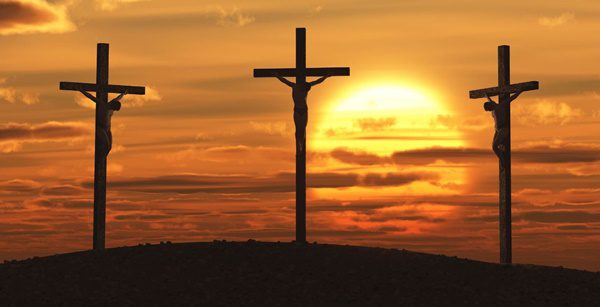
When we gaze upon Jesus on that cross, we should see the indigenous people wiped from their own land, slaves bound in chains and robbed of the recognition of their humanity, bodies burning in ovens or incinerated by a nuclear blast, young men and women of color killed by lies, fears, and guns, crying children ripped from the arms of wailing parents, crowded prisons and solitary cells, and on and on and on. As our violence still churns and burns throughout the world, Jesus feels the pain of the suffering, weeps with them, embraces them. His death on the cross was the distillation of the violence inflicted in all times and places into a single body. He didn’t just die for them, he died with them. As long as they continue to die, he remains ever crucified. As long as we kill, we crucify him.
We cannot wash the blood from our hands, as Pilate tried to do.
When we try to distance ourselves from the violence of the world, we project it onto others. We label ourselves good in relation to the evil we can only see in others. We blind ourselves to our own sin and call our righteous violence good. To disconnect from our responsibility for our violence is to lay the foundation for the scapegoating institutions that manifest in racism, anti-Semitism, homophobia and every kind of bigotry. The misreading of this very Gospel has been the cause of suffering throughout history around the world.
We see the blood on Pilate’s hands. We must see the blood on our own.
“Crucify him” is our confession. We must own those words on Good Friday and always. They are the truth.
But there is a deeper truth upon that cross to which we turn our gaze. The truth of who we are as violent human beings is not the full truth of who we are becoming as we turn to the One who bears all our violence and answers it with mercy, with compassion, with love.
In Jesus, the unfinished creation is finished. All the fears that tempt us to violence, Jesus has lived. Oppression, poverty, loss, abandonment, ridicule… Jesus has experienced all of these, and rather than call down legions from heaven to seek his revenge, he bears them. He takes the pain and insecurities we thrust upon him, he takes our fears of dying alone and unloved, into himself. And he gives until he is utterly spent. On the cross, the fullness of God’s love is magnified to the world. All we need to live into the fullness of the Love in which we were created is given to us. This is the culmination of creation that is everlasting. All that we need is given to us, with some assembly required. The powers of division and death lose their stranglehold upon us. They may trip us up, but they will no longer hold us back forever.
A life more beautiful and abundant than we have ever imagined is opened to us by the life, death, and resurrection of Jesus. We learn and find the capacity to do that which we see. Jesus models to us a life of giving, embracing, healing, and seeing beyond the hate to the heart, so that we also may live that life. That life is always open to us through God’s unchanging love, but until we recognize it, we are blind to it. People of all times and places have lived lives of compassion and mercy, and in Christ we see how such life when lived to its fullest breaks down the barrier of death itself. This life spreads through those walk with Jesus on the path of mercy and compassion regardless of dogma or creed, opening hearts to Love, to the kindom of God in which we all know each other as sisters and brothers.
The cross reveals the brutal truth of human hatred, but also to the beautiful truth of God’s love made manifest in the Truly Human One. For our full humanity to be awakened, we must look at the One we crucify, recognize our violence for what it is, and let love burn through our egos and excuses and justifications. Then, in humility, we will be ignited for the work of mercy and justice as Christ’s body on earth.
It starts by looking to the cross to see – reflected in the One who bears all of our hate and fears and insecurities – all that we are and all that we are becoming. Then may we recognize Christ in all who suffer our violence and apathy, repent with hearts broken open, and find our full humanity that we may respond to violence against ourselves with the same heart-changing love.
These are some of my reflections heading into Good Friday. Adam and I will continue to reflect on Wednesday at 10:30 CT. We will discuss John 18 – 19:42, but we may not read all of it aloud, because it’s only a half-hour show. Please join us for a special Good Friday Girardian Virtual Bible Study (we usually follow the Sunday lectionary, but we know that we must go through the darkness of the crucifixion before we can bask in the light of the risen Son!)
Whether you’re a minister preparing your Sunday sermon or a lay person trying to better understand the Bible, whatever you believe, question, or doubt, we warmly invite you to participate with comments and questions as we seek to grow our virtual community. Your presence is more than an honor and a blessing – it’s a necessity! Since we are interdividual beings, growing in relationship with one-another, we need each other! Your participation is an integral part of the Girardian Virtual Bible Study!
Image: Stock Photo: “Crucifixion at Sunset” by mikekiev via 123rf.com.
Previous Post

April 15, 2019
Jesus Still Weeps: Palm Sunday, War Horses, and Asses
Next Post
April 18, 2019 Good Friday? Or Worst Day Ever Friday? – Girardian Virtual Bible Study
Browse Our Archives
Select a Category Atonement and Current Events Curriculum Faith and Families Interviews Jesus the Forgiving Victim Lent Montessori politics Reviews The Bible Explained Uncategorized Valentine's Day Wednesday Sermon Who is God?
Select a Month July 2020 November 2019 October 2019 September 2019 August 2019 July 2019 June 2019 May 2019 April 2019 March 2019 February 2019 January 2019 December 2018 November 2018 October 2018 September 2018 August 2018 July 2018 June 2018 May 2018 April 2018 March 2018 February 2018 January 2018 December 2017 November 2017 October 2017 September 2017 August 2017 July 2017 June 2017 May 2017 April 2017 March 2017 February 2017 January 2017 December 2016 November 2016 October 2016 September 2016 August 2016 June 2016 May 2016 April 2016 March 2016 February 2016 January 2016 December 2015 November 2015 October 2015 September 2015 August 2015 July 2015 June 2015 May 2015 April 2015 March 2015 February 2015 January 2015 December 2014 November 2014 October 2014 September 2014 August 2014 July 2014 June 2014 May 2014 April 2014 March 2014 January 2014 December 2013 September 2013 August 2013 July 2013
Follow Us!
TAKE THE
Religious Wisdom Quiz
Which woman was the judge and prophetess who led Israel?
Select your answer to see how you score.
Esther Deborah Jael Miriam
Related posts from Teaching Nonviolent Atonement

Toxic Christianity: 3 Things We Can Do That...

The Secret of Life: An Interview with Audrey...

Forgiveness in the Time of COVID-19 by Julia...

TRENDING AT PATHEOS Progressive Christian

What Being a Modern-Day Apostle Means to Me
In my last column, I discussed the ins and outs of modern-day...

Did Ancient China Once Worship the God of...
Across human history, a common thread weaves through the origins of the...

Love Your Neighbor – Including Earth-Kin: Lev. 19,...
God’s command to love your neighbor means acting in an ethical and...

Lead a Church Study of “Jesus and Lao...
Guest writer Jack Thomas (The Irreverent Reverend) reflects on leading his church...

Pastoral Wisdom for Responding to Sermon Pushback
Getting sermon pushback on your social justice sermon? Learn practical, Proverbs-based strategies...

Principles for Understanding the Apostolic Ministry Today
Whenever people discover that my formal ministry title is "apostle," as in...
view all Progressive Christian blogs
Ad-Free & Subscriber Log-In Subscription Support
- About Us
- 2026 Calendar
- Videos
- Podcasts
- Library of World Religions
- Faith In Media Tracker
- Advertise With Us
- Write for Us
- Privacy Policy
- Terms of Service
- Do Not Sell My Data
- Contact Us
- Radiant Digital
- Manage Newsletter Subscriptions
- Unsubscribe From Notifications
- Sitemap
Copyright 2008-2026, Patheos. All rights reserved.
Subscription Support Ad-Free & Subscriber Log-In
Follow Patheos