
BuddhistCatholicContemplativeEvangelicalGeneral ChristianHinduJewishLatter-day SaintMuslimNew VisionsProgressive Christian
Beliefs
- Buddhist
- Catholic
- Contemplative
- Evangelical
- General Christian
- Hindu
- Jewish
- Latter-day Saint
- More Voices
- Muslim
- New Visions
- Pagan
- Progressive Christian
Topics
- Religion News
- Food and Religion
- Sports and Religion
- Religious Art
- Religious Music and Entertainment
- Religious Events
- History and Religion
- Style and Religion
- Politics and Religion
- Women in Religion
- Recreation Outdoors and Religion
- Business Finance and Religion
- Careers Workplace and Religion
- Education and Religion
- Family Parenting and Religion
- Health Fitness and Religion
- Home and Religion
- Relationships and Religion
- Technology and Religion
- Travel and Religion
Columnists
- Buddhist Columnists
- Business Finance and Religion Columnists
- Careers Workplace and Religion Columnists
- Catholic Columnists
- Contemplative Columnists
- Education and Religion Columnists
- Evangelists Columnists
- Family Parenting and Religion Columnists
- General Christian Columnists
- Health Fitness and Religion Columnists
- Hindu Columnists
- History and Religion Columnists
- Home and Religion Columnists
- Jewish Columnists
- More Voices Columnists
- Latter Day Columnists
- Muslim Columnists
- New Visions Columnists
- Nonreligious Columnists
- Pagan Columnists
- Politics and Religion Columnists
- Progressive Columnists
- Recreation Outdoors and Religion Columnists
- Relationships and Religion Columnists
- Religion News Columnists
- Religious Art Columnists
- Religious Events Columnists
- Religious Music and Entertainment Columnists
- Sports and Religion Columnists
- Style and Religion Columnists
- Technology and Religion Columnists
- Travel and Religion Columnists
- Women in Religion Columnists
Resource Library
- 2026 Calendar
- Library of World Religions
- The 100 Most Holy Places on Earth
- Patheos Answers
- Podcasts
- Videos
- Faith Leaders Database
- Anglican Episcopalian
- Bahai
- Baptist
- Buddhism
- Christianity
- Confucianism
- Eastern Orthodoxy
- Hinduism
- Holiness and Pentecostal
- ISKCON
- Islam
- Judaism
- Lutheran
- Methodist
- The Church of Jesus Christ of Latter-day Saints
- New Age
- Paganism
- Presbytarian and Reformed
- Protestantism
- Religion Behind the Scenes
- Roman Catholic
- Scientology
- Shia Islam
- Sikhism
- Sufism
- Sunni Islam
- Taoism
- Zen
- See all religions
Research Tools
 Ad-Free & Subscriber Log-In Subscription Support
Ad-Free & Subscriber Log-In Subscription Support
Follow Patheos 

- Trending:
- Forgiveness
- |
- Marriage
- |
- Consciousness
- |
- Death Penalty
- |
- Election
- |
- Halloween
 Teaching Nonviolent Atonement
- Home
- Progressive Christian
- A Donkey, Not A War Horse: Girardian Virtual Bible Study Preview
A Donkey, Not A War Horse: Girardian Virtual Bible Study Preview
Last updated on: April 9, 2019 at 3:00 pm by Lindsey Paris-Lopez
A Donkey, Not A War Horse: Girardian Virtual Bible Study Preview 2019-04-09T15:00:36-05:00 Lindsey Paris-Lopez
Patheos Explore the world's faith through different perspectives on religion and spirituality! Patheos has the views of the prevalent religions and spiritualities of the world.
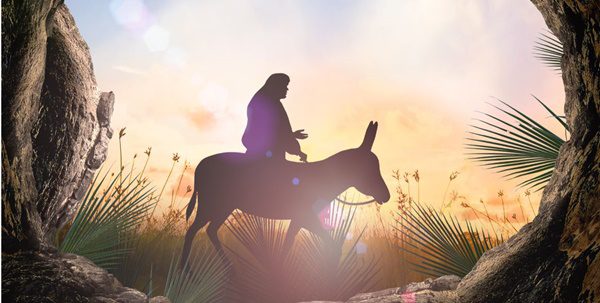
Editor’s Note: Every Wednesday at 10:30 am CT, Adam and Lindsey host a live Girardian Virtual Bible Study following the Sunday lectionary on the Raven Foundation Facebook page. We invite our listeners to join the conversation with comments and questions. I take some notes to help me prepare… and share them with you to help you do the same! This is the Girardian Virtual Bible Study preview!
Hosanna, Hey Sanna, Sanna Sanna Ho… Sanna Hey, Sanna Ho-san-ah!
Hey JC! J-C! You’re alright by me! Sanna Ho, Sanna Hey, Superstar!
This is the Palm Sunday processional that rings in my ears and my heart as Holy Week overtakes Lent and our journey to the cross nears its destination. Andrew Lloyd Webber’s lyrics may sound glib or fickle, but that very fickleness alludes to the shift in tone that will take place over the course of the week as the palms give way to the Passion. For now, however, there is honor and celebration as Jesus enters Jerusalem.
“All glory, laud, and honor to Thee, Redeemer King!”
The people wave their branches. They spread their cloaks along the way. They shout “Hosanna” and sing praise as their king comes out to meet them, to lead them… riding on a donkey.
This is the most subversive royal processional ever.
And I wonder if the people understand this. Surely they could not have missed the fact that Jesus is not coming to them on a noble steed but on a humble beast of burden — a young one, at that! (So, he would be even lower to the ground. Hardly the grand entrance!) Did they think he would later trade in his donkey for a war horse?
The quickness with which the “Hosanna!”s of Palm Sunday melt into the “Crucify him!”s of Good Friday begs the question: “What did they expect?”
But if I distance myself from the crowd, I miss the point. I could — I can — I do — fall into these crowds where hope on the one hand and fury on the other are each magnified by the crowd, like a hall of mirrors illuminating and multiplying our passions. Being swept up in the moment, finding belonging in the mass of people where emotions flow like a river and it’s nearly impossible to stand against the current… this is part of being human. And the collective violence that falls upon Jesus on Good Friday often starts out as collective hope thwarted or disappointed. The pattern of collective accolade to accusation is nothing new.
The hope is genuine. In fact, I believe the crowds are sincere in their praise of Jesus. Among the people waving their palms, spreading their cloaks and shouting their joy are probably those Jesus has healed, those he has fed, those who have received his words as good news. Those who for so many years had felt themselves locked out of the community — the marginalized and excluded — are now restored to society. I believe they are truly grateful.
“Open to me the gates of righteousness, that I may enter through them and give thanks to the Lord,” as Psalm 118 says. Jesus’ triumphal entrance is also theirs, for they who have been on the margins are now at the center. They feel themselves caught up in something monumental. Something is about to happen… a change is coming. They are right! But this change is beyond what they can yet imagine.
“The stone that the builders rejected has become the chief cornerstone.”
We can’t help but see the Crucified One in these words. But before Jesus has been crucified, the crowds that gather may see themselves this way. Those most grateful to Jesus, those who place the most hope in him, are those who see what he has already done to restore them. Those who were once rejected now see themselves as integral to this new thing that is about to happen. But do they yet recognize what it will take to restore the whole world?
See, from the beginning of time, humanity has found its identity over and against others. Unity has been created at the expense of those cast aside or fought — scapegoats or enemies. People deemed unclean or unworthy were dehumanized, while those who excluded, exploited or oppressed them could not recognize their own evil because they saw themselves as the “good guys” over and against their enemy others.
The multitudes who come to Jesus in hope and gratitude have seen how others have thrived at their expense. Now they have been brought into the fold from the margins. Some have had their physical bodies restored, but the healing of their individual bodies is just the beginning, the personal reflection of the collective healing that comes from restoring outcasts into the community.
But, ultimately the community is still oppressed at the hands of Rome. So the question is, do those who have been restored to health and reintegrated into their communities recognize that the circle of healing is meant to widen until all the world is gathered as one community, or do they believe that they have been brought together to fight a greater enemy?
How can we blame them for believing the latter? Don’t we do the same? Aren’t military and diplomatic alliances based on the premise that nations have not only mutual interests but also mutual enemies? Might these crowds have felt a sense of hope that they might be on top, for once, instead of on the bottom? Because isn’t there always a top and a bottom? How do we know ourselves if not by the fact that we are not them?
Jesus wants us to know ourselves and one another in a completely different way. He wants us to recognize ourselves in each other and live for one-another.
Therefore, he will not be the warrior for whom the people long. Their hope will turn to disappointment. It is not so much out of bloodlust as out of a desire for survival, for life. They only know the life that comes from the expense of others, even if it has been the life of others at their expense.
Again, “they” are “us.”
The life Jesus will give will be something entirely new. He has come not to defeat others, but to undergo the defeat we inflict upon ourselves when we live according to the ways of death that say we must kill or be killed. In rising, he will defeat death itself, and build a new world on a foundation not of violence and exclusion, but on connection and relationship. Jesus’s outstretched arms will embrace the whole in love.
But before he stretches out his arms, he rides in, and people project their expectations onto him. What expectations do we project onto Jesus? Onto our leaders? Do the weight of our hopes become a cross of condemnation when they are too heavy to shoulder alone?
Do we hear the ominous warning behind the pomp and pageantry?
There is so much still to unpack. And I, for one, will be unpacking my Jesus Christ Superstar DVD in preparation for Holy Week. But even moreso this year, I am looking forward to our Palm Sunday Girardian Virtual Bible Study tomorrow at 10:30 CT on the Raven Foundation Facebook page. Please join us!
Whether you’re a minister preparing your Sunday sermon or a lay person trying to better understand the Bible, whatever you believe, question, or doubt, we warmly invite you to participate with comments and questions as we seek to grow our virtual community. Your presence is more than an honor and a blessing – it’s a necessity! Since we are interdividual beings, growing in relationship with one-another, we need each other! Your participation is an integral part of the Girardian Virtual Bible Study!
Image: Palm Sunday Concept from 123rf.com.

Browse Our Archives
Select a Category Atonement and Current Events Curriculum Faith and Families Interviews Jesus the Forgiving Victim Lent Montessori politics Reviews The Bible Explained Uncategorized Valentine's Day Wednesday Sermon Who is God?
Select a Month July 2020 November 2019 October 2019 September 2019 August 2019 July 2019 June 2019 May 2019 April 2019 March 2019 February 2019 January 2019 December 2018 November 2018 October 2018 September 2018 August 2018 July 2018 June 2018 May 2018 April 2018 March 2018 February 2018 January 2018 December 2017 November 2017 October 2017 September 2017 August 2017 July 2017 June 2017 May 2017 April 2017 March 2017 February 2017 January 2017 December 2016 November 2016 October 2016 September 2016 August 2016 June 2016 May 2016 April 2016 March 2016 February 2016 January 2016 December 2015 November 2015 October 2015 September 2015 August 2015 July 2015 June 2015 May 2015 April 2015 March 2015 February 2015 January 2015 December 2014 November 2014 October 2014 September 2014 August 2014 July 2014 June 2014 May 2014 April 2014 March 2014 January 2014 December 2013 September 2013 August 2013 July 2013
Follow Us!
TAKE THE
Religious Wisdom Quiz
Who wore a coat of many colors?
Select your answer to see how you score.
Moses Abel Joseph Jacob
Related posts from Teaching Nonviolent Atonement

Toxic Christianity: 3 Things We Can Do That...

The Secret of Life: An Interview with Audrey...

Forgiveness in the Time of COVID-19 by Julia...

TRENDING AT PATHEOS Progressive Christian

What Being a Modern-Day Apostle Means to Me
In my last column, I discussed the ins and outs of modern-day...

Did Ancient China Once Worship the God of...
Across human history, a common thread weaves through the origins of the...

Love Your Neighbor – Including Earth-Kin: Lev. 19,...
God’s command to love your neighbor means acting in an ethical and...

Lead a Church Study of “Jesus and Lao...
Guest writer Jack Thomas (The Irreverent Reverend) reflects on leading his church...

Pastoral Wisdom for Responding to Sermon Pushback
Getting sermon pushback on your social justice sermon? Learn practical, Proverbs-based strategies...

Principles for Understanding the Apostolic Ministry Today
Whenever people discover that my formal ministry title is "apostle," as in...
view all Progressive Christian blogs
Ad-Free & Subscriber Log-In Subscription Support
- About Us
- 2026 Calendar
- Videos
- Podcasts
- Library of World Religions
- Faith In Media Tracker
- Advertise With Us
- Write for Us
- Privacy Policy
- Terms of Service
- Do Not Sell My Data
- Contact Us
- Radiant Digital
- Manage Newsletter Subscriptions
- Unsubscribe From Notifications
- Sitemap
Copyright 2008-2026, Patheos. All rights reserved.
Subscription Support Ad-Free & Subscriber Log-In
Follow Patheos