
BuddhistCatholicContemplativeEvangelicalGeneral ChristianHinduJewishLatter-day SaintMuslimNew VisionsProgressive Christian
Beliefs
- Buddhist
- Catholic
- Contemplative
- Evangelical
- General Christian
- Hindu
- Jewish
- Latter-day Saint
- More Voices
- Muslim
- New Visions
- Pagan
- Progressive Christian
Topics
- Religion News
- Food and Religion
- Sports and Religion
- Religious Art
- Religious Music and Entertainment
- Religious Events
- History and Religion
- Style and Religion
- Politics and Religion
- Women in Religion
- Recreation Outdoors and Religion
- Business Finance and Religion
- Careers Workplace and Religion
- Education and Religion
- Family Parenting and Religion
- Health Fitness and Religion
- Home and Religion
- Relationships and Religion
- Technology and Religion
- Travel and Religion
Columnists
- Buddhist Columnists
- Business Finance and Religion Columnists
- Careers Workplace and Religion Columnists
- Catholic Columnists
- Contemplative Columnists
- Education and Religion Columnists
- Evangelists Columnists
- Family Parenting and Religion Columnists
- General Christian Columnists
- Health Fitness and Religion Columnists
- Hindu Columnists
- History and Religion Columnists
- Home and Religion Columnists
- Jewish Columnists
- More Voices Columnists
- Latter Day Columnists
- Muslim Columnists
- New Visions Columnists
- Nonreligious Columnists
- Pagan Columnists
- Politics and Religion Columnists
- Progressive Columnists
- Recreation Outdoors and Religion Columnists
- Relationships and Religion Columnists
- Religion News Columnists
- Religious Art Columnists
- Religious Events Columnists
- Religious Music and Entertainment Columnists
- Sports and Religion Columnists
- Style and Religion Columnists
- Technology and Religion Columnists
- Travel and Religion Columnists
- Women in Religion Columnists
Resource Library
- 2026 Calendar
- Library of World Religions
- The 100 Most Holy Places on Earth
- Patheos Answers
- Podcasts
- Videos
- Faith Leaders Database
- Anglican Episcopalian
- Bahai
- Baptist
- Buddhism
- Christianity
- Confucianism
- Eastern Orthodoxy
- Hinduism
- Holiness and Pentecostal
- ISKCON
- Islam
- Judaism
- Lutheran
- Methodist
- The Church of Jesus Christ of Latter-day Saints
- New Age
- Paganism
- Presbytarian and Reformed
- Protestantism
- Religion Behind the Scenes
- Roman Catholic
- Scientology
- Shia Islam
- Sikhism
- Sufism
- Sunni Islam
- Taoism
- Zen
- See all religions
Research Tools
 Ad-Free & Subscriber Log-In Subscription Support
Ad-Free & Subscriber Log-In Subscription Support
Follow Patheos 

- Trending:
- Forgiveness
- |
- Marriage
- |
- Consciousness
- |
- Death Penalty
- |
- Election
- |
- Halloween
 Teaching Nonviolent Atonement
- Home
- Progressive Christian
- Jesus, the Wilderness, and How to Advocate for the Devil – Lent 1, Year C – Girardian Virtual Bible Study
Jesus, the Wilderness, and How to Advocate for the Devil – Lent 1, Year C – Girardian Virtual Bible Study
Last updated on: March 8, 2019 at 7:16 pm by Adam Ericksen
Jesus, the Wilderness, and How to Advocate for the Devil – Lent 1, Year C – Girardian Virtual Bible Study 2019-03-08T19:16:47-05:00 Adam Ericksen
Patheos Explore the world's faith through different perspectives on religion and spirituality! Patheos has the views of the prevalent religions and spiritualities of the world.
Welcome to the Girardian Virtual Bible Study! Each week we explore the lectionary passage with the help of René Girard’s insights into human relationships. We hope you enjoy this installment of the GVBS. Join us next week at 10 am Central on the Raven Foundation Facebook page for the live show. The show notes and video recording are below. This week’s episode explores Lent 1, Year C, Deuteronomy 26:1-11 and Luke 4:1-13. You can subscribe to the GVBS on Podbean!
Show Notes
Deuteronomy 26:1-11 – Everyone Is Invited to the Party
This passage is rich with perennial human issues that relate to our modern context. Here are three interrelated examples.
First, this passage is about trusting something bigger than yourself and your abilities. Here we find the instruction to offer some of the first fruits of the land to God.
But wait, what if we don’t get “second fruits”? What if there’s a drought or another tragic event happens? There are no guarantees in life, but this passage leads us to trust God’s grace. The land and the fruits don’t belong to you. They are gifts from God’s grace. Trust that even as you make an offering, God will continue to gracious unto you.
Second, this passage is about identity. The Hebrew imagination brings history into the present. Why can you trust God? Because God has always been gracious to us, even in our past. In the past, God was gracious to our ancestors – God provided for our father, who was a “wandering Aramean.” There is some debate as to whom this “wandering Aramean” is. It could be referring to Abraham, but is most likely referring to Jacob-Israel. Both men went down into Egypt. The point is that God provided for both men and their descendants. God worked mighty deeds to free the Hebrews from Egyptian slavery. The Hebrews were wanderers and aliens in strange lands. And God provided for them.
This leads to the third point – Why should they offer their first fruits to God? Is it because God needs fruit? No. God doesn’t need anything from us. Is it to get God on our side – in a type of exchange? I’ll offer this gift to God and then God will love me? No. God doesn’t change – God always loves you.
The reason that the passage gives for offering the first fruits is so that you can celebrate the bounty of God with the priests and the aliens. Everyone was to share. Everyone was invited to the party. Even aliens.
One could easily relate this passage in a sermon in many ways. I would pick the theme of trust. Israel is to trust that there is enough for everyone. So give thanks to God by offering your gift. Not because you need to exchange something for God’s favor, but because you are thankful for the bounty that God offers. Mimetic theory teaches us that on a human level, we tend to provide gifts expecting something in return – at least a thank you card! But that’s not how God is. God doesn’t need our thanks. We need to be thankful and trust in God’s bounty so that our hearts can be open to the “other.” In this case the other is identified as the “alien.”
This relates to the conflict between Israel and Palestine. It’s believed that God gave the land to Israel. But how is Israel supposed to respond to the “alien” other? By trusting in God that there is enough land and fruit and hospitality to go around. Trusting in God means that we begin to move beyond fear of the other to serving the other.
A sermon could also relate this to immigration in the United States. There are those who claim we are a nation of laws. Indeed! But if we are anything like a Christian nation, that means we must care for the immigrant, even the undocumented immigrant, in our midst. Why? Because God was generous to our ancestors who were wandering Arameans. God is generous to us. And God calls us to be generous to all who wander.
Luke 4:1-13 – Playing Devil’s Advocate…
Jesus was just baptized. God came to him and said, “This is my Son, the beloved, with whom I am well pleased.”
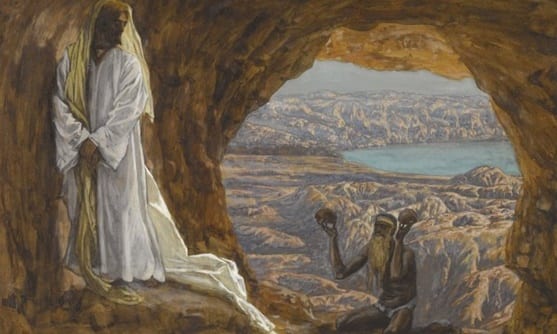
Then the Spirit drove Jesus into the wilderness to be tempted by the devil.
Shout out to Rev. Craig Morton of the Mission Place for reminding us that the word “devil” comes from the Greek word “diablos.” In the Greek, “dia” means through, and “blos” comes from the Greek word “ballow” which means to throw, as in throw a ball. The devil throws stuff at us and creates chaos. You might say the devil throws us curveballs.
And the big curveball that the devil throws Jesus is doubt. God just told Jesus that he is God’s Son. There is no doubt about this! But the devil sows some doubt by saying, “If you are God’s son…” The devil subtly tells Jesus he can’t trust God, so he must prove himself. Jesus refuses to swing at the curveball, because he puts his trust in the words of God.
But can I advocate for the devil a bit? After all, Jesus was in the wilderness for 40 days. That’s a long time! The first temptation is for Jesus to turn a stone into bread so he can eat. What’s wrong with eating? After all, Jesus has to do some self-care, doesn’t he? Jesus taught that we are to love our neighbors as we love ourselves. Shouldn’t Jesus love himself by caring for his body and eating some bread?
Jesus went to the desert so that he could fully identify with the human experience. Part of the human experience is hunger. Jesus knew what it was like to be hungry. Because he knew what it was like to be hungry he was able to feed the 5,000 by multiplying a few loaves of bread and some fish so that all could eat and there was some left over.
To advocate for the devil a little more – wouldn’t it be great if the devil gave Jesus all the kingdoms of the world? Jesus is the king of the world anyway, right? Why didn’t he just take the deal?
Because he would have had to worship the devil. And here’s the thing: You become like what you worship. The devil rules the world through domination, accusation, and scapegoating. Jesus would rule the world through love – a nonviolent love that forgives and refuses to respond to violence with violence. Why? Because Jesus worships the God he is like – the God of nonviolent love.
The next temptation is for Jesus to throw himself down from the pinnacle of the temple and trust that God will protect you. Why? Because the Bible says God will send angels, “He will command his angels concerning you, to protect you…On their hands they will bear you up, so that you will not dash your foot against the stone.”
The devil knows scripture and quotes it. But it is not enough to quote scripture. Do you know of anyone who quotes scripture in a way that harms people? The devil quotes scripture as part of a plan to get Jesus to doubt his identity as God’s beloved Son. Do you know anyone who quotes scripture to get people to doubt their identity as a beloved child of God? According to this passage, that’s the devil at work.
Jesus interpreted the Bible through mercy, not sacrifice. You might say that the devil quotes scripture in a sacrificial way that uses the Bible to exclude and marginalize. But Jesus doesn’t use his scriptures that way. Instead, he chooses to interpret the Bible through mercy, not sacrifice.
Conclusion
Lent is a time of transformation. It’s officially 40 days, but this transformation takes a lifetime. There are no shortcuts to this transformation. For learning to trust God with our offerings is a constant practice of letting go of fear – especially fear of those we label as others, like undocumented immigrants. It’s a slow process because we are constantly battered with messages that we are not good enough or smart enough or faithful enough and we need to behave better so that God will accept us.
But that’s a lie. God only comes to us in the Spirit of love and forgiveness. Lent will bring us to the cross, where Jesus shows us the heart of God, “Father, forgive them, for they know not what they do.” The very heart of God is forgiveness. Jesus reveals forgiveness is a divine act, and as the Human One, he reveals it is also a fully human act.
Image: Wikimedia, Jesus Tempted in the Wilderness, James Tissot, Public Domain.

Previous Post

March 4, 2019
The Christian Doctrine that Leads to Full Inclusion
Next Post
March 11, 2019 God Embraces Our Undocumented Siblings - And So Should We
Browse Our Archives
Select a Category Atonement and Current Events Curriculum Faith and Families Interviews Jesus the Forgiving Victim Lent Montessori politics Reviews The Bible Explained Uncategorized Valentine's Day Wednesday Sermon Who is God?
Select a Month July 2020 November 2019 October 2019 September 2019 August 2019 July 2019 June 2019 May 2019 April 2019 March 2019 February 2019 January 2019 December 2018 November 2018 October 2018 September 2018 August 2018 July 2018 June 2018 May 2018 April 2018 March 2018 February 2018 January 2018 December 2017 November 2017 October 2017 September 2017 August 2017 July 2017 June 2017 May 2017 April 2017 March 2017 February 2017 January 2017 December 2016 November 2016 October 2016 September 2016 August 2016 June 2016 May 2016 April 2016 March 2016 February 2016 January 2016 December 2015 November 2015 October 2015 September 2015 August 2015 July 2015 June 2015 May 2015 April 2015 March 2015 February 2015 January 2015 December 2014 November 2014 October 2014 September 2014 August 2014 July 2014 June 2014 May 2014 April 2014 March 2014 January 2014 December 2013 September 2013 August 2013 July 2013
Follow Us!
TAKE THE
Religious Wisdom Quiz
The sun and moon stood still at my command so Israel could defeat their enemies. Who am I?
Select your answer to see how you score.
Moses Gideon Caleb Joshua
Related posts from Teaching Nonviolent Atonement

Forgiveness in the Time of COVID-19 by Julia...

Reflections on Indigenous Wisdom For Healing A Wounded...

How Forgiveness Can Transform Our Violence and Build...

Jesus Unmasked: God's Economy and How to Cheat...
TRENDING AT PATHEOS Progressive Christian

Why Christians Have a Sacred Duty to Vote:...
The Bible offers strong support for the sacred duty to vote. Here...

What Being a Modern-Day Apostle Means to Me
In my last column, I discussed the ins and outs of modern-day...

Did Ancient China Once Worship the God of...
Across human history, a common thread weaves through the origins of the...

Love Your Neighbor – Including Earth-Kin: Lev. 19,...
God’s command to love your neighbor means acting in an ethical and...

Lead a Church Study of “Jesus and Lao...
Guest writer Jack Thomas (The Irreverent Reverend) reflects on leading his church...

Principles for Understanding the Apostolic Ministry Today
Whenever people discover that my formal ministry title is "apostle," as in...
view all Progressive Christian blogs
Ad-Free & Subscriber Log-In Subscription Support
- About Us
- 2026 Calendar
- Videos
- Podcasts
- Library of World Religions
- Faith In Media Tracker
- Advertise With Us
- Write for Us
- Privacy Policy
- Terms of Service
- Do Not Sell My Data
- Contact Us
- Radiant Digital
- Manage Newsletter Subscriptions
- Unsubscribe From Notifications
- Sitemap
Copyright 2008-2026, Patheos. All rights reserved.
Subscription Support Ad-Free & Subscriber Log-In
Follow Patheos