
BuddhistCatholicContemplativeEvangelicalGeneral ChristianHinduJewishLatter-day SaintMuslimNew VisionsProgressive Christian
Beliefs
- Buddhist
- Catholic
- Contemplative
- Evangelical
- General Christian
- Hindu
- Jewish
- Latter-day Saint
- More Voices
- Muslim
- New Visions
- Pagan
- Progressive Christian
Topics
- Religion News
- Food and Religion
- Sports and Religion
- Religious Art
- Religious Music and Entertainment
- Religious Events
- History and Religion
- Style and Religion
- Politics and Religion
- Women in Religion
- Recreation Outdoors and Religion
- Business Finance and Religion
- Careers Workplace and Religion
- Education and Religion
- Family Parenting and Religion
- Health Fitness and Religion
- Home and Religion
- Relationships and Religion
- Technology and Religion
- Travel and Religion
Columnists
- Buddhist Columnists
- Business Finance and Religion Columnists
- Careers Workplace and Religion Columnists
- Catholic Columnists
- Contemplative Columnists
- Education and Religion Columnists
- Evangelists Columnists
- Family Parenting and Religion Columnists
- General Christian Columnists
- Health Fitness and Religion Columnists
- Hindu Columnists
- History and Religion Columnists
- Home and Religion Columnists
- Jewish Columnists
- More Voices Columnists
- Latter Day Columnists
- Muslim Columnists
- New Visions Columnists
- Nonreligious Columnists
- Pagan Columnists
- Politics and Religion Columnists
- Progressive Columnists
- Recreation Outdoors and Religion Columnists
- Relationships and Religion Columnists
- Religion News Columnists
- Religious Art Columnists
- Religious Events Columnists
- Religious Music and Entertainment Columnists
- Sports and Religion Columnists
- Style and Religion Columnists
- Technology and Religion Columnists
- Travel and Religion Columnists
- Women in Religion Columnists
Resource Library
- 2026 Calendar
- Library of World Religions
- The 100 Most Holy Places on Earth
- Patheos Answers
- Podcasts
- Videos
- Faith Leaders Database
- Anglican Episcopalian
- Bahai
- Baptist
- Buddhism
- Christianity
- Confucianism
- Eastern Orthodoxy
- Hinduism
- Holiness and Pentecostal
- ISKCON
- Islam
- Judaism
- Lutheran
- Methodist
- The Church of Jesus Christ of Latter-day Saints
- New Age
- Paganism
- Presbytarian and Reformed
- Protestantism
- Religion Behind the Scenes
- Roman Catholic
- Scientology
- Shia Islam
- Sikhism
- Sufism
- Sunni Islam
- Taoism
- Zen
- See all religions
Research Tools
 Ad-Free & Subscriber Log-In Subscription Support
Ad-Free & Subscriber Log-In Subscription Support
Follow Patheos 

- Trending:
- Forgiveness
- |
- Marriage
- |
- Consciousness
- |
- Death Penalty
- |
- Election
- |
- Halloween
 Teaching Nonviolent Atonement
- Home
- Progressive Christian
- God’s Economy of Grace: Everyone Belongs
God’s Economy of Grace: Everyone Belongs
Last updated on: March 27, 2019 at 10:37 am by Adam Ericksen
God’s Economy of Grace: Everyone Belongs 2019-03-27T10:37:58-05:00 Adam Ericksen
Patheos Explore the world's faith through different perspectives on religion and spirituality! Patheos has the views of the prevalent religions and spiritualities of the world.
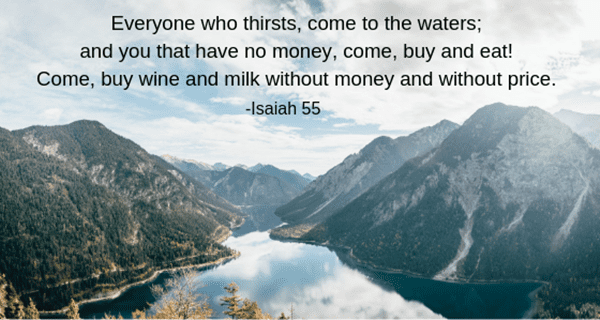
The following is a sermon I preached at Clackamas United Church of Christ, near Portland, Oregon. You can read or watch the sermon below. The primary scripture texts were Isaiah 55:1-9 and Luke 13:1-9.
When I started as a youth pastor about 13 years ago, there was a high school freshman boy in our group named Johnny.* Johnny had a severe case of Asperger’s. He would often blurt out disruptive comments that were often inappropriate, but not directed against anyone. I often brought snacks to the youth group. Johnny got up, put his hand in the bowl, took out a handful of chips, and scarfed them down. He then licked all the Dorito dust from his hand, and went in for another handful of chips.
I had Johnny for all four years of his high school experience. Johnny’s freshman year was also my first year of ministry. I was learning how to do ministry as I went along.
And I want to admit to you that I was uncomfortable with Johnny. During that first year, I had no clue what to do with him. Did I need to draw boundaries? Did I need to threaten to kick him out if he continued to disrupt our sessions? After all, I spent a lot of time preparing and I didn’t want him to disrupt my precious lesson plans!
As the year continued, I noticed how the other members of the youth group responded to Johnny. They grew up with Johnny. They knew him. And they cared about him. It took me a while to figure out what the other members of that youth group already knew – Johnny belonged.
You see, I wanted Johnny to “fit in.” I wanted him to play by my rules. He needed to sit there quietly, participate when I said he could participate, always raise his hand, and for God’s sake, eat Doritos like everyone else!
But the youth group didn’t need Johnny to “fit in.” They didn’t need him to change. They knew that Johnny needed what they all needed – a place to go where they could be fully themselves and know that they were fully loved and accepted just as they were.
I’m a slow learner, but I eventually got the message. And yet, I seem to constantly need to be reminded of this lesson.
Because Johnny was not a very productive member of our youth group. In fact, he tended to be disruptive, and frankly, I labeled him a burden. But Johnny was not a burden for the other members of that group. Johnny was a gift. His worth and value was not in his ability to be productive. Johnny’s value and worth in our little community was in Johnny’s ability to simply be Johnny. The gift Johnny gave us was the gift of belonging. He knew that he belonged, and everyone else knew he belonged, too.
This way of being in community that those high school students lived out was deeply spiritual. And it’s the same spirituality that we find in our readings this morning.
The prophet Isaiah says, “Everyone who thirsts, come to the waters; and you that have no money; come, buy and eat! Come, buy wine and milk without money and without price.”
That is God’s economy. It’s an the economy of grace where people don’t have to fit in because everyone already belongs and has their needs met. And this economy of grace extends throughout the Bible.
A few weeks ago, we heard a story from Deuteronomy where Israel first entered the Promised Land. God gave them the land and all of the food within it was God’s gift to them. And God said to them that they needed to give a portion of the food back to God. Not because God was hungry and God needed food to eat. Rather, God wanted them to give a portion back so that they can all share in the abundance of God’s gifts together. In fact, God told them to have a celebration and everyone should be invited. And do you remember who God specifically wanted them to invite to the party?
Immigrants.
Because throughout the Bible, God wants everyone – the poor, the vulnerable, and the immigrant – to partake in God’s abundant gifts. The question is not about someone fitting in because everyone already belongs to the community and to God’s economy of grace.
Isaiah continues in this strand. He says that even if you don’t have money, come and eat! Buy without price!
Through Isaiah, God invites us to participate in God’s radical economy of grace. It’s not an economy of competition of us against them. It is an economy of grace. It’s an economy of giving to one another because God has already given us so much.
The Bible repeatedly teaches us to care for and support all people, but especially the poor. Because like Johnny belonged to the youth group, the poor belong to us.
And yes, we can find all kinds of excuses to not do this. We can blame the poor for not fitting in or for being lazy or for making bad decisions or for sinning or for just not being lucky.
In our Gospel reading today, some people come to Jesus and tell him about a big tower that fell and killed 18 people. They wanted to blame these people for their demise. Surely they must have been sinners, which means they deserved that catastrophe to happen to them.
Jesus tells them that the people making these statements, “must repent.” Now, if you are like me, whenever you hear the word “repent,” a shiver runs down your spine and you want to run away because you think only religious zealot street preachers who yell, “You must repent or you’re going to hell!” use that word.
But that’s not the point. Repent literally means “Change your mind.” What does Jesus want us to change our minds about? He wants us to change from a cycle of blaming the victim. Why did the tower fall on those 18 people? The people thought it must be because they sinned. Why did Hurricane Katrina strike New Orleans? It must be because God was punishing New Orleans for sinning. Why were there wildfires in Northern California last year? God must be punishing California for legalizing pot.
When people came to Jesus with that idea, he told them to repent! He told them to change their minds about God because God doesn’t punish people like that.
What does God do? God is the giver. God always comes to us with the gift of grace, which in God’s economy is always free because everyone belongs to God’s love and care.
So when we start blaming the poor for being lazy or making poor decisions with their lives and for not fitting in, we perpetuate a cycle of blame and we neglect to participate in God’s economy of grace. And Jesus calls us to repent from blaming the victim.
In the Gospel of Luke, Jesus says, “Blessed are you who are poor.” You see, God doesn’t curse the poor. In God’s economy, the poor receive God’s blessing. They belong to God’s blessing just like everyone else. If anything curses the poor, it’s human economic systems that claim the poor don’t belong.
Now, I’m not an economist. But what I can tell you is that every economy has a spirituality. Capitalism as an economic system is amoral. In and of itself, it does not reach out to help people. In fact, we are witnessing that unfettered capitalism leads to corruption and greed for the few while leaving many others in poverty.
That’s why we need an economy with social programs to help people. There are many who want to demonize the word socialism and claim that any social program is a form of socialism, but we already have social programs like Medicare and Medicaid and the Supplemental Nutrition Assistance Program. From a biblical perspective, these social programs are good because God’s economy is social. God’s economy seeks to help those in need.
But did you know that here in Clackamas County, there are 2,293 people who are homeless and 1,193 are children? More than half the homeless population in Clackamas County are children.
The reason for this is not because God is punishing them or because they are lazy. One major reason is that housing prices have skyrocketed. To purchase or rent housing has increased, but wages have not kept up. Many families who were financially stable just 15 years ago have lost their homes or are under threat of losing their homes. 15 years ago, these families never would have seen a future of homelessness.
To add salt to the wound, Forbes Magazine notes that the Trump Tax Cuts and Job Act of 2017 left open “a slew of tax loopholes that allow profitable companies to routinely avoid paying federal and state income taxes on almost half of their profits.” In fact, the tax cuts have allowed companies like Amazon to pay $0 in Federal taxes on its $11.2 billion in profit.
I don’t want to make Amazon into the bad guy, but I do want to point out that Amazon operates within an economic system that glorifies massive wealth at the expense of the poor, who are too often excluded from wealth. Under our current economic system, the poor don’t belong.
But God’s economy is different. It’s an economy that isn’t based on greed or the competition of amassing more wealth than the other guy. It’s an economy of grace that helps those in need. Why? Simply because they belong to the human family. They are created in the image of the divine. They are children of God. And so in the words of Isaiah, “Everyone who thirsts, come to the waters; and you that have no money, come, buy and eat! Come, buy wine and milk without money and without price.”
That is God’s economy of grace. May we receive that grace into our lives, and may we work to make it a reality. Amen.
*I changed the name for this sermon.
Image: made with canva.com
Next Post

March 27, 2019 The Prodigal Son: What Do You Really Want? Lent 4, Year C - GVBS
Browse Our Archives
Select a Category Atonement and Current Events Curriculum Faith and Families Interviews Jesus the Forgiving Victim Lent Montessori politics Reviews The Bible Explained Uncategorized Valentine's Day Wednesday Sermon Who is God?
Select a Month July 2020 November 2019 October 2019 September 2019 August 2019 July 2019 June 2019 May 2019 April 2019 March 2019 February 2019 January 2019 December 2018 November 2018 October 2018 September 2018 August 2018 July 2018 June 2018 May 2018 April 2018 March 2018 February 2018 January 2018 December 2017 November 2017 October 2017 September 2017 August 2017 July 2017 June 2017 May 2017 April 2017 March 2017 February 2017 January 2017 December 2016 November 2016 October 2016 September 2016 August 2016 June 2016 May 2016 April 2016 March 2016 February 2016 January 2016 December 2015 November 2015 October 2015 September 2015 August 2015 July 2015 June 2015 May 2015 April 2015 March 2015 February 2015 January 2015 December 2014 November 2014 October 2014 September 2014 August 2014 July 2014 June 2014 May 2014 April 2014 March 2014 January 2014 December 2013 September 2013 August 2013 July 2013
Follow Us!
TAKE THE
Religious Wisdom Quiz
What book of the Bible tells about Jesus’ birth?
Select your answer to see how you score.
Luke Acts Revelation Hebrews
Related posts from Teaching Nonviolent Atonement

Jesus Unmasked: Kingdom Economics: On Being Rich Toward...
Jesus, Mary, and the Jackals – Everyone Belongs...

Welcome to my world: Notes on the reception...
Sermon: The Eleventh Commandment
TRENDING AT PATHEOS Progressive Christian

What Being a Modern-Day Apostle Means to Me
In my last column, I discussed the ins and outs of modern-day...

Did Ancient China Once Worship the God of...
Across human history, a common thread weaves through the origins of the...

Love Your Neighbor – Including Earth-Kin: Lev. 19,...
God’s command to love your neighbor means acting in an ethical and...

Lead a Church Study of “Jesus and Lao...
Guest writer Jack Thomas (The Irreverent Reverend) reflects on leading his church...

Pastoral Wisdom for Responding to Sermon Pushback
Getting sermon pushback on your social justice sermon? Learn practical, Proverbs-based strategies...

Principles for Understanding the Apostolic Ministry Today
Whenever people discover that my formal ministry title is "apostle," as in...
view all Progressive Christian blogs
Ad-Free & Subscriber Log-In Subscription Support
- About Us
- 2026 Calendar
- Videos
- Podcasts
- Library of World Religions
- Faith In Media Tracker
- Advertise With Us
- Write for Us
- Privacy Policy
- Terms of Service
- Do Not Sell My Data
- Contact Us
- Radiant Digital
- Manage Newsletter Subscriptions
- Unsubscribe From Notifications
- Sitemap
Copyright 2008-2026, Patheos. All rights reserved.
Subscription Support Ad-Free & Subscriber Log-In
Follow Patheos