
BuddhistCatholicContemplativeEvangelicalGeneral ChristianHinduJewishLatter-day SaintMuslimNew VisionsProgressive Christian
Beliefs
- Buddhist
- Catholic
- Contemplative
- Evangelical
- General Christian
- Hindu
- Jewish
- Latter-day Saint
- More Voices
- Muslim
- New Visions
- Pagan
- Progressive Christian
Topics
- Religion News
- Food and Religion
- Sports and Religion
- Religious Art
- Religious Music and Entertainment
- Religious Events
- History and Religion
- Style and Religion
- Politics and Religion
- Women in Religion
- Recreation Outdoors and Religion
- Business Finance and Religion
- Careers Workplace and Religion
- Education and Religion
- Family Parenting and Religion
- Health Fitness and Religion
- Home and Religion
- Relationships and Religion
- Technology and Religion
- Travel and Religion
Columnists
- Buddhist Columnists
- Business Finance and Religion Columnists
- Careers Workplace and Religion Columnists
- Catholic Columnists
- Contemplative Columnists
- Education and Religion Columnists
- Evangelists Columnists
- Family Parenting and Religion Columnists
- General Christian Columnists
- Health Fitness and Religion Columnists
- Hindu Columnists
- History and Religion Columnists
- Home and Religion Columnists
- Jewish Columnists
- More Voices Columnists
- Latter Day Columnists
- Muslim Columnists
- New Visions Columnists
- Nonreligious Columnists
- Pagan Columnists
- Politics and Religion Columnists
- Progressive Columnists
- Recreation Outdoors and Religion Columnists
- Relationships and Religion Columnists
- Religion News Columnists
- Religious Art Columnists
- Religious Events Columnists
- Religious Music and Entertainment Columnists
- Sports and Religion Columnists
- Style and Religion Columnists
- Technology and Religion Columnists
- Travel and Religion Columnists
- Women in Religion Columnists
Resource Library
- 2026 Calendar
- Library of World Religions
- The 100 Most Holy Places on Earth
- Patheos Answers
- Podcasts
- Videos
- Faith Leaders Database
- Anglican Episcopalian
- Bahai
- Baptist
- Buddhism
- Christianity
- Confucianism
- Eastern Orthodoxy
- Hinduism
- Holiness and Pentecostal
- ISKCON
- Islam
- Judaism
- Lutheran
- Methodist
- The Church of Jesus Christ of Latter-day Saints
- New Age
- Paganism
- Presbytarian and Reformed
- Protestantism
- Religion Behind the Scenes
- Roman Catholic
- Scientology
- Shia Islam
- Sikhism
- Sufism
- Sunni Islam
- Taoism
- Zen
- See all religions
Research Tools
 Ad-Free & Subscriber Log-In Subscription Support
Ad-Free & Subscriber Log-In Subscription Support
Follow Patheos 

- Trending:
- Forgiveness
- |
- Marriage
- |
- Consciousness
- |
- Death Penalty
- |
- Election
- |
- Halloween
 Teaching Nonviolent Atonement
- Home
- Progressive Christian
- Power To The People On President’s Day
Power To The People On President’s Day
Last updated on: February 19, 2019 at 1:10 am by Lindsey Paris-Lopez
Power To The People On President’s Day 2019-02-19T01:10:48-05:00 Lindsey Paris-Lopez
Patheos Explore the world's faith through different perspectives on religion and spirituality! Patheos has the views of the prevalent religions and spiritualities of the world.
In the early 2000s, I was a die-hard fan of The West Wing. I still consider it a great show, though I haven’t seen it in about a decade. The sweeping, majestic score, the fast-paced, witty banter, the humor, and, above all, a sense of trust and pride in an administration – albeit a fictional one – that was truly looking out for the American people.
I remember watching and rooting for the Bartlett administration. I sympathized with the characters and believed that they had the wellbeing of the people at heart, even when I didn’t always agree with all the positions or policies. Overall, it seemed so obvious to me then that if we had a wise and compassionate leader, our whole nation would be in good hands.
In the earlier seasons, there was a frequent refrain: “I serve at the pleasure of the president.” That’s true enough for the president’s staff, but the words and the stirring music made me feel as if I would jump to say them as well. I felt like a better president would make me a better person…
I had it all so backwards.
I have seen so many memes today thanking all our previous presidents and excluding the current one. I have seen longings for previous or fictional administrations. I understand the sentiment. I could spend hours listing my objections to current policies and even longer expressing my feelings about the crass and heartless words and actions of this administration. I could also go on a rant about the war expansions and drone strikes under the previous administration (the latter of which have increased under the current administration but are never discussed). But on this president’s day, I want to consider something else…
Because I have come to believe that this day itself, regardless of which administration happens to be in power at any given moment, can contribute to a top-down understanding of our history and our identity. History books divide our pasts by presidential eras. We have endless election cycles. The president has the world’s largest bully pulpit, amplified by social media and a 24-hour news cycle, and more name and facial recognition than anyone in the world. Given all of this, it can seem like we live in a world where every day is President’s Day and ultimate power resides in whomever inhabits the oval office.
This is not the way democracy is supposed to work.
The truth is, the president’s job is to sign into law the legislation that our Congress passes. And our Congress is supposed to represent us. Democracy is meant to work from the ground up. We the peoplehave more power, collectively, than we imagine. We know this on a surface level, and yet, I fear we too often underestimate, forget, and fail to utilize our collective strength.
And when peoples’ movements bring long-sought change, we tend to single out individual leaders for our history books. The millions who organize, protest, boycott, and find creative ways to uplift one-another until all voices rise together fade into the background. As Angela Davis points out, the first name that comes to mind any time we think about Civil Rights is Martin Luther King Jr., who “was a powerful figure,” but “did not create the Civil Rights Movement.” Remembering leaders in order to learn from them is good and noble, but isolating them so that the work of achieving change seems like the supernatural achievement of giants instead of the collective power of many is at best a misguided honor and at worst a cynical ploy to intimidate.
Davis, world-renowned feminist and human rights activist who consistently points to those who preceded her and work alongside her, goes on to comment: “[P]articularly at this moment in our history, when we are so influenced by the neoliberal ideologies of global capitalism, we have to figure out ways in which we can contest this individualism that shapes the way we think about the world.”
One way to contest that individualism is to recognize that we are not individuals but interdividuals, interconnected and formed in relationship with one-another. While our mutual needs and desires can form conflicts and rivalries, they can also draw out our empathy and creativity and bring us together to nurture communities of compassion. To learn the depths of our interconnection is to know that none of us can be our fullest selves until all of us are our fullest selves. This is true in an economic sense, in a social sense, and in a spiritual sense: our responsibility to ourselves is our responsibility to each other because we can only flourish in relationship with one another.
And to focus so much attention – not just one day a year but every day – on the power of the president, a single person, is to become myopic in regard to our own power, potential, and responsibility. Whether we love or hate the president, focusing on the president’s role blurs our own. Idolizing and scapegoating a president (or anyone else for that matter) are two sides of the same coin. The problem is not so much whether or not they have done anything to warrant our praise or scorn; most presidents do plenty to warrant some of each. The problem is rather that concentrating our energy on reacting to the works of a president – good or bad – detracts from our energy to proactively set the tone of the nation for the president to follow.
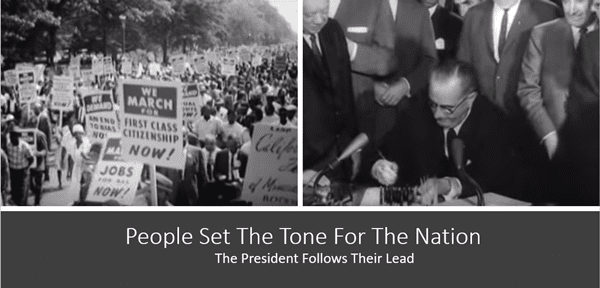
Movements of many have shaped the course of our nation. Progressive laws have followed on the heals of people realizing their collective power. Women’s suffrage, the Civil Rights Act, the Voting Rights Act – these laws were signed by presidents but brought about through marches, boycotts, arrests, organization and persistence. Those who organized for change created enough tension to convince authorities that their own livelihoods were inextricably tied to the lives of those who fought for the recognition of their dignity. Today, the Green New Deal has been inspired in large part by the peaceful (though violently-quelled) protests at Standing Rock. Prisoners have organized and fasted for better treatment, and prison reform and restorative justice movements are gaining popularity. Black Lives Matter, immigrant rights activists, student movements against gun violence from Parkland and beyond – these movements of hundreds and thousands, inspiring millions more, are shaping our nation and receiving support and solidarity worldwide. Good presidents in the future will draw their energy from these movements and one day sign laws to help secure the demands of the people. But they will take their cues from the ground up – not the other way around.
Yes, the power of the executive is undeniable. But throughout history, our country has progressed forward through the collective movements of those who refused to be silent even when pushed to the margins. With perseverance and creativity, they persuaded even those personally against their causes to act in their interests.
And in a time in which our democracy is eroding into an oligarchy, when income inequality is growing between the rich and the poor, when ideological divisions keep many from coming together for the sake of mutual interest, and when the fate of our planet depends upon solidarity and cooperation with one another, it is absolutely crucial that we come to recognize the collective power of nonviolent social movement and come together in ways we have not yet seen.
One crucial thing we must do is demand that Congress take back its Constitutional power to declare war, a power abdicated to the president since World War II. If wars were in the hands of Congress, we would have more power – through our votes – as to whether or not wars would drain us of our resources at home only to fund destruction abroad. Beyond this, there is so much more to do.
We need education to help us transcend our prejudices. We need training in non-violent conflict resolution not only for the causes we will face but for the internal struggles that are inevitable when mass groups organize. We need to gather in meetings to discover and assess the needs in our neighborhoods and broader communities, and we need to intentionally seek out and listen to those who are most vulnerable – poor and marginalized communities.
And though we need to understand the power of the many, we need not disregard the concept of leadership. We think of leaders as single individuals, but as interdividuals we should recognize that we all influence each other and need one-another’s influence. As Alicia Garza says of Black Lives Matter, movements should be “leader-full,” in which we listen to the experience and expertise of one-another and recognize our own value not merely as a cog in a system but as unique but interdependent members of a body.
We the people have more power than we realize to shape our nation. While it may seem today as if the president sets the tone of the nation for better or worse, a true democracy would see this phenomenon reversed. The best presidents would be those who would listen to the voices of the people crying for freedom and justice. It is good and right to appreciate and show gratitude for a difficult job well done, and this can apply to presidents as much as anyone else. But if President’s Day is to be recognized, let’s recognize it in the midst of a larger, year-round celebration of true, ground-up democracy that we exercise to the fullest extent of our ability. Because the truth is, it’s the people who have the power to make the president – and the nation – better.
Power to the people on President’s Day and evermore.
Images: Left: Screenshot from Youtube: History Specials: King Leads the March on Washington | History; Right: Screenshot from Youtube: “LBJ signs Civil Rights Act of 1964,” by Max Power

Browse Our Archives
Select a Category Atonement and Current Events Curriculum Faith and Families Interviews Jesus the Forgiving Victim Lent Montessori politics Reviews The Bible Explained Uncategorized Valentine's Day Wednesday Sermon Who is God?
Select a Month July 2020 November 2019 October 2019 September 2019 August 2019 July 2019 June 2019 May 2019 April 2019 March 2019 February 2019 January 2019 December 2018 November 2018 October 2018 September 2018 August 2018 July 2018 June 2018 May 2018 April 2018 March 2018 February 2018 January 2018 December 2017 November 2017 October 2017 September 2017 August 2017 July 2017 June 2017 May 2017 April 2017 March 2017 February 2017 January 2017 December 2016 November 2016 October 2016 September 2016 August 2016 June 2016 May 2016 April 2016 March 2016 February 2016 January 2016 December 2015 November 2015 October 2015 September 2015 August 2015 July 2015 June 2015 May 2015 April 2015 March 2015 February 2015 January 2015 December 2014 November 2014 October 2014 September 2014 August 2014 July 2014 June 2014 May 2014 April 2014 March 2014 January 2014 December 2013 September 2013 August 2013 July 2013
Follow Us!
TAKE THE
Religious Wisdom Quiz
What is the name of the tree whose fruit Adam and Eve were forbidden to eat?
Select your answer to see how you score.
Tree of Life Olive Tree Tree of the Knowledge of Good and Evil Fig Tree
Related posts from Teaching Nonviolent Atonement

Role Model: A Tribute To My Mother In...

The Left Hand of God - Jesus and...

What Are We Fighting For? Covington Students, Indigenous...

Christmas Eve and the Call to Nonviolence: Girardian...
TRENDING AT PATHEOS Progressive Christian

What Being a Modern-Day Apostle Means to Me
In my last column, I discussed the ins and outs of modern-day...

Did Ancient China Once Worship the God of...
Across human history, a common thread weaves through the origins of the...

Love Your Neighbor – Including Earth-Kin: Lev. 19,...
God’s command to love your neighbor means acting in an ethical and...

Lead a Church Study of “Jesus and Lao...
Guest writer Jack Thomas (The Irreverent Reverend) reflects on leading his church...

Pastoral Wisdom for Responding to Sermon Pushback
Getting sermon pushback on your social justice sermon? Learn practical, Proverbs-based strategies...

Principles for Understanding the Apostolic Ministry Today
Whenever people discover that my formal ministry title is "apostle," as in...
view all Progressive Christian blogs
Ad-Free & Subscriber Log-In Subscription Support
- About Us
- 2026 Calendar
- Videos
- Podcasts
- Library of World Religions
- Faith In Media Tracker
- Advertise With Us
- Write for Us
- Privacy Policy
- Terms of Service
- Do Not Sell My Data
- Contact Us
- Radiant Digital
- Manage Newsletter Subscriptions
- Unsubscribe From Notifications
- Sitemap
Copyright 2008-2026, Patheos. All rights reserved.
Subscription Support Ad-Free & Subscriber Log-In
Follow Patheos