
BuddhistCatholicContemplativeEvangelicalGeneral ChristianHinduJewishLatter-day SaintMuslimNew VisionsProgressive Christian
Beliefs
- Buddhist
- Catholic
- Contemplative
- Evangelical
- General Christian
- Hindu
- Jewish
- Latter-day Saint
- More Voices
- Muslim
- New Visions
- Pagan
- Progressive Christian
Topics
- Religion News
- Food and Religion
- Sports and Religion
- Religious Art
- Religious Music and Entertainment
- Religious Events
- History and Religion
- Style and Religion
- Politics and Religion
- Women in Religion
- Recreation Outdoors and Religion
- Business Finance and Religion
- Careers Workplace and Religion
- Education and Religion
- Family Parenting and Religion
- Health Fitness and Religion
- Home and Religion
- Relationships and Religion
- Technology and Religion
- Travel and Religion
Columnists
- Buddhist Columnists
- Business Finance and Religion Columnists
- Careers Workplace and Religion Columnists
- Catholic Columnists
- Contemplative Columnists
- Education and Religion Columnists
- Evangelists Columnists
- Family Parenting and Religion Columnists
- General Christian Columnists
- Health Fitness and Religion Columnists
- Hindu Columnists
- History and Religion Columnists
- Home and Religion Columnists
- Jewish Columnists
- More Voices Columnists
- Latter Day Columnists
- Muslim Columnists
- New Visions Columnists
- Nonreligious Columnists
- Pagan Columnists
- Politics and Religion Columnists
- Progressive Columnists
- Recreation Outdoors and Religion Columnists
- Relationships and Religion Columnists
- Religion News Columnists
- Religious Art Columnists
- Religious Events Columnists
- Religious Music and Entertainment Columnists
- Sports and Religion Columnists
- Style and Religion Columnists
- Technology and Religion Columnists
- Travel and Religion Columnists
- Women in Religion Columnists
Resource Library
- 2026 Calendar
- Library of World Religions
- The 100 Most Holy Places on Earth
- Patheos Answers
- Podcasts
- Videos
- Faith Leaders Database
- Anglican Episcopalian
- Bahai
- Baptist
- Buddhism
- Christianity
- Confucianism
- Eastern Orthodoxy
- Hinduism
- Holiness and Pentecostal
- ISKCON
- Islam
- Judaism
- Lutheran
- Methodist
- The Church of Jesus Christ of Latter-day Saints
- New Age
- Paganism
- Presbytarian and Reformed
- Protestantism
- Religion Behind the Scenes
- Roman Catholic
- Scientology
- Shia Islam
- Sikhism
- Sufism
- Sunni Islam
- Taoism
- Zen
- See all religions
Research Tools
 Ad-Free & Subscriber Log-In Subscription Support
Ad-Free & Subscriber Log-In Subscription Support
Follow Patheos 

- Trending:
- Forgiveness
- |
- Marriage
- |
- Consciousness
- |
- Death Penalty
- |
- Election
- |
- Halloween
 Teaching Nonviolent Atonement
- Home
- Progressive Christian
- How To Solve a National Emergency: Religion, Politics, and the Common Good
How To Solve a National Emergency: Religion, Politics, and the Common Good
Last updated on: February 25, 2019 at 4:28 pm by Adam Ericksen
How To Solve a National Emergency: Religion, Politics, and the Common Good 2019-02-25T16:28:39-05:00 Adam Ericksen
Patheos Explore the world's faith through different perspectives on religion and spirituality! Patheos has the views of the prevalent religions and spiritualities of the world.
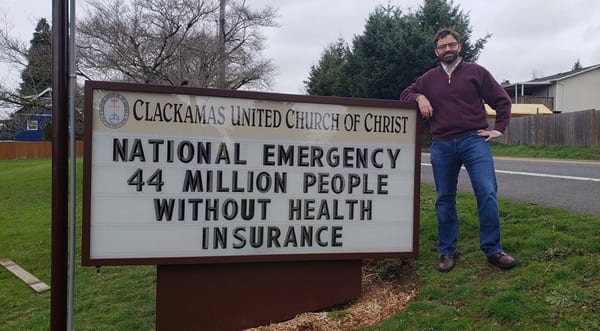
The following is a sermon I preached at Clackamas United Church of Christ, near Portland, Oregon. You can read or watch the sermon below. The primary scripture texts were Genesis 45:3-11, 15 and Luke 6:27-38.
It’s been quite a week for us here at Clackamas United Church of Christ. After posting the messages on our sign this last week, we received a lot of positive feedback and also some negative feedback.
I would like to address some of the negative feedback. For the most part, the negative feedback is some version of, “Churches shouldn’t be political.”
I want to tell you this: Everything is political. We are social beings, living together. Politics tries to answer the question, “How are we going to live together?”
We are social, and thus, political beings. We are always responding in a political manner. Even the idea of political quietism is itself a response to politics.
But Jesus does not call us to be quiet. Jesus was political because he knew that the political was deeply spiritual. He preached the Kingdom of God while living in the Empire of Rome and in the Kingdom of a man named Herod. When Jesus said, “The Kingdom of God is like…” he used explosive and subversive political language. Jesus wasn’t killed because he taught us to love our neighbors, who include even our enemies. He was killed because he subverted the political, religious, and economic status quo of his day that profited some and left others out. Jesus worked for the common good. And he did it in the most subversive way possible – through direct nonviolent action based on love that sought a more just world for all people.
Churches in the United States have always been involved in the political issues of the day. In fact, our ancestors in the United Church of Christ were some of those who left Europe in hopes of finding political freedom on this continent. Our ancestors in the UCC were also on the forefront in the political struggle to end slavery in the United States and we extended that struggle a century later as we worked for the civil rights movement.
Churches have always had a voice in national politics. When there is a national emergency, churches and other nonprofits have risen to help individuals during those emergencies, but they have also worked on a policy level to help the common good.
Our brother Charlie asked a brilliant question about the relationship between churches and politics on our Facebook page that cuts to the heart of the issue for me. Charlie asked, “Should churches use a Bible that contains political messages?” It’s a brilliant point because the Bible is full of political messages. If we want a Bible without a political message, we would have to create an entirely different book.
But we know that there’s a danger in politics. Politics can become about gaining more power and wealth for yourself and your friends. People can use politics for their own good and forget about the common good.
But that’s exactly why the church is important. The Bible tells the story of prophets who confronted the political leaders of their day. Following his question, Charlie quoted the prophet Ezekiel. In Ezekiel’s day, politicians were referred to as shepherds, because they were supposed to care for their people. Ezekiel wrote, “Woe betide Israel’s shepherds, who care only for themselves. Should not the shepherds care for the flock?” The answer, of course, is yes.
The Bible tells the story of many politicians, some of them do care for their people, but many of them only care about themselves. One of the greatest politicians in the Bible was a man named Joseph.
Joseph grew up in a land called Canaan with 11 brothers, who were all plagued by sibling rivalry. Joseph was their father’s favorite son. And as anyone who has siblings knows, this is a recipe for disaster. His brothers become intensely jealous of Joseph as they wanted their father’s affection. They united in a plan to kill him by throwing him down a pit and leaving him there to die.
Joseph became the scapegoat for his brothers. They projected all of their internal jealousies and rivalries upon him. And as they united against him, they formed a glue that bonded them in a kind of unholy cooperation and mutuality. They forgot that the common good for all of them even included their annoying brother Joseph.
And here I want to take a step back and ask, have you ever been a scapegoat? Maybe you were your family’s scapegoat. Or maybe you were a scapegoat in middle school. Or maybe you are the scapegoat at your work or in your retirement community. Or maybe, if you are more like me, you are more like one of the brothers. You often find yourself more like a scapegoater or a bystander. At some point, you might have sensed the power and prestige that comes with uniting people against a common enemy. Or maybe you were part of the crowd, and you felt a strong sense of belonging, not to the common good, but to our good against that person’s good. Or maybe you were a bystander and thought it was too risky to get involved. In my life I’ve played all of these roles.
But back to Joseph and his brothers. The brothers realize that instead of leaving Joseph in the pit to die, they can make some money by selling Joseph into slavery.
Joseph becomes a slave in Egypt, but he had a gift of interpreting dreams. The Pharaoh was plagued by nightmares and soon Joseph was called to interpret Pharaoh’s dreams. Joseph said the dreams revealed a national emergency and that a massive famine was about to plague Egypt and Canaan.
Now, this is where things get even more interesting. The Pharaoh thinks Joseph is not only good at interpreting dreams, he also thinks Joseph has the skills to be a good administrator. So Pharaoh makes Joseph his right-hand man and puts him in charge of solving this national emergency.
And here Joseph has some options. As a political leader, Joseph could deal with this national emergency in basically two different ways. The first way is the way many politicians and family members have dealt with crises from the beginning of human history. It’s the same way Joseph’s brothers dealt with him. When a crisis hits, we often forget about the common good and focus on our own good. And we do this, it seems that our default mechanism is to find someone to blame. A scapegoat. Whether it’s an immigrant or the poor or women or the sick or LGBTQ folks or black people or brown people, or the list goes on. Whenever politicians try to solve a national emergency by blaming a group of people, you can be pretty sure that the emergency is made up. Or in modern parlance, you can be sure it’s “fake news.” In fact, when we blame a certain group for our problems, it is a way to distract us from the real threats facing our nation.
But Joseph didn’t take that option. He didn’t respond to the national crisis of his day by scapegoating anyone. Instead, he did something remarkable. He kept his attention on the real emergency and working for the common good, which he knew included everyone. He planned for the emergency by storing up leftover grain in the Egyptian granary. And so everyone in Egypt had enough food for the seven years of famine.
But even more remarkable was that the famine affected the whole middle east. And so people from other nations came to Egypt in search of food. Joseph could have shaken his head at them and said, “You foreigners. Why didn’t you plan for this? We Egyptians are so smart. We planned ahead! You didn’t. We don’t have enough for everyone. If we shared with you then we would run out.”
But Joseph didn’t say that. He knew that as a politician, God called him to work for the common good, which included even foreigners. Joseph believed that God put him in his place of power, not to gain more power and wealth for himself, but to share the abundance of Egypt with others.
And this is what we learn from the great spiritual stories of the Bible. During moments national emergencies, if we take a step back from the tendency to scapegoat, we will realize that we already have enough for everyone…if we just share with one another.
The Bible tells us that the flow of the universe is the flow of abundance. But unfortunately, we tend to believe in scarcity. We tend to be run by fear that there is not enough for everyone, so during times of crisis and emergency, we can easily forget about the common good and hoard things for ourselves.
But political leaders like Joseph trust that there is enough for everyone. They don’t live by fear and scarcity. They live by abundance and hope. Jesus, the Messiah, or King, trusted there was enough for everyone as he multiplied a couple of fish and a few loaves. Thousands ate and there was enough left over. These leaders are able to provide for all people – they work for the common good – because they have entered into the flow of God’s abundant love for all people – even those we might call our enemies.
And so as we hear words of national emergency, let us resist the tendency to fear and to scapegoat.
Let us remember the truth of the Bible that there is enough for all people if we work for the common good by sharing what we have with others.
And let us enter into the flow of God’s generosity, justice, and love for all people. Amen.

Browse Our Archives
Select a Category Atonement and Current Events Curriculum Faith and Families Interviews Jesus the Forgiving Victim Lent Montessori politics Reviews The Bible Explained Uncategorized Valentine's Day Wednesday Sermon Who is God?
Select a Month July 2020 November 2019 October 2019 September 2019 August 2019 July 2019 June 2019 May 2019 April 2019 March 2019 February 2019 January 2019 December 2018 November 2018 October 2018 September 2018 August 2018 July 2018 June 2018 May 2018 April 2018 March 2018 February 2018 January 2018 December 2017 November 2017 October 2017 September 2017 August 2017 July 2017 June 2017 May 2017 April 2017 March 2017 February 2017 January 2017 December 2016 November 2016 October 2016 September 2016 August 2016 June 2016 May 2016 April 2016 March 2016 February 2016 January 2016 December 2015 November 2015 October 2015 September 2015 August 2015 July 2015 June 2015 May 2015 April 2015 March 2015 February 2015 January 2015 December 2014 November 2014 October 2014 September 2014 August 2014 July 2014 June 2014 May 2014 April 2014 March 2014 January 2014 December 2013 September 2013 August 2013 July 2013
Follow Us!
TAKE THE
Religious Wisdom Quiz
Jesus drove the merchants and money-changers out of the temple with this.
Select your answer to see how you score.
Stick Scourge Sword Stool
Related posts from Teaching Nonviolent Atonement

The Chosen One Chooses Love Over Fear [VIDEO]

God’s Holy Name, False Prophets, and the Politics...

The Politics of Jesus - Legion and Immigrant...

Why You Should Run from Religion that Emphasizes...
TRENDING AT PATHEOS Progressive Christian

Why Christians Have a Sacred Duty to Vote:...
The Bible offers strong support for the sacred duty to vote. Here...

What Being a Modern-Day Apostle Means to Me
In my last column, I discussed the ins and outs of modern-day...

Did Ancient China Once Worship the God of...
Across human history, a common thread weaves through the origins of the...

Love Your Neighbor – Including Earth-Kin: Lev. 19,...
God’s command to love your neighbor means acting in an ethical and...

Lead a Church Study of “Jesus and Lao...
Guest writer Jack Thomas (The Irreverent Reverend) reflects on leading his church...

Principles for Understanding the Apostolic Ministry Today
Whenever people discover that my formal ministry title is "apostle," as in...
view all Progressive Christian blogs
Ad-Free & Subscriber Log-In Subscription Support
- About Us
- 2026 Calendar
- Videos
- Podcasts
- Library of World Religions
- Faith In Media Tracker
- Advertise With Us
- Write for Us
- Privacy Policy
- Terms of Service
- Do Not Sell My Data
- Contact Us
- Radiant Digital
- Manage Newsletter Subscriptions
- Unsubscribe From Notifications
- Sitemap
Copyright 2008-2026, Patheos. All rights reserved.
Subscription Support Ad-Free & Subscriber Log-In
Follow Patheos