
BuddhistCatholicContemplativeEvangelicalGeneral ChristianHinduJewishLatter-day SaintMuslimNew VisionsProgressive Christian
Beliefs
- Buddhist
- Catholic
- Contemplative
- Evangelical
- General Christian
- Hindu
- Jewish
- Latter-day Saint
- More Voices
- Muslim
- New Visions
- Pagan
- Progressive Christian
Topics
- Religion News
- Food and Religion
- Sports and Religion
- Religious Art
- Religious Music and Entertainment
- Religious Events
- History and Religion
- Style and Religion
- Politics and Religion
- Women in Religion
- Recreation Outdoors and Religion
- Business Finance and Religion
- Careers Workplace and Religion
- Education and Religion
- Family Parenting and Religion
- Health Fitness and Religion
- Home and Religion
- Relationships and Religion
- Technology and Religion
- Travel and Religion
Columnists
- Buddhist Columnists
- Business Finance and Religion Columnists
- Careers Workplace and Religion Columnists
- Catholic Columnists
- Contemplative Columnists
- Education and Religion Columnists
- Evangelists Columnists
- Family Parenting and Religion Columnists
- General Christian Columnists
- Health Fitness and Religion Columnists
- Hindu Columnists
- History and Religion Columnists
- Home and Religion Columnists
- Jewish Columnists
- More Voices Columnists
- Latter Day Columnists
- Muslim Columnists
- New Visions Columnists
- Nonreligious Columnists
- Pagan Columnists
- Politics and Religion Columnists
- Progressive Columnists
- Recreation Outdoors and Religion Columnists
- Relationships and Religion Columnists
- Religion News Columnists
- Religious Art Columnists
- Religious Events Columnists
- Religious Music and Entertainment Columnists
- Sports and Religion Columnists
- Style and Religion Columnists
- Technology and Religion Columnists
- Travel and Religion Columnists
- Women in Religion Columnists
Resource Library
- 2026 Calendar
- Library of World Religions
- The 100 Most Holy Places on Earth
- Patheos Answers
- Podcasts
- Videos
- Faith Leaders Database
- Anglican Episcopalian
- Bahai
- Baptist
- Buddhism
- Christianity
- Confucianism
- Eastern Orthodoxy
- Hinduism
- Holiness and Pentecostal
- ISKCON
- Islam
- Judaism
- Lutheran
- Methodist
- The Church of Jesus Christ of Latter-day Saints
- New Age
- Paganism
- Presbytarian and Reformed
- Protestantism
- Religion Behind the Scenes
- Roman Catholic
- Scientology
- Shia Islam
- Sikhism
- Sufism
- Sunni Islam
- Taoism
- Zen
- See all religions
Research Tools
 Ad-Free & Subscriber Log-In Subscription Support
Ad-Free & Subscriber Log-In Subscription Support
Follow Patheos 

- Trending:
- Forgiveness
- |
- Marriage
- |
- Consciousness
- |
- Death Penalty
- |
- Election
- |
- Halloween
 Teaching Nonviolent Atonement
- Home
- Progressive Christian
- Emptiness, Abundance, and the God Who Doesn’t Exist – Girardian Virtual Bible Study, Epiphany 5, Year C
Emptiness, Abundance, and the God Who Doesn’t Exist – Girardian Virtual Bible Study, Epiphany 5, Year C
Last updated on: February 8, 2019 at 2:59 pm by Lindsey Paris-Lopez
Emptiness, Abundance, and the God Who Doesn’t Exist – Girardian Virtual Bible Study, Epiphany 5, Year C 2019-02-08T14:59:24-05:00 Lindsey Paris-Lopez
Patheos Explore the world's faith through different perspectives on religion and spirituality! Patheos has the views of the prevalent religions and spiritualities of the world.
Welcome to the Girardian Virtual Bible Study! Each week we explore the lectionary passage with the help of René Girard’s insights into human relationships. We hope you enjoy this installment of the GVBS. Join us next week at 10 am Central on the Raven Foundation Facebook page for the live show. The show notes and video recording are below. This week’s episode explores Epiphany 5, Year C, Isaiah 6:1-13 and Luke 5:1-11. You can subscribe to the GVBS on Podbean!
Show Notes:
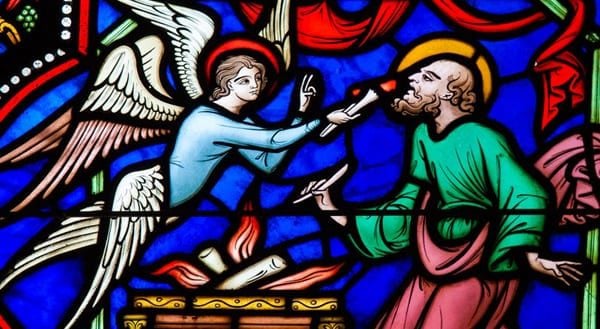
Isaiah 6:1-13 The Nonexistent God Who Empties Us
This is a difficult passage! So difficult, in fact, that the lectionary allows for skipping over the scary section in verses 9-13, where God sends the prophet to say to the people, “Keep listening, but do not comprehend; keep looking, but do not understand…” God will dull the mind and stop the ears and shut the eyes of the people lest they turn and be healed. What kind of God would do this?
To figure out exactly what kind of God, in fact, does this, we start at the beginning, with verses 1-8. Throughout Isaiah, a new understanding of God is coming to light. Scripture, in fact, shows a trajectory of the people’s understanding of God away from the idea of “gods;” much of the Bible works within a polytheistic understanding of the nature of divinity. Fr. James Alison, Girardian priest and author of many eye-opening works including the Jesus the Forgiving Victim series and the CD The Shape of God’s Affection, helps us understand that Isaiah is giving a new shape to the very concept of God. It is not simply that there is one God and not many; it is that God – unlike previous concepts of gods – is unlike anything in existence. Thomas Aquinas says “God is not part of the species of existence.” Does this mean God doesn’t exist?
Not in the sense that you and I do, and not in the sense that any other god was thought to exist. We take up space; we occupy area that no one else can fill, and thus, we may get into rivalries with each other over space… or whatever resources we may need to continue in our existence… or whatever desires we may have for the things that give our existence meaning, whether they be physical objects, status, power… whatever. Gods were thought to be those who took up space… massive amounts of space… physical space, mental space, emotional space… and thereby displace others. “Gods” are the things in our lives to which we would give ourselves over, whether that be selling ourselves for wealth or positions of prestige, etc. And, when our lives revolve around these gods, the gods that acquire at the expense of others, then we, too, will displace people for our own sake. Everything in existence is in a potential position for rivalry, displacement, domination over something else.
God is beyond all of this.
God is beyond all rivalry and competition.
God fills the whole world, the whole of everything, but displaces no one.
The images in Isaiah’s vision show the Lord sitting on the throne, and the hem of his garment fills the whole temple. God’s glory fills the earth. There is an abundance that permeates all and fills and surrounds everything without pushing anything aside. In God there is no over and against, but rather all in all.
And with this sense of God, and this contrast to the idolatrous “gods” that have ruled over human existence from the beginning, we begin to see what God is sending the prophet to do.
“Go and say to this people: ‘Keep listening, but do not comprehend; keep looking, but do not understand.’ Make the mind of this people dull, and stop their ears, and shut their eyes, so that they may not look with their eyes, and listen with their ears, and comprehend with their minds, and turn and be healed.”
We need a complete re-orientation of our understanding of God. Because we have been living according to false gods of conquest and marginalization, false gods of taking space and pushing people aside, false-gods of me-against-you.
The prophet realizes that he is a man of unclean lips living amongst a people of unclean lips. He is not an intentional liar – he is someone who has lived a lie and been submerged in a culture of a lie. This lie is a lie of human sacrifice, a lie that has evolved from literal collective violence over and against a person or group to the social, political, religious and economic violence that exploits, displaces, and continues to kill some for the profit, comfort, and sense of worth of others.
How do we live according to this lie? Isn’t the foundation of the United States the displacement and exploitation of others, genocide and slavery? And now, our national sense of self-worth is bound up in the notion that we are good, noble people who fight wars for humanitarian reasons – for democracy, for freedom – even as a few enrich themselves through the bloodshed and exploitation of others and many more feed off the lie of exceptionalism. The land of the free is the home of the most prisoners on earth and a military footprint stomping out life around the world. This is living according to a lie.
And what would it take to change? The full, brilliant truth would blow our minds and render us dumb. Some of us are just beginning to come to terms with the damage of racism and sexism and homophobia and the exploitation, abuse, and dehumanization of migrants. I hope, soon, we will come to see the interconnection of these injustices with the injustices of war and conquest and exploitation around the world. I hope that we will be able to see through the mask of “humanitarianism” to the human toll of death and destruction and physical, psychological, and environmental damage taking place because we believe ourselves to be good, we believe ourselves to be “helping.”
But isn’t this – the justification of war in the name of humanitarianism – the danger of turning to be healed too soon? It used to be that no one cared about victims – that conquerors were the “good guys” by virtue of being winners. Now, we see more clearly the innocence of victims around the world – so why do we keep creating victims? I think we still live according to a justice of retribution and punishment – a sort of justice that takes on violence with violence, that responds to pain inflicted by inflicting more pain – for the sake of the victims. I think this is why God says, in a sense, “burn it all down.”
The emptying in verses 9-13 is an emptying of all of our notions of living over and against others, and moreover, an emptying of our understanding of how justice is created. Violence for violence, punishment that renders more people victims… our hearts and minds and societies need to be wiped utterly clean of these lies. At the very heart of it all is our understanding of God. If we live according to gods who conquer and displace, we will conquer and displace. If we live according to gods who tell us to live according to vengeance – even if we understand in part (caring for victims) – we will continue to destroy, and we will bolster ourselves in our destruction with a false sense of righteousness. Everything must change. God must utterly empty us.
Luke 5:1-11 The Living God Who Fills Us
But the good news is that God won’t leave us empty! The parallels between Isaiah and the Gospel of Luke are striking, but they ultimately draw a sharp contrast in the end, a contrast between emptiness and fulfillment. The former must precede the latter, but fulfillment in God is our ultimate destiny.
In both texts, there are those whom God calls. In both texts, the people feel utterly unworthy. And in both texts, the people, despite their insecurities, unhesitatingly follow. Do they know what they are getting themselves into?
Fishermen were among the marginalized of society. Pushed out onto the sea, the symbol of chaos and uncertainty, they were unable to make a living on land, which represents stability and order. Fishermen stank. They were not among the learned, and they were far from the religious elite. They were poor, and deservedly so by the standards of their time, because poverty and marginalization and disease were punishment for sin according to the gods of over-and-against.
These are the people Jesus calls. They express their unworthiness, and Jesus says, “Exactly. I want you because you are not among the “worthy.” Your worth has nothing to do with the standards of the world that have pushed you aside.”
In other words, they were already among the empty, or close to empty. They were not as saturated in the false notions of false gods as those who lived at the expense of others (often unconsciously). By calling the fishermen, Jesus is already subverting our understandings of God.
Jesus blesses the fishermen with the catch of their lives… so far. There is such an abundance of fish that their nets nearly burst and the boat nearly sinks. But then, Jesus tells them to follow, and they leave everything behind to do so. They won’t be selling these fish to enrich themselves; they won’t be gloating in their success.
It’s worth noticing how hard that would be to do. If we were to receive great wealth, especially in the midst of poverty, we would want to use it to better our lives. There is nothing necessarily wrong with this; it is not selfish to want necessities and to acquire them when you become able to do so. But think about it. If we received blessings, we might attribute them to God. But would we then perceive a calling to give them up to follow God? Would we risk becoming poor again to be in solidarity with the poor, which is where God always is?
I don’t know if the disciples fully comprehend this, but they understand enough to drop their nets, leave the boats and follow Jesus.
But it is worth wondering if they knew what Jesus meant by “catching people.” This phrase has an ominous ring to it. Did they think they were going to catch people for judgment, for vengeance? They are living under occupation, and they will later ask to sit in power alongside Jesus. They see him as the promised Messiah, but do they understand him as a conqueror who will pull up Israel by pulling down Rome?
Perhaps vengeance is what they are expecting, but Jesus will show them otherwise. They are disciples – students – with much to learn, and the learning is in the following itself. As they go to bring in the marginalized, embrace the sick, feed the hungry, comfort the afflicted… they will learn that “catching people” means catching all of humanity up in a new, wonderful, abundant life. It is a life in which we will know ourselves not over and against others, but with each-other. It is a life where we will discover how much more we can be when we make space for the full potential of our neighbors to flourish. It is a life that rejects enmity, embraces the spark of God’s love within every human being, and nurtures that love to create a world which we can now barely imagine.
The fishermen who become Jesus’s disciples may not understand all this. 2000 years later, we barely understand it. But the fishermen understand enough to leave their catch behind because they know that the fish are not the point; they are merely the sign pointing to the bigger picture: Jesus. And Jesus is the embodiment of a bigger God – a God beyond rivalry and competition, beyond systems of marginalization and displacement. Beyond all we could wish for ourselves which would set us apart from others, beyond all material blessings or answered prayers for wealth or status or power, God calls us to something more – a new life in which we are all caught up in everlasting love.

Browse Our Archives
Select a Category Atonement and Current Events Curriculum Faith and Families Interviews Jesus the Forgiving Victim Lent Montessori politics Reviews The Bible Explained Uncategorized Valentine's Day Wednesday Sermon Who is God?
Select a Month July 2020 November 2019 October 2019 September 2019 August 2019 July 2019 June 2019 May 2019 April 2019 March 2019 February 2019 January 2019 December 2018 November 2018 October 2018 September 2018 August 2018 July 2018 June 2018 May 2018 April 2018 March 2018 February 2018 January 2018 December 2017 November 2017 October 2017 September 2017 August 2017 July 2017 June 2017 May 2017 April 2017 March 2017 February 2017 January 2017 December 2016 November 2016 October 2016 September 2016 August 2016 June 2016 May 2016 April 2016 March 2016 February 2016 January 2016 December 2015 November 2015 October 2015 September 2015 August 2015 July 2015 June 2015 May 2015 April 2015 March 2015 February 2015 January 2015 December 2014 November 2014 October 2014 September 2014 August 2014 July 2014 June 2014 May 2014 April 2014 March 2014 January 2014 December 2013 September 2013 August 2013 July 2013
Follow Us!
TAKE THE
Religious Wisdom Quiz
Who pleaded with Joseph for Benjamin's release?
Select your answer to see how you score.
Reuben Judah Naphtali Levi
Related posts from Teaching Nonviolent Atonement

Forgiveness in the Time of COVID-19 by Julia...

Reflections on Indigenous Wisdom For Healing A Wounded...

How Forgiveness Can Transform Our Violence and Build...

Jesus Unmasked: God's Economy and How to Cheat...
TRENDING AT PATHEOS Progressive Christian

What Being a Modern-Day Apostle Means to Me
In my last column, I discussed the ins and outs of modern-day...

Did Ancient China Once Worship the God of...
Across human history, a common thread weaves through the origins of the...

Love Your Neighbor – Including Earth-Kin: Lev. 19,...
God’s command to love your neighbor means acting in an ethical and...

Lead a Church Study of “Jesus and Lao...
Guest writer Jack Thomas (The Irreverent Reverend) reflects on leading his church...

Pastoral Wisdom for Responding to Sermon Pushback
Getting sermon pushback on your social justice sermon? Learn practical, Proverbs-based strategies...

Principles for Understanding the Apostolic Ministry Today
Whenever people discover that my formal ministry title is "apostle," as in...
view all Progressive Christian blogs
Ad-Free & Subscriber Log-In Subscription Support
- About Us
- 2026 Calendar
- Videos
- Podcasts
- Library of World Religions
- Faith In Media Tracker
- Advertise With Us
- Write for Us
- Privacy Policy
- Terms of Service
- Do Not Sell My Data
- Contact Us
- Radiant Digital
- Manage Newsletter Subscriptions
- Unsubscribe From Notifications
- Sitemap
Copyright 2008-2026, Patheos. All rights reserved.
Subscription Support Ad-Free & Subscriber Log-In
Follow Patheos