
BuddhistCatholicContemplativeEvangelicalGeneral ChristianHinduJewishLatter-day SaintMuslimNew VisionsProgressive Christian
Beliefs
- Buddhist
- Catholic
- Contemplative
- Evangelical
- General Christian
- Hindu
- Jewish
- Latter-day Saint
- More Voices
- Muslim
- New Visions
- Pagan
- Progressive Christian
Topics
- Religion News
- Food and Religion
- Sports and Religion
- Religious Art
- Religious Music and Entertainment
- Religious Events
- History and Religion
- Style and Religion
- Politics and Religion
- Women in Religion
- Recreation Outdoors and Religion
- Business Finance and Religion
- Careers Workplace and Religion
- Education and Religion
- Family Parenting and Religion
- Health Fitness and Religion
- Home and Religion
- Relationships and Religion
- Technology and Religion
- Travel and Religion
Columnists
- Buddhist Columnists
- Business Finance and Religion Columnists
- Careers Workplace and Religion Columnists
- Catholic Columnists
- Contemplative Columnists
- Education and Religion Columnists
- Evangelists Columnists
- Family Parenting and Religion Columnists
- General Christian Columnists
- Health Fitness and Religion Columnists
- Hindu Columnists
- History and Religion Columnists
- Home and Religion Columnists
- Jewish Columnists
- More Voices Columnists
- Latter Day Columnists
- Muslim Columnists
- New Visions Columnists
- Nonreligious Columnists
- Pagan Columnists
- Politics and Religion Columnists
- Progressive Columnists
- Recreation Outdoors and Religion Columnists
- Relationships and Religion Columnists
- Religion News Columnists
- Religious Art Columnists
- Religious Events Columnists
- Religious Music and Entertainment Columnists
- Sports and Religion Columnists
- Style and Religion Columnists
- Technology and Religion Columnists
- Travel and Religion Columnists
- Women in Religion Columnists
Resource Library
- 2026 Calendar
- Library of World Religions
- The 100 Most Holy Places on Earth
- Patheos Answers
- Podcasts
- Videos
- Faith Leaders Database
- Anglican Episcopalian
- Bahai
- Baptist
- Buddhism
- Christianity
- Confucianism
- Eastern Orthodoxy
- Hinduism
- Holiness and Pentecostal
- ISKCON
- Islam
- Judaism
- Lutheran
- Methodist
- The Church of Jesus Christ of Latter-day Saints
- New Age
- Paganism
- Presbytarian and Reformed
- Protestantism
- Religion Behind the Scenes
- Roman Catholic
- Scientology
- Shia Islam
- Sikhism
- Sufism
- Sunni Islam
- Taoism
- Zen
- See all religions
Research Tools
 Ad-Free & Subscriber Log-In Subscription Support
Ad-Free & Subscriber Log-In Subscription Support
Follow Patheos 

- Trending:
- Forgiveness
- |
- Marriage
- |
- Consciousness
- |
- Death Penalty
- |
- Election
- |
- Halloween
 Teaching Nonviolent Atonement
- Home
- Progressive Christian
- Girardian Reflection on the Lectionary: The Baptism of Jesus: Deconstructing the Fires of Hell
Girardian Reflection on the Lectionary: The Baptism of Jesus: Deconstructing the Fires of Hell
Last updated on: January 11, 2019 at 12:13 pm by Adam Ericksen
Girardian Reflection on the Lectionary: The Baptism of Jesus: Deconstructing the Fires of Hell 2019-01-11T12:13:18-05:00 Adam Ericksen
Patheos Explore the world's faith through different perspectives on religion and spirituality! Patheos has the views of the prevalent religions and spiritualities of the world.
Happy 2019! Are you feeling hopeful?
Adam is feeling hopefully because more people are calling out political fear mongering. Even Fox News’ Chris Wallace and Shepherd Smith are challenging fear based “statistics” that are used to scapegoat immigrants!
Lindsey is feeling hopeful because of new people in congress, especially the women and refugees. There is a new generation of people who have not traditional occupied places of power coming in and bringing with them the perspective of people who have not traditionally occupied places of power.
But Adam and Lindsey find even more hope in the Biblical text!
Show Notes
Isaiah 43:1-7 – Who demands sacrifice?
Our first passage is from Isaiah 43:1-7. This passage is from what’s known as Second Isaiah, who wrote during the Babylonian Exile. The Babylonians conquered the nation of Judah and sent many of the people throughout their empire.
Isaiah gave words of hope during this time of horror. Isaiah says that when you walk through the waters and through the fire, God will be with you and you will not drown and you won’t get burned.
As Paul Nuechterlein states on his website “The Girardian Reflections on the Lectionary,” water and fire were used to sacrifice people. People were drowned in water or forced to walk through fire as a sacrifice to the gods. This passage is an anti-sacrificial text. It is not God who demands death through sacrifice. Humans are the ones who sacrifice on another. God is on the side of the victim because God is with the victim, not the victimizers.
But God does say that God will give Ethiopia, Egypt, and Seba in exchange for the people. Does God sacrifice the enemies of Judah in order for Judah to survive? There’s another way to interpret this passage. Those in exile became contributing members of their societies. There is some debate about this, but it’s possible that some of those in exile were slaves. Either way, when the people went back to Judah, it changed the economy of Ethiopia, Egypt, and Seba. It was painful in the short term for those nations. So, in a sense, whenever God works to change an economic system for the benefit of the marginalized, those who are better off don’t tend to like it.
Luke 3:15-22 – The Waters of Baptism Extinguish the Fires of Hell
The lectionary takes out verses 18-20. We think this is a bad idea! Leave those two verses in there. Why? Because Luke emphasizes the politics of the Gospel. Jesus came during a certain political moment – when Herod was king. Luke juxtaposes the Empire of Rome, and the Kingdom of Herod, with the Kingdom of Heaven. Luke is political – he names names. And what does the Kingdom of Herod do to political enemies? It locks them up! Luke wants us to know this because politics matters to Luke, so don’t take that out!
People wondered if John the Baptist was the Messiah. All of the Gospels are clear that John was not the Messiah, but that Jesus was the Messiah. That’s because this was a debate – and did you know that there are still people who follow John the Baptist over Jesus? Their religion is called Mandaeism.
John the Baptist says that one who is more powerful than he is will come and baptize with fire. He will separate the wheat from the chaff and “the chaff he will burn with unquenchable fire”!!!!
Ouch. Does your mind go straight to the fires of hell? Hold on a minute. That’s not with this is about. For the most part, fire in the Bible is not about punishment. It’s about purificiation. The wheat and the chaff were once one element. Jesus separates the wheat from the chaff in all of us, and the chaff he will burn away. Isaiah said cultures would change and that change would be painful. The same is true when we change and our chaff is burned away. That’s what this fire language is about – not hell. But, could the fires of hell also be a purifying agent? Paul says in 1 Cor 3:15 that “If any man’s work is burned up, he will suffer loss, though he himself will be saved, but only as through fire.” Fire burns, but it is meant to purify, not punish.
Could one say that the water of baptism extinguish the fires of hell?
When Jesus was baptized, the spirit in the form of a dove comes upon him. Interestingly, the symbol of the Roman Empire was a fierce eagle – a bird of prey. The early Christians had a different symbol, a peaceful dove. These symbols were apt metaphors for both entities.
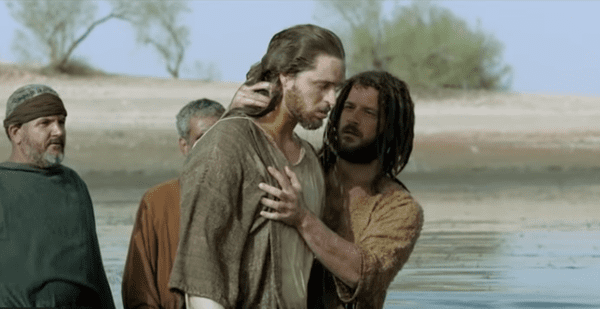
For example, Caesar and Herod both through the way to peace was through violence. Herod killed his political enemies in many ways, including by drowning his brother in law in water. Isaiah spoke out against this form of sacrifice 500 years earlier. And now Jesus is held under water by John the Baptist to be lifted out of it and into new life. Jesus heard the voice of God confirm what was always true about Jesus – that he is the Son of God.
And in a sense, that’s what baptism is for us too. It’s a sign of what’s always already true – no matter what the Herods or Caesars of this world say, what God says who you are. And you are a beloved child of God.
Stay in the loop! Like Teaching Nonviolent Atonement on Facebook!
Previous Post

January 9, 2019
Be Not Afraid: Advice from Africa’s Peace Movement
Browse Our Archives
Select a Category Atonement and Current Events Curriculum Faith and Families Interviews Jesus the Forgiving Victim Lent Montessori politics Reviews The Bible Explained Uncategorized Valentine's Day Wednesday Sermon Who is God?
Select a Month July 2020 November 2019 October 2019 September 2019 August 2019 July 2019 June 2019 May 2019 April 2019 March 2019 February 2019 January 2019 December 2018 November 2018 October 2018 September 2018 August 2018 July 2018 June 2018 May 2018 April 2018 March 2018 February 2018 January 2018 December 2017 November 2017 October 2017 September 2017 August 2017 July 2017 June 2017 May 2017 April 2017 March 2017 February 2017 January 2017 December 2016 November 2016 October 2016 September 2016 August 2016 June 2016 May 2016 April 2016 March 2016 February 2016 January 2016 December 2015 November 2015 October 2015 September 2015 August 2015 July 2015 June 2015 May 2015 April 2015 March 2015 February 2015 January 2015 December 2014 November 2014 October 2014 September 2014 August 2014 July 2014 June 2014 May 2014 April 2014 March 2014 January 2014 December 2013 September 2013 August 2013 July 2013
Follow Us!
TAKE THE
Religious Wisdom Quiz
The sun and moon stood still at my command so Israel could defeat their enemies. Who am I?
Select your answer to see how you score.
Moses Gideon Caleb Joshua
Related posts from Teaching Nonviolent Atonement

Forgiveness in the Time of COVID-19 by Julia...

Reflections on Indigenous Wisdom For Healing A Wounded...

How Forgiveness Can Transform Our Violence and Build...

Jesus Unmasked: God's Economy and How to Cheat...
TRENDING AT PATHEOS Progressive Christian

Why Christians Have a Sacred Duty to Vote:...
The Bible offers strong support for the sacred duty to vote. Here...

What Being a Modern-Day Apostle Means to Me
In my last column, I discussed the ins and outs of modern-day...

Did Ancient China Once Worship the God of...
Across human history, a common thread weaves through the origins of the...

Love Your Neighbor – Including Earth-Kin: Lev. 19,...
God’s command to love your neighbor means acting in an ethical and...

Lead a Church Study of “Jesus and Lao...
Guest writer Jack Thomas (The Irreverent Reverend) reflects on leading his church...

Principles for Understanding the Apostolic Ministry Today
Whenever people discover that my formal ministry title is "apostle," as in...
view all Progressive Christian blogs
Ad-Free & Subscriber Log-In Subscription Support
- About Us
- 2026 Calendar
- Videos
- Podcasts
- Library of World Religions
- Faith In Media Tracker
- Advertise With Us
- Write for Us
- Privacy Policy
- Terms of Service
- Do Not Sell My Data
- Contact Us
- Radiant Digital
- Manage Newsletter Subscriptions
- Unsubscribe From Notifications
- Sitemap
Copyright 2008-2026, Patheos. All rights reserved.
Subscription Support Ad-Free & Subscriber Log-In
Follow Patheos