
BuddhistCatholicContemplativeEvangelicalGeneral ChristianHinduJewishLatter-day SaintMuslimNew VisionsProgressive Christian
Beliefs
- Buddhist
- Catholic
- Contemplative
- Evangelical
- General Christian
- Hindu
- Jewish
- Latter-day Saint
- More Voices
- Muslim
- New Visions
- Pagan
- Progressive Christian
Topics
- Religion News
- Food and Religion
- Sports and Religion
- Religious Art
- Religious Music and Entertainment
- Religious Events
- History and Religion
- Style and Religion
- Politics and Religion
- Women in Religion
- Recreation Outdoors and Religion
- Business Finance and Religion
- Careers Workplace and Religion
- Education and Religion
- Family Parenting and Religion
- Health Fitness and Religion
- Home and Religion
- Relationships and Religion
- Technology and Religion
- Travel and Religion
Columnists
- Buddhist Columnists
- Business Finance and Religion Columnists
- Careers Workplace and Religion Columnists
- Catholic Columnists
- Contemplative Columnists
- Education and Religion Columnists
- Evangelists Columnists
- Family Parenting and Religion Columnists
- General Christian Columnists
- Health Fitness and Religion Columnists
- Hindu Columnists
- History and Religion Columnists
- Home and Religion Columnists
- Jewish Columnists
- More Voices Columnists
- Latter Day Columnists
- Muslim Columnists
- New Visions Columnists
- Nonreligious Columnists
- Pagan Columnists
- Politics and Religion Columnists
- Progressive Columnists
- Recreation Outdoors and Religion Columnists
- Relationships and Religion Columnists
- Religion News Columnists
- Religious Art Columnists
- Religious Events Columnists
- Religious Music and Entertainment Columnists
- Sports and Religion Columnists
- Style and Religion Columnists
- Technology and Religion Columnists
- Travel and Religion Columnists
- Women in Religion Columnists
Resource Library
- 2026 Calendar
- Library of World Religions
- The 100 Most Holy Places on Earth
- Patheos Answers
- Podcasts
- Videos
- Faith Leaders Database
- Anglican Episcopalian
- Bahai
- Baptist
- Buddhism
- Christianity
- Confucianism
- Eastern Orthodoxy
- Hinduism
- Holiness and Pentecostal
- ISKCON
- Islam
- Judaism
- Lutheran
- Methodist
- The Church of Jesus Christ of Latter-day Saints
- New Age
- Paganism
- Presbytarian and Reformed
- Protestantism
- Religion Behind the Scenes
- Roman Catholic
- Scientology
- Shia Islam
- Sikhism
- Sufism
- Sunni Islam
- Taoism
- Zen
- See all religions
Research Tools
 Ad-Free & Subscriber Log-In Subscription Support
Ad-Free & Subscriber Log-In Subscription Support
Follow Patheos 

- Trending:
- Forgiveness
- |
- Marriage
- |
- Consciousness
- |
- Death Penalty
- |
- Election
- |
- Halloween
 Teaching Nonviolent Atonement
- Home
- Progressive Christian
- The Provocation of Love and the Four Horsemen of the Apocalypse
The Provocation of Love and the Four Horsemen of the Apocalypse
Last updated on: December 19, 2018 at 8:26 pm by Adam Ericksen
The Provocation of Love and the Four Horsemen of the Apocalypse 2018-12-19T20:26:52-05:00 Adam Ericksen
Patheos Explore the world's faith through different perspectives on religion and spirituality! Patheos has the views of the prevalent religions and spiritualities of the world.
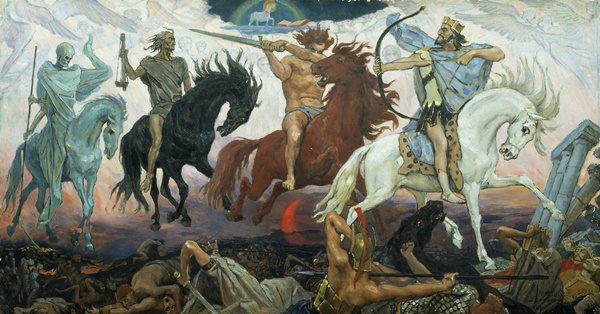
The Book of Revelation is weird. And it can be really scary. Let’s start with that. Many Christians throughout history have criticized Revelation. Martin Luther once said he thought it was “neither apostolic nor prophetic” because “Christ is neither taught nor known in it.” I think it’s weird and has scary images, but I disagree with brother Martin. Here’s why – In chapters 5 and 6, John has a vision of the heavenly throne room. There is a scroll with seven seals. The seals are locked and no one has the key to unlock them. And the key unlocks the way to understand the passage. But then the Lamb of God who was slain comes into the room with the keys. The Lamb unlocks the seals and everyone rejoices! w00t w00t! The Lamb is the winner! What a hero! Except when the Lamb unlocks the seals and opens the scrolls, something really scary happens. A voice from the mysterious living creatures in God’s throne room says, “Come.” And out of the scrolls emerge the Four Horse men of the Apocalypse. The Horsemen bring with them conquest, war, famine, and the plague of death. If you are like me, you think this is getting a little weird and you might be asking a few questions. Like, why would Jesus, the Lamb of God who was slain, unlock a scroll that brings forth the Big Scary Four Horsemen of the Apocalypse? After all, they bring all the horrible things that people do to one another. Shouldn’t Jesus have kept the four Horsemen locked up? And why woulda voice from Heaven call them out to unleash destruction? It’s weird stuff. Revelation doesn’t explicitly answer these questions, but I think looking at the life of Jesus gives us clues. In fact, Jesus is the key that unlocks the mystery behind Revelation. Here’s what we know about the life of Jesus: His radical love provoked a violent response, as it continues to do today for anyone who challenges the status quote. The key to life that Jesus teaches is love. What are the most important commandments? Love God and love your neighbor. In fact, for Jesus, all of the commandments boil down to love. This isn’t a passive love. It’s active. It forgives. It heals. It feeds the hungry. And it flips over the tables of the status quo. But we also know that in some sense, Jesus didn’t come to bring peace, but a sword. This was not a literal sword. Jesus said the Gospel was like a sword that would split families apart. Why? Because the love of Jesus subverts the political, economic, and religious status quo. And like the Four Horsemen of the Apocalypse, the status quo always fights back. That can be pretty scary. The status quo is scapegoating. That’s the primary sin Jesus came to save us from. Since the beginning of human history, we have created a sense of peace among ourselves by uniting against a common enemy. Notice that the real problem is that we have conflict among us. That conflict needs an outlet, otherwise we risk destroying ourselves. The outlet comes in the form of uniting against a scapegoat. If we don’t find a scapegoat, we could destroy ourselves. The scapegoating pattern essentially looks like this: We know *we* are good and right because we know *they* are bad and evil. If we just got rid of *them,* then *we* would have peace. The scapegoating pattern is a lie. It never leads to true or lasting peace. It only leads to a cycle that creates more enemies. But it has always been our crutch for creating “peace.” Whenever we have conflicts within our group, our default is to unite against a common enemy. Jesus took that crutch away from us when he gave us the key to life. Which is love. If you are like me, you would rather use the crutch of scapegoating. It’s easier. And unfortunately, it can still “work” as an outlet for our conflicts. When Jesus challenged the system of scapegoating with love, he provoked and unleashed the scapegoating mechanism against himself. Jesus unraveled the scapegoating mechanism by challenging the status quo and the status quo fought against him. While scapegoating never leads to true peace, it does “work” to alleviate the conflicts within a group. The blood of our victim washes away our conflicts. That’s the whole point of sacrifice. But Jesus takes the sacrificial crutch away from us with the key of love. Which takes us back to the Four Horsemen of the Apocalypse. The Four Horsemen are metaphors of the status quo of scapegoating violence that Jesus challenged with the key of nonviolent love. Jesus took the sacrificial crutch away, but we keep grasping for it. We hobble along in our scapegoating as we stumble over one another with scapegoating in the form of racism, sexism, classism, and all other kinds of “isms.” We must learn to walk. We must learn how to deal with our underlying conflicts and anxieties in ways that don’t scapegoat. Jesus gave us practical advice – go directly to the person with whom you are in a conflict and talk with them. Work it out. Don’t gossip. And forgive70 times 7 times! Jesus provides the antidote to scapegoating, but he doesn’t promise peace. In fact, when you challenge the status quo, it could lead you to the cross. Here’s the point of Revelation: When you participate in the Gospel, it may not make things better. People might get provoked and turn against you because we all like our sacrificial crutches. Jesus warned us that fathers and sons might turn on one another. And indeed, like the early Christians, you might get persecuted. But as Jesus warns us that all of this might happen, he also invites us to hold on to the Gospel of love. When people turn against you, do not become resentful. Do not scapegoat the scapegoaters. Rather, continue to forgive. Continue to work for justice through nonviolence. And continue love. Because love is the key.
Image: The Four Horsemen of the Apocalypse by Vastnetov. Wikipedia. Public Domain.
four horsemen of the apocalypse

Browse Our Archives
Select a Category Atonement and Current Events Curriculum Faith and Families Interviews Jesus the Forgiving Victim Lent Montessori politics Reviews The Bible Explained Uncategorized Valentine's Day Wednesday Sermon Who is God?
Select a Month July 2020 November 2019 October 2019 September 2019 August 2019 July 2019 June 2019 May 2019 April 2019 March 2019 February 2019 January 2019 December 2018 November 2018 October 2018 September 2018 August 2018 July 2018 June 2018 May 2018 April 2018 March 2018 February 2018 January 2018 December 2017 November 2017 October 2017 September 2017 August 2017 July 2017 June 2017 May 2017 April 2017 March 2017 February 2017 January 2017 December 2016 November 2016 October 2016 September 2016 August 2016 June 2016 May 2016 April 2016 March 2016 February 2016 January 2016 December 2015 November 2015 October 2015 September 2015 August 2015 July 2015 June 2015 May 2015 April 2015 March 2015 February 2015 January 2015 December 2014 November 2014 October 2014 September 2014 August 2014 July 2014 June 2014 May 2014 April 2014 March 2014 January 2014 December 2013 September 2013 August 2013 July 2013
Follow Us!
TAKE THE
Religious Wisdom Quiz
Who was the wife of Isaac?
Select your answer to see how you score.
Leah Rachel Rebekah Sarah
Related posts from Teaching Nonviolent Atonement

Forgiveness in the Time of COVID-19 by Julia...

Reflections on Indigenous Wisdom For Healing A Wounded...

How Forgiveness Can Transform Our Violence and Build...

Jesus Unmasked: God's Economy and How to Cheat...
TRENDING AT PATHEOS Progressive Christian

What Being a Modern-Day Apostle Means to Me
In my last column, I discussed the ins and outs of modern-day...

Did Ancient China Once Worship the God of...
Across human history, a common thread weaves through the origins of the...

Love Your Neighbor – Including Earth-Kin: Lev. 19,...
God’s command to love your neighbor means acting in an ethical and...

Lead a Church Study of “Jesus and Lao...
Guest writer Jack Thomas (The Irreverent Reverend) reflects on leading his church...

Pastoral Wisdom for Responding to Sermon Pushback
Getting sermon pushback on your social justice sermon? Learn practical, Proverbs-based strategies...

Principles for Understanding the Apostolic Ministry Today
Whenever people discover that my formal ministry title is "apostle," as in...
view all Progressive Christian blogs
Ad-Free & Subscriber Log-In Subscription Support
- About Us
- 2026 Calendar
- Videos
- Podcasts
- Library of World Religions
- Faith In Media Tracker
- Advertise With Us
- Write for Us
- Privacy Policy
- Terms of Service
- Do Not Sell My Data
- Contact Us
- Radiant Digital
- Manage Newsletter Subscriptions
- Unsubscribe From Notifications
- Sitemap
Copyright 2008-2026, Patheos. All rights reserved.
Subscription Support Ad-Free & Subscriber Log-In
Follow Patheos