
BuddhistCatholicContemplativeEvangelicalGeneral ChristianHinduJewishLatter-day SaintMuslimNew VisionsProgressive Christian
Beliefs
- Buddhist
- Catholic
- Contemplative
- Evangelical
- General Christian
- Hindu
- Jewish
- Latter-day Saint
- More Voices
- Muslim
- New Visions
- Pagan
- Progressive Christian
Topics
- Religion News
- Food and Religion
- Sports and Religion
- Religious Art
- Religious Music and Entertainment
- Religious Events
- History and Religion
- Style and Religion
- Politics and Religion
- Women in Religion
- Recreation Outdoors and Religion
- Business Finance and Religion
- Careers Workplace and Religion
- Education and Religion
- Family Parenting and Religion
- Health Fitness and Religion
- Home and Religion
- Relationships and Religion
- Technology and Religion
- Travel and Religion
Columnists
- Buddhist Columnists
- Business Finance and Religion Columnists
- Careers Workplace and Religion Columnists
- Catholic Columnists
- Contemplative Columnists
- Education and Religion Columnists
- Evangelists Columnists
- Family Parenting and Religion Columnists
- General Christian Columnists
- Health Fitness and Religion Columnists
- Hindu Columnists
- History and Religion Columnists
- Home and Religion Columnists
- Jewish Columnists
- More Voices Columnists
- Latter Day Columnists
- Muslim Columnists
- New Visions Columnists
- Nonreligious Columnists
- Pagan Columnists
- Politics and Religion Columnists
- Progressive Columnists
- Recreation Outdoors and Religion Columnists
- Relationships and Religion Columnists
- Religion News Columnists
- Religious Art Columnists
- Religious Events Columnists
- Religious Music and Entertainment Columnists
- Sports and Religion Columnists
- Style and Religion Columnists
- Technology and Religion Columnists
- Travel and Religion Columnists
- Women in Religion Columnists
Resource Library
- 2026 Calendar
- Library of World Religions
- The 100 Most Holy Places on Earth
- Patheos Answers
- Podcasts
- Videos
- Faith Leaders Database
- Anglican Episcopalian
- Bahai
- Baptist
- Buddhism
- Christianity
- Confucianism
- Eastern Orthodoxy
- Hinduism
- Holiness and Pentecostal
- ISKCON
- Islam
- Judaism
- Lutheran
- Methodist
- The Church of Jesus Christ of Latter-day Saints
- New Age
- Paganism
- Presbytarian and Reformed
- Protestantism
- Religion Behind the Scenes
- Roman Catholic
- Scientology
- Shia Islam
- Sikhism
- Sufism
- Sunni Islam
- Taoism
- Zen
- See all religions
Research Tools
 Ad-Free & Subscriber Log-In Subscription Support
Ad-Free & Subscriber Log-In Subscription Support
Follow Patheos 

- Trending:
- Forgiveness
- |
- Marriage
- |
- Consciousness
- |
- Death Penalty
- |
- Election
- |
- Halloween
 Teaching Nonviolent Atonement
- Home
- Progressive Christian
- All Flesh Shall See Salvation – Advent as Political Protest
All Flesh Shall See Salvation – Advent as Political Protest
Last updated on: December 10, 2018 at 11:07 pm by Adam Ericksen
All Flesh Shall See Salvation – Advent as Political Protest 2018-12-10T23:07:49-05:00 Adam Ericksen
Patheos Explore the world's faith through different perspectives on religion and spirituality! Patheos has the views of the prevalent religions and spiritualities of the world.
The following is a sermon I preached at Clackamas United Church of Christ, near Portland, Oregon. You can read or watch the sermon below. The primary scripture text were Luke 3:1-6 and Exodus 2:23-25.
The second Sunday of Advent is when we light the Candle of Peace. And we follow Jesus, who is called the Prince of Peace.
But to be honest, the world is not at peace. It has never been at peace. Personally, I don’t feel at peace. In fact, I often feel overwhelmed by all the strife, violence, and political drama in our world.
And yet every Advent we continue to light this candle of peace. The world is in strife, so why do we do this? Because this light is a protest. In fact, every light of Advent is a protest against the way the world is. Things are messed up. Things are upside down. But Advent is here to tell us that all the strife, violence, and darkness in the world put together cannot extinguish the light of God.
And we see this in our passages today. During the next year, we will be looking at the Gospel of Luke. I love this Gospel because Luke is historical. He names names. And it’s easy for us to gloss over these names, but they are important, and we need to know why they are important. In our passage, Luke talks about the influential political and religious rulers of his day: Tiberius, the Emperor of Rome. Pontius Pilate, the Roman Governor of Judea. Herod, the ruler of the Jews in Galilee. Philip, the ruler of the Jews in Ituraea. He also names Caiaphas and Anas, the great high priests.
Why does Luke name these powerful rulers? Because throughout human history, there has been a basic principle that people have always believed. If you want to know where God is in the world, look to those with power. God, after all, is powerful, so must be with those in power, right?
Not according to the Biblical tradition. Luke drops all of these names and then he flips our expectations upside down. After he says these names, he claims that the word of God came to this really weird guy out in the desert.
Do you see how this story is a protest against the way people generally think about the divine? God didn’t show up in a palace or a temple, not in the political and religious elite. Instead, God showed up in the outskirts of the desert. In a man who had wild hair and ate locusts. The man’s name was John. He was a nobody, the son of a priest named Zechariah, who was a lowly nobody priest at the Temple.
This lowly nobody named John told the people who came to him to repent and to receive forgiveness of sins.
And here I want to say a few things about the word “repent.” For many of us, “repent” is a bad word because it feels moralistic. It’s as if God is like Santa Claus. God is looking over your shoulders. He knows when you are sleeping. He knows when you’re awake. He knows if you’ve been bad or good so be good for goodness sake!
Why do we sing that song? And to children?!? It’s so creepy…
Repentance might have something to do with saying you are sorry for something, but the word repent comes from the Greek word “Metanoia.” And metanoia literally means, “Change your heart” or “Change your mind.”
This passage asks us to have a metanoia about God. To change our hearts and minds. God is not like a creepy Santa Claus who looks over your shoulder and makes a list of good and bad people and checks it twice just to make sure. Nor is God is not primarily seen in the powerful rulers. God is seen in those on the margins. Those who are out in the desert.
Now, of course, God is everywhere in our world. But the Bible makes this point over and over again – if you want to find God, do not look primarily to those in power. Look, rather, to the powerless. Look to someone like John the Baptist, who gets sent to jail and beheaded by those in power. It’s in someone like that where you find God in the world. Do you see how this is a total mind flip of our expectations of God?
Take the fundamental story for our Jewish siblings – the Exodus. This story is also a protest against the way the world it. Those in ancient Egypt thought that God was primarily seen in the Pharaoh. In fact, the Pharaoh was thought to be the “Son of God.” If you wanted to know what God is like, look to the Pharaoh.
But the Pharaoh oppressed a group of ragtag nobodies called the Hebrews. The Hebrews were an enslaved people. Like almost every other group of slaves in world history, the Hebrews should have have been a forgotten blip in world history. But guess what? They cried out to God in their oppression and God heard their cry.
Why did God hear their cry? Because of the same principle that Luke tells us in our reading today. God is with those on the margins.
And here’s the thing that every government does with those on the margins – Governments dehumanize them. Pharaoh said that the few thousands of Hebrews were a growing radical threat to the Egyptian Empire. That of course, was a lie. But that didn’t matter. Pharaoh either intentionally lied about the Hebrews, or he was consumed by irrational fear. That debate didn’t really matter. What mattered was that the Egyptians united against the Hebrews by dehumanizing and oppressing them.
But God worked through Moses and the Hebrews to lead them on an Exodus from Egypt. God led them in a Caravan of a few thousand as they traveled through the desert to the promised land.
Because God does not work through powerful political leaders who oppress and spread fear through lies. Rather, God works through a small group of people looking for freedom and new life.
And now we come back to our New Testament passage. John says, Prepare the way for the Lord. Make his path straight and “all flesh shall see the salvation of God.”
Did you catch that? “All flesh shall see the salvation of God.” That all radical, all-inclusive statement is a massive protest against the way the world works. But even more, it’s a vision for a new reality that Jesus called the Kingdom of God.
How did the Egyptian Pharaoh seek salvation? For him, salvation wasn’t for “all flesh.” It was only for the Egyptians. And so they decided they needed to deal with whatever threat they claimed was in their way. So they oppressed and killed those they deemed a threat.
The Roman Empire did the same thing. Rome had a military propaganda slogan that went like this, “Peace through strength.” Of course, that means peace through military might. The Peace of Rome was not peace. It was war and oppression against a perceived enemy.
Another propaganda slogan that the Roman Empire was a claim about salvation. That propaganda went like this, “There is no other name under heaven that one can be saved except by that of Caesar.”
Of course, for the Roman empire and for Caesar, peace and salvation was not for “all flesh.” It was for Roman flesh. Peace and salvation for Rome came at the expense of those Rome labeled as enemies. And then Rome killed their enemies with the sword.
The early Christians protested this idea by hijacking the Roman propaganda statement by stating that “There is no other name under heaven that one can be saved except by that of Jesus Christ.”
The early Christians said that if you want to know what God is like, and what peace and salvation are like, don’t look to Caesar. In fact, don’t pay Caesar much attention at all. Look to the baby who was born in a manger. Look to the man who refused to fight violence with violence, but who lived a life of radical love, a love that embraced even his enemies. Look to the man who hung on the cross and prayed that those who put him there would be forgiven. Look to the man who resurrected not for revenge, but to offer peace and salvation not just to his friends, but to all flesh.
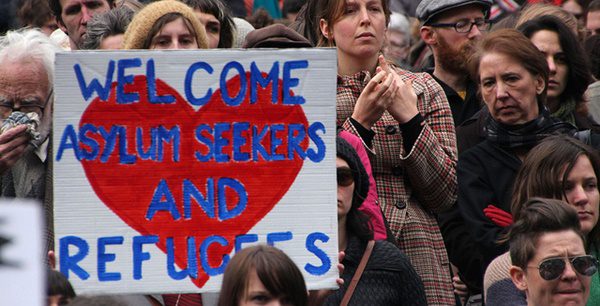
And so where do we find God today? If Luke wrote his Gospel today, he might write this, “In the second year of the Presidency of Donald Trump, when Jerry Brown was Governor of California, and Francis was the Pope, the word of God came to a ragtag group of refugees fleeing violence and persecution in their homeland. They came to the United States through the desert to fulfill the words of Isaiah, that the way of the Lord would be prepared and that all flesh, including the flesh of refugees, would see the salvation of God.”
All flesh shall see the salvation of God. You shall see salvation. I shall see salvation. The refugees coming from central America shall see salvation. Political rulers shall see salvation. Because all flesh shall see God’s salvation.
The point for us on a personal level and national level is to share the salvation of all flesh right now. Personally, I have hate, resentment, and violence inside of me. It threatens to diminish God’s light that is also inside of me. It does no good for me to deny that those things are there. Only when I’m honest about those things inside of me can I realize the light of God’s radical love for me and for all flesh.
On a national level, we are torn by hatred, resentment, and violence. God continues to love us, but we need to tell the truth about ourselves. Our past is full of dehumanizing and scapegoating others. So don’t believe the political propaganda that dehumanizes the oppressed and the refugees. Instead, let us believe in the message of the good news that true peace, true love, and true salvation is offered to you and to me and to refugees. And may we make the road smooth as we prepare the way of the Lord, so that all flesh can receive God’s peace, l0ove, and salvation. Amen.
Image: Flickr, Creative Commons License 2.0.
Stay in the loop! Like Teaching Nonviolent Atonement on Facebook!
Previous Post

December 7, 2018
“Preaching About Racism” with Carolyn Helsel – The RavenCast
Browse Our Archives
Select a Category Atonement and Current Events Curriculum Faith and Families Interviews Jesus the Forgiving Victim Lent Montessori politics Reviews The Bible Explained Uncategorized Valentine's Day Wednesday Sermon Who is God?
Select a Month July 2020 November 2019 October 2019 September 2019 August 2019 July 2019 June 2019 May 2019 April 2019 March 2019 February 2019 January 2019 December 2018 November 2018 October 2018 September 2018 August 2018 July 2018 June 2018 May 2018 April 2018 March 2018 February 2018 January 2018 December 2017 November 2017 October 2017 September 2017 August 2017 July 2017 June 2017 May 2017 April 2017 March 2017 February 2017 January 2017 December 2016 November 2016 October 2016 September 2016 August 2016 June 2016 May 2016 April 2016 March 2016 February 2016 January 2016 December 2015 November 2015 October 2015 September 2015 August 2015 July 2015 June 2015 May 2015 April 2015 March 2015 February 2015 January 2015 December 2014 November 2014 October 2014 September 2014 August 2014 July 2014 June 2014 May 2014 April 2014 March 2014 January 2014 December 2013 September 2013 August 2013 July 2013
Follow Us!
TAKE THE
Religious Wisdom Quiz
Who pleaded with Joseph for Benjamin's release?
Select your answer to see how you score.
Reuben Judah Naphtali Levi
Related posts from Teaching Nonviolent Atonement

Forgiveness in the Time of COVID-19 by Julia...

Reflections on Indigenous Wisdom For Healing A Wounded...

How Forgiveness Can Transform Our Violence and Build...

Jesus Unmasked: God's Economy and How to Cheat...
TRENDING AT PATHEOS Progressive Christian

What Being a Modern-Day Apostle Means to Me
In my last column, I discussed the ins and outs of modern-day...

Did Ancient China Once Worship the God of...
Across human history, a common thread weaves through the origins of the...

Love Your Neighbor – Including Earth-Kin: Lev. 19,...
God’s command to love your neighbor means acting in an ethical and...

Lead a Church Study of “Jesus and Lao...
Guest writer Jack Thomas (The Irreverent Reverend) reflects on leading his church...

Pastoral Wisdom for Responding to Sermon Pushback
Getting sermon pushback on your social justice sermon? Learn practical, Proverbs-based strategies...

Principles for Understanding the Apostolic Ministry Today
Whenever people discover that my formal ministry title is "apostle," as in...
view all Progressive Christian blogs
Ad-Free & Subscriber Log-In Subscription Support
- About Us
- 2026 Calendar
- Videos
- Podcasts
- Library of World Religions
- Faith In Media Tracker
- Advertise With Us
- Write for Us
- Privacy Policy
- Terms of Service
- Do Not Sell My Data
- Contact Us
- Radiant Digital
- Manage Newsletter Subscriptions
- Unsubscribe From Notifications
- Sitemap
Copyright 2008-2026, Patheos. All rights reserved.
Subscription Support Ad-Free & Subscriber Log-In
Follow Patheos