
BuddhistCatholicContemplativeEvangelicalGeneral ChristianHinduJewishLatter-day SaintMuslimNew VisionsProgressive Christian
Beliefs
- Buddhist
- Catholic
- Contemplative
- Evangelical
- General Christian
- Hindu
- Jewish
- Latter-day Saint
- More Voices
- Muslim
- New Visions
- Pagan
- Progressive Christian
Topics
- Religion News
- Food and Religion
- Sports and Religion
- Religious Art
- Religious Music and Entertainment
- Religious Events
- History and Religion
- Style and Religion
- Politics and Religion
- Women in Religion
- Recreation Outdoors and Religion
- Business Finance and Religion
- Careers Workplace and Religion
- Education and Religion
- Family Parenting and Religion
- Health Fitness and Religion
- Home and Religion
- Relationships and Religion
- Technology and Religion
- Travel and Religion
Columnists
- Buddhist Columnists
- Business Finance and Religion Columnists
- Careers Workplace and Religion Columnists
- Catholic Columnists
- Contemplative Columnists
- Education and Religion Columnists
- Evangelists Columnists
- Family Parenting and Religion Columnists
- General Christian Columnists
- Health Fitness and Religion Columnists
- Hindu Columnists
- History and Religion Columnists
- Home and Religion Columnists
- Jewish Columnists
- More Voices Columnists
- Latter Day Columnists
- Muslim Columnists
- New Visions Columnists
- Nonreligious Columnists
- Pagan Columnists
- Politics and Religion Columnists
- Progressive Columnists
- Recreation Outdoors and Religion Columnists
- Relationships and Religion Columnists
- Religion News Columnists
- Religious Art Columnists
- Religious Events Columnists
- Religious Music and Entertainment Columnists
- Sports and Religion Columnists
- Style and Religion Columnists
- Technology and Religion Columnists
- Travel and Religion Columnists
- Women in Religion Columnists
Resource Library
- 2026 Calendar
- Library of World Religions
- The 100 Most Holy Places on Earth
- Patheos Answers
- Podcasts
- Videos
- Faith Leaders Database
- Anglican Episcopalian
- Bahai
- Baptist
- Buddhism
- Christianity
- Confucianism
- Eastern Orthodoxy
- Hinduism
- Holiness and Pentecostal
- ISKCON
- Islam
- Judaism
- Lutheran
- Methodist
- The Church of Jesus Christ of Latter-day Saints
- New Age
- Paganism
- Presbytarian and Reformed
- Protestantism
- Religion Behind the Scenes
- Roman Catholic
- Scientology
- Shia Islam
- Sikhism
- Sufism
- Sunni Islam
- Taoism
- Zen
- See all religions
Research Tools
 Ad-Free & Subscriber Log-In Subscription Support
Ad-Free & Subscriber Log-In Subscription Support
Follow Patheos 

- Trending:
- Forgiveness
- |
- Marriage
- |
- Consciousness
- |
- Death Penalty
- |
- Election
- |
- Halloween
 Teaching Nonviolent Atonement
- Home
- Progressive Christian
- Sermon: Jesus Had a Political Agenda
Sermon: Jesus Had a Political Agenda
Last updated on: October 31, 2018 at 2:22 pm by Adam Ericksen
Sermon: Jesus Had a Political Agenda 2018-10-31T14:22:49-05:00 Adam Ericksen
Patheos Explore the world's faith through different perspectives on religion and spirituality! Patheos has the views of the prevalent religions and spiritualities of the world.
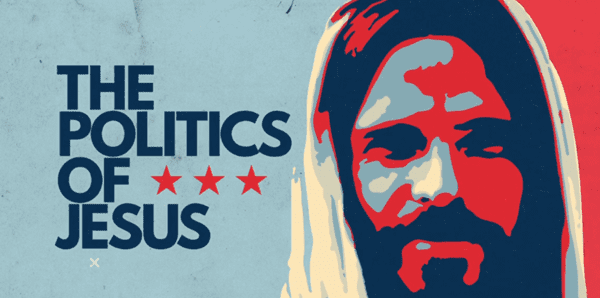
The following is a sermon I preached at Clackamas United Church of Christ, near Portland, Oregon. You can read or watch the sermon below. The scripture text was Mark 10:46-52.
Jesus had a clear political agenda.
As people who follow Jesus, I want to invite us to have the same political agenda that Jesus had.
Jesus called it the Kingdom of God. And Jesus boldly preached the Kingdom of God while he lived in the Kingdom of Herod. But Jesus didn’t just live in the Kingdom of Herod. Jesus preached the Kingdom of God while he lived in the Empire of Rome.
When Jesus used the phrase “Kingdom of God,” he used politically loaded language. From nearly the day he was born and the Magi went to King Herod and asked Herod where the King of the Jews was born, Jesus was on a collision course with the political leaders of his day.
Because if you are King Herod and you hear rumors of a new king coming into your kingdom, you are going to view that new king as a political threat.
Now there are some Christians who say that Jesus wasn’t political at all. They claim that Jesus was only concerned about the spiritual realm. And so Jesus left the physical realm, including politics, up to us.
The technical theological term for that argument is … malarkey. As in “that’s a load of malarkey.”
Every Sunday we pray the Lord’s prayer together. In that prayer, Jesus taught us to ask for God’s kingdom to come on earth as it is in heaven. Jesus was concerned with the earthly realm, the physical realm, just as much as he was concerned with the heavenly realm. In fact, in Jesus we find that the two realms are united.
Our passage this morning provides evidence that Jesus was concerned about our political realm. A blind man named Bartimaeus cried out to Jesus, using the title “Son of David.” Jesus has many titles in the New Testament, including: Son of Man, Messiah, King, Savior, Christ, Lord, and Son of David.
This leads to a question. What does the title “Son of David” mean? Well, this is one of the great gifts of Judaism. Jews have a profound sense of history. They constantly tell their ancient stories about how God was actively involved with their ancestors as they sought to bring more love and mercy and justice into the world.
In this way, Jews know the importance of remembering the people from their past. One important figure was a man named David. He was the greatest king in all of Israel. God promised David that his bloodline would be established in the kingdom of Israel forever. In other words, God promised that David would always have a son or a grandson or a great grandson … sitting on the throne of Israel’s kingdom.
Now, again, one of the titles the Gospels give to Jesus is “Son of David.”
Do you see how this is a politically loaded and subversive title?
Here’s the point for first century Jews – many of them were waiting for a new king to bring back the glory days of David. The king at the time was a man named Herod. Everyone knew that Herod was not a descendent in the line of David. In other words, he was not a “son of David.”
This matters because many first century Jews looked to someone from the line of David to become the new king. That’s why the Gospels emphasize Jesus as the “Son of David.” They were expecting him to step up as the new Messiah.
The title “Son of David” means there’s a new king in town. It means that Herod and his sons are not the rightful kings. It means there’s going to be a political subversion.
And the subversion happens in the most subversive way: through a nonviolent love that heals.
The blind man Bartimaeus was cast aside because of his blindness. Some in the ancient world thought blindness was caused because the blind person sinned. In other words, it was his own fault. And God’s justice meant that he got what he deserved.
But the man wasn’t just blind. He was a social outcast. He suffered a social death. Human cultures tend to have one thing in common. They tend to blame the victim. They tend to scapegoat those who are on the margins, those who are most vulnerable. These people make easy scapegoats. And so we project all kinds of blame for the problems of our community onto them.
I don’t know if you have noticed, but this is largely how politics works. We blame someone else, accusing them of being the problem, which conveniently makes it so that we are not the problem and we don’t have to take responsibility to make changes.
Why is it that those who are vulnerable and marginalized make the easiest scapegoats? Because they are usually ignored by good, well-meaning people. Like Bartimaeus, they are cast aside. This scapegoating creates a culture of social death where people are excluded, which leads to a culture of physical death because they are scapegoated and ignored. And so they make an easy scapegoat because nobody will rise up to defend them.
Until a man named Jesus showed up.
Bartimaeus cried out to Jesus and said, “Jesus, Son of David, have mercy on me!”
The crowd sternly ordered Bartimaeus to keep quiet. The crowd didn’t believe he was worthy of Jesus’ attention.
But Jesus thought Bartimaeus was worthy, so he called him forward.
This part of the story so important. Because when I’m in a crowd, I am highly influenced by it. I don’t want to go against the crowd. Some might say I’m weak minded or that I easily fall into group think, which is probably true. But crowds have tremendous power to influence us. As social creatures, we have a natural propensity to go with the crowd, and more often than not, we don’t even realize we are just going with the crowd! It just feels natural.
And it’s risky to go against the crowd. The crowd can easily turn against us if we start asking questions that challenge the crowd. We may turn into the crowd’s next scapegoat.
So, when Jesus looks to this man that the crowd has just scolded, he does something pretty amazing. Because Jesus lived so fully in the presence of God and not in the presence of the crowd, Jesus was able to see this man for who he was: a beloved child of God, worthy of healing and living in a community of love.
Jesus was the Son of David. He is what politics are meant to be. Politics is not meant to organize us around our scapegoats and blame. Politics is meant to provide healing to those most in need and it’s meant to find ways to invite the most vulnerable into a community based on love.
As you know, the applications for today are endless. We live a country where there are forces leading us further into a culture of death. Our Jewish siblings are under increasing threat these days, as seen in the tragic shooting yesterday at the Tree of Life Synagogue. White Supremacy is on the rise, as we saw in the fatal shooting of two black people at a Kroger store in Kentucky. But as we celebrate Dia de los Muertos today, I can’t help but think of those traveling the long road from Honduras through Mexico as they seek a better life in the United States.
These are some of the most vulnerable people in the world. They live in a country and a city that is often described as the murder capital of the world. The Honduran government, including the police and military, are corrupt and often bought off by drug dealers. In fact, drug dealers and gangs often work in tandem with the Honduran police. And these vulnerable people are the ones who suffer violence and death because of it. No wonder they want to escape.
Honduras has a culture of death and the United States actually funds it. The US has had economic interests in Honduras since the late 1800s. More recently, from Reagan to Obama and now to Trump, US policy has found the most benefit in supporting the political and economic elite of Honduras at the expense of the poor and marginalized. Joseph Nevins, an expert on the relationship between Honduras and US relations, states that Washington DC has a “longstanding willingness to overlook the corruption in Honduras as long as the country’s ruling elite serve what are defined as U.S. economic and geopolitical interests.”
I don’t bring this up to make us feel guilty as Americans. The world doesn’t need more people to feel guilty. The world needs more people to feel responsible. I bring it up because as a nation, we have a responsibility to these people escaping the political corruption and violence of Honduras that we either enable or ignore. But instead, we have politicians scapegoating them, striking fear among their followers as they label this already vulnerable group an army of invaders.
But here’s the Good News: the American people are too smart and compassionate to fall for those lies. Like Jesus defended the blind man, so Americans are rising up to defend the caravan.
I came across an interview from Fox News this last week. The host was interviewing a panel of independent voters. The interviewer asked, “What should the United States do if those 7,000 people, by the time it gets here it could be 10,000, it could be 20,000, what should the United States do about those people?” Do you see how the interviewer was trying to stoke fear? It could grow up to 10,000 or 20,000.
But the people being interviewed didn’t fall for the politics of fear. He responded, “This is the mightiest country on the planet. I think we can handle a caravan of people unarmed coming to this country.”
Can I get an Amen! This is the politics of Jesus. This is the politics of hope. This is the politics that transforms a culture of death and scapegoating into a culture of life and love. It says we don’t need to scapegoat vulnerable people like a blind man or a group of people on an exodus from violence and corruption in their homeland. Yes, there is a process for immigrants and refugees to enter the US, but like Jesus invited the blind man into his new realm, the US is mighty enough to invite a caravan of unarmed people into our realm.
My friends, Jesus was political. He was the Son of David. He preached the Kingdom of God. He sought to save us through love, radical embrace of others, and trusting that there is enough for everyone. And he invites us to follow him in working for a more just and merciful world.
May follow him today and forever more. Amen.
Image: Screenshot from Vimeo.
Stay in the loop! Like Teaching Nonviolent Atonement on Facebook!
We want to know what you think about the upcoming midterm elections. Vote in our poll below!
Next Post

November 2, 2018 The RavenCast - Politics and Apocalypse
Browse Our Archives
Select a Category Atonement and Current Events Curriculum Faith and Families Interviews Jesus the Forgiving Victim Lent Montessori politics Reviews The Bible Explained Uncategorized Valentine's Day Wednesday Sermon Who is God?
Select a Month July 2020 November 2019 October 2019 September 2019 August 2019 July 2019 June 2019 May 2019 April 2019 March 2019 February 2019 January 2019 December 2018 November 2018 October 2018 September 2018 August 2018 July 2018 June 2018 May 2018 April 2018 March 2018 February 2018 January 2018 December 2017 November 2017 October 2017 September 2017 August 2017 July 2017 June 2017 May 2017 April 2017 March 2017 February 2017 January 2017 December 2016 November 2016 October 2016 September 2016 August 2016 June 2016 May 2016 April 2016 March 2016 February 2016 January 2016 December 2015 November 2015 October 2015 September 2015 August 2015 July 2015 June 2015 May 2015 April 2015 March 2015 February 2015 January 2015 December 2014 November 2014 October 2014 September 2014 August 2014 July 2014 June 2014 May 2014 April 2014 March 2014 January 2014 December 2013 September 2013 August 2013 July 2013
Follow Us!
TAKE THE
Religious Wisdom Quiz
In what town did Jesus grow up?
Select your answer to see how you score.
Jerusalem Nazareth Jericho Bethlehem
Related posts from Teaching Nonviolent Atonement

Forgiveness in the Time of COVID-19 by Julia...

Reflections on Indigenous Wisdom For Healing A Wounded...

How Forgiveness Can Transform Our Violence and Build...

Jesus Unmasked: God's Economy and How to Cheat...
TRENDING AT PATHEOS Progressive Christian

What Being a Modern-Day Apostle Means to Me
In my last column, I discussed the ins and outs of modern-day...

Did Ancient China Once Worship the God of...
Across human history, a common thread weaves through the origins of the...

Love Your Neighbor – Including Earth-Kin: Lev. 19,...
God’s command to love your neighbor means acting in an ethical and...

Lead a Church Study of “Jesus and Lao...
Guest writer Jack Thomas (The Irreverent Reverend) reflects on leading his church...

Pastoral Wisdom for Responding to Sermon Pushback
Getting sermon pushback on your social justice sermon? Learn practical, Proverbs-based strategies...

Principles for Understanding the Apostolic Ministry Today
Whenever people discover that my formal ministry title is "apostle," as in...
view all Progressive Christian blogs
Ad-Free & Subscriber Log-In Subscription Support
- About Us
- 2026 Calendar
- Videos
- Podcasts
- Library of World Religions
- Faith In Media Tracker
- Advertise With Us
- Write for Us
- Privacy Policy
- Terms of Service
- Do Not Sell My Data
- Contact Us
- Radiant Digital
- Manage Newsletter Subscriptions
- Unsubscribe From Notifications
- Sitemap
Copyright 2008-2026, Patheos. All rights reserved.
Subscription Support Ad-Free & Subscriber Log-In
Follow Patheos