
BuddhistCatholicContemplativeEvangelicalGeneral ChristianHinduJewishLatter-day SaintMuslimNew VisionsProgressive Christian
Beliefs
- Buddhist
- Catholic
- Contemplative
- Evangelical
- General Christian
- Hindu
- Jewish
- Latter-day Saint
- More Voices
- Muslim
- New Visions
- Pagan
- Progressive Christian
Topics
- Religion News
- Food and Religion
- Sports and Religion
- Religious Art
- Religious Music and Entertainment
- Religious Events
- History and Religion
- Style and Religion
- Politics and Religion
- Women in Religion
- Recreation Outdoors and Religion
- Business Finance and Religion
- Careers Workplace and Religion
- Education and Religion
- Family Parenting and Religion
- Health Fitness and Religion
- Home and Religion
- Relationships and Religion
- Technology and Religion
- Travel and Religion
Columnists
- Buddhist Columnists
- Business Finance and Religion Columnists
- Careers Workplace and Religion Columnists
- Catholic Columnists
- Contemplative Columnists
- Education and Religion Columnists
- Evangelists Columnists
- Family Parenting and Religion Columnists
- General Christian Columnists
- Health Fitness and Religion Columnists
- Hindu Columnists
- History and Religion Columnists
- Home and Religion Columnists
- Jewish Columnists
- More Voices Columnists
- Latter Day Columnists
- Muslim Columnists
- New Visions Columnists
- Nonreligious Columnists
- Pagan Columnists
- Politics and Religion Columnists
- Progressive Columnists
- Recreation Outdoors and Religion Columnists
- Relationships and Religion Columnists
- Religion News Columnists
- Religious Art Columnists
- Religious Events Columnists
- Religious Music and Entertainment Columnists
- Sports and Religion Columnists
- Style and Religion Columnists
- Technology and Religion Columnists
- Travel and Religion Columnists
- Women in Religion Columnists
Resource Library
- 2026 Calendar
- Library of World Religions
- The 100 Most Holy Places on Earth
- Patheos Answers
- Podcasts
- Videos
- Faith Leaders Database
- Anglican Episcopalian
- Bahai
- Baptist
- Buddhism
- Christianity
- Confucianism
- Eastern Orthodoxy
- Hinduism
- Holiness and Pentecostal
- ISKCON
- Islam
- Judaism
- Lutheran
- Methodist
- The Church of Jesus Christ of Latter-day Saints
- New Age
- Paganism
- Presbytarian and Reformed
- Protestantism
- Religion Behind the Scenes
- Roman Catholic
- Scientology
- Shia Islam
- Sikhism
- Sufism
- Sunni Islam
- Taoism
- Zen
- See all religions
Research Tools
 Ad-Free & Subscriber Log-In Subscription Support
Ad-Free & Subscriber Log-In Subscription Support
Follow Patheos 

- Trending:
- Forgiveness
- |
- Marriage
- |
- Consciousness
- |
- Death Penalty
- |
- Election
- |
- Halloween
 Teaching Nonviolent Atonement
- Home
- Progressive Christian
- Jesus Knew Families Belong Together
Jesus Knew Families Belong Together
Last updated on: July 2, 2018 at 3:05 pm by Adam Ericksen
Jesus Knew Families Belong Together 2018-07-02T15:05:21-05:00 Adam Ericksen
Patheos Explore the world's faith through different perspectives on religion and spirituality! Patheos has the views of the prevalent religions and spiritualities of the world.
There’s a truth about being human that I would rather avoid. And that truth is that I’m vulnerable.
I pretty much hate this fact.
Maybe you would rather avoid this truth, too. But it’s true. I’m vulnerable. I’m vulnerable to being sick. For example, I just caught a summer cold and have an annoying tickle in my throat. I hate having a cold.
I’m vulnerable here with you. I’m here talking and as much as I think, “Okay, Adam, just preach the Good News and it’s going to be OK,” I can’t help but feel vulnerable. I can’t help but wonder if you are going to like what I’m about to say. I wonder if what I’m going to say is actually Good News. I’m vulnerable to this kind of self-doubt.
I’m vulnerable in my family. Yesterday morning I had a dream about one of my children. I left one of my sons in a room with some of my clergy colleagues in our conference. My colleagues said they would care for him as I left for the bathroom. When I came back they had him tied up in a chair with duct tape over his mouth. They were scolding him as I ran into that room. So I pushed them out of the way and held him in my arms. Now I trust my clergy colleagues, but the dream was about my vulnerability as a father with three vulnerable children, and a vulnerable wife.
People sometimes tell me to enjoy this time with my children because I’ll look back on it as the best time in my life. I often feel vulnerable to judgment about parenting because sometimes being a parent is really hard and I don’t enjoy it. And sometimes being a good son to my father is difficult. Sometimes being a good brother to my siblings can feel draining. And sometimes I feel totally inadequate as a husband.
And maybe you also feel vulnerable. There’s a cancer diagnosis. There’s divorce. There’s a loss of a job. There’s loss of a beloved spouse or friend.
And at this moment in our history, our nation feels vulnerable. The Supreme Court vacancy has left many of us with a lot of questions and anxieties, particularly surrounding advances made in women’s health and our beloved LGBTQ family members.
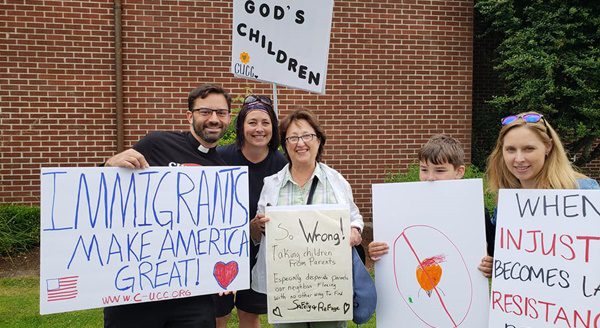
And in the back of our minds, as we celebrate the 4th of July this week, we know that children are some of the most vulnerable among us, as we’ve seen our own government separating children from their families and refusing to take responsibility to reunite those families.
So, maybe it’s true that we’re all vulnerable. But for some reason we would rather not admit this truth. I’d rather believe that I have it all together. And I’d rather you believe that I have it all together, too. I don’t want you to know my fears that at some point you will discover that I’m a fraud. That I preach love of neighbor and of enemies and the importance of forgiveness and treating people as I’d like to be treated, but so often I find myself failing and feeling like a total hypocrite.
I’m vulnerable to thinking I’m not enough. I’m not doing enough as a progressive pastor to fight for justice and inclusion in the world. I get a case of the shoulds. I should be doing more here. I should be doing more in the community. I should be doing more to struggle for what I believe in. I should be flying to the border. And I should be giving more money to all the causes.
And then I need to remind myself to take a deep breath. Breathe. Because I have warts and scars and fears. They are part of who I am. I’m vulnerable because I’m human. And the best way, maybe the only way, that I know deep in my bones that I’m loved is to be open about my vulnerabilities. Because when I hide them, I hide myself. And when I hide myself, I’ll never know that I’m fully loved for who I fully am.
I think this is part of the message of our Gospel passage this morning. Jesus meets three vulnerable people who run to him in desperate hope for an act of love.
I want to emphasize two of those people today – a dad and his 12 year old daughter. The dad’s name was Jairus. He was a man who seemingly had his life together. Jairus was the president of the local synagogue. This meant he was a man of privilege. He had money and power and social influence. He was a highly respected leader of this community.
He had all the advantages that his culture could provide, and yet those advantages meant nothing when his daughter fell extremely ill to the point of death. Jairus loved his daughter, and this love left him vulnerable to the pain and the heartache of losing her.
Because of a women’s health issue, the forces of death were about to separate this family. And so with desperate hope, Jairus ran to Jesus and fell at his feet. Imagine the tears rolling down his cheeks in all of his vulnerability as he begged Jesus repeatedly, saying, “My little daughter is at the point of death. Come and lay your hands on her, so that she may be made well.”
Jesus knew two things. First, that women matter. That women’s bodies and their health matter. And second, Jesus knew that nothing, not even the forces of death, should be allowed to separate families. All families belong together. And so Jesus went with Jairus to heal his daughter.
But Jesus didn’t make it in time. They received word that Jairus’s daughter died as they walked to his house.
Jairus hung his head in sorrow. But with great compassion, Jesus said to the man, “Do not fear. Only believe.” The crowd at Jairus’s house laughed at Jesus when he said there was hope for the girl. But Jesus didn’t listen to the mocking crowds, for he knew that God’s desire heal all people, especially women, and to keep families together is stronger even than the forces of death.
Jesus took the girl by the hand and told her to rise up. And the girl got up and began to walk around. She was brought back to her dad. She was brought back to her community.
Jesus said to the man, “Do not fear. Only believe.” And I have to tell you, there are times that I am afraid and that I struggle to believe. Here we get to the part in this sermon that I don’t know how to preach. Because like Jairus, I do go to Jesus begging for a miracle and I’m often left disappointed. I didn’t get the miracle of Jairus’s daughter. And so what do we do with that?
The best I know is to say, Jim, I love you. And I’m with you. And this church is with you.
And I love Amy and Gary and Judy and Rhonda and Heather and Jodi and all of you who are suffering from the loss of a loved one or an illness or difficult family relationships. And you know what? That’s pretty much all of us.
And I’d like for Jesus to perform some miracle right on our national stage so that we live out his command to welcome the stranger and to care for women’s health, and protect the gains we’ve made for our LGBTQ family members.
Because we’re all vulnerable. And so I read this story and part of me wants to shake my fist at God, yelling at God to perform some miracles for us now.
I don’t know, but maybe there’s another miracle in the story for us. Maybe the miracle is the vulnerability of Jairus. He wasn’t afraid to show his fear amidst a crowd and come to Jesus. He believed that in his vulnerability and his pain, that Jesus might care about him, his daughter, and his family.
One miracle in this story is the miracle of being open about our vulnerability. As a rich, powerful leader of his community, Jairus could have hidden his pain and pretended he was in control. But he knew he wasn’t in control and, despite his resources, he couldn’t do this alone. He knew he needed help. He knew he needed his community. He knew he needed Jesus.
And maybe that’s the miracle for us. Women’s bodies matter. The LGBTQ community matters. Families matter and belong together and many of us, along with hundreds of thousands of people from Seattle to New York and from Cheyenne, Wyoming to Jackson, Mississippi, marched against the forces of evil and death yesterday. We marched to keep vulnerable immigrant families together. And we, the members of the church, are also a family. We have our vulnerabilities. If you are like me, you’d rather hide them. But we’re called to share our joys, hopes, dreams, along with our wounds, pain, and suffering. For when we do, we can hold one another by the hand, lift one another up, and it is there that we are able to find healing.
So in our continued struggle for justice for families, women, and our LGBTQ family members, may we know that Jesus struggles with us.
In our sorrow amidst the pain and suffering of illness and death, may we know that Jesus is with us in our pain and suffering working to heal.
And may we be with one another working to heal, too. Amen.
Next Post

July 5, 2018 Was It the Bread of Life?
Browse Our Archives
Select a Category Atonement and Current Events Curriculum Faith and Families Interviews Jesus the Forgiving Victim Lent Montessori politics Reviews The Bible Explained Uncategorized Valentine's Day Wednesday Sermon Who is God?
Select a Month July 2020 November 2019 October 2019 September 2019 August 2019 July 2019 June 2019 May 2019 April 2019 March 2019 February 2019 January 2019 December 2018 November 2018 October 2018 September 2018 August 2018 July 2018 June 2018 May 2018 April 2018 March 2018 February 2018 January 2018 December 2017 November 2017 October 2017 September 2017 August 2017 July 2017 June 2017 May 2017 April 2017 March 2017 February 2017 January 2017 December 2016 November 2016 October 2016 September 2016 August 2016 June 2016 May 2016 April 2016 March 2016 February 2016 January 2016 December 2015 November 2015 October 2015 September 2015 August 2015 July 2015 June 2015 May 2015 April 2015 March 2015 February 2015 January 2015 December 2014 November 2014 October 2014 September 2014 August 2014 July 2014 June 2014 May 2014 April 2014 March 2014 January 2014 December 2013 September 2013 August 2013 July 2013
Follow Us!
TAKE THE
Religious Wisdom Quiz
What Christian tradition is especially associated with speaking in tongues?
Select your answer to see how you score.
Presbyterianism Anglicanism Methodism Pentecostalism
Related posts from Teaching Nonviolent Atonement

Forgiveness in the Time of COVID-19 by Julia...

Reflections on Indigenous Wisdom For Healing A Wounded...

How Forgiveness Can Transform Our Violence and Build...

Jesus Unmasked: God's Economy and How to Cheat...
TRENDING AT PATHEOS Progressive Christian

Why Christians Have a Sacred Duty to Vote:...
The Bible offers strong support for the sacred duty to vote. Here...

What Being a Modern-Day Apostle Means to Me
In my last column, I discussed the ins and outs of modern-day...

Did Ancient China Once Worship the God of...
Across human history, a common thread weaves through the origins of the...

Love Your Neighbor – Including Earth-Kin: Lev. 19,...
God’s command to love your neighbor means acting in an ethical and...

Lead a Church Study of “Jesus and Lao...
Guest writer Jack Thomas (The Irreverent Reverend) reflects on leading his church...

Principles for Understanding the Apostolic Ministry Today
Whenever people discover that my formal ministry title is "apostle," as in...
view all Progressive Christian blogs
Ad-Free & Subscriber Log-In Subscription Support
- About Us
- 2026 Calendar
- Videos
- Podcasts
- Library of World Religions
- Faith In Media Tracker
- Advertise With Us
- Write for Us
- Privacy Policy
- Terms of Service
- Do Not Sell My Data
- Contact Us
- Radiant Digital
- Manage Newsletter Subscriptions
- Unsubscribe From Notifications
- Sitemap
Copyright 2008-2026, Patheos. All rights reserved.
Subscription Support Ad-Free & Subscriber Log-In
Follow Patheos