
BuddhistCatholicContemplativeEvangelicalGeneral ChristianHinduJewishLatter-day SaintMuslimNew VisionsProgressive Christian
Beliefs
- Buddhist
- Catholic
- Contemplative
- Evangelical
- General Christian
- Hindu
- Jewish
- Latter-day Saint
- More Voices
- Muslim
- New Visions
- Pagan
- Progressive Christian
Topics
- Religion News
- Food and Religion
- Sports and Religion
- Religious Art
- Religious Music and Entertainment
- Religious Events
- History and Religion
- Style and Religion
- Politics and Religion
- Women in Religion
- Recreation Outdoors and Religion
- Business Finance and Religion
- Careers Workplace and Religion
- Education and Religion
- Family Parenting and Religion
- Health Fitness and Religion
- Home and Religion
- Relationships and Religion
- Technology and Religion
- Travel and Religion
Columnists
- Buddhist Columnists
- Business Finance and Religion Columnists
- Careers Workplace and Religion Columnists
- Catholic Columnists
- Contemplative Columnists
- Education and Religion Columnists
- Evangelists Columnists
- Family Parenting and Religion Columnists
- General Christian Columnists
- Health Fitness and Religion Columnists
- Hindu Columnists
- History and Religion Columnists
- Home and Religion Columnists
- Jewish Columnists
- More Voices Columnists
- Latter Day Columnists
- Muslim Columnists
- New Visions Columnists
- Nonreligious Columnists
- Pagan Columnists
- Politics and Religion Columnists
- Progressive Columnists
- Recreation Outdoors and Religion Columnists
- Relationships and Religion Columnists
- Religion News Columnists
- Religious Art Columnists
- Religious Events Columnists
- Religious Music and Entertainment Columnists
- Sports and Religion Columnists
- Style and Religion Columnists
- Technology and Religion Columnists
- Travel and Religion Columnists
- Women in Religion Columnists
Resource Library
- 2026 Calendar
- Library of World Religions
- The 100 Most Holy Places on Earth
- Patheos Answers
- Podcasts
- Videos
- Faith Leaders Database
- Anglican Episcopalian
- Bahai
- Baptist
- Buddhism
- Christianity
- Confucianism
- Eastern Orthodoxy
- Hinduism
- Holiness and Pentecostal
- ISKCON
- Islam
- Judaism
- Lutheran
- Methodist
- The Church of Jesus Christ of Latter-day Saints
- New Age
- Paganism
- Presbytarian and Reformed
- Protestantism
- Religion Behind the Scenes
- Roman Catholic
- Scientology
- Shia Islam
- Sikhism
- Sufism
- Sunni Islam
- Taoism
- Zen
- See all religions
Research Tools
 Ad-Free & Subscriber Log-In Subscription Support
Ad-Free & Subscriber Log-In Subscription Support
Follow Patheos 

- Trending:
- Forgiveness
- |
- Marriage
- |
- Consciousness
- |
- Death Penalty
- |
- Election
- |
- Halloween
 Teaching Nonviolent Atonement
- Home
- Progressive Christian
- Giving Peace A Chance in Korea
Giving Peace A Chance in Korea
Last updated on: June 18, 2018 at 2:20 pm by Lindsey Paris-Lopez
Giving Peace A Chance in Korea 2018-06-18T14:20:25-05:00 Lindsey Paris-Lopez
Patheos Explore the world's faith through different perspectives on religion and spirituality! Patheos has the views of the prevalent religions and spiritualities of the world.
Hope and Concern
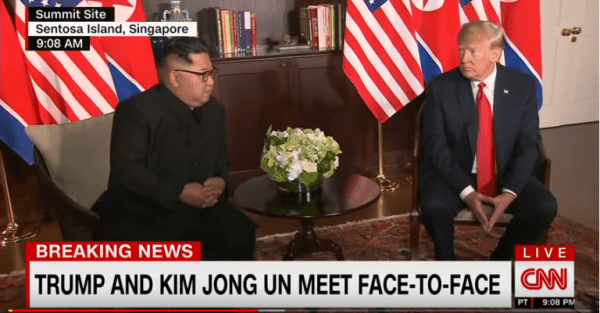
The longest war of our lifetimes – the Korean War – might be coming to an end. Steps are being taken not only to cease hostilities, but to bring the long-divided peoples together after seventy years of separation. So many Koreans have not only hoped and longed for peace, but also advocated and worked for it. The recent summits, first between North Korean Chairman Kim Jong Un and South Korean President Moon Jae In in Panmunjom and most recently between Chairman Kim and President Trump in Singapore, could be seen as the first fruits towards peacemaking that have grown out of the hearts and efforts, toil and tears, of the Korean people. An overwhelming majority of Koreans are hopeful that these summits are seedlings that, with patience and nurturing, may blossom into a peaceful, reunified Korea.
Caution is absolutely warranted. Skepticism is more than understandable. But many people in the United States, in contrast to the people of North and South Korea, are angry about the Singapore summit between President Trump and Chairman Kim. Of the myriad reasons for this anger, the four most cited are as follows: 1. The very presence of an American president in the same room with the North Korean dictator will be used to legitimize the regime. 2. The agreement was heavy on optics but thin on substance, with no talk about human rights. 3. President Trump had no right to concede to ending military exercises off of the North Korean coast without consulting South Korea. 4. President Trump will use this summit for a political victory which could help his party in the midterms and him in 2020, though he did little more than cozy up to a dictator.
I acknowledge these concerns but come to a different conclusion. While I am bothered by many aspects of the Singapore summit, including my doubts about the sincerity of both parties and Trump’s over-the-top praise for Kim, I am guardedly optimistic about the outcome. The hope of the Korean people strengthens my resolve to work for the peace these summits are meant to build. I want to address each of the concerns posed by the summit’s detractors in order to present them from another perspective.
Legitimacy
First, legitimacy. The juxtaposition of the United States flag alongside that of North Korea. The handshake. The willingness for President Trump to meet with Chairman Kim at all. Many people see this as the most brutal dictatorship on the planet being put on the same moral plane as democracy.
Yet this meeting, interpreted as a moral affront by many in the United States, could also have been taken as a moral affront by the people of both North and South Korea, given the brutality of the stalemated Korean War. This is a war that shifted from active killing, including the most thorough and merciless bombing campaign the United States has ever waged, to a ceasefire in which sanctions and isolation have been part of the continued violence against the people of North Korea in another form. No peace treaty has yet been signed, but the Pamnunjom agreement, reaffirmed by the Singapore agreement, claims to be beginnings of a peace process that, if followed through, will finally bring a resolution that by all indications is welcomed by the Korean people.
What happened at the summit in Singapore was this: The leader of a nation that killed what some estimate to be twenty percent of the population of another nation sat down with the leader of that other nation to begin to negotiate the normalization of relations. It was the United States that divided and then mercilessly bombed Korea in the aftermath of World War II. The bombing there was worse than our use of conventional weapons against both Germany and Japan. Rather than allow Korea to reunite under Communist rule, the United States waged a bloody war, kept North Korea isolated when it found it could not unite Korea under its own hegemony, and imposed oppression (including dictatorships up until 1988) in South Korea. Families on both sides of the 38th parallel have been divided ever since, while the people of North Korea continue to live under threat of US weaponry just off their shores.
So the people of Korea have just as much reason to denounce the meeting between Chairman Kim and President Trump when the US has bombed and oppressed Korea and countless other nations. And yet they are hopeful. The desire of peace and reunification – which for now means not uniting the Korean peninsula under single leadership but rather the creation of positive relations including family reunions, travel, and trade – overwhelms the misgivings about compromise with the world’s most militaristic nation.
In short, two violent leaders met, ostensibly, to bring the world closer to peace. Whether it was a real effort or a photo opportunity is debatable as it was very short on details, but it did reaffirm the commitment to peace articulated in Panmunjom. The measurement of legitimacy cannot be the morality of either leader. Leaders with the best interests of their people at heart must frequently negotiate with corrupt and violent leaders. In this case two oppressive leaders came together – one who exercises his power against his own people and one who, for all his regressive domestic policies, has waged the most brutality by exacerbating imperialist policies abroad. Yet it cannot be forgotten that a genuine mediator and leader for peace, South Korean President Moon Jae In, was instrumental in bringing them together, and that an end to the Korean war will benefit members of all nations involved. The legitimacy of this summit must then be measured by the degree to which its outcome fulfills the people’s aspirations for peace. Time will tell, but there is reason to be at once skeptical and hopeful.
Human Rights
Human rights cannot wait. Both those who are optimistic and those who are pessimistic about the summit agree on this. I agree with all who are disappointed that the meeting between President Trump and Chairman Kim did not address the atrocious human rights violations of the North Korean regime. Nevertheless, progress toward human rights comes with peace, and if progress is made toward peace, human rights will improve.
The division of Korea into North and South separated families, which in itself is a human rights violation. The people of North Korea have lived under threat of the United States for generations, with war games off of their coast for decades and harsh sanctions dating back to the beginning of their nation’s existence, imposed by President Truman. The hawkish rhetoric toward North Korea by one administration after another, most recently and blatantly by Trump but also notably with President Bush’s “Axis of Evil” designation, makes North Koreans afraid. Even if Americans don’t think war in Korea is likely, people who remember the utter destruction of their country are afraid of that destruction being repeated when military exercises are performed off their coast. And the nuclear deterrent North Korea has built in order to ward off a US attack puts South Korea at risk. The cycles of violence of the Korean war have not ceased but are merely suspended in a threatening tension. The human right of the North Korean people to live in security is violated not only by the North Korean regime, but also by the United States.
There is no way a state of permanent war can improve the lives of the North Korean people. Authoritarians under threat crack down harshly on dissent. Isolation nourishes distrust and allows propaganda to take root. Peace and dialogue, however, are fertile soil in which human rights may flourish.
South Korean President Moon Jae In wants to open up communication and work toward reunification with North Korea. He began his political career working for human rights and was imprisoned multiple times for doing so, and he is working to de-centralize the South Korean government in order to listen to and draw in as many voices as possible for peace. The summits in Panmunjom and Singapore are just the beginning. I am confident that President Moon will advocate for human rights across the Korean peninsula in ways that the United States cannot, given the shared history and culture of North and South Korea as well as the US history of hostility with Korea. The international community will also have more leverage to advocate for human rights once war has truly ended and channels of relationship are opened. But the best the United States can do for human rights in North Korea right now is cooperate with both North and South Korea in ending hostilities.
Ending Military Exercises
To that end, President Trump’s promise to end military exercises off the coast of North Korea is an unexpected positive development. While pundits decry this promise as an enormous concession, they fail to acknowledge that many South Koreans want an end to the heavy US military presence in their land. Furthermore, it is counterproductive to disparage the dearth of specifics laid out in the agreement while simultaneously bemoaning a specific promise that could make the most positive difference in terms of incentivizing North Korea to disarm.
The specific promise to end the military exercises off of North Korea’s coast is not spelled out in detail in either the Singapore or Panmunjom summits. Yet it is implied in the Panmunjom agreement, which the Singapore agreement reaffirms, which states “South and North Korea agree to cease all hostile acts against each other in every domain, including land, air, and sea, that are the source of military tension and conflict.” If this does not include the joint military exercises between the United States and South Korea, then this promise is worthless and peace will remain elusive.
The military exercises that the United States defends as “business as usual” are the largest in the world. They simulate the invasion and occupation of the very nation we once tried to bomb into submission when we “burned down every town,” dropping over 420,000 bombs in one city – Pyongyang – alone. They simulate both “decapitation,” or “regime-change” strikes as well as nuclear first strikes. Needless to say, we in the United States would never accept such “games” off our own shores.
Those who decry this concession do not consider the fact that North Korea has made concessions of its own, including destroying a nuclear testing site ahead of the summit. It also behooves us to acknowledge that no matter how conciliatory it may appear to end these war exercises, nothing plays into North Korean anti-American hatred more than the credible threat of annihilation. Ending war games does not make us look weak. It makes us look, perhaps for the first time – to a population in which every family remembers loss of life and destruction caused by our bombs – human.
The worst thing about promising to end our military exercises off the coast of North Korea is not that the promise was made, but that it might be broken. While critics are right to point out that North Korea must be held accountable to their promise to disarm and that further summits must iron out the details of denuclearization and verification, it is up to United States citizens, through pressure on our representatives, to hold President Trump accountable for keeping his promise to end our threat to North Korea. A promise without verification is meaningless. But if the promise to end the world’s largest military exercises off the coast of North Korea is fulfilled, the world will be more secure for it.
Credit Where It Is Due
Much of the inclination to decry any potentially positive development coming from the Singapore summit comes from a distrust of President Trump as well as Chairman Kim, and a reluctance to give Trump credit in the peacemaking process. While President Trump is potentially making progress toward peace on the Korean peninsula, he is also exponentially escalating civilian death tolls in the Middle East, beating war drums for Iran in the wake of his own destruction of the Iran deal, and creating new rifts with allies in Europe and Canada. It is very understandable that he has little credibility in the arena of peacemaking. And yet, that does not change the fact that he is the first US president to sit down with the leader of North Korea and sign an agreement that can be considered a step toward peacemaking.
One of our themes at the Raven ReView is the way in which rivalry with our enemies eclipses us from our goals. In our quest to defeat our enemies, we can lose sight of what it is we are fighting for and even destroy it in our desire to win. If the goal is peace, then aversion to President Trump should not blind those wary of him to the potential good he may be doing for Korea and for the world. It would be easy to interpret the denunciation of the Singapore summit as an example of letting enmity cloud judgment and being unable to recognize good coming from opponents. This is always something we must guard against, and it is a lesson to apply in this case. But there is also reason to be very critical of President Trump’s approach to the situation in Korea, and to see another factor at work in the growing possibility for peace.
In short, I think we are witnessing the inverse of scapegoating. If scapegoating is defined as rivals uniting over and against a common enemy and making peace through exclusion and violence, then what is happening between the United States and North and South Korea is the opposite.
It was less than a year ago that President Trump promised to rain down “fire and fury” on “little Rocket Man.” The threat to totally destroy North Korea also left South Korea vulnerable, as it would have been in the line of nuclear fire. This may have pushed South Korean President Moon to work faster to bring about peace, but he had already pledged to pursue peace with North Korea in his 2017 campaign for president. And, in fact, it was Chairman Kim that reached out to South Korea, wishing them good luck hosting the 2018 Olympics. This sparked the summits in Panmunjom and then Singapore, the latter which President Moon revived after its cancellation when members of the Trump administration angered North Korean officials by referencing the “Libyan model” of deterrence, in which Libya abandoned its nuclear weapons only later to be bombed and have its president brutally assassinated.
As Tufts University history professor Gary Leupp says:
To credit the president with some sort of unprecedented wisdom (and attributing this breakthrough to him) is to validate his crude menacing rhetoric—which should in fact be no more admired than his misogynistic or racist pronouncements—as the impetus for a positive historical change. But it is not Trump who accomplished this. It was accomplished by Koreans united in fear to the threat he poses to all of them.
Recognizing a mutual threat in President Trump, President Moon and Chairman Kim came together. But rather than unite over and against Trump, they did the only thing that might actually create real peace in the region – they came together in relationship and drew Trump into the relationship as well. Taking the precarious opportunity presented by the threat of danger to create relationship is the opposite of scapegoating. It is a risk. But it may just lead to an end to hostilities and a new beginning, and that is a credit to the Korean people choosing reconciliation over rivalry.
Conclusion
The Singapore summit, while short on detail, reaffirmed the Panmunjom agreement, which promises not only an end to hostilities, but the renewal of relationships across the Korean peninsula. The worst that could have happened – the rejection of the Panmunjom agreement and a further exchange of threats – did not come to pass. Furthermore, the promise to end US-South Korean war exercises off the coast of North Korea was an unexpected, positive development. Again, ending these exercises is implied in the Panmunjom agreement, so this is really just a specification of what was already implied. However, it is in specifications just like this one that the prospect of peace goes from being a wish to a reality.
The responsibility of peacemakers in the United States now is to support peace in the strange and unlikely package in which it has come to us. Rather than decry Trump for promising peace, we must hold him accountable to it. And while North Korea must also be held accountable to peace, we must recognize our role as the aggressor in the war that divided Korea and devastated people on both sides of the 38th parallel but especially in the North. It is more appropriate for the international community and South Korea to verify the peacemaking efforts of North Korea at home and abroad than it is for the United States to take the lead in that regard, given our track record of war and brutality.
It is not only Korea that will benefit from an end of United States aggression. If we back off from our war exercises off the coast of North Korea, we may find that we have more resources for meeting the needs of our own people on our own soil. We may even find that we can accomplish more for peace and prosperity at home and around the world through diplomacy and negotiation than through military posturing. It is up to peacemakers to re-imagine what we can do with the thought, time and resources we divest from war, and push for their application toward justice and peacemaking. We may have the opportunity to do just that, if we give peace a chance in Korea.
Image: Screenshot from Youtube: “President Trump, Kim Jong Un meet in Singapore,” by CNN.
Previous Post

June 15, 2018
How to Desecrate the American Flag: Trump, the NFL, and North Korea
Next Post
June 25, 2018 Sermon: Make America Care Again
Browse Our Archives
Select a Category Atonement and Current Events Curriculum Faith and Families Interviews Jesus the Forgiving Victim Lent Montessori politics Reviews The Bible Explained Uncategorized Valentine's Day Wednesday Sermon Who is God?
Select a Month July 2020 November 2019 October 2019 September 2019 August 2019 July 2019 June 2019 May 2019 April 2019 March 2019 February 2019 January 2019 December 2018 November 2018 October 2018 September 2018 August 2018 July 2018 June 2018 May 2018 April 2018 March 2018 February 2018 January 2018 December 2017 November 2017 October 2017 September 2017 August 2017 July 2017 June 2017 May 2017 April 2017 March 2017 February 2017 January 2017 December 2016 November 2016 October 2016 September 2016 August 2016 June 2016 May 2016 April 2016 March 2016 February 2016 January 2016 December 2015 November 2015 October 2015 September 2015 August 2015 July 2015 June 2015 May 2015 April 2015 March 2015 February 2015 January 2015 December 2014 November 2014 October 2014 September 2014 August 2014 July 2014 June 2014 May 2014 April 2014 March 2014 January 2014 December 2013 September 2013 August 2013 July 2013
Follow Us!
TAKE THE
Religious Wisdom Quiz
What is the name of the tree whose fruit Adam and Eve were forbidden to eat?
Select your answer to see how you score.
Tree of Life Olive Tree Tree of the Knowledge of Good and Evil Fig Tree
Related posts from Teaching Nonviolent Atonement

Jesus Unmasked: Jesus Brings the Fire!

"I Do Not Give As The World Gives"...

Doubt, Faith, And The God Who Holds Us...

Ancient Resurrection Stories: How Jesus Is Transforming the...
TRENDING AT PATHEOS Progressive Christian

What Being a Modern-Day Apostle Means to Me
In my last column, I discussed the ins and outs of modern-day...

Did Ancient China Once Worship the God of...
Across human history, a common thread weaves through the origins of the...

Love Your Neighbor – Including Earth-Kin: Lev. 19,...
God’s command to love your neighbor means acting in an ethical and...

Lead a Church Study of “Jesus and Lao...
Guest writer Jack Thomas (The Irreverent Reverend) reflects on leading his church...

Pastoral Wisdom for Responding to Sermon Pushback
Getting sermon pushback on your social justice sermon? Learn practical, Proverbs-based strategies...

Principles for Understanding the Apostolic Ministry Today
Whenever people discover that my formal ministry title is "apostle," as in...
view all Progressive Christian blogs
Ad-Free & Subscriber Log-In Subscription Support
- About Us
- 2026 Calendar
- Videos
- Podcasts
- Library of World Religions
- Faith In Media Tracker
- Advertise With Us
- Write for Us
- Privacy Policy
- Terms of Service
- Do Not Sell My Data
- Contact Us
- Radiant Digital
- Manage Newsletter Subscriptions
- Unsubscribe From Notifications
- Sitemap
Copyright 2008-2026, Patheos. All rights reserved.
Subscription Support Ad-Free & Subscriber Log-In
Follow Patheos