
BuddhistCatholicContemplativeEvangelicalGeneral ChristianHinduJewishLatter-day SaintMuslimNew VisionsProgressive Christian
Beliefs
- Buddhist
- Catholic
- Contemplative
- Evangelical
- General Christian
- Hindu
- Jewish
- Latter-day Saint
- More Voices
- Muslim
- New Visions
- Pagan
- Progressive Christian
Topics
- Religion News
- Food and Religion
- Sports and Religion
- Religious Art
- Religious Music and Entertainment
- Religious Events
- History and Religion
- Style and Religion
- Politics and Religion
- Women in Religion
- Recreation Outdoors and Religion
- Business Finance and Religion
- Careers Workplace and Religion
- Education and Religion
- Family Parenting and Religion
- Health Fitness and Religion
- Home and Religion
- Relationships and Religion
- Technology and Religion
- Travel and Religion
Columnists
- Buddhist Columnists
- Business Finance and Religion Columnists
- Careers Workplace and Religion Columnists
- Catholic Columnists
- Contemplative Columnists
- Education and Religion Columnists
- Evangelists Columnists
- Family Parenting and Religion Columnists
- General Christian Columnists
- Health Fitness and Religion Columnists
- Hindu Columnists
- History and Religion Columnists
- Home and Religion Columnists
- Jewish Columnists
- More Voices Columnists
- Latter Day Columnists
- Muslim Columnists
- New Visions Columnists
- Nonreligious Columnists
- Pagan Columnists
- Politics and Religion Columnists
- Progressive Columnists
- Recreation Outdoors and Religion Columnists
- Relationships and Religion Columnists
- Religion News Columnists
- Religious Art Columnists
- Religious Events Columnists
- Religious Music and Entertainment Columnists
- Sports and Religion Columnists
- Style and Religion Columnists
- Technology and Religion Columnists
- Travel and Religion Columnists
- Women in Religion Columnists
Resource Library
- 2026 Calendar
- Library of World Religions
- The 100 Most Holy Places on Earth
- Patheos Answers
- Podcasts
- Videos
- Faith Leaders Database
- Anglican Episcopalian
- Bahai
- Baptist
- Buddhism
- Christianity
- Confucianism
- Eastern Orthodoxy
- Hinduism
- Holiness and Pentecostal
- ISKCON
- Islam
- Judaism
- Lutheran
- Methodist
- The Church of Jesus Christ of Latter-day Saints
- New Age
- Paganism
- Presbytarian and Reformed
- Protestantism
- Religion Behind the Scenes
- Roman Catholic
- Scientology
- Shia Islam
- Sikhism
- Sufism
- Sunni Islam
- Taoism
- Zen
- See all religions
Research Tools
 Ad-Free & Subscriber Log-In Subscription Support
Ad-Free & Subscriber Log-In Subscription Support
Follow Patheos 

- Trending:
- Forgiveness
- |
- Marriage
- |
- Consciousness
- |
- Death Penalty
- |
- Election
- |
- Halloween
 Teaching Nonviolent Atonement
- Home
- Progressive Christian
- “Come Sunday”: Hell Hath No Fury
“Come Sunday”: Hell Hath No Fury
Last updated on: May 23, 2018 at 8:29 am by Maura Junius
“Come Sunday”: Hell Hath No Fury 2018-05-23T08:29:48-05:00 Maura Junius
Patheos Explore the world's faith through different perspectives on religion and spirituality! Patheos has the views of the prevalent religions and spiritualities of the world.
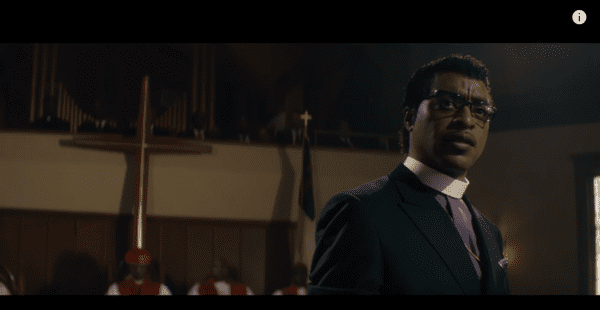
The opening sequence of the Netflix biopix Come Sunday follows Bishop Carlton Pearson (Chiwetel Ejiofor) from a triumphant preaching engagement onto a plane flight where, despite his weariness, he works to convert his once Catholic seatmate. Why? Because as an Evangelical, he is dutybound to convert the unsaved, preventing them from going to hell. The strength of this belief had empowered Pearson to ascend from the storefront churches of his youth to the mentorship of Oral Roberts, to his own 5,000 person racially diverse Higher Dimensions congregation in Tulsa, Oklahoma.
Then, he experiences his own conversion.
While deeply troubled by a news report about people suffering during the 1994 Rwandan genocide, people his beliefs declared were doomed to hell, he received a message from God stating all people are saved. Sharing this message with church members led to his life unraveling – he loses his congregation, must sell his worship center, and is branded a heretic.
If no one goes to hell, wouldn’t people in Pearson’s congregation experience a new level of freedom and divine love? Unfortunately, that is not how human beings work. How humans know they are “good” is by separating themselves from people they know to be “bad.” Up till his conversion Pearson had preached a comforting message to his congregation, that they had already been saved from hell. Only the unsaved, the unrepentant, were condemned. As Catholic theologian James Alison explains in this interview with Raven Foundation Founder Suzanne Ross, “… think how much investment in our culture and society there is in being the good guy, and how much talk there is about morality, as though people can put a boundary around themselves as ‘good.’ This then has real value in any form of public engagement.” Pearson’s declaration stripped from his congregation the critical boundary of goodness. If everyone was saved, their goodness had been robbed of meaning.
The film illustrates the cost of Pearson’s new belief to him and his family; it also displays the pain inflicted on people labeled “unsaved”:
- Pearson’s refusal to assist his aged, incarcerated Uncle Quincy (Danny Glover) by writing a letter to the parole board;
- Pearson telling the congregation’s closeted gay music director Reggie (Lakeith Stanfield) it was okay to be gay as long as he didn’t “live gay”;
- Televangelist and Pearson mentor Oral Roberts (Martin Sheen) sadly, but firmly, stating his gay son Ronnie, who committed suicide, was in hell.
Pearson’s path to recovery is supported by his wife, Gina (Condola Rashad), whose shift from handmaiden to First Lady is brilliantly depicted. As he moves forward, Pearson’s view of salvation expands, leading him to repent of his harshness to his uncle and Reggie. The closing scene bookends the opening with Pearson preaching to the ultra-diverse City of Refuge congregation in Oakland. There he acknowledges he would never have encountered a group like them without this life change. In closing he ponders, “What is so hard about unconditional love?”
[tweetthis]“What is so hard about unconditional love?” – Carlton Pearson[/tweetthis]
Carlton Pearson’s story was first related in 2005 in the “Heretics” episode of This American Life. This American Life host, Ira Glass, acted as one of the producers for the film. In the viewing I attended, Glass led a post-show discussion which included Carlton Pearson, his wife Gina Pearson, and film director Joshua Marston. During the Q&A session, Pearson explained he has moved beyond universalism (brilliantly explained in Kevin Miller’s Raven Award winning documentary Hellbound?) to Metacostalism, focused on expanded consciousness, where he no longer considers Jesus divine, but a brother. On that note, I wholeheartedly agree with Peter Laarman’s statement in his Religion Dispatches article, “Personally, I wish that the impressively gifted Pearson could have stuck it out and fought the good fight within a Christianity that desperately needs to ‘go and learn what this means: “I desire mercy, not sacrifice”‘ (Mt. 9:13 – Jesus quoting Hosea)”.
As a practicing Catholic, viewed by Evangelicals as one of the unsaved, I left the theater wondering whatever happened to that unconditional love.
Image: Screenshot from Youtube: “Come Sunday | A Netflix Original Film | Netflix”
Next Post

May 25, 2018 Being A Friend to Israel and Palestine: Five Truths for Making Peace
Browse Our Archives
Select a Category Atonement and Current Events Curriculum Faith and Families Interviews Jesus the Forgiving Victim Lent Montessori politics Reviews The Bible Explained Uncategorized Valentine's Day Wednesday Sermon Who is God?
Select a Month July 2020 November 2019 October 2019 September 2019 August 2019 July 2019 June 2019 May 2019 April 2019 March 2019 February 2019 January 2019 December 2018 November 2018 October 2018 September 2018 August 2018 July 2018 June 2018 May 2018 April 2018 March 2018 February 2018 January 2018 December 2017 November 2017 October 2017 September 2017 August 2017 July 2017 June 2017 May 2017 April 2017 March 2017 February 2017 January 2017 December 2016 November 2016 October 2016 September 2016 August 2016 June 2016 May 2016 April 2016 March 2016 February 2016 January 2016 December 2015 November 2015 October 2015 September 2015 August 2015 July 2015 June 2015 May 2015 April 2015 March 2015 February 2015 January 2015 December 2014 November 2014 October 2014 September 2014 August 2014 July 2014 June 2014 May 2014 April 2014 March 2014 January 2014 December 2013 September 2013 August 2013 July 2013
Follow Us!
TAKE THE
Religious Wisdom Quiz
What Christian tradition requires confession to a priest for forgiveness of sins?
Select your answer to see how you score.
Baptist Roman Catholic Methodist Quaker
Related posts from Teaching Nonviolent Atonement

Jesus Unmasked: Jesus Brings the Fire!
Love One Another As I Have Loved You:...
The Resurrected Jesus and the Destruction of Hell

Christianity Is Not About Being Good
TRENDING AT PATHEOS Progressive Christian

What Being a Modern-Day Apostle Means to Me
In my last column, I discussed the ins and outs of modern-day...

Did Ancient China Once Worship the God of...
Across human history, a common thread weaves through the origins of the...

Love Your Neighbor – Including Earth-Kin: Lev. 19,...
God’s command to love your neighbor means acting in an ethical and...

Lead a Church Study of “Jesus and Lao...
Guest writer Jack Thomas (The Irreverent Reverend) reflects on leading his church...

Pastoral Wisdom for Responding to Sermon Pushback
Getting sermon pushback on your social justice sermon? Learn practical, Proverbs-based strategies...

Principles for Understanding the Apostolic Ministry Today
Whenever people discover that my formal ministry title is "apostle," as in...
view all Progressive Christian blogs
Ad-Free & Subscriber Log-In Subscription Support
- About Us
- 2026 Calendar
- Videos
- Podcasts
- Library of World Religions
- Faith In Media Tracker
- Advertise With Us
- Write for Us
- Privacy Policy
- Terms of Service
- Do Not Sell My Data
- Contact Us
- Radiant Digital
- Manage Newsletter Subscriptions
- Unsubscribe From Notifications
- Sitemap
Copyright 2008-2026, Patheos. All rights reserved.
Subscription Support Ad-Free & Subscriber Log-In
Follow Patheos