
BuddhistCatholicContemplativeEvangelicalGeneral ChristianHinduJewishLatter-day SaintMuslimNew VisionsProgressive Christian
Beliefs
- Buddhist
- Catholic
- Contemplative
- Evangelical
- General Christian
- Hindu
- Jewish
- Latter-day Saint
- More Voices
- Muslim
- New Visions
- Pagan
- Progressive Christian
Topics
- Religion News
- Food and Religion
- Sports and Religion
- Religious Art
- Religious Music and Entertainment
- Religious Events
- History and Religion
- Style and Religion
- Politics and Religion
- Women in Religion
- Recreation Outdoors and Religion
- Business Finance and Religion
- Careers Workplace and Religion
- Education and Religion
- Family Parenting and Religion
- Health Fitness and Religion
- Home and Religion
- Relationships and Religion
- Technology and Religion
- Travel and Religion
Columnists
- Buddhist Columnists
- Business Finance and Religion Columnists
- Careers Workplace and Religion Columnists
- Catholic Columnists
- Contemplative Columnists
- Education and Religion Columnists
- Evangelists Columnists
- Family Parenting and Religion Columnists
- General Christian Columnists
- Health Fitness and Religion Columnists
- Hindu Columnists
- History and Religion Columnists
- Home and Religion Columnists
- Jewish Columnists
- More Voices Columnists
- Latter Day Columnists
- Muslim Columnists
- New Visions Columnists
- Nonreligious Columnists
- Pagan Columnists
- Politics and Religion Columnists
- Progressive Columnists
- Recreation Outdoors and Religion Columnists
- Relationships and Religion Columnists
- Religion News Columnists
- Religious Art Columnists
- Religious Events Columnists
- Religious Music and Entertainment Columnists
- Sports and Religion Columnists
- Style and Religion Columnists
- Technology and Religion Columnists
- Travel and Religion Columnists
- Women in Religion Columnists
Resource Library
- 2026 Calendar
- Library of World Religions
- The 100 Most Holy Places on Earth
- Patheos Answers
- Podcasts
- Videos
- Faith Leaders Database
- Anglican Episcopalian
- Bahai
- Baptist
- Buddhism
- Christianity
- Confucianism
- Eastern Orthodoxy
- Hinduism
- Holiness and Pentecostal
- ISKCON
- Islam
- Judaism
- Lutheran
- Methodist
- The Church of Jesus Christ of Latter-day Saints
- New Age
- Paganism
- Presbytarian and Reformed
- Protestantism
- Religion Behind the Scenes
- Roman Catholic
- Scientology
- Shia Islam
- Sikhism
- Sufism
- Sunni Islam
- Taoism
- Zen
- See all religions
Research Tools
 Ad-Free & Subscriber Log-In Subscription Support
Ad-Free & Subscriber Log-In Subscription Support
Follow Patheos 

- Trending:
- Forgiveness
- |
- Marriage
- |
- Consciousness
- |
- Death Penalty
- |
- Election
- |
- Halloween
 Teaching Nonviolent Atonement
- Home
- Progressive Christian
- The Good Shepherd Who Cares for the Man Born Blind
The Good Shepherd Who Cares for the Man Born Blind
Last updated on: April 25, 2018 at 6:30 pm by Tom Truby
The Good Shepherd Who Cares for the Man Born Blind 2018-04-25T18:30:55-05:00 Tom Truby
Patheos Explore the world's faith through different perspectives on religion and spirituality! Patheos has the views of the prevalent religions and spiritualities of the world.
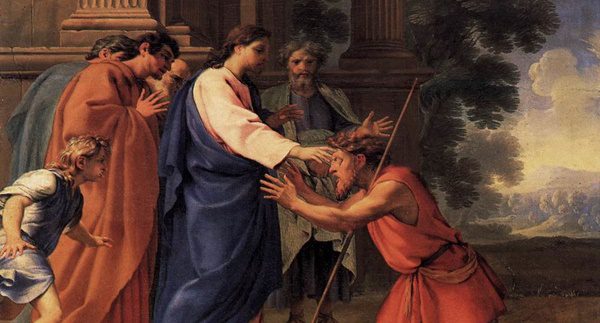
Their sin, the thing that made them blind, was thinking themselves able to distinguish who was good and who was evil.
-Rev. Tom Truby
Pastors have a frequent question when they begin to discover mimetic theory. “That’s great. But how does it preach?”
Reverend Tom Truby shows that mimetic theory is a powerful tool that enables pastors to preach the Gospel in a way that is meaningful and refreshing to the modern world. Each week, Teaching Nonviolent Atonement will highlight his sermons as examples of preaching the Gospel through mimetic theory.
Year B, Easter 4 – The Good Shepherd Who Cares for the Man Born Blind
April 22, 2018
By Thomas L. Truby
The Good Shepherd Who Cares for the Man Born Blind
It all started with a blind man Jesus healed. Jesus healed him to show his disciples that the man’s blindness had nothing to do with sin, punishment or blame. He was just born blind.
Apparently the creator ran short of creative mud so the eyes didn’t get finished. This is why Jesus mixed some of his saliva with earth, the stuff from which Adam was made, to make mud. Jesus then pasted it over the blind man’s eyes and with the missing mixture no longer missing, the man suddenly could see. Jesus finished God’s creation, something he did during Holy Week, on another level.
This was Jesus’ way of saying he and God worked together, they worked for the completion and benefit of all and that the idea of blindness as some sort of Divine blame, retribution, or reason for the exclusion of those persons so afflicted was pure B. S. That means falsely benefiting society by creating a temporary peace built on excluding the weak, the vulnerable and the different while blaming them for their own exclusion.
Well, those in authority found the idea that Jesus could be working with God impossible to swallow so they initiated an investigation. They talked to the man’s parents who confirmed he had been born blind, and they talked to the man himself who also said it was true.
Of course, everyone had their own take on this increasingly public event. Gossip, the social media of the day, picked it up and soon some Pharisees where saying, “This man is not from God, for he doesn’t observe the Sabbath.” After all, the healing occurred on the day of rest, proof that God had nothing to do with it. Others said, “How can a man who is a sinner perform such signs? And they were divided.” This was getting dangerous as the unity of their culture was eroding and Jesus was behind it all.
Well, this thing just kept heating up as the friction of the various segments of their leadership structure rubbed against each other. They decided to call the formerly blind man for a second hearing. This time they put him under oath by saying, “Give glory to God!” and then they tell him what to say that will please them. It isn’t exactly a fair trial since they provide him the expected answer before he has a chance to testify. Essentially they are saying you had better support us on this or you will be in big trouble.
I have always been amazed at the man’s courage. Had his being different all those years enabled him to see the truth the majority could not? He ignores their instruction and contradicts what the prosecutor clearly wants him to say. He diplomatically answers, “I do not know whether he is a sinner but the one thing I do know, that though I was blind, now I see.”
They don’t like his answer and pepper him with more questions. He grows impatient as he can see this is not about determining truth but rather protecting power and privilege. When they again ask how this happened he answers with some irritation, “I have told you already, and you would not listen. Why do you want to hear it again? Do you also want to become his disciple?”
His question draws their venom to the surface. They answer, “You are born entirely in sins, and you are trying to teach us? And they drove him out.”
Later Jesus found the man and asked him if he believed in the Son of Man. When the man said he did and worshipped him, Jesus replied, “I came into this world for judgment so that those who do not see may see, and those who do see may become blind.” I think Jesus is saying we judge ourselves by how we respond to Jesus.
Some of the Pharisees overheard Jesus and said to him, “Surely we are not blind are we?” A crack appeared in the certainty of their righteousness—a small light shown through the blackness of their blindness.
“Jesus said to them, ‘If you were blind you would not have sin. But now that you say ‘We see,’ your sin remains.” Their sin, the thing that made them blind, was thinking themselves able to distinguish who was good and who was evil.
There was an Associated Press story in the Oregonian on Friday about the two young men arrested in the Philadelphia Starbucks restaurant for being black, sitting at a table and using the restroom before buying coffee. They were waiting for a third person, a white man, to arrive, so they could have a business meeting. By the time the third man arrived, the first two men, both black, were in handcuffs. They did not resist arrest and were taken to jail though the third man confirmed the truth of their story.
Like those born blind we often assume those born black carry suspicion and must be kept apart. Our sin is in the dividing of us and them. The dividing shows us to be blind and our residence the actual place sin resides.
Rashon Nelson, one of the two young men, in reflecting on his experience with reporters said, “We do want to make sure it doesn’t happen to anybody again. What if it wasn’t us sitting there? What if it was a kid that didn’t know somebody that knew somebody that knew somebody? Do they make it to jail? Do they die? What happens?.…When you know that you did nothing wrong, how do you really react to it? You can either be ignorant or you can show some type of sophistication and act like you have class. This is the choice we had.” In a final class act Robinson said he “appreciated the public support but that anger and boycotting Starbucks are not the solution.”
The Pharisees didn’t see the blind man as in their care. He was like one of those sheep that gets sacrificed on the altar of cultural cohesiveness. Jesus, however, sees himself as the good shepherd. His special domain is the welfare of those sheep and their human counterparts headed through the gates that lead to their violent and sacrificial death on the temple altar.
When the gates open he goes through with the sheep. He is involved. He cares. The sheep know his voice and he knows his sheep. When the wolf of violence appears the hired man runs. He abandons the sheep and they are ravaged and scattered. He won’t lay his life down for the sheep. He doesn’t enter the sheepfold through the gate of love, co-suffering and self-sacrifice. The hired man climbs in over the fence and takes no permanent residence among the sheep. When violence threatens he climbs back over the fence and hides.
The hired man is just a hired hand and has little capacity to identify with the sheep. They don’t even belong to him. He won’t lay down his life for the sheep and he doesn’t believe he has the capacity to pick his life up again if he were to lay it down.
There is a big difference between the good shepherd and just any shepherd. The good shepherd does not kill and yet responds to the wolf of violence by laying down his life rather than running away. Laying down his life and then picking it up again strips violence of its power. All kinds of people from all kinds of religions or none at all, are waking up to the nonviolent power Jesus shows us in laying down his life for others and then picking it up again as a model of life beyond death.
There is nothing violence can do to thwart what we are discovering. Jesus’s willingness to take this route is the reason the Father, who created us all, loves him. As the world hears about this fundamentally anthropological rather than sectarian religious response to violence, they too hear the voice of the nonviolent good shepherd and they are drawn to it. When the world hears this voice it will listen and Jesus’ purpose will be achieved. Amen.
Image: Wikimedia

Previous Post

April 24, 2018
Seven Stories – Chapter 4: Wrath to Compassion
Next Post
April 27, 2018 Does Facebook Fuel Revenge? - The RavenCast
Browse Our Archives
Select a Category Atonement and Current Events Curriculum Faith and Families Interviews Jesus the Forgiving Victim Lent Montessori politics Reviews The Bible Explained Uncategorized Valentine's Day Wednesday Sermon Who is God?
Select a Month July 2020 November 2019 October 2019 September 2019 August 2019 July 2019 June 2019 May 2019 April 2019 March 2019 February 2019 January 2019 December 2018 November 2018 October 2018 September 2018 August 2018 July 2018 June 2018 May 2018 April 2018 March 2018 February 2018 January 2018 December 2017 November 2017 October 2017 September 2017 August 2017 July 2017 June 2017 May 2017 April 2017 March 2017 February 2017 January 2017 December 2016 November 2016 October 2016 September 2016 August 2016 June 2016 May 2016 April 2016 March 2016 February 2016 January 2016 December 2015 November 2015 October 2015 September 2015 August 2015 July 2015 June 2015 May 2015 April 2015 March 2015 February 2015 January 2015 December 2014 November 2014 October 2014 September 2014 August 2014 July 2014 June 2014 May 2014 April 2014 March 2014 January 2014 December 2013 September 2013 August 2013 July 2013
Follow Us!
TAKE THE
Religious Wisdom Quiz
In Philippians, Paul mentions two women who need to be of the same mind. Who are they?
Select your answer to see how you score.
Lydia and Chloe Mary and Martha Phoebe and Priscilla Euodia and Syntyche
Related posts from Teaching Nonviolent Atonement

Forgiveness in the Time of COVID-19 by Julia...


How Forgiveness Can Transform Our Violence and Build...

Jesus Unmasked: On Being Lost And Found: Sheep,...
TRENDING AT PATHEOS Progressive Christian

Why Christians Have a Sacred Duty to Vote:...
The Bible offers strong support for the sacred duty to vote. Here...

What Being a Modern-Day Apostle Means to Me
In my last column, I discussed the ins and outs of modern-day...

Did Ancient China Once Worship the God of...
Across human history, a common thread weaves through the origins of the...

Love Your Neighbor – Including Earth-Kin: Lev. 19,...
God’s command to love your neighbor means acting in an ethical and...

Lead a Church Study of “Jesus and Lao...
Guest writer Jack Thomas (The Irreverent Reverend) reflects on leading his church...

Principles for Understanding the Apostolic Ministry Today
Whenever people discover that my formal ministry title is "apostle," as in...
view all Progressive Christian blogs
Ad-Free & Subscriber Log-In Subscription Support
- About Us
- 2026 Calendar
- Videos
- Podcasts
- Library of World Religions
- Faith In Media Tracker
- Advertise With Us
- Write for Us
- Privacy Policy
- Terms of Service
- Do Not Sell My Data
- Contact Us
- Radiant Digital
- Manage Newsletter Subscriptions
- Unsubscribe From Notifications
- Sitemap
Copyright 2008-2026, Patheos. All rights reserved.
Subscription Support Ad-Free & Subscriber Log-In
Follow Patheos