
BuddhistCatholicContemplativeEvangelicalGeneral ChristianHinduJewishLatter-day SaintMuslimNew VisionsProgressive Christian
Beliefs
- Buddhist
- Catholic
- Contemplative
- Evangelical
- General Christian
- Hindu
- Jewish
- Latter-day Saint
- More Voices
- Muslim
- New Visions
- Pagan
- Progressive Christian
Topics
- Religion News
- Food and Religion
- Sports and Religion
- Religious Art
- Religious Music and Entertainment
- Religious Events
- History and Religion
- Style and Religion
- Politics and Religion
- Women in Religion
- Recreation Outdoors and Religion
- Business Finance and Religion
- Careers Workplace and Religion
- Education and Religion
- Family Parenting and Religion
- Health Fitness and Religion
- Home and Religion
- Relationships and Religion
- Technology and Religion
- Travel and Religion
Columnists
- Buddhist Columnists
- Business Finance and Religion Columnists
- Careers Workplace and Religion Columnists
- Catholic Columnists
- Contemplative Columnists
- Education and Religion Columnists
- Evangelists Columnists
- Family Parenting and Religion Columnists
- General Christian Columnists
- Health Fitness and Religion Columnists
- Hindu Columnists
- History and Religion Columnists
- Home and Religion Columnists
- Jewish Columnists
- More Voices Columnists
- Latter Day Columnists
- Muslim Columnists
- New Visions Columnists
- Nonreligious Columnists
- Pagan Columnists
- Politics and Religion Columnists
- Progressive Columnists
- Recreation Outdoors and Religion Columnists
- Relationships and Religion Columnists
- Religion News Columnists
- Religious Art Columnists
- Religious Events Columnists
- Religious Music and Entertainment Columnists
- Sports and Religion Columnists
- Style and Religion Columnists
- Technology and Religion Columnists
- Travel and Religion Columnists
- Women in Religion Columnists
Resource Library
- 2026 Calendar
- Library of World Religions
- The 100 Most Holy Places on Earth
- Patheos Answers
- Podcasts
- Videos
- Faith Leaders Database
- Anglican Episcopalian
- Bahai
- Baptist
- Buddhism
- Christianity
- Confucianism
- Eastern Orthodoxy
- Hinduism
- Holiness and Pentecostal
- ISKCON
- Islam
- Judaism
- Lutheran
- Methodist
- The Church of Jesus Christ of Latter-day Saints
- New Age
- Paganism
- Presbytarian and Reformed
- Protestantism
- Religion Behind the Scenes
- Roman Catholic
- Scientology
- Shia Islam
- Sikhism
- Sufism
- Sunni Islam
- Taoism
- Zen
- See all religions
Research Tools
 Ad-Free & Subscriber Log-In Subscription Support
Ad-Free & Subscriber Log-In Subscription Support
Follow Patheos 

- Trending:
- Forgiveness
- |
- Marriage
- |
- Consciousness
- |
- Death Penalty
- |
- Election
- |
- Halloween
 Teaching Nonviolent Atonement
- Home
- Progressive Christian
- Seven Stories Book Review, Part 2: Violence to Forgiveness
Seven Stories Book Review, Part 2: Violence to Forgiveness
Last updated on: April 11, 2018 at 1:01 pm by Lindsey Paris-Lopez
Seven Stories Book Review, Part 2: Violence to Forgiveness 2018-04-11T13:01:59-05:00 Lindsey Paris-Lopez
Patheos Explore the world's faith through different perspectives on religion and spirituality! Patheos has the views of the prevalent religions and spiritualities of the world.
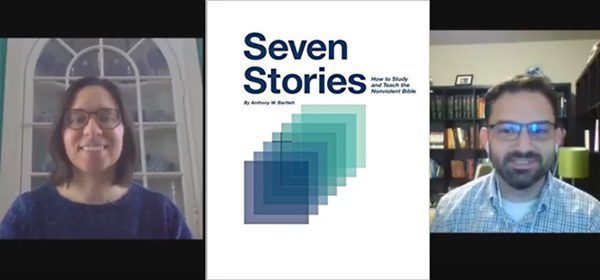
In this episode of the RavenCast, Adam Ericksen and I discuss the second chapter Anthony Bartlett’s latest book Seven Stories: How to Study and Teach the Nonviolent Bible. You can watch the video of the conversation below, or listen to the podcast above. You can also subscribe to the RavenCast on iTunes, Stitcher Radio, or Podbean.
Genesis is a theological meditation that implicitly reverses all the violence of Israel’s history. Both violence and love are imitative and generative processes, but with very different results. Genesis tells us that God’s plan is for us to choose generative nonviolence and forgiveness over generative violence. – Anthony Bartlett, Seven Stories, Story 2: “Violence to Forgiveness.”
Last week, Adam and I talked about the “first” story: “From Oppression to Justice.” Tony starts his Bible Study with the story of the Exodus, showing how this story, the story of escape from slavery to freedom, is the beginning of the Hebrew cultural identity. It is important to recognize the Hebrews not as an ethnicity, but as people connected by an experience of displacement, marginalization, and oppression. God’s “chosen people” are not a race but people who have been forced to or beyond the edges of their own communities. God’s love is universal, but God intentionally includes and works through the excluded. Tony helps us understand that God’s peace is rooted in justice – in recognition of the dignity of all, in inclusion, in freedom. God’s peace is not a passive complacency with suffering and oppression. Before we move on to the second story, “From Violence to Forgiveness,” we must understand that the call to forgiveness is not a call to allow oppressors to continue in their oppression or abusers to continue in their abuse. The full love of God leaves no room for treating human beings – or indeed any part of creation – without respect and dignity.
With that established, Adam and I turn to story number 2: “From Violence to Forgiveness.” Here we get into Genesis, which Tony describes as a theological preview of the trajectory of the rest of scripture – a critique on violence and a lesson in forgiveness. Each of the seven stories are subdivided into three parts, with lessons 1 and 2 focusing on Genesis – first the “prehistories” and then the “patriarchs” – and then turning in lesson 3 to Jesus with the story of the Prodigal Son.
The prehistories focus on Genesis chapters 2 -11 with the stories of the exile from the Garden, Cain’s murder of Abel, the “sons of God and daughters of men,” the flood, and the tower of Babel. In each of these stories, God is presented as a rival figure to humanity, because freedom, desire, and rivalry are intimately connected.
To understand the connection between freedom, desire, and rivalry, it is important to understand ourselves as creatures of relationship and imitation rather than instinct. We are made in relationship with God and with one another, and our desires come from imitating the desires of others. We learn what love is and what to love through watching and relating to others. Without relationship and learning from models, we would be bound by instinct, innately pulled to the things we need, guided not by thought or emotion but simply survival. But as relational creatures we learn from the desires of others. Our relationships show us what to desire, but they also put us in rivalry with one another when we don’t want to share our desires, or when we want to take the place of our role models because we want their talent or status for ourselves.
The story of the Garden of Eden shows how as human desire was kindled, a perceived rivalry between humans and God was also kindled. The serpent tells Eve that God is prohibiting her from eating of the Tree of Knowledge of Good and Evil because God does not want Eve, or Adam, to eat of the tree and become “like God.” The serpent gives the impression that God wants to keep power and control to God’s self, thus making not only the fruit, but power and control desirable in the eyes of the first humans. The notion that God is in rivalry with humans is critiqued by the fact that God in the very beginning creates humans in God’s own image, so from the beginning of Genesis we have a sense both of God’s love and generosity and of human’s misperception of God.
We turn from the Garden of Eden to the first mention of sin in the story of Cain and Abel. Tony helps us to connect these stories, drawing parallels between them. Both stories include an object of desire: the fruit and God’s favor, both stories involve a personification of desire, both involve prohibitions, shame, hiding, expulsion, and protection.
We move quickly from rivalrous desire and a perception of enmity rather than love in the Garden to murder, and from murder we move on to violence begetting violence. The story of the flood – the world drowning in violence – appears so quickly in Genesis, showing how quickly violence moves. The flood is God’s violent response to violence, but by the end of the story, God repents and promises never to flood the world again. Thus, in these prehistories, even where God is depicted in rivalry toward humans, there is a sense of God’s displeasure with violence and a sense of the understanding of God moving away from violence. Desire, rivalry, and violence are depicted as the central problem of the human condition.
In the section on the patriarchs, Tony focuses primarily on Abraham and Joseph. We see Abraham as hapiru, called from his land, wandering, doing what it takes to survive, and coming to a deeper understanding of God’s nature, moving from violence to nonviolence. Tony explores the Akedah, or binding of Isaac, when God stays Abraham’s hand. God teaches humanity a vital lesson of nonviolence through the command to spare Isaac. Later, Abraham attempts to stay God’s violent hand by interceding for Sodom and Gomorrah. Thus in the story of Abraham, we see God turning humanity so much from violence to forgiveness that humanity begins to question and struggle against a violent God in the name of compassion.
From Abraham, we move on to the story of Joseph, a prefigure to Jesus. We read about Joseph suffering at the hands of his brothers, only to come to power and be in a position to not only forgive, but help his brothers in their own time of suffering. We look not only at Joseph, but at his brother Judah, who offers to take the place of punishment for his falsely-accused brother Benjamin. This very human story has few references to God, but we see God through the love of Joseph’s forgiveness and Judah’s willingness to endure suffering so that that suffering does not fall to another. From a God of rivalry with humans at the beginning of Genesis, we move through this theological scriptural preview to a God shown through the forgiveness and mercy of humans by the end. This leads us perfectly to Jesus.
Finally, we look at the story of the Prodigal Son in Luke, but first we look back on the story of Jacob and Esau as a prefiguration of the Prodigal. Reading these stories together shed new light on both of them for me. Jacob, the rival twin of Esau, becomes “Israel” after wrestling with a mysterious man/ God in the Jabbok River. This story – Jacob wrestling in the Jabbok – has been close to my heart ever since my confirmation into the church as a teenager, and I have always been intrigued by an identity – not just for one man but for a nation – rooted in struggle with God, perseverance and survival. I felt connected through my own doubts and fears and wonderings to Jacob the wrestler. But to connect this story with the Prodigal helps me to see the God of forgiveness and unconditional love at the end of the tunnel of my doubts.
Jacob wrestles with God in the Jabbok on his way to see the brother he has deceived and cheated. Jacob usurped the blessing intended for Esau. The very idea of blessing for one at the expense of another is part of the human misconception of God, of viewing God through the lens of rivalry. But Jacob, who has usurped the blessing of Esau, now comes face-to-face with the brother he has wronged. Esau, who had been in a murderous rage over his injustice, now meets Jacob with an abundance of love and forgiveness. Esau is a precursor not to the brother but to the father in the story of the Prodigal Son.
Jacob, who has just wrestled with his fears of God in the Jabbok River, comes through the river with a blessing, and then goes on to meet his brother Esau. He tells Esau that seeing his face is like seeing the face of God. Seeing the face of forgiveness, the face of one who upends all of our deepest fears and shames in the most beautiful, unexpected way – this is what it means to look on the face of God.
When we perceive violence in God, we approach each other in rivalry. When we recognize compassion, mercy, love, and forgiveness in God, we will relate to each other that way. And more often than not, it takes seeing love, mercy, and compassion in one another to understand that this is the ultimate nature of God.
Join Adam and me next week, at 10 CT on AnyMeeting, to learn and reflect on the next story of Anthony Bartlett’s incredible Bible study leading us out of our violent understanding of God and our violent relationships with one another to the fullness of life made manifest in the resurrection. We will be discussing story 3: “The Land and Its Loss.”
Previous Post

April 9, 2018
Sermon: Holy Humor: What’s So Funny about the Atonement?
Next Post
April 12, 2018 Jimmy Kimmel, Sean Hannity, and How to Save Our Souls
Browse Our Archives
Select a Category Atonement and Current Events Curriculum Faith and Families Interviews Jesus the Forgiving Victim Lent Montessori politics Reviews The Bible Explained Uncategorized Valentine's Day Wednesday Sermon Who is God?
Select a Month July 2020 November 2019 October 2019 September 2019 August 2019 July 2019 June 2019 May 2019 April 2019 March 2019 February 2019 January 2019 December 2018 November 2018 October 2018 September 2018 August 2018 July 2018 June 2018 May 2018 April 2018 March 2018 February 2018 January 2018 December 2017 November 2017 October 2017 September 2017 August 2017 July 2017 June 2017 May 2017 April 2017 March 2017 February 2017 January 2017 December 2016 November 2016 October 2016 September 2016 August 2016 June 2016 May 2016 April 2016 March 2016 February 2016 January 2016 December 2015 November 2015 October 2015 September 2015 August 2015 July 2015 June 2015 May 2015 April 2015 March 2015 February 2015 January 2015 December 2014 November 2014 October 2014 September 2014 August 2014 July 2014 June 2014 May 2014 April 2014 March 2014 January 2014 December 2013 September 2013 August 2013 July 2013
Follow Us!
TAKE THE
Religious Wisdom Quiz
Which writer besides Solomon and David contributed to Proverbs?
Select your answer to see how you score.
Moses Nathan Agur Asaph
Related posts from Teaching Nonviolent Atonement

Forgiveness in the Time of COVID-19 by Julia...

Reflections on Indigenous Wisdom For Healing A Wounded...

How Forgiveness Can Transform Our Violence and Build...

Jesus Unmasked: God's Economy and How to Cheat...
TRENDING AT PATHEOS Progressive Christian

What Being a Modern-Day Apostle Means to Me
In my last column, I discussed the ins and outs of modern-day...

Did Ancient China Once Worship the God of...
Across human history, a common thread weaves through the origins of the...

Love Your Neighbor – Including Earth-Kin: Lev. 19,...
God’s command to love your neighbor means acting in an ethical and...

Lead a Church Study of “Jesus and Lao...
Guest writer Jack Thomas (The Irreverent Reverend) reflects on leading his church...

Pastoral Wisdom for Responding to Sermon Pushback
Getting sermon pushback on your social justice sermon? Learn practical, Proverbs-based strategies...

Principles for Understanding the Apostolic Ministry Today
Whenever people discover that my formal ministry title is "apostle," as in...
view all Progressive Christian blogs
Ad-Free & Subscriber Log-In Subscription Support
- About Us
- 2026 Calendar
- Videos
- Podcasts
- Library of World Religions
- Faith In Media Tracker
- Advertise With Us
- Write for Us
- Privacy Policy
- Terms of Service
- Do Not Sell My Data
- Contact Us
- Radiant Digital
- Manage Newsletter Subscriptions
- Unsubscribe From Notifications
- Sitemap
Copyright 2008-2026, Patheos. All rights reserved.
Subscription Support Ad-Free & Subscriber Log-In
Follow Patheos