
BuddhistCatholicContemplativeEvangelicalGeneral ChristianHinduJewishLatter-day SaintMuslimNew VisionsProgressive Christian
Beliefs
- Buddhist
- Catholic
- Contemplative
- Evangelical
- General Christian
- Hindu
- Jewish
- Latter-day Saint
- More Voices
- Muslim
- New Visions
- Pagan
- Progressive Christian
Topics
- Religion News
- Food and Religion
- Sports and Religion
- Religious Art
- Religious Music and Entertainment
- Religious Events
- History and Religion
- Style and Religion
- Politics and Religion
- Women in Religion
- Recreation Outdoors and Religion
- Business Finance and Religion
- Careers Workplace and Religion
- Education and Religion
- Family Parenting and Religion
- Health Fitness and Religion
- Home and Religion
- Relationships and Religion
- Technology and Religion
- Travel and Religion
Columnists
- Buddhist Columnists
- Business Finance and Religion Columnists
- Careers Workplace and Religion Columnists
- Catholic Columnists
- Contemplative Columnists
- Education and Religion Columnists
- Evangelists Columnists
- Family Parenting and Religion Columnists
- General Christian Columnists
- Health Fitness and Religion Columnists
- Hindu Columnists
- History and Religion Columnists
- Home and Religion Columnists
- Jewish Columnists
- More Voices Columnists
- Latter Day Columnists
- Muslim Columnists
- New Visions Columnists
- Nonreligious Columnists
- Pagan Columnists
- Politics and Religion Columnists
- Progressive Columnists
- Recreation Outdoors and Religion Columnists
- Relationships and Religion Columnists
- Religion News Columnists
- Religious Art Columnists
- Religious Events Columnists
- Religious Music and Entertainment Columnists
- Sports and Religion Columnists
- Style and Religion Columnists
- Technology and Religion Columnists
- Travel and Religion Columnists
- Women in Religion Columnists
Resource Library
- 2026 Calendar
- Library of World Religions
- The 100 Most Holy Places on Earth
- Patheos Answers
- Podcasts
- Videos
- Faith Leaders Database
- Anglican Episcopalian
- Bahai
- Baptist
- Buddhism
- Christianity
- Confucianism
- Eastern Orthodoxy
- Hinduism
- Holiness and Pentecostal
- ISKCON
- Islam
- Judaism
- Lutheran
- Methodist
- The Church of Jesus Christ of Latter-day Saints
- New Age
- Paganism
- Presbytarian and Reformed
- Protestantism
- Religion Behind the Scenes
- Roman Catholic
- Scientology
- Shia Islam
- Sikhism
- Sufism
- Sunni Islam
- Taoism
- Zen
- See all religions
Research Tools
 Ad-Free & Subscriber Log-In Subscription Support
Ad-Free & Subscriber Log-In Subscription Support
Follow Patheos 

- Trending:
- Forgiveness
- |
- Marriage
- |
- Consciousness
- |
- Death Penalty
- |
- Election
- |
- Halloween
 Teaching Nonviolent Atonement
- Home
- Progressive Christian
- Only Fools Believe in the Resurrection
Only Fools Believe in the Resurrection
Last updated on: April 2, 2018 at 9:32 pm by Adam Ericksen
Only Fools Believe in the Resurrection 2018-04-02T21:32:40-05:00 Adam Ericksen
Patheos Explore the world's faith through different perspectives on religion and spirituality! Patheos has the views of the prevalent religions and spiritualities of the world.
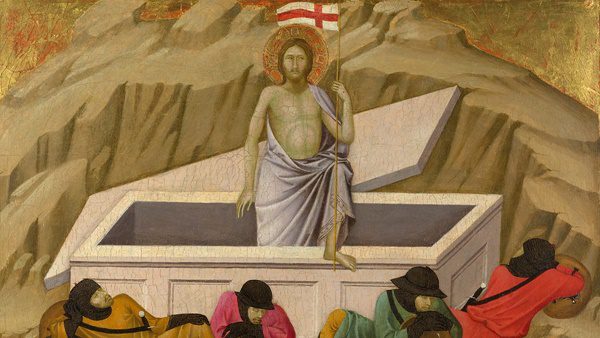
The following is a sermon I preached on Easter at Clackamas United Church of Christ, near Portland, Oregon. The text was John 1:1-5 and John 20:1-18. The video recording of the sermon is below, along with the text.
I love that today is both Easter Sunday and April Fool’s Day. There’s something utterly foolish about believing in the resurrection.
I’m not talking about the debate about whether Jesus literally rose from the dead in bodily form. For some, if you believe that, you are foolish because we know that people don’t rise from the dead. For them, it’s a metaphor. But for others, if you don’t believe Jesus literally resurrected then you just don’t have enough faith and you need to try harder.
Fortunately for you, I have the answer to this debate and I’m going to convince you of the right answer in the next 10-15 minutes!
No, I won’t do that. But I am going to tell you that whether you believe the resurrection is a metaphor or you believe it literally happened, either way, you are foolish.
The Gospel passage from this morning is from the end of John’s Gospel. It’s part of the resurrection account. But I’d like to set the stage by reading the beginning of John’s Gospel. They are some of my favorite verses in the Bible but I’m going to read these familiar words with a slight twist.
In the beginning was the logos, and the logos was with God, and the logos was God. The logos was in the beginning with God. All things came into being through the logos, and without the logos not one thing came into being.
We usually hear this passage as “In the beginning was the word, and the word was with God, and the word was God.”
But the word in the original Greek that we usually translate as word is the Greek word logos.
I love the word logos because it means so much more than simply word. It means reason. It where we get the word logic. Logos is the root of wisdom. It’s connected to our words philosophy, theology, psychology, anthropology, and all of the other -ologies that people study to gain wisdom.
In the ancient Greco-Roman world where the Gospels were written, logos wasn’t just about the human quest for wisdom and knowledge. The logos had a transcendent, divine-like quality. It was the underlying principle of reality that holds everything together. Logos was the reason that gives birth and forms creation. Everyone in the Greco-Roman world knew that the logos mattered and there was primarily one way of understanding the logos in the Greco-Roman world.
There was a famous Greek philosopher named Heraclitus who described the dominant way of understanding the logos. Heraclitus claimed that the logos, the fundamental reality of the universe, is violence, strife, and war. He wrote that, “all things happen according to strife and necessity.” And that, “War is father of all and king of all.”
For Heraclitus, the logos, the fundamental reality of the universe, is connected with violence and war.
And then came the Gospel according to John. From beginning to end, John subverts the logos of violence. When John wrote that the logos was in the beginning and all things came into being through the logos and that the logos was concretely seen in Jesus, he was subverting the logos of Heraclitus.
John’s Gospel is an insurrection of how things are. What’s the logos really like? It’s not like Heraclitus. Rather, it’s like Jesus of Nazareth, the one who loved and forgave his enemies. It’s like Jesus, the one who implored his disciples to put their swords back in its place. It’s like Jesus, the one who prayed for the Father to forgive those who threw him up on a cross. It’s like Jesus, the one whom God resurrected not to seek revenge against those who betrayed and abandoned him, but to offer peace and reconciliation.
Jesus is the logos. He reveals that the fundamental reality of the universe is love. The flow of the universe is love. What structures and gives birth to creation? Not violence and war, but Love.
Right from the very beginning of his Gospel, John subverts common human wisdom that justifies violence.
But unfortunately, most Christians today have more faith in Heraclitus than they do in Jesus. Oh sure, many Christians will proclaim faith in Jesus, but they don’t really believe in the way of nonviolent love that Jesus revealed. They believe in war. They believe in violence. They believe in Heraclitus.
Any Christian nation that believes war and violence is the way to peace is not a Christian nation. It’s a Heraclitan nation.
Any president that scapegoats Muslims and immigrants and black NFL players and manages to rejuvenate white supremacy believes in Heraclitus, not Jesus.
Any Congress where Republicans and Democrats increase a military budget that is already the highest military budget in the world believes in Heraclitus, not Jesus.
Anyone who thinks that building walls is the way to peace and security believes in Heraclitus, not Jesus.
But, you see, I can’t entirely blame a president or Congress for having more faith in Heraclitus than in Jesus. Violence and war is the common wisdom of the world. It claims that if you hit me, I get to hit you back. Only I’m going to hit you back even harder so that you won’t hit me again. But that wisdom doesn’t work because eventually you will hit me back harder than I hit you. And soon we are in an imitative cycle of violence that will only lead to our mutual death.
And the cycle will continue until a different kind of wisdom enters our lives. This different kind of wisdom is the wisdom of the resurrection. When Mary met the resurrected Jesus, she calls him rabbi, or teacher. She doesn’t call him savior or God or even Messiah, although those titles would have been appropriate. She calls him teacher. Why? Because we have some wisdom we need to learn from the resurrected Christ.
We need to unlearn the ways of Heraclitus so that we can learn the ways of the resurrected Christ. For in Christ we learn that the true logos, the true wisdom of God that structures everything and holds the universe together, is nonviolent love and forgiveness.
And those who are seduced by the wisdom of Heraclitus will call those who follow the wisdom of the resurrected Christ foolish. So be it.
Like high schoolers labeled foolish because they march in the streets proclaiming “Enough” to gun violence, Christians must start marching in the streets to proclaim that we’ve had enough of the “wisdom” of Heraclitus. We’ve had enough of violence and war and strife. For we know that violence and war and strife are not the fundamental structures of the universe. Because of the resurrection we know that the fundamental structure of the universe is Christ’s nonviolent love and forgiveness and reconciliation.
And here’s the deal: Once we start living into the resurrected Christ, people from the right, people from the left, and people in between will call us foolish. Again, so be it. We know that they are under the myth of Heraclitus. And we know the world doesn’t need us to respond to them with more hate and violence. So we will respond to them with Christ’s resurrected spirit of love and forgiveness and reconciliation.
But we will also respond with the truth revealed in Christ. The truth of Christ doesn’t just sit back and let violence and evil run their course. No. The truth of Christ comes face to face with the forces of evil and death. That’s what Good Friday was about. Jesus wasn’t killed because he passively taught his followers to love everyone. No, he was killed because he said “No” to violent and greedy political and religious institutions. He said “No” to those institutions because he had already said “Yes” to the God of love and justice for all people, but especially for the oppressed.
You see, friends, because of the resurrection, the false wisdom that claims violence and war are the primary ways to peace is coming to an end. For the true way to peace is seen through the logos of Jesus, not the logos of Heraclitus.
And yes, there are a lot of problems in our world. We have work to do, but we will not fall into despair or cynicism. For we know that even as we walk through the darkness and violence and death of Good Friday, they do not have the last word.
Hope has the last word.
Love has the last word.
Resurrection has the last word.
So this Easter season, as we celebrate the resurrection, may we be fools in the eyes of the world.
May we know the difference between the logos of Heraclitus and the logos of Christ, and may we proclaim the logos of Christ.
And may we rise up as we journey together into God’s future of universal love, justice, and reconciliation. Amen.
Image: Wikimedia.

Stay in the loop! Like Teaching Nonviolent Atonement on Facebook!
Next Post

April 3, 2018 Gratitude For My Muslim Friends On "Love A Muslim Day"
Browse Our Archives
Select a Category Atonement and Current Events Curriculum Faith and Families Interviews Jesus the Forgiving Victim Lent Montessori politics Reviews The Bible Explained Uncategorized Valentine's Day Wednesday Sermon Who is God?
Select a Month July 2020 November 2019 October 2019 September 2019 August 2019 July 2019 June 2019 May 2019 April 2019 March 2019 February 2019 January 2019 December 2018 November 2018 October 2018 September 2018 August 2018 July 2018 June 2018 May 2018 April 2018 March 2018 February 2018 January 2018 December 2017 November 2017 October 2017 September 2017 August 2017 July 2017 June 2017 May 2017 April 2017 March 2017 February 2017 January 2017 December 2016 November 2016 October 2016 September 2016 August 2016 June 2016 May 2016 April 2016 March 2016 February 2016 January 2016 December 2015 November 2015 October 2015 September 2015 August 2015 July 2015 June 2015 May 2015 April 2015 March 2015 February 2015 January 2015 December 2014 November 2014 October 2014 September 2014 August 2014 July 2014 June 2014 May 2014 April 2014 March 2014 January 2014 December 2013 September 2013 August 2013 July 2013
Follow Us!
TAKE THE
Religious Wisdom Quiz
What happened when Peter tried to walk on water?
Select your answer to see how you score.
He ran ahead of Jesus He sank when he doubted The Spirit descended upon him He led other disciples out
Related posts from Teaching Nonviolent Atonement

Forgiveness in the Time of COVID-19 by Julia...

Reflections on Indigenous Wisdom For Healing A Wounded...

How Forgiveness Can Transform Our Violence and Build...

Jesus Unmasked: God's Economy and How to Cheat...
TRENDING AT PATHEOS Progressive Christian

What Being a Modern-Day Apostle Means to Me
In my last column, I discussed the ins and outs of modern-day...

Did Ancient China Once Worship the God of...
Across human history, a common thread weaves through the origins of the...

Love Your Neighbor – Including Earth-Kin: Lev. 19,...
God’s command to love your neighbor means acting in an ethical and...

Lead a Church Study of “Jesus and Lao...
Guest writer Jack Thomas (The Irreverent Reverend) reflects on leading his church...

Pastoral Wisdom for Responding to Sermon Pushback
Getting sermon pushback on your social justice sermon? Learn practical, Proverbs-based strategies...

Principles for Understanding the Apostolic Ministry Today
Whenever people discover that my formal ministry title is "apostle," as in...
view all Progressive Christian blogs
Ad-Free & Subscriber Log-In Subscription Support
- About Us
- 2026 Calendar
- Videos
- Podcasts
- Library of World Religions
- Faith In Media Tracker
- Advertise With Us
- Write for Us
- Privacy Policy
- Terms of Service
- Do Not Sell My Data
- Contact Us
- Radiant Digital
- Manage Newsletter Subscriptions
- Unsubscribe From Notifications
- Sitemap
Copyright 2008-2026, Patheos. All rights reserved.
Subscription Support Ad-Free & Subscriber Log-In
Follow Patheos