
BuddhistCatholicContemplativeEvangelicalGeneral ChristianHinduJewishLatter-day SaintMuslimNew VisionsProgressive Christian
Beliefs
- Buddhist
- Catholic
- Contemplative
- Evangelical
- General Christian
- Hindu
- Jewish
- Latter-day Saint
- More Voices
- Muslim
- New Visions
- Pagan
- Progressive Christian
Topics
- Religion News
- Food and Religion
- Sports and Religion
- Religious Art
- Religious Music and Entertainment
- Religious Events
- History and Religion
- Style and Religion
- Politics and Religion
- Women in Religion
- Recreation Outdoors and Religion
- Business Finance and Religion
- Careers Workplace and Religion
- Education and Religion
- Family Parenting and Religion
- Health Fitness and Religion
- Home and Religion
- Relationships and Religion
- Technology and Religion
- Travel and Religion
Columnists
- Buddhist Columnists
- Business Finance and Religion Columnists
- Careers Workplace and Religion Columnists
- Catholic Columnists
- Contemplative Columnists
- Education and Religion Columnists
- Evangelists Columnists
- Family Parenting and Religion Columnists
- General Christian Columnists
- Health Fitness and Religion Columnists
- Hindu Columnists
- History and Religion Columnists
- Home and Religion Columnists
- Jewish Columnists
- More Voices Columnists
- Latter Day Columnists
- Muslim Columnists
- New Visions Columnists
- Nonreligious Columnists
- Pagan Columnists
- Politics and Religion Columnists
- Progressive Columnists
- Recreation Outdoors and Religion Columnists
- Relationships and Religion Columnists
- Religion News Columnists
- Religious Art Columnists
- Religious Events Columnists
- Religious Music and Entertainment Columnists
- Sports and Religion Columnists
- Style and Religion Columnists
- Technology and Religion Columnists
- Travel and Religion Columnists
- Women in Religion Columnists
Resource Library
- 2026 Calendar
- Library of World Religions
- The 100 Most Holy Places on Earth
- Patheos Answers
- Podcasts
- Videos
- Faith Leaders Database
- Anglican Episcopalian
- Bahai
- Baptist
- Buddhism
- Christianity
- Confucianism
- Eastern Orthodoxy
- Hinduism
- Holiness and Pentecostal
- ISKCON
- Islam
- Judaism
- Lutheran
- Methodist
- The Church of Jesus Christ of Latter-day Saints
- New Age
- Paganism
- Presbytarian and Reformed
- Protestantism
- Religion Behind the Scenes
- Roman Catholic
- Scientology
- Shia Islam
- Sikhism
- Sufism
- Sunni Islam
- Taoism
- Zen
- See all religions
Research Tools
 Ad-Free & Subscriber Log-In Subscription Support
Ad-Free & Subscriber Log-In Subscription Support
Follow Patheos 

- Trending:
- Forgiveness
- |
- Marriage
- |
- Consciousness
- |
- Death Penalty
- |
- Election
- |
- Halloween
 Teaching Nonviolent Atonement
- Home
- Progressive Christian
- Sowing Seeds of Love: My Daughter Wrestles with a Sunday School Parable
Sowing Seeds of Love: My Daughter Wrestles with a Sunday School Parable
Last updated on: March 13, 2018 at 10:49 am by Lindsey Paris-Lopez
Sowing Seeds of Love: My Daughter Wrestles with a Sunday School Parable 2018-03-13T10:49:57-05:00 Lindsey Paris-Lopez
Patheos Explore the world's faith through different perspectives on religion and spirituality! Patheos has the views of the prevalent religions and spiritualities of the world.
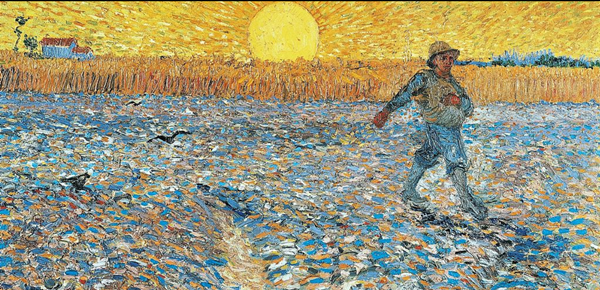
We were sitting in a circle, children and teachers, listening to the storyteller before breaking into Sunday school classes. I was teaching, as I do once a month, and sitting beside my daughter, whom I had the privilege to teach that day. The storyteller was retelling the parable of the careless sower from Matthew 13.
“A sower went out to sow. And as he sowed, some seeds fell on the path, and the birds came and ate them up. Other seeds fell on rocky ground, where they did not have much soil, and they sprang up quickly, since they had no depth of soil. But when the sun rose, they were scorched; and since they had no root, they withered away. Other seeds fell among thorns, and the thorns grew up and choked them. Other seeds fell on good soil and brought forth grain, some a hundredfold, some sixty, some thirty. Let anyone with ears listen!”
As the lady in front of us spoke of hungry birds and rocky soil, I could see the sadness descending on my daughter’s face – the eyes holding back tears, the quivering frown.
I had been afraid of this.
We would soon divide into classrooms and I would explain this parable in more depth to my daughter and a few of her peers. I wondered if any of them would share the concerns I read behind my daughter’s anxious expression. I wondered to what extent my daughter’s concerns mirrored those I had had at her age, and for most of my life, when I heard these parables of Jesus.
The kingdom of heaven is like… scattered seeds, most of which don’t grow. It sure sounded, to my young ears, like Jesus was telling a story first of those who didn’t make it to heaven before telling a story of those who did. Some seeds never had a chance; taken by birds. Were those seeds like my atheist father, no depth of faith in which to take root? How was that the fault of the seeds, and how was their fate fair, I had often wondered.
Some seeds landed in rock, taking root quickly but withering in the sun. Lazy seeds, that didn’t want to do the hard work of remaining faithful through rough times. Fair-weather Christians, who abandon God when things get rough, those who “stopped praying or going to church,” as my teacher’s guide said. That had never made sense to me either. Faith was supposed to be something we didn’t have to work for, right? It was supposed to be a gift… but it was one I was never sure I had received. I didn’t want to abandon God, but I was afraid and ashamed to admit that faith felt like work to me. It didn’t come naturally. Fear of what might happen to me if a God I didn’t know if I could believe in actually existed, and what might happen to my father and anyone else who didn’t believe, tugged at me often.
Some seeds fell among thorns, where the cares of the world choked out their life. I was determined not to let that happen to me, though I never quite understood what that meant. As a child, there really was nothing I wanted more than the assurance that God was there and that God loved me and loved everyone. But fear of my own doubt played tug of war with my desire for a loving God. If God was real, if God was love, what was hell, and what did it mean for nonbelievers, I wondered. If there was a God, I was going to spend my life trying to believe, working out my salvation with fear and trembling. Lots of fear and trembling and doubt.
Were those fears nagging at my daughter? My husband and I are raising her in the faith we have both found through our winding paths of doubt: faith in God who is Love and universal, unconditional salvation from hatred, fear, and violence. But there are other ideas of God out there, and the roads children take must someday diverge from those of their parents, even if the destination is ultimately the same. My daughter had never expressed doubt to me. I hoped she knew that she could.
But I also knew her tender heart, and I knew her fears were not only for herself, if she had any fears for herself at all.
“Can you think of people who might value things more than God? Like being rich or famous or popular?” the lady was asking. Some of the children talked about things that could distract people from God. In the sea of faces surrounding me, I didn’t see the same concern on anyone’s face as I saw on my daughter’s. It reminded me of when I had felt alone in my doubts. Bravely, she raised her hand and the teacher gestured for her to speak.
“Well,” my daughter hesitated, hiding the pain in her voice as best she could, “some people act like they don’t care what God thinks. Some people act like bullies. But I don’t think anyone is all bad. Everyone has good inside them. I think everyone can grow and become better if we just have love…”
The storyteller quickly agreed with her, but the story she had told had opened up these doubts and anxieties. I had anticipated this. Before we broke into groups, I took my daughter aside for a moment.
“Are you afraid for the seeds in this story that didn’t grow?” I asked her. She nodded, a few tears spilling from her eyes. I gave her a hug.
“Everything is all right,” I said. “I am so proud of you for your love and concern. That’s God’s seed growing inside you. When we get to the classroom, I’ll explain more.”
There weren’t other students sitting in the area marked for my daughter’s grade level, and before we broke up into our grade-level groups, I briefly wondered if my daughter would be the only student, as she had occasionally been before. Then there would be time for a deep conversation about this story that had caused me so much anxiety as a child. I wanted to tell my daughter that the seeds are God’s love, and God scatters love generously, and even if love doesn’t always flourish in our environments, God’s love is there for us. I wanted to tell her that the kingdom of God is not far away but in our hearts, and that though it is there for us when we die, it is also within us right now. I wanted to tell her that some hearts receive God’s love even before they’re ready for it, but we can help nurture that love for all people, so all seeds can grow. I wanted to tell her that the tears in her eyes were a sign that she was nourishing the love of God so much in her own heart that it would spill out to others.
But as we walked to our classroom, more people joined us. Now I would have to go back to my original lesson plan, which was to tell a few more parables and then have the children play parable charades. They would act out heaven being like a treasure buried in a field, or yeast that makes bread rise, or a net full of fish! This plan was much more about breadth than depth.
“Ok,” I told myself. “Just make it clear that God loves everyone, and that heaven is open to all.”
We came into the classroom, myself and an assistant, my daughter, and three other friends. We had about six short parables to read, including the one we had just gone over, before the kids would get to play. There was no time for a long discussion.
But just after we reviewed the parable about the farmer and the seeds, my daughter raised her hand.
“Mom, the point of this story is that the seeds that land in the good soil should help the seeds that land in the bad soil, so that they can all grow together, right?”
After church that day, I would tell her that some people go through years of seminary and even preaching without learning that lesson so well. But in that moment, I just gave her a big smile.
“Yes. Yes it is.”
Previous Post

March 12, 2018
How Progressive Christians Can Reclaim John 3:16
Browse Our Archives
Select a Category Atonement and Current Events Curriculum Faith and Families Interviews Jesus the Forgiving Victim Lent Montessori politics Reviews The Bible Explained Uncategorized Valentine's Day Wednesday Sermon Who is God?
Select a Month July 2020 November 2019 October 2019 September 2019 August 2019 July 2019 June 2019 May 2019 April 2019 March 2019 February 2019 January 2019 December 2018 November 2018 October 2018 September 2018 August 2018 July 2018 June 2018 May 2018 April 2018 March 2018 February 2018 January 2018 December 2017 November 2017 October 2017 September 2017 August 2017 July 2017 June 2017 May 2017 April 2017 March 2017 February 2017 January 2017 December 2016 November 2016 October 2016 September 2016 August 2016 June 2016 May 2016 April 2016 March 2016 February 2016 January 2016 December 2015 November 2015 October 2015 September 2015 August 2015 July 2015 June 2015 May 2015 April 2015 March 2015 February 2015 January 2015 December 2014 November 2014 October 2014 September 2014 August 2014 July 2014 June 2014 May 2014 April 2014 March 2014 January 2014 December 2013 September 2013 August 2013 July 2013
Follow Us!
TAKE THE
Religious Wisdom Quiz
Which disciple brought his brother to Jesus, saying, 'We have found the Messiah'?
Select your answer to see how you score.
Andrew Peter James John
Related posts from Teaching Nonviolent Atonement

The Secret of Life: An Interview with Audrey...

Forgiveness in the Time of COVID-19 by Julia...

Reflections on Indigenous Wisdom For Healing A Wounded...

How Forgiveness Can Transform Our Violence and Build...
TRENDING AT PATHEOS Progressive Christian

Why Christians Have a Sacred Duty to Vote:...
The Bible offers strong support for the sacred duty to vote. Here...

What Being a Modern-Day Apostle Means to Me
In my last column, I discussed the ins and outs of modern-day...

Did Ancient China Once Worship the God of...
Across human history, a common thread weaves through the origins of the...

Love Your Neighbor – Including Earth-Kin: Lev. 19,...
God’s command to love your neighbor means acting in an ethical and...

Lead a Church Study of “Jesus and Lao...
Guest writer Jack Thomas (The Irreverent Reverend) reflects on leading his church...

Principles for Understanding the Apostolic Ministry Today
Whenever people discover that my formal ministry title is "apostle," as in...
view all Progressive Christian blogs
Ad-Free & Subscriber Log-In Subscription Support
- About Us
- 2026 Calendar
- Videos
- Podcasts
- Library of World Religions
- Faith In Media Tracker
- Advertise With Us
- Write for Us
- Privacy Policy
- Terms of Service
- Do Not Sell My Data
- Contact Us
- Radiant Digital
- Manage Newsletter Subscriptions
- Unsubscribe From Notifications
- Sitemap
Copyright 2008-2026, Patheos. All rights reserved.
Subscription Support Ad-Free & Subscriber Log-In
Follow Patheos