
BuddhistCatholicContemplativeEvangelicalGeneral ChristianHinduJewishLatter-day SaintMuslimNew VisionsProgressive Christian
Beliefs
- Buddhist
- Catholic
- Contemplative
- Evangelical
- General Christian
- Hindu
- Jewish
- Latter-day Saint
- More Voices
- Muslim
- New Visions
- Pagan
- Progressive Christian
Topics
- Religion News
- Food and Religion
- Sports and Religion
- Religious Art
- Religious Music and Entertainment
- Religious Events
- History and Religion
- Style and Religion
- Politics and Religion
- Women in Religion
- Recreation Outdoors and Religion
- Business Finance and Religion
- Careers Workplace and Religion
- Education and Religion
- Family Parenting and Religion
- Health Fitness and Religion
- Home and Religion
- Relationships and Religion
- Technology and Religion
- Travel and Religion
Columnists
- Buddhist Columnists
- Business Finance and Religion Columnists
- Careers Workplace and Religion Columnists
- Catholic Columnists
- Contemplative Columnists
- Education and Religion Columnists
- Evangelists Columnists
- Family Parenting and Religion Columnists
- General Christian Columnists
- Health Fitness and Religion Columnists
- Hindu Columnists
- History and Religion Columnists
- Home and Religion Columnists
- Jewish Columnists
- More Voices Columnists
- Latter Day Columnists
- Muslim Columnists
- New Visions Columnists
- Nonreligious Columnists
- Pagan Columnists
- Politics and Religion Columnists
- Progressive Columnists
- Recreation Outdoors and Religion Columnists
- Relationships and Religion Columnists
- Religion News Columnists
- Religious Art Columnists
- Religious Events Columnists
- Religious Music and Entertainment Columnists
- Sports and Religion Columnists
- Style and Religion Columnists
- Technology and Religion Columnists
- Travel and Religion Columnists
- Women in Religion Columnists
Resource Library
- 2026 Calendar
- Library of World Religions
- The 100 Most Holy Places on Earth
- Patheos Answers
- Podcasts
- Videos
- Faith Leaders Database
- Anglican Episcopalian
- Bahai
- Baptist
- Buddhism
- Christianity
- Confucianism
- Eastern Orthodoxy
- Hinduism
- Holiness and Pentecostal
- ISKCON
- Islam
- Judaism
- Lutheran
- Methodist
- The Church of Jesus Christ of Latter-day Saints
- New Age
- Paganism
- Presbytarian and Reformed
- Protestantism
- Religion Behind the Scenes
- Roman Catholic
- Scientology
- Shia Islam
- Sikhism
- Sufism
- Sunni Islam
- Taoism
- Zen
- See all religions
Research Tools
 Ad-Free & Subscriber Log-In Subscription Support
Ad-Free & Subscriber Log-In Subscription Support
Follow Patheos 

- Trending:
- Forgiveness
- |
- Marriage
- |
- Consciousness
- |
- Death Penalty
- |
- Election
- |
- Halloween
 Teaching Nonviolent Atonement
- Home
- Progressive Christian
- Sermon: The Temple Becomes a Person
Sermon: The Temple Becomes a Person
Last updated on: March 7, 2018 at 12:53 pm by Tom Truby
Sermon: The Temple Becomes a Person 2018-03-07T12:53:43-05:00 Tom Truby
Patheos Explore the world's faith through different perspectives on religion and spirituality! Patheos has the views of the prevalent religions and spiritualities of the world.
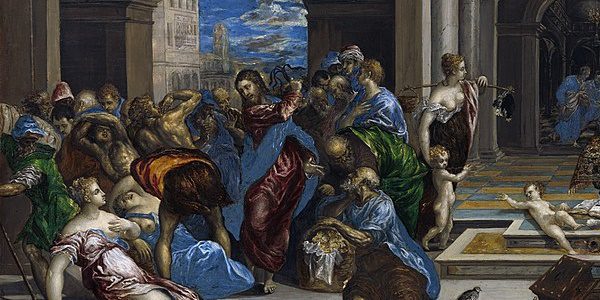
Jesus is the new temple. Instead of allowing us to believe God is wrathful and in need of being paid off to placate his wrath (like being shaken down by the Mafia), Jesus undercuts the whole thing by showing us God is not only not wrathful but nonviolent, one who not only loves us when we behave but forgives us when we misbehave.
-Rev. Tom Truby
Pastors have a frequent question when they begin to discover mimetic theory. “That’s great. But how does it preach?”
Reverend Tom Truby shows that mimetic theory is a powerful tool that enables pastors to preach the Gospel in a way that is meaningful and refreshing to the modern world. Each week, Teaching Nonviolent Atonement will highlight his sermons as examples of preaching the Gospel through mimetic theory.
Lent3-2018-The Temple Becomes a Person
March 4, 2018
Thomas L. Truby
John 2:13-22
It is Lent three on our journey to Holy week and the gospel text has switched from St. Mark to the Gospel of John. In John’s gospel the cleansing of the temple occurs at the beginning of Jesus’ ministry rather than the end. In the other three gospels the ruckus at temple is the turning point where the temple authorities decide Jesus must be killed and it is very near the end of his ministry and close to the Crucifixion. He is threatening the Temple authority’s power by declaring them unnecessary. How is he doing this? He is saying God loves all people, has no wrath toward them and therefore does not need or want them to sacrifice animals, birds, their children nor any other creature to appease him. He didn’t need to be appeased. If this was true, if Jesus was right, or if the people began believing Jesus, the Temple would be unnecessary and its priests and administrators out of business.
The synoptic gospels present this message at the end of a sequence of historical revelations and it directly leads to Jesus’ crucifixion at the hands of the powers that be. As we said last week Jesus knows this is coming and prepares his disciples by telling them “he must be rejected by the elders, the chief priests, and the scribes, and be killed, and after three days rise again. He said all of this quite plainly.” He knew that when he attacked the temple, not because he was angry, but to dramatically symbolize its uselessness and end, they would react by destroying him. It was as predictable as night following day. What they didn’t know was that the non-violent and totally benevolent Face of God that Jesus was showing all people, would also apply to them. Even as they were killing him, Jesus declared his love toward them by forgiving them. This was the point of transformation and the revelation that caused the old, human-made temple that took forty-six years to build and still wasn’t done, to collapse from the inside.
It didn’t need violence to destroy it. It only needed the truth of nonviolence and forgiveness and it imploded from within.
Tony Bartlett, who I will tell you more about in a moment, writes: “What renders the Temple redundant is forgiveness: if we humans forgive, i.e. respond nonviolently, then necessarily there will be no need for Temple and we will be one with the forgiveness/nonviolence of the Father. Forgiveness deconstructs and replaces sacrifice.”
John is different from the other three gospels. He is more theological and so starts his story with “In the beginning was the Word, and the Word was with God, and the Word was God,”—the big picture. In John’s writing the actions of Jesus’ life in relation to the Temple are so important to Jesus’ message that he starts his story with the overturning of the money changer’s tables. But it couldn’t have happened this way historically because the Temple leaders would have wiped Jesus out before he had a chance to begin to spread his news of a non-violent God if he had started his ministry there. So here we have a historical contradiction in the Bible that actually underlines the importance of the ruckus in the temple all four of the gospel writers were trying to convey.
I want now to make an aside. Just before I got sick last December I received a book by Anthony Bartlett entitled Seven Stories: How to Study and Teach the Nonviolent Bible. Tony was one of two teachers that introduced me to Girardian Theory with its emphasis on a nonviolent God and forgiveness in 2002 in Upstate New York.
I read his book eagerly, though I had difficulty comprehending what he was saying. I now wonder if the brain condition that led to my hospitalization was already affecting my thinking. After leaving the hospital I had totally forgotten that I had ever read this book in the first place. When my friend Roy insisted I had I would not believe him until he showed me the notes I had written in the margin in my own hand.
The sixth story of the seven that Tony says shaped how human’s think was entitled “The Temple and its Deconstruction.” Our lectionary passage from John traces the way Jesus announced the deconstruction, the taking apart of the Temple, and all other sacrificial institutions. “Temple” is a worldwide human institution that produces the “holy” through killing/sacrifice. I want to use Tony’s words to try to explain what Jesus was doing when he disrupted the temple.
John’s description highlights both the expulsion of the animals and the money changers. What is going on? In both cases Jesus is bringing the actual operation of the Temple to a halt. Jesus is not simply “clearing the Temple, or “cleansing “it, he is rendering sacrifice impossible. If there are no animals, there are no sacrifices. If there is no money to buy the animals, again no sacrifice.
Do you see how far this is from an angry Jesus losing his temper? This is something way, way bigger than that. From the beginning we have made God in our own image and made him angry because we have been angry. We were rivalrous and jealous toward each other and projected that onto God. Since we feel that way toward others surely God feels that way for us. Since we have seen God as wrathful and envious of us, we have attempted to appease God so that God will be good to us and let us live. The Temple is the institution that carries out this transaction. People used their scarce and hard-earned money to buy cattle, sheep and doves that would then be slaughtered and burned on the altar so that the one who bought these creatures would be safe from misfortune or disease caused by an angry God who hadn’t been paid off. But if God is not angry, and maybe even forgiving, this is not necessary.
Jesus plugs up the machinery of sacrifice. He doesn’t cleanse it as though once cleansed it can be used again. He is not clearing the Temple as though the problem had been its overcrowding with commercial interests and animal dung. He is telling the world the Temple has seen its day and Jesus is its replacement.
“The Jews then said to him, ‘What sign can you show us for doing this?’ Jesus answered them, ‘Destroy this temple, and in three days I will raise it up.’
The Jews then said, ‘This temple has been under construction for forty-six years, and will you raise it up in three days’ But he was speaking of the temple of his body.”
Jesus is the new temple. Instead of allowing us to believe God is wrathful and in need of being paid off to placate his wrath (like being shaken down by the Mafia), Jesus undercuts the whole thing by showing us God is not only not wrathful but nonviolent, one who not only loves us when we behave but forgives us when we misbehave. The forgiving body of Jesus whom God raised up in three days is the new temple. With Jesus being raised in three days, relationship is restored all around and none are lost. The human and the divine are on the same page and there is no gap between them that needs to be appeased. As Tony says, “forgiveness deconstructs and replaces sacrifice.” This new temple is not separate from the world but fills it completely. No one is excluded. There is no inner and outer chamber. Jesus as Temple is for all people. This temple doesn’t take life, it gives it. In a moment we will take Communion together where, as Tony says:
Jesus replaces the ritual of the sacrifice with this symbol of his life and death. He replaces the sacrificed animal with bread and wine, as a constantly-to-be-enacted parable of his non-violent self-giving death. Nothing is hidden here. (Seven Stories, 190.).
The Eucharist displaces sacrifice and shows Jesus as the New Temple. No sacrifice of humans or animals, no outraged blood to rile us up and move us toward violence—only the self-giving sacrifice of the Son of God represented as bread and wine. As Tony says, “What is disclosed is pure and simple nonviolence and forgiveness.” Thanks be to God. Amen.
Image: Christ Driving the Money Changers from the Temple, El Greco, Wikimedia, Public Domain.

Stay in the loop! Like Teaching Nonviolent Atonement on Facebook!
Previous Post

March 6, 2018
Guns, Racism, and Mimetic Theory: Disarming Fear With Love
Next Post
March 12, 2018 How Progressive Christians Can Reclaim John 3:16
Browse Our Archives
Select a Category Atonement and Current Events Curriculum Faith and Families Interviews Jesus the Forgiving Victim Lent Montessori politics Reviews The Bible Explained Uncategorized Valentine's Day Wednesday Sermon Who is God?
Select a Month July 2020 November 2019 October 2019 September 2019 August 2019 July 2019 June 2019 May 2019 April 2019 March 2019 February 2019 January 2019 December 2018 November 2018 October 2018 September 2018 August 2018 July 2018 June 2018 May 2018 April 2018 March 2018 February 2018 January 2018 December 2017 November 2017 October 2017 September 2017 August 2017 July 2017 June 2017 May 2017 April 2017 March 2017 February 2017 January 2017 December 2016 November 2016 October 2016 September 2016 August 2016 June 2016 May 2016 April 2016 March 2016 February 2016 January 2016 December 2015 November 2015 October 2015 September 2015 August 2015 July 2015 June 2015 May 2015 April 2015 March 2015 February 2015 January 2015 December 2014 November 2014 October 2014 September 2014 August 2014 July 2014 June 2014 May 2014 April 2014 March 2014 January 2014 December 2013 September 2013 August 2013 July 2013
Follow Us!
TAKE THE
Religious Wisdom Quiz
"Resist the devil, and he will _____."
Select your answer to see how you score.
Flee From You Pursue You Grudgingly Respect You Despise You
Related posts from Teaching Nonviolent Atonement

Forgiveness in the Time of COVID-19 by Julia...


Reflections on Indigenous Wisdom For Healing A Wounded...

How Forgiveness Can Transform Our Violence and Build...
TRENDING AT PATHEOS Progressive Christian

What Being a Modern-Day Apostle Means to Me
In my last column, I discussed the ins and outs of modern-day...

Did Ancient China Once Worship the God of...
Across human history, a common thread weaves through the origins of the...

Love Your Neighbor – Including Earth-Kin: Lev. 19,...
God’s command to love your neighbor means acting in an ethical and...

Lead a Church Study of “Jesus and Lao...
Guest writer Jack Thomas (The Irreverent Reverend) reflects on leading his church...

Pastoral Wisdom for Responding to Sermon Pushback
Getting sermon pushback on your social justice sermon? Learn practical, Proverbs-based strategies...

Principles for Understanding the Apostolic Ministry Today
Whenever people discover that my formal ministry title is "apostle," as in...
view all Progressive Christian blogs
Ad-Free & Subscriber Log-In Subscription Support
- About Us
- 2026 Calendar
- Videos
- Podcasts
- Library of World Religions
- Faith In Media Tracker
- Advertise With Us
- Write for Us
- Privacy Policy
- Terms of Service
- Do Not Sell My Data
- Contact Us
- Radiant Digital
- Manage Newsletter Subscriptions
- Unsubscribe From Notifications
- Sitemap
Copyright 2008-2026, Patheos. All rights reserved.
Subscription Support Ad-Free & Subscriber Log-In
Follow Patheos