
BuddhistCatholicContemplativeEvangelicalGeneral ChristianHinduJewishLatter-day SaintMuslimNew VisionsProgressive Christian
Beliefs
- Buddhist
- Catholic
- Contemplative
- Evangelical
- General Christian
- Hindu
- Jewish
- Latter-day Saint
- More Voices
- Muslim
- New Visions
- Pagan
- Progressive Christian
Topics
- Religion News
- Food and Religion
- Sports and Religion
- Religious Art
- Religious Music and Entertainment
- Religious Events
- History and Religion
- Style and Religion
- Politics and Religion
- Women in Religion
- Recreation Outdoors and Religion
- Business Finance and Religion
- Careers Workplace and Religion
- Education and Religion
- Family Parenting and Religion
- Health Fitness and Religion
- Home and Religion
- Relationships and Religion
- Technology and Religion
- Travel and Religion
Columnists
- Buddhist Columnists
- Business Finance and Religion Columnists
- Careers Workplace and Religion Columnists
- Catholic Columnists
- Contemplative Columnists
- Education and Religion Columnists
- Evangelists Columnists
- Family Parenting and Religion Columnists
- General Christian Columnists
- Health Fitness and Religion Columnists
- Hindu Columnists
- History and Religion Columnists
- Home and Religion Columnists
- Jewish Columnists
- More Voices Columnists
- Latter Day Columnists
- Muslim Columnists
- New Visions Columnists
- Nonreligious Columnists
- Pagan Columnists
- Politics and Religion Columnists
- Progressive Columnists
- Recreation Outdoors and Religion Columnists
- Relationships and Religion Columnists
- Religion News Columnists
- Religious Art Columnists
- Religious Events Columnists
- Religious Music and Entertainment Columnists
- Sports and Religion Columnists
- Style and Religion Columnists
- Technology and Religion Columnists
- Travel and Religion Columnists
- Women in Religion Columnists
Resource Library
- 2026 Calendar
- Library of World Religions
- The 100 Most Holy Places on Earth
- Patheos Answers
- Podcasts
- Videos
- Faith Leaders Database
- Anglican Episcopalian
- Bahai
- Baptist
- Buddhism
- Christianity
- Confucianism
- Eastern Orthodoxy
- Hinduism
- Holiness and Pentecostal
- ISKCON
- Islam
- Judaism
- Lutheran
- Methodist
- The Church of Jesus Christ of Latter-day Saints
- New Age
- Paganism
- Presbytarian and Reformed
- Protestantism
- Religion Behind the Scenes
- Roman Catholic
- Scientology
- Shia Islam
- Sikhism
- Sufism
- Sunni Islam
- Taoism
- Zen
- See all religions
Research Tools
 Ad-Free & Subscriber Log-In Subscription Support
Ad-Free & Subscriber Log-In Subscription Support
Follow Patheos 

- Trending:
- Forgiveness
- |
- Marriage
- |
- Consciousness
- |
- Death Penalty
- |
- Election
- |
- Halloween
 Teaching Nonviolent Atonement
- Home
- Progressive Christian
- Sermon: Satan, Guns, and the Flow of Divine Love
Sermon: Satan, Guns, and the Flow of Divine Love
Last updated on: February 26, 2018 at 6:52 pm by Adam Ericksen
Sermon: Satan, Guns, and the Flow of Divine Love 2018-02-26T18:52:35-05:00 Adam Ericksen
Patheos Explore the world's faith through different perspectives on religion and spirituality! Patheos has the views of the prevalent religions and spiritualities of the world.
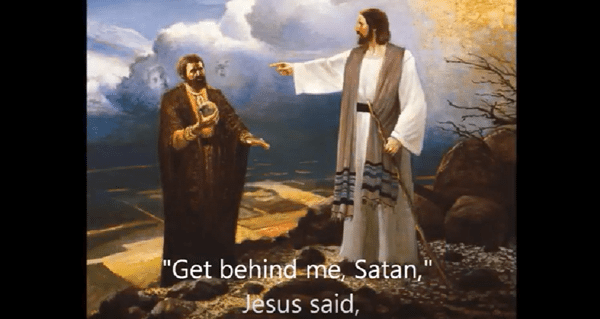
This is a sermon I preached at Clackamas United Church of Christ, in Milwaukie, Oregon. The text was Mark 8:31-38. You can read the sermon text or watch the video below.
There are only two truth statements about God in the New Testament.
These are the only two statements in the New Testament that claim “God is …” something.
These two statements are as close to a definition of God the Bible makes. Many say that you can’t put God in a box. And I think that’s right. I can’t put God in my God box. God is too big for my box. But I think God has put God’s own Self in a box. And that divine box is found in these two statements.
Both of these truth statements come from a letter in the New Testament called 1 John. The author claims to have written down what he witnessed from the beginning of Jesus’ ministry and what Jesus means to him and to the world.
And the letter can be boiled down to these two truth statements, which are:
And God is light and in him there is no darkness at all.
God is love. Period. We in the United Church of Christ like to say “Never put a period where God has put a comma.” I like that slogan. Except for when it comes to this truth statement. You see, 1 John does not say “God is love, but you better stay on God’s side otherwise God will hate you.” And it doesn’t say, “God is love, but you better not sin, otherwise God’s going to come after you with divine vengeance.” No, it just says, “God is love.”
The other truth statement is similar. It says, “God is light and in him there is no darkness at all.”
In the ancient world, darkness was associated with evil and danger. And I need to be very careful here because this association between the darkness and evil has been abused in the modern world by some Christians, especially some white Christians. Associating darkness with evil has been used to associate dark skin with evil. Anyone who associates John’s symbolism of darkness as being against people with dark skin has made an evil and racist interpretation of John’s symbolic use of the term darkness that John never intended to make.
Here’s what John meant by the darkness: in the ancient world, they didn’t have electricity, which we largely take for granted. We can easily see in the darkness of the night because we have flashlights and streetlamps. But in the ancient world, it was always very dangerous to be out at night. You never knew if your next step was going to be your last. Were you about to walk into a pit, trip over a stump, or was there a thief hiding in the bushes waiting to get you? Sure, you could bring a candle, but you never knew if a wind would blow it out. It was much safer to walk in the light of day.
That’s the point. God is love and light and in him there is no darkness. You don’t have to be afraid of God like you have to be afraid of the dark. God is not like a thief in the dark cover of the night waiting in the bushes to attack you.
Why? Because God is love. Universal, all-embracing, relentless love without any darkness or hate.
I think this is the fundamental message of progressive Christianity. God is love and there’s nothing you or I can do to separate ourselves from God’s love.
As much as I love this message, there is a little bit of a rub for me. Because, you see, God loves you and me without condition, and that means God loves everyone else without condition too.
Jesus asks a question in the sermon on the Mount. To paraphrase, Jesus asks, “If you just love your friends, what good is that? Everyone does that. Love your enemies too, because God loves your enemies.”
So what does that mean? God loves your neighbor who’s a Donald Trump supporter.
God loves the leadership of the NRA.
God loves tragically troubled teenage boys whose parents die at a young age and no one helps them deal with their pain so they take it out on others by shooting up a school. God loves the victims and survivors of those shooting. God loves those who seek a more just world where people live the prophet’s dream that swords and guns will be transformed into productive tools of peace. And God loves those who live in real or perceived fear and think their only way to protect themselves is with a gun.
So, yes, God loves all people and calls us to love all people, including those we call our enemies.
But as our passage this morning reminds us, God’s love doesn’t call us to just sit back and let evil run its course. Rather, God’s love calls us to confront and name evil wherever we see it.
Last week was the first Sunday of Lent. We heard the story of Jesus being driven into the wilderness to confront Satan. And we learned last week that the word “satan” in Hebrew refers to “tempter” and “adversary,” but the literal meaning is “accuser.” Satan tempted Jesus to become the Messiah, the king, through the satanic spirit of accusation. If Jesus followed in the steps of Satan, he would have ruled the world by uniting his followers in accusations against a common enemy.
But Jesus resisted that temptation. Instead, he lived into the flow of love that is his Abba, his Father, his God who has nothing to do with accusations or hatred or violence, but who is love and in him there is no darkness at all.
Which leads us to today’s reading. Today we hear that Jesus confronts Satan again, but this time it’s not out in the desert. It’s in one of his closest disciples. A man named Peter.
Jesus says to Peter, “Get behind me Satan! For you are setting your mind not on divine things, but on human things.”
When I was in seminary and I read this passage, two thoughts came to my mind.
First, I thought Jesus was kind of a jerk. I mean, calling Peter “Satan”? That seems a bit much.
Second, I thought I’m glad Jesus called Peter Satan, because if Peter is Satan, that means I’m not.
Well, I’ve come to understand this passage a bit differently since then.
Just before our passage today, Jesus asked his disciple what people were saying about him. “Who do people say I am?” he asked. His disciples answered that people were calling him John the Baptist or Elijah or another great prophet. Then Jesus asked them, “But who do you say that I am?”
Peter answered Jesus’ question by saying, “You are the Messiah.” The Christ. The King. And this was the right answer, but Peter was only partially correct, because there’s another part of this question. What does it mean for Jesus the Messiah, the King? What are our expectations for a political ruler?
Peter expected what we all expect from our political rulers. Someone to keep us safe and secure. And that means rulers need to defeat our enemies. It means rulers need to unite us against a common enemy.
That’s what Peter wanted. He wanted Jesus to be a king like all other kings. Peter thought that to be the Messiah meant that Jesus would kill the Roman oppressors and bring glory to Israel.
But after Peter declared Jesus as the Messiah, Jesus didn’t say he would lead a violent rebellion against Israel. Instead, he said that he would suffer and die at the hands of the Romans and religious authorities.
In other words, Jesus told his disciples that he would be a failed Messiah.
He would fail according to their expectations. And so Peter rebuked Jesus, essentially saying, “Surely not Lord! The Messiah can’t suffer like that. He’s not supposed to be killed by his enemies. He’s supposed to kill his enemies.”
But Jesus resisted the temptation Peter set before him. He rebuked Peter, saying, “Get behind me Satan! For you are setting your mind not on divine things but on human things.”
Why did Jesus call Peter Satan? Because underlying Peter’s protest was an accusation that Jesus was wrong. But Peter had his mind set on human things. Peter wanted what we all want. It’s a human thing to want to defeat our enemies. It’s a human thing to use violence to get our way, to coerce, to win.
And that’s what satan is about. In this passage, Jesus makes a close connection between Satan and this human way of thinking. Jesus says, “Get behind me Satan for you have set your mind on human things.” That’s because Satan isn’t best seen as a fallen angel. It’s best seen as a human reality, a human way of thinking. Anytime we fall into the trap of accusation and violence against others, we are falling into the ways of satan, which is all too human.
Jesus contrasts the way of Satan with the way of the divine flow of love. You see, God is the flow of eternal and unconditional love that pulsates throughout the universe. As Jesus shows in this story, it confronts human evil, human violence, wherever it’s found, even if it’s found in his right-hand man, Peter. And Jesus said that his job would be to suffer by going to the cross, and he told his disciples that in a world hell-bent on violence, we may need to pick up our crosses and follow him.
Tragically, Christians continue to look a lot like Peter. This last week, we watched Wayne LaPierre, the CEO of the NRA claim at the Conservative Political Action Conference, “There is no greater personal individual freedom than the right to keep and bear arms, the right to protect yourself, and the right to survive. It’s not bestowed by man, but granted by God to all Americans as our American birthright.”
Like Jesus, I think we need to name evil wherever we find it. And so to say that the right to keep and bear arms is the greatest personal individual freedom that we have is sick and twisted. It’s like Peter saying to Jesus that the way of the Messiah, the way of God, is not the way of love that may have to suffer at the hands of a violent world. And so to say that our greatest freedom is to own and carry a gun is idolatry.
But before I demonize LaPierre, I need to say that I’m a lot more like him than I want to admit. I’m a lot more like Peter than I want to admit. Remember that God is light and in him there is no darkness at all. So, where is the darkness? It’s in us. It’s in me.
You see, I don’t really want a Messiah who will suffer at the hands of his enemies and be killed on the cross. I don’t want a Messiah who calls me to love in such a way that in a world hell-bent on violence, I may need to suffer from that violence in the name of nonviolent love. Like LaPierre, I want a Messiah who will protect himself and me from that violence.
But that’s not the Messiah we have. We have a messiah who calls us to a bigger mission. Jesus calls us to enter the flow of divine love. Carrying a gun is not our greatest God-given freedom. Loving like Jesus and entering into the flow of God’s love is our greatest freedom. Sometimes it means naming the evil in the world without falling into a hostile spirit of accusation against those with whom we disagree. And sometimes it means we may need to pick up our cross and suffer. It’s not a necessary call to suffering. Jesus didn’t glorify suffering. The mission isn’t to suffer for the sake of suffering. The mission is to enter the flow of divine love that embraces all things and all people as we work for a more just world.
God loves you and me and Peter and Wayne Lapierre. And thank God, because I’m a lot more like Peter and Wayne LaPierre than I’d like to admit. You see, when Jesus says to Peter, “Get behind me Satan,” Jesus says the same thing to me. For the satanic principle of accusation lives inside of me, too. It’s those parts inside of me that must die, so that I can live more fully in the divine flow of love.
And so as we continue our journey into Lent, may we continue to name the darkness in the world and in ourselves.
May we come to know the God of love more fully.
And may we die to the spirit of accusation so that we may live even more fully into the divine flow of God’s love that embraces all things and all people.
Amen.
Image: Screenshot from YouTube.
Stay in the loop! Like Teaching Nonviolent Atonement on Facebook!
Previous Post

February 23, 2018
The Gun Debate: Telling the Difference Between a Mob and a Community
Next Post
February 28, 2018 Sermon: Jesus Teaches His Disciples Something Totally New
Browse Our Archives
Select a Category Atonement and Current Events Curriculum Faith and Families Interviews Jesus the Forgiving Victim Lent Montessori politics Reviews The Bible Explained Uncategorized Valentine's Day Wednesday Sermon Who is God?
Select a Month July 2020 November 2019 October 2019 September 2019 August 2019 July 2019 June 2019 May 2019 April 2019 March 2019 February 2019 January 2019 December 2018 November 2018 October 2018 September 2018 August 2018 July 2018 June 2018 May 2018 April 2018 March 2018 February 2018 January 2018 December 2017 November 2017 October 2017 September 2017 August 2017 July 2017 June 2017 May 2017 April 2017 March 2017 February 2017 January 2017 December 2016 November 2016 October 2016 September 2016 August 2016 June 2016 May 2016 April 2016 March 2016 February 2016 January 2016 December 2015 November 2015 October 2015 September 2015 August 2015 July 2015 June 2015 May 2015 April 2015 March 2015 February 2015 January 2015 December 2014 November 2014 October 2014 September 2014 August 2014 July 2014 June 2014 May 2014 April 2014 March 2014 January 2014 December 2013 September 2013 August 2013 July 2013
Follow Us!
TAKE THE
Religious Wisdom Quiz
Who rebelled against David and declared himself king at Hebron?
Select your answer to see how you score.
Amnon Absalom Adonijah Sheba
Related posts from Teaching Nonviolent Atonement

Forgiveness in the Time of COVID-19 by Julia...

Reflections on Indigenous Wisdom For Healing A Wounded...

How Forgiveness Can Transform Our Violence and Build...

Jesus Unmasked: God's Economy and How to Cheat...
TRENDING AT PATHEOS Progressive Christian

What Being a Modern-Day Apostle Means to Me
In my last column, I discussed the ins and outs of modern-day...

Did Ancient China Once Worship the God of...
Across human history, a common thread weaves through the origins of the...

Love Your Neighbor – Including Earth-Kin: Lev. 19,...
God’s command to love your neighbor means acting in an ethical and...

Lead a Church Study of “Jesus and Lao...
Guest writer Jack Thomas (The Irreverent Reverend) reflects on leading his church...

Pastoral Wisdom for Responding to Sermon Pushback
Getting sermon pushback on your social justice sermon? Learn practical, Proverbs-based strategies...

Principles for Understanding the Apostolic Ministry Today
Whenever people discover that my formal ministry title is "apostle," as in...
view all Progressive Christian blogs
Ad-Free & Subscriber Log-In Subscription Support
- About Us
- 2026 Calendar
- Videos
- Podcasts
- Library of World Religions
- Faith In Media Tracker
- Advertise With Us
- Write for Us
- Privacy Policy
- Terms of Service
- Do Not Sell My Data
- Contact Us
- Radiant Digital
- Manage Newsletter Subscriptions
- Unsubscribe From Notifications
- Sitemap
Copyright 2008-2026, Patheos. All rights reserved.
Subscription Support Ad-Free & Subscriber Log-In
Follow Patheos