
BuddhistCatholicContemplativeEvangelicalGeneral ChristianHinduJewishLatter-day SaintMuslimNew VisionsProgressive Christian
Beliefs
- Buddhist
- Catholic
- Contemplative
- Evangelical
- General Christian
- Hindu
- Jewish
- Latter-day Saint
- More Voices
- Muslim
- New Visions
- Pagan
- Progressive Christian
Topics
- Religion News
- Food and Religion
- Sports and Religion
- Religious Art
- Religious Music and Entertainment
- Religious Events
- History and Religion
- Style and Religion
- Politics and Religion
- Women in Religion
- Recreation Outdoors and Religion
- Business Finance and Religion
- Careers Workplace and Religion
- Education and Religion
- Family Parenting and Religion
- Health Fitness and Religion
- Home and Religion
- Relationships and Religion
- Technology and Religion
- Travel and Religion
Columnists
- Buddhist Columnists
- Business Finance and Religion Columnists
- Careers Workplace and Religion Columnists
- Catholic Columnists
- Contemplative Columnists
- Education and Religion Columnists
- Evangelists Columnists
- Family Parenting and Religion Columnists
- General Christian Columnists
- Health Fitness and Religion Columnists
- Hindu Columnists
- History and Religion Columnists
- Home and Religion Columnists
- Jewish Columnists
- More Voices Columnists
- Latter Day Columnists
- Muslim Columnists
- New Visions Columnists
- Nonreligious Columnists
- Pagan Columnists
- Politics and Religion Columnists
- Progressive Columnists
- Recreation Outdoors and Religion Columnists
- Relationships and Religion Columnists
- Religion News Columnists
- Religious Art Columnists
- Religious Events Columnists
- Religious Music and Entertainment Columnists
- Sports and Religion Columnists
- Style and Religion Columnists
- Technology and Religion Columnists
- Travel and Religion Columnists
- Women in Religion Columnists
Resource Library
- 2026 Calendar
- Library of World Religions
- The 100 Most Holy Places on Earth
- Patheos Answers
- Podcasts
- Videos
- Faith Leaders Database
- Anglican Episcopalian
- Bahai
- Baptist
- Buddhism
- Christianity
- Confucianism
- Eastern Orthodoxy
- Hinduism
- Holiness and Pentecostal
- ISKCON
- Islam
- Judaism
- Lutheran
- Methodist
- The Church of Jesus Christ of Latter-day Saints
- New Age
- Paganism
- Presbytarian and Reformed
- Protestantism
- Religion Behind the Scenes
- Roman Catholic
- Scientology
- Shia Islam
- Sikhism
- Sufism
- Sunni Islam
- Taoism
- Zen
- See all religions
Research Tools
 Ad-Free & Subscriber Log-In Subscription Support
Ad-Free & Subscriber Log-In Subscription Support
Follow Patheos 

- Trending:
- Forgiveness
- |
- Marriage
- |
- Consciousness
- |
- Death Penalty
- |
- Election
- |
- Halloween
 Teaching Nonviolent Atonement
- Home
- Progressive Christian
- Live Author Interview: “Anxious To Talk About It: Helping White Christians Talk Faithfully About Racism”
Live Author Interview: “Anxious To Talk About It: Helping White Christians Talk Faithfully About Racism”
Last updated on: February 5, 2018 at 5:59 pm by Adam Ericksen
Live Author Interview: “Anxious To Talk About It: Helping White Christians Talk Faithfully About Racism” 2018-02-05T17:59:47-05:00 Adam Ericksen
Patheos Explore the world's faith through different perspectives on religion and spirituality! Patheos has the views of the prevalent religions and spiritualities of the world.
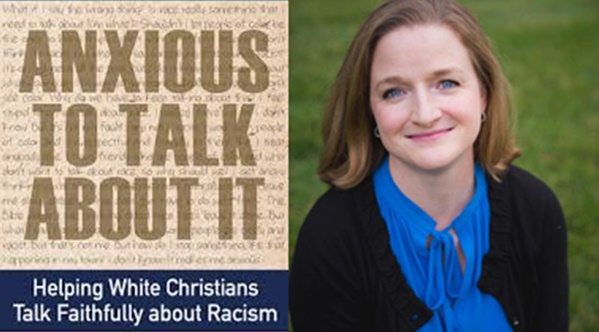
The following is a review of Carolyn Helsel’s masterful book, Anxious to Talk About It: Helping White Christians Faithfully Talk about Racism. I will be interviewing Carolyn about her book this Friday at 9:00 am Central on the Raven Foundation Facebook page. You can join us for free with your comments and questions.
Perhaps you also feel some anxiety when talking about racism in the United States. I often wonder, “What if I say something foolish?” “What if someone calls me a racist?” “I don’t know enough about the history of racism. I don’t want to look stupid.”
As a white Christian, these are a few of the thoughts that run through my head when it comes to discussions about racism. I get anxious. And then I avoid the conversation.
If you are like me and experience this kind of anxiety when it comes to discussions about racism, then Carolyn Helsel’s book Anxious to Talk about it: Helping White Christians Faithfully Talk about Racism is a must read.
Carolyn’s book is a breath of fresh air. You will not find an accusatory tone anywhere in this book. It’s a firm yet gentle invitation for white people to acknowledge our anxieties and fears when it comes to discussions of race in the United States. As Carolyn suggests, it’s only when we acknowledge our emotions that we can we manage them in compassionate ways.
Anxious to Talk about It is also a good reminder that, “There are plenty of opportunities for persons to make mistakes in the work for justice!” Carolyn’s gentleness put me at ease. Mistakes are part of the process of growing and learning. We can expect to make mistakes, and when we do, we can accept them and ourselves in the process.
And Carolyn is also firm. She writes about how racism infects our culture. Those familiar with mimetic theory will appreciate Carolyn’s writing for at least two reasons. First, she affirms that we unconsciously receive negative messages from our culture about black persons. Those messages come to us in many forms, including childhood cartoons and in the evening news. Mimetic theory claims we are formed by the “Other,” including the larger culture. This formation is largely unconscious. It’s the sea in which we swim. Often the only way we can recognize those messages is if someone points them out. That’s what Carolyn does so beautifully in this book.
Second, Carolyn claims that we need to move away from forming an identity that is in opposition to anyone else. This identity includes our racial identity. There’s a certain sense of shame when it comes to white people talking about race that involves the shame of being white. Carolyn invites us to move beyond that sense of shame, because it doesn’t help anyone. She writes that white people often “do not know how to be ‘white’ apart from this negative history of inflicting racial discrimination onto people of color. It is important for white people to be able to address racism by understanding first what it means to be white, and then be able to understand other ways that a person can be ‘white’ within this history.” The other way of being “white” within the history of racism is to be confessional about the racism that continues to infect our culture, and to work for a future where racism no longer exists.
With deep analysis and statistics and storytelling, Carolyn has given us a great gift in her book, Anxious to Talk about It. I hope you aren’t too anxious to join me as I talk with Carolyn about her book this Friday at 9:00 am CT on the Raven Foundation Facebook page!
Stay in the loop! Like Teaching Nonviolent Atonement on Facebook!
Next Post

February 7, 2018 Sermon: It’s Good to Be Home!
Browse Our Archives
Select a Category Atonement and Current Events Curriculum Faith and Families Interviews Jesus the Forgiving Victim Lent Montessori politics Reviews The Bible Explained Uncategorized Valentine's Day Wednesday Sermon Who is God?
Select a Month July 2020 November 2019 October 2019 September 2019 August 2019 July 2019 June 2019 May 2019 April 2019 March 2019 February 2019 January 2019 December 2018 November 2018 October 2018 September 2018 August 2018 July 2018 June 2018 May 2018 April 2018 March 2018 February 2018 January 2018 December 2017 November 2017 October 2017 September 2017 August 2017 July 2017 June 2017 May 2017 April 2017 March 2017 February 2017 January 2017 December 2016 November 2016 October 2016 September 2016 August 2016 June 2016 May 2016 April 2016 March 2016 February 2016 January 2016 December 2015 November 2015 October 2015 September 2015 August 2015 July 2015 June 2015 May 2015 April 2015 March 2015 February 2015 January 2015 December 2014 November 2014 October 2014 September 2014 August 2014 July 2014 June 2014 May 2014 April 2014 March 2014 January 2014 December 2013 September 2013 August 2013 July 2013
Follow Us!
TAKE THE
Religious Wisdom Quiz
What did Daniel’s vision of the ram and the goat represent?
Select your answer to see how you score.
The battle of good and evil The end of the world The fall of Jerusalem The Medo-Persian and Greek Empires
Related posts from Teaching Nonviolent Atonement

The Secret of Life: An Interview with Audrey...

Perfect Love Casts Out Fear, But Can It...

Racism: Survivors and Perpetrators Find Healing in Africa

The One Thing: My Dad, City Slickers, and...
TRENDING AT PATHEOS Progressive Christian

Why Christians Have a Sacred Duty to Vote:...
The Bible offers strong support for the sacred duty to vote. Here...

What Being a Modern-Day Apostle Means to Me
In my last column, I discussed the ins and outs of modern-day...

Did Ancient China Once Worship the God of...
Across human history, a common thread weaves through the origins of the...

Love Your Neighbor – Including Earth-Kin: Lev. 19,...
God’s command to love your neighbor means acting in an ethical and...

Lead a Church Study of “Jesus and Lao...
Guest writer Jack Thomas (The Irreverent Reverend) reflects on leading his church...

Principles for Understanding the Apostolic Ministry Today
Whenever people discover that my formal ministry title is "apostle," as in...
view all Progressive Christian blogs
Ad-Free & Subscriber Log-In Subscription Support
- About Us
- 2026 Calendar
- Videos
- Podcasts
- Library of World Religions
- Faith In Media Tracker
- Advertise With Us
- Write for Us
- Privacy Policy
- Terms of Service
- Do Not Sell My Data
- Contact Us
- Radiant Digital
- Manage Newsletter Subscriptions
- Unsubscribe From Notifications
- Sitemap
Copyright 2008-2026, Patheos. All rights reserved.
Subscription Support Ad-Free & Subscriber Log-In
Follow Patheos