
BuddhistCatholicContemplativeEvangelicalGeneral ChristianHinduJewishLatter-day SaintMuslimNew VisionsProgressive Christian
Beliefs
- Buddhist
- Catholic
- Contemplative
- Evangelical
- General Christian
- Hindu
- Jewish
- Latter-day Saint
- More Voices
- Muslim
- New Visions
- Pagan
- Progressive Christian
Topics
- Religion News
- Food and Religion
- Sports and Religion
- Religious Art
- Religious Music and Entertainment
- Religious Events
- History and Religion
- Style and Religion
- Politics and Religion
- Women in Religion
- Recreation Outdoors and Religion
- Business Finance and Religion
- Careers Workplace and Religion
- Education and Religion
- Family Parenting and Religion
- Health Fitness and Religion
- Home and Religion
- Relationships and Religion
- Technology and Religion
- Travel and Religion
Columnists
- Buddhist Columnists
- Business Finance and Religion Columnists
- Careers Workplace and Religion Columnists
- Catholic Columnists
- Contemplative Columnists
- Education and Religion Columnists
- Evangelists Columnists
- Family Parenting and Religion Columnists
- General Christian Columnists
- Health Fitness and Religion Columnists
- Hindu Columnists
- History and Religion Columnists
- Home and Religion Columnists
- Jewish Columnists
- More Voices Columnists
- Latter Day Columnists
- Muslim Columnists
- New Visions Columnists
- Nonreligious Columnists
- Pagan Columnists
- Politics and Religion Columnists
- Progressive Columnists
- Recreation Outdoors and Religion Columnists
- Relationships and Religion Columnists
- Religion News Columnists
- Religious Art Columnists
- Religious Events Columnists
- Religious Music and Entertainment Columnists
- Sports and Religion Columnists
- Style and Religion Columnists
- Technology and Religion Columnists
- Travel and Religion Columnists
- Women in Religion Columnists
Resource Library
- 2026 Calendar
- Library of World Religions
- The 100 Most Holy Places on Earth
- Patheos Answers
- Podcasts
- Videos
- Faith Leaders Database
- Anglican Episcopalian
- Bahai
- Baptist
- Buddhism
- Christianity
- Confucianism
- Eastern Orthodoxy
- Hinduism
- Holiness and Pentecostal
- ISKCON
- Islam
- Judaism
- Lutheran
- Methodist
- The Church of Jesus Christ of Latter-day Saints
- New Age
- Paganism
- Presbytarian and Reformed
- Protestantism
- Religion Behind the Scenes
- Roman Catholic
- Scientology
- Shia Islam
- Sikhism
- Sufism
- Sunni Islam
- Taoism
- Zen
- See all religions
Research Tools
 Ad-Free & Subscriber Log-In Subscription Support
Ad-Free & Subscriber Log-In Subscription Support
Follow Patheos 

- Trending:
- Forgiveness
- |
- Marriage
- |
- Consciousness
- |
- Death Penalty
- |
- Election
- |
- Halloween
 Teaching Nonviolent Atonement
- Home
- Progressive Christian
- Jesus Came to be Baptized: The Nonviolence of God
Jesus Came to be Baptized: The Nonviolence of God
Last updated on: February 21, 2018 at 1:15 pm by Tom Truby
Jesus Came to be Baptized: The Nonviolence of God 2018-02-21T13:15:38-05:00 Tom Truby
Patheos Explore the world's faith through different perspectives on religion and spirituality! Patheos has the views of the prevalent religions and spiritualities of the world.
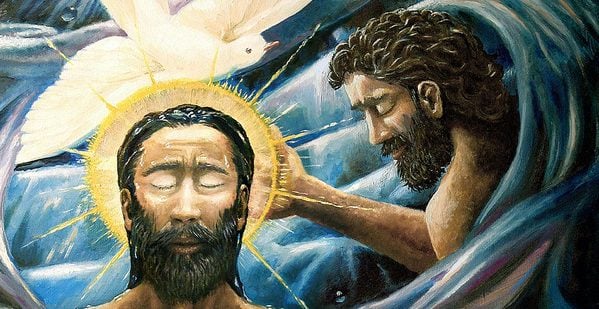
Lent 1- 2018-Jesus Came to be Baptized
February 18th, 2018
By Thomas L. Truby
Jesus Came from Nazareth of Galilee to be Baptized in the River Jordan
This has been a week full of Olympic Winter Games in South Korea. We have been watching skaters leap into the air, briefly defy gravity and then return to the ice with grace and beauty or with awkwardness and pain. Like the skaters at the Olympics, in writing this sermon I have taken bold leaps in my attempt to understand Jesus and the Gospel message. Have I soared and landed with a display of beauty and truth or have I lost the edge and fallen on my face?
Here it goes.
“In those days Jesus came from Nazareth of Galilee and was baptized by John in the Jordan.” The one sentence contains two geographical reference points, Nazareth of Galilee and the Jordan River.
Nazareth was an impoverished hill town in the interior of Galilee where the poor lived, those the rest of Galilee excluded. A Galilean who lived by the sea asked, “Can anything good come out of Nazareth?” The question suggests no one should expect much from Nazareth. Those people aren’t worth much. And yet those people were Jesus’ people and he was one of them. Galilee had some beautiful places where the water lapped against the shore but the text makes it clear this was not the place from which Jesus came. He comes from the bottom of the culture, the place where people really know about being shoved aside.
John, on the other hand, made his base at the River Jordan because the people of the Exodus had entered the Promised Land through the Jordan. From John’s point of view, they had crossed over, settled the land, and then promptly forgot their covenant with God. In God’s “anger” he had withdrawn his protection and allowed them to be conquered. This was John’s theology.
But God had made a covenant and was not done with them. He was about to return and starting from the Jordan River, would reinvade in a war between good and evil. The people could participate in the battle by allowing John to baptize them. Baptism protected them from God’s wrath by cleansing them of their sin, making them pure enough to join God in this cosmic fight.
John believed this whole battle sequence between good and evil was soon to happen. How many movies can you think of that carry this theme? And each movie competes with the last to see which can be the more graphic. John’s baptism was a way to sign up for this epic struggle. He was wildly popular with people coming from Jerusalem and all the cities and villages of the land to enlist.
In the midst of this excitement, when it was most popular to enlist, and just before the authorities clamped down and imprisoned John, Jesus came to be baptized. This was a unique and short-lived time and Jesus’ coming underscored the need for change. But Jesus has a vision much larger than John’s that he thinks will show the nonviolence of God while undercutting the power of violence over the human species.
Jesus agrees that God is about to act, but his saving act will be nonviolent. It has to be or it won’t work. Violence only leads to more violence. Jesus knows the only response to violence that works is forgiveness and that comes at a cost. Jesus will symbolically cross the Jordan and bring a new wisdom to all humanity. Not only will he bring a new wisdom, he will allow himself to be put in the position where he can offer forgiveness; a forgiveness that counters and undercuts all violence.
Having decided this he enters the waters and John’s strong hands of retributive violence push him under the flood of violence that washes through history. On the cross at the end of Lent and after forgiving us, he will drown in our violence but three days later God will raise him up.
But is he right to interpret history through this lens? No one in history had ever viewed things quite like this. Violence had always been seen as the energizer, not non-violence. He was taking a huge risk; testing his faith in his non-violent God few others could see.
“And just as he was coming up out of the water, he saw the heavens torn apart and the Spirit descending like a dove on him.” The power to tear open the heavens combined with the gentleness of a dove – what a symbol. Better the heavens torn than a fellow human being, or maybe 17 of them, unless the count has changed overnight (The number killed in this week’s school shooting in Florida). This tearing apart reveals the truth of a nonviolent and fully benevolent God who does not pit us against each other.
The young man who did the shooting is loved. He didn’t need to strike out in violence to show his disappointment and rage with the world. He was loved and he still is. The truth is with the heavens torn apart, a dove descends, not a drone or a warhead or even distorted logic meant to justify violence. A dove: could there be a gentler, more compelling symbol?
“And a voice came from heaven, ‘You are my Son, the Beloved; with you I am well pleased.’” Jesus didn’t agree with John but could see a way to accomplish what John really wanted. He would use John’s symbols but allow his own life to reveal a new depth to them. He didn’t need to be over-against John, the way of violence, he could humble himself and be baptized by him as an expression of solidarity with all peoples’ desire for peace. Choosing the way of peace was the reason the voice could say “You are my Son, the Beloved; with you I am well pleased.”
“And the Spirit immediately drove him out into the wilderness.” This Spirit that came looking like a dove drove him into the wilderness. Why? Was the testing a kind of necessary tempering to harden his resolve? You may have a plan that gives humanity a way out of their predicament but do you have what it takes to carry it out? It’s tough to go against what everyone else says: your neighbor, family, even many of your religious leaders are saying and believe that God is non-violent. So Jesus has to go through an ordeal to be sure he can maintain his edge against the abrasion of how the world thinks.
“He was in the wilderness forty days, tempted by Satan; and he was with wild beasts; and the angels waited on him.” The people of the Exodus were in the wilderness for 40 years. In both cases they have an opportunity to look at themselves, sort truth from fiction and face the ways they use excuses to evade their own growth. It’s hard to let go of our hurts, our victimage stories, and our identities built on being the victim even if the payoff is our own freedom.
For Jesus the question is: did he believe in the non-violence of God, God’s wonderful compassion toward all people with enough conviction to allow the human finger of accusation to point at him without melting? And could he believe that God would raise him up with enough conviction to go to the cross in the first place?
A voice within Jesus that Mark calls Satan says, “Give it up Jesus. You can’t save humanity. Live for the day and go with the culture.” And “the wild beasts;” I see them as vengeful impulses, lusts that have been so prevalent in the news of late and our untamed desires. They come from those primitive places within us that haven’t submitted to discipline. I am angry, feel ignored or left behind and so picture myself with a submachine gun getting even with the world. My generation largely fantasied these things and enjoyed seeing them play out on the silver screen but now, it seems, the wild beasts have gotten bolder and demand they be literally acted out.
“Now after John was arrested, Jesus came to Galilee, proclaiming the good news of God, and saying, “The time is fulfilled, and the kingdom of God has come near; repent, and believe in the good news.”
John’s message of a pure and holy violence pitted against an impure and evil violence hasn’t worked. It has only gotten him arrested and taken off the stage. But with John’s departure Jesus steps up. He has a message that does work. It involves good news that delivers us from violence; the kingdom of God that has no room for rivalry, and the conditions making it possible for us to see it, having been fulfilled. When Jesus uses the word “repent,” he means repent of violence and believe the good news of the nonviolence of God and of his kingdom built on forgiveness and compassion. Amen.
Image: Flickr: by Waiting for the Word, Baptism of Christ 10, Creative Commons License, some changes made.
Stay in the loop! Like Teaching Nonviolent Atonement on Facebook!
Previous Post

February 19, 2018
Sermon: Swimming through the Flood - Guns, Violence, and US Politics
Next Post
February 22, 2018 Jesus At The Border
Browse Our Archives
Select a Category Atonement and Current Events Curriculum Faith and Families Interviews Jesus the Forgiving Victim Lent Montessori politics Reviews The Bible Explained Uncategorized Valentine's Day Wednesday Sermon Who is God?
Select a Month July 2020 November 2019 October 2019 September 2019 August 2019 July 2019 June 2019 May 2019 April 2019 March 2019 February 2019 January 2019 December 2018 November 2018 October 2018 September 2018 August 2018 July 2018 June 2018 May 2018 April 2018 March 2018 February 2018 January 2018 December 2017 November 2017 October 2017 September 2017 August 2017 July 2017 June 2017 May 2017 April 2017 March 2017 February 2017 January 2017 December 2016 November 2016 October 2016 September 2016 August 2016 June 2016 May 2016 April 2016 March 2016 February 2016 January 2016 December 2015 November 2015 October 2015 September 2015 August 2015 July 2015 June 2015 May 2015 April 2015 March 2015 February 2015 January 2015 December 2014 November 2014 October 2014 September 2014 August 2014 July 2014 June 2014 May 2014 April 2014 March 2014 January 2014 December 2013 September 2013 August 2013 July 2013
Follow Us!
TAKE THE
Religious Wisdom Quiz
Who was Hezekiah's prophet counselor?
Select your answer to see how you score.
Ezekiel Isaiah Nathan Jeremiah
Related posts from Teaching Nonviolent Atonement

Forgiveness in the Time of COVID-19 by Julia...

Reflections on Indigenous Wisdom For Healing A Wounded...

How Forgiveness Can Transform Our Violence and Build...

Jesus Unmasked: God's Economy and How to Cheat...
TRENDING AT PATHEOS Progressive Christian

What Being a Modern-Day Apostle Means to Me
In my last column, I discussed the ins and outs of modern-day...

Did Ancient China Once Worship the God of...
Across human history, a common thread weaves through the origins of the...

Love Your Neighbor – Including Earth-Kin: Lev. 19,...
God’s command to love your neighbor means acting in an ethical and...

Lead a Church Study of “Jesus and Lao...
Guest writer Jack Thomas (The Irreverent Reverend) reflects on leading his church...

Pastoral Wisdom for Responding to Sermon Pushback
Getting sermon pushback on your social justice sermon? Learn practical, Proverbs-based strategies...

Principles for Understanding the Apostolic Ministry Today
Whenever people discover that my formal ministry title is "apostle," as in...
view all Progressive Christian blogs
Ad-Free & Subscriber Log-In Subscription Support
- About Us
- 2026 Calendar
- Videos
- Podcasts
- Library of World Religions
- Faith In Media Tracker
- Advertise With Us
- Write for Us
- Privacy Policy
- Terms of Service
- Do Not Sell My Data
- Contact Us
- Radiant Digital
- Manage Newsletter Subscriptions
- Unsubscribe From Notifications
- Sitemap
Copyright 2008-2026, Patheos. All rights reserved.
Subscription Support Ad-Free & Subscriber Log-In
Follow Patheos