
BuddhistCatholicContemplativeEvangelicalGeneral ChristianHinduJewishLatter-day SaintMuslimNew VisionsProgressive Christian
Beliefs
- Buddhist
- Catholic
- Contemplative
- Evangelical
- General Christian
- Hindu
- Jewish
- Latter-day Saint
- More Voices
- Muslim
- New Visions
- Pagan
- Progressive Christian
Topics
- Religion News
- Food and Religion
- Sports and Religion
- Religious Art
- Religious Music and Entertainment
- Religious Events
- History and Religion
- Style and Religion
- Politics and Religion
- Women in Religion
- Recreation Outdoors and Religion
- Business Finance and Religion
- Careers Workplace and Religion
- Education and Religion
- Family Parenting and Religion
- Health Fitness and Religion
- Home and Religion
- Relationships and Religion
- Technology and Religion
- Travel and Religion
Columnists
- Buddhist Columnists
- Business Finance and Religion Columnists
- Careers Workplace and Religion Columnists
- Catholic Columnists
- Contemplative Columnists
- Education and Religion Columnists
- Evangelists Columnists
- Family Parenting and Religion Columnists
- General Christian Columnists
- Health Fitness and Religion Columnists
- Hindu Columnists
- History and Religion Columnists
- Home and Religion Columnists
- Jewish Columnists
- More Voices Columnists
- Latter Day Columnists
- Muslim Columnists
- New Visions Columnists
- Nonreligious Columnists
- Pagan Columnists
- Politics and Religion Columnists
- Progressive Columnists
- Recreation Outdoors and Religion Columnists
- Relationships and Religion Columnists
- Religion News Columnists
- Religious Art Columnists
- Religious Events Columnists
- Religious Music and Entertainment Columnists
- Sports and Religion Columnists
- Style and Religion Columnists
- Technology and Religion Columnists
- Travel and Religion Columnists
- Women in Religion Columnists
Resource Library
- 2026 Calendar
- Library of World Religions
- The 100 Most Holy Places on Earth
- Patheos Answers
- Podcasts
- Videos
- Faith Leaders Database
- Anglican Episcopalian
- Bahai
- Baptist
- Buddhism
- Christianity
- Confucianism
- Eastern Orthodoxy
- Hinduism
- Holiness and Pentecostal
- ISKCON
- Islam
- Judaism
- Lutheran
- Methodist
- The Church of Jesus Christ of Latter-day Saints
- New Age
- Paganism
- Presbytarian and Reformed
- Protestantism
- Religion Behind the Scenes
- Roman Catholic
- Scientology
- Shia Islam
- Sikhism
- Sufism
- Sunni Islam
- Taoism
- Zen
- See all religions
Research Tools
 Ad-Free & Subscriber Log-In Subscription Support
Ad-Free & Subscriber Log-In Subscription Support
Follow Patheos 

- Trending:
- Forgiveness
- |
- Marriage
- |
- Consciousness
- |
- Death Penalty
- |
- Election
- |
- Halloween
 Teaching Nonviolent Atonement
- Home
- Progressive Christian
- God Is Nonviolent Love: Creation Stories, Baptism, and Martin Luther King Jr
God Is Nonviolent Love: Creation Stories, Baptism, and Martin Luther King Jr
Last updated on: January 17, 2018 at 8:55 am by Adam Ericksen
God Is Nonviolent Love: Creation Stories, Baptism, and Martin Luther King Jr 2018-01-17T08:55:12-05:00 Adam Ericksen
Patheos Explore the world's faith through different perspectives on religion and spirituality! Patheos has the views of the prevalent religions and spiritualities of the world.
The creation story in Genesis 1 starts with “In the beginning, God created the heavens and the earth.” Those are familiar words to us. We may not be able to recite what God created on certain days, but we know God spoke the world into existence. And God looks at what God has created at the end of the first day, and God says, “And it was good.” In fact, God says “And it was good after days each day except for the sixth, when God created humans. Does anyone remember what God said after humans were created? “And it was very good.” Some of us might doubt that goodness these days, but here’s the point. The Bible begins with original goodness. The earth and everything in it is good!
So, we are familiar with the creation account in Genesis 1. But did you know that there were many other stories about creation in the ancient world? One story was told in the Middle East, around the area of present-day Iraq, by a people known as the Babylonians. The first line of that story goes like this:
“In the beginning, only water and the mist that hovered above it existed.”
Apsu is the name of a god in this creation story. He was the great Father god. And there was a great Mother god named Tiamat. They were the first gods and were both gods of the water. Apsu and Tiamat did what fathers and mothers do by definition. They produced a baby god named Mummu. Then they produced other child gods and their children produced children.
So Apsu and Tiamat had grandchildren, cute little baby gods. But as we all know, cute little baby gods eventually turn into teenage gods. And teenage gods apparently like to play loud music. The story says that “The young gods joined together and had merry times. They were so rowdy that they disturbed Tiamat…” Tiamat and Apsu resented the presence of the teenage gods. Apsu complained that he couldn’t get any sleep because the teenage gods were just too loud.
Now, I know many of you have had teenagers. And I’m about to have teenagers in my house pretty soon. I’m sure many of you can relate to this story. Hopefully you won’t relate to what happens next!
So Apsu, Tiamat, and Mummu got together to discuss what they should do about the teenagers who were causing them so many problems. The Father god Apsu devised a plan to stop their ruckus the only way he knew how, “by destroying them!”
Tiamat didn’t want to kill the younger gods, but Apsu and Mummu ignored her motherly pleas. Instead, they planned to kill the teenagers because they were so loud.
The teenage gods quickly learned about Apsu and Mummu’s plan. The younger gods outnumbered Apsu and Mummu and so they captured these first gods and the teenagers had their revenge. They killed Apsu and enslaved Mummu.
It’s a pretty dysfunctional family of gods.
Tiamat was enraged that her husband was killed and her son enslaved. But the teenagers didn’t care. They only played their music louder and created more of a ruckus! Tiamat met with another god named Kingu who also couldn’t get any sleep. Kingu happened to be a military general. He told Tiamat he would help her seek vengeance against the younger gods.
At this point, the story claims that Tiamat turned from her motherly ways and became evil. She loved the idea of killing all the younger gods. She created monster serpents and filled them with venom and sharp teeth. She created vicious vipers, dragons, a sphinx, a giant lion, a mad dog, a scorpion-man, and demons to help destroy the younger gods.
The younger gods were terrified by Tiamat’s army. Each god ran in fear, until the great teenage god Marduk came to save them. Marduk was the wisest and strongest of the gods. He created his own beasts for battle against Tiamat – he named his beasts Destroyer, Relentless, Trampler, and Flier. They were more terrifying than Tiamat’s monsters, who quickly ran away at the sight of Marduk’s forces.
Tiamat and Kingu were alone when they faced off against Marduk and his army. Marduk quickly killed his enemies. Poor Tiamat and Kingu didn’t stand a chance. Marduk took Tiamat’s dead body and cut it in half. With one half he created the earth and with the other half he created the sky. He took Kingu’s blood and from it he created humanity.
According to the ancient Babylonian creation story, the heavens, the earth, and humanity were created out of a cosmic war between the gods. And all of creation is the product of the evil body of Tiamat and Kingu.
And so at the core of creation is hostility, violence, and evil that pulsates throughout the universe. And we cannot escape. We are bound to create a sense of hostile community in opposition to others. In this case it’s about age, but it could be about race or nationality or sexuality or gender. The list could go on.
Now, compare that ancient creation story told in the Middle East with the Jewish creation story we know so well:
“In the beginning, God created the heavens and the earth…”
Can you imagine ancient people as they heard these two vastly different stories? If I were in the ancient Middle East and heard someone tell the Jewish creation story, I think I’d respond by saying, “Wait. That’s it? There’s no violence? There’s no war among the gods? Where are the monsters that have to be defeat? No hostility? This story is so … boring.”
It’s helpful to know that the Babylonian Empire conquered the Jewish people. They lived out the violence of their creation story by killing many Jews, destroying the Jewish temple and Jerusalem, and kidnapping the Jewish people, and spreading them throughout the Babylonian empire. The Babylonians created a sense of community for themselves by being against other nations, including the Jewish people.
And many scholars think the Jewish creation story was finally written down during the Babylonian exile. So, the Jews would have heard the Babylonian creation story and wrote down their creation story as a reaction to the Babylonian story.
And here’s the point, the Jews resisted telling their story of creation as a violent event. There is no war among the gods. There is no hostile community over and against anyone. All God had to do was speak the universe into existence. The spirit of God doesn’t go to war. It simply hovers over creation.
God creates a good world with fundamentally good people in it. In fact, humans are created in the very image of God. Now, if I were telling the Jewish creation story and the Babylonians had just conquered my land, I would tell it differently. I would say that all humans are created in the image of God, except for those evil Babylonians. We all know that those Babylonians are jerks!
But the Jewish creation story doesn’t do that. It says that everyone, even our enemies, even those Babylonians who just conquered our people and our land, are fundamentally good and created in the image of God.
There’s a radically nonviolent spiritual strand that runs throughout the Bible, and we see it right here in the beginning with the creation story. But the Jews were also devoted to justice. Justice in the creation account isn’t based on vengeance. So often we associate justice with punishment or even revenge. But revenge would make the ancient Jews just like the Babylonians who conquered through violence.
Fortunately, the Jews found a different way. They entered into a violent world and they told a different story. A story that resisted the violence of the world with nonviolent goodness and love.
This nonviolent strand runs throughout the Bible. The same nonviolent Spirit that hovered over the waters of creation came to Jesus at his baptism. When Jesus emerged out of the waters of baptism, the Spirit descended on him like a dove, and he heard a voice from heaven say, “You are my Son, the beloved, with you I am well pleased.” Here we see Jesus being called the Son of God.
Who in the ancient world are the Sons of God? The Pharaohs. The Caesars. Those who rule with violent force.
The human Sons of God were like Marduk in the Babylonian creation myth, able to violently defeat their enemies. This is why the phrase “Son of God” is so important in the Gospels. In the ancient world, if you wanted to know what a father was like, you would look to his son. If you wanted to know what God is like, you would look to those who have the title “Son of God.” Many thought that the sons of God were those who ruled with power and might, who could exert their will over others. And so that’s what God is like.
But Jesus changed all of that for the early Christians. They said that if you want to know what God is like, if you want to know what the fundamental reality of the universe is like, look to Jesus, the true Son of God. God is like Jesus, who was born to refugee parents who fled their country to seek safety in another land. God is like Jesus, who identifies with the sinners, the outcasts, the weak and the vulnerable. God is like Jesus who taught us to forgive because we have already been forgiven for so much. And God is like Jesus, who teaches us that instead of defeating our enemies, we are to love them, because the fundamental reality of the universe is love.
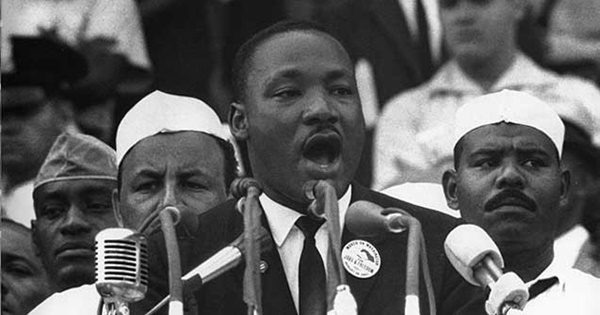
This is what Martin Luther King Jr knew so well. Following the creation account that asserts the fundamental goodness of all things and all people, and following Jesus who reveals that the nonviolent love of God pulsates throughout the universe and embraces all people, King took up the mantle of nonviolent love in his search for justice.
King wrote in his classic book titled Strength To Love, “… we love [people] not because we like them, nor because their ways appeal to us, nor even because they possess some type of divine spark; we love [everyone] because God loves them.”
This was one of King’s great gifts to us. Like the Jewish authors of Genesis 1 and like Jesus, King fought for justice by entering into the hatred and violence of the world, but he didn’t respond with hatred and violence in kind. Instead, he told a different story. Instead, he brought the love of God with him. As King would also claim, “Darkness cannot drive out darkness, only light can do that. Hate cannot drive out hate, only love can do that.”
King had a dream. Instead of a community that’s based on hostility against others, like we see in the Babylonian creation myth, King dreamed of a Beloved Community, where all people are accepted and loved no matter their age or the color of their skin. Our current president reminded us this last week with his derogatory language about Haiti, El Salvador, and African countries that we have a long way to go.
And I get angry because of this hostile attempt to divide the world into us and them. And maybe you get angry, too. Anger is fine, but don’t let it distract us from telling a better story. Because the world needs us to live into a better story that seeks a better form of justice. A story that isn’t based on responding to hostility with hostility, or anger with anger, or to hate with hate. The world needs us to live into a story that seeks justice by living into the nonviolent love of God that pulsates throughout the universe. And, as King said, we need people who trust that the arc of the moral universe is long, but it bends towards justice.
May we tell that better story.
May we help bend the moral arc of the universe towards justice.
And may we receive the unconditional love of God and share it with all that we meet.
Amen.
Image: Flickr, David Erickson, Creative Commons 2.0.
Stay in the loop! Like Teaching Nonviolent Atonement on Facebook!
Previous Post

January 12, 2018
Erica Garner's Life Teaches the Truth of "No Justice, No Peace"
Browse Our Archives
Select a Category Atonement and Current Events Curriculum Faith and Families Interviews Jesus the Forgiving Victim Lent Montessori politics Reviews The Bible Explained Uncategorized Valentine's Day Wednesday Sermon Who is God?
Select a Month July 2020 November 2019 October 2019 September 2019 August 2019 July 2019 June 2019 May 2019 April 2019 March 2019 February 2019 January 2019 December 2018 November 2018 October 2018 September 2018 August 2018 July 2018 June 2018 May 2018 April 2018 March 2018 February 2018 January 2018 December 2017 November 2017 October 2017 September 2017 August 2017 July 2017 June 2017 May 2017 April 2017 March 2017 February 2017 January 2017 December 2016 November 2016 October 2016 September 2016 August 2016 June 2016 May 2016 April 2016 March 2016 February 2016 January 2016 December 2015 November 2015 October 2015 September 2015 August 2015 July 2015 June 2015 May 2015 April 2015 March 2015 February 2015 January 2015 December 2014 November 2014 October 2014 September 2014 August 2014 July 2014 June 2014 May 2014 April 2014 March 2014 January 2014 December 2013 September 2013 August 2013 July 2013
Follow Us!
TAKE THE
Religious Wisdom Quiz
Who was Timothy's mother?
Select your answer to see how you score.
Mary Priscilla Lois Eunice
Related posts from Teaching Nonviolent Atonement
Thoughts Beyond Vietnam: A Contemporary Reflection On Martin...
Jesus Came to Party: The Girardian Virtual Bible...

Living Boldly in a World of Shame
Battling From The Beginning: From Columbus To Afghanistan
TRENDING AT PATHEOS Progressive Christian

Why Christians Have a Sacred Duty to Vote:...
The Bible offers strong support for the sacred duty to vote. Here...

What Being a Modern-Day Apostle Means to Me
In my last column, I discussed the ins and outs of modern-day...

Did Ancient China Once Worship the God of...
Across human history, a common thread weaves through the origins of the...

Love Your Neighbor – Including Earth-Kin: Lev. 19,...
God’s command to love your neighbor means acting in an ethical and...

Lead a Church Study of “Jesus and Lao...
Guest writer Jack Thomas (The Irreverent Reverend) reflects on leading his church...

Principles for Understanding the Apostolic Ministry Today
Whenever people discover that my formal ministry title is "apostle," as in...
view all Progressive Christian blogs
Ad-Free & Subscriber Log-In Subscription Support
- About Us
- 2026 Calendar
- Videos
- Podcasts
- Library of World Religions
- Faith In Media Tracker
- Advertise With Us
- Write for Us
- Privacy Policy
- Terms of Service
- Do Not Sell My Data
- Contact Us
- Radiant Digital
- Manage Newsletter Subscriptions
- Unsubscribe From Notifications
- Sitemap
Copyright 2008-2026, Patheos. All rights reserved.
Subscription Support Ad-Free & Subscriber Log-In
Follow Patheos