
BuddhistCatholicContemplativeEvangelicalGeneral ChristianHinduJewishLatter-day SaintMuslimNew VisionsProgressive Christian
Beliefs
- Buddhist
- Catholic
- Contemplative
- Evangelical
- General Christian
- Hindu
- Jewish
- Latter-day Saint
- More Voices
- Muslim
- New Visions
- Pagan
- Progressive Christian
Topics
- Religion News
- Food and Religion
- Sports and Religion
- Religious Art
- Religious Music and Entertainment
- Religious Events
- History and Religion
- Style and Religion
- Politics and Religion
- Women in Religion
- Recreation Outdoors and Religion
- Business Finance and Religion
- Careers Workplace and Religion
- Education and Religion
- Family Parenting and Religion
- Health Fitness and Religion
- Home and Religion
- Relationships and Religion
- Technology and Religion
- Travel and Religion
Columnists
- Buddhist Columnists
- Business Finance and Religion Columnists
- Careers Workplace and Religion Columnists
- Catholic Columnists
- Contemplative Columnists
- Education and Religion Columnists
- Evangelists Columnists
- Family Parenting and Religion Columnists
- General Christian Columnists
- Health Fitness and Religion Columnists
- Hindu Columnists
- History and Religion Columnists
- Home and Religion Columnists
- Jewish Columnists
- More Voices Columnists
- Latter Day Columnists
- Muslim Columnists
- New Visions Columnists
- Nonreligious Columnists
- Pagan Columnists
- Politics and Religion Columnists
- Progressive Columnists
- Recreation Outdoors and Religion Columnists
- Relationships and Religion Columnists
- Religion News Columnists
- Religious Art Columnists
- Religious Events Columnists
- Religious Music and Entertainment Columnists
- Sports and Religion Columnists
- Style and Religion Columnists
- Technology and Religion Columnists
- Travel and Religion Columnists
- Women in Religion Columnists
Resource Library
- 2026 Calendar
- Library of World Religions
- The 100 Most Holy Places on Earth
- Patheos Answers
- Podcasts
- Videos
- Faith Leaders Database
- Anglican Episcopalian
- Bahai
- Baptist
- Buddhism
- Christianity
- Confucianism
- Eastern Orthodoxy
- Hinduism
- Holiness and Pentecostal
- ISKCON
- Islam
- Judaism
- Lutheran
- Methodist
- The Church of Jesus Christ of Latter-day Saints
- New Age
- Paganism
- Presbytarian and Reformed
- Protestantism
- Religion Behind the Scenes
- Roman Catholic
- Scientology
- Shia Islam
- Sikhism
- Sufism
- Sunni Islam
- Taoism
- Zen
- See all religions
Research Tools
 Ad-Free & Subscriber Log-In Subscription Support
Ad-Free & Subscriber Log-In Subscription Support
Follow Patheos 

- Trending:
- Forgiveness
- |
- Marriage
- |
- Consciousness
- |
- Death Penalty
- |
- Election
- |
- Halloween
 Teaching Nonviolent Atonement
- Home
- Progressive Christian
- Erica Garner’s Life Teaches the Truth of “No Justice, No Peace”
Erica Garner’s Life Teaches the Truth of “No Justice, No Peace”
Last updated on: January 16, 2018 at 5:41 am by Lindsey Paris-Lopez
Erica Garner’s Life Teaches the Truth of “No Justice, No Peace” 2018-01-16T05:41:38-05:00 Lindsey Paris-Lopez
Patheos Explore the world's faith through different perspectives on religion and spirituality! Patheos has the views of the prevalent religions and spiritualities of the world.
 “No justice, no peace.”
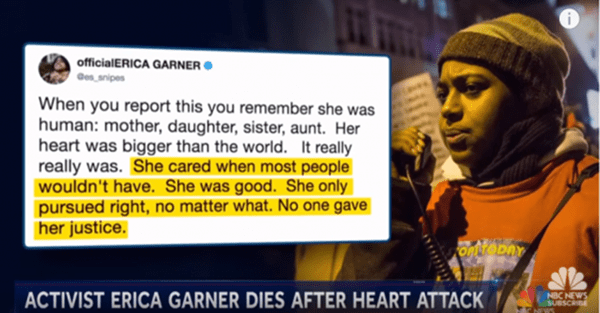
These words are not a threat, they’re a fact. And nothing could more powerfully demonstrate this fact than the life and death of anti-racist activist Erica Garner.
Erica Garner’s untimely death at age 27 drew the year 2017 to a bitter close. After three and a half years of struggling for justice in the wake of her father, Eric Garner, being choked to death by the New York Police Department – after bi-weekly vigils and die-ins and marches, petitioning and organizing, standing in solidarity with others who lost loved ones to police violence and systemic racism, of raising her voice on behalf of those whose voices were silenced – racism broke her heart.
If you don’t know very much about Erica Garner, I recommend you go to her official website and read her own words. Then read this beautiful tribute from her friend, Kristen West Savali, and this reflection from her family lawyer, Reggie Harris. Those who knew her – who struggled with her and felt her love as they worked together to make black lives matter to an uncaring, exploitive nation – they give us the clearest glimpses of her life and message. Those in the trenches with Erica can tell her story.
The best I can do to try to honor Erica Garner is listen and point to those who knew her and take up my responsibility in the struggle for racial justice. One aspect of that struggle is helping people understand that Black Lives Matter and movements to hold law enforcement accountable are driven by concern for the health and safety of communities, not a sense of revenge. I know there are people who distrust or even denounce social justice work because they confuse it with vengeance. There are people who interpret “No justice, no peace,” as a threat to return violence for violence. It would be more appropriate to interpret this phrase as a wake-up call to the reality of insecurity and instability that keep people living under injustice from being at peace. Those who only see the warning, and not the reality, of these words will never be able to understand and support those who are crying out for their survival.
There is indeed a warning in this message. A society that perpetuates injustice cannot survive forever; people will rise up in defense of themselves. A society where black people are killed with impunity is not safe and certainly not peaceful for them, and the peace others may experience in such a society is a false and unstable peace. But the violence of injustice that makes life hell for African Americans in this country is not echoed in peaceful marches and protests. It can be unnerving to have our eyes opened to injustices that we may participate in or perpetuate, but it is not violent. The media has a history of stoking anxieties and raising defenses by portraying peaceful protests as riots, and social pressures and conventions make white people uncomfortable when our prejudices and biases are pointed out to us. But those of us with white privilege need to lower our defenses, lower our voices, and open our eyes to the reality around us. Injustice kills. Without justice, no one can be at peace.
Erica Garner’s life and death remind us that when racism claims a life, when violence claims a life, when enmity claims a life, so many more lives are affected. Violence is never limited, never contained in the body of the one injured or killed. The deep, systemic violence of structural racism which affects all black and brown lives personally is compounded by the suffering that spreads through families and communities when one person is subjected to injustice. Deep and intertwined networks of human pain flow from systems of dehumanization and oppression.
Racism can kill immediately, through chokeholds or gunshots or rough rides, but it also kills slowly, through stress, trauma, and heartache. In fact, studies have shown that black women bear long-term costs – physical and emotional as well as financial – of police violence when black men are physically arrested, assaulted, or killed (which is not to say that these immediate acts of violence do not also happen to women.) From the financial burdens of court costs and income loss to increased stress of childcare without extra support to the emotional torment of a system that overwhelmingly justifies excessive police force, the burdens of excessive police force and a racially-biased criminal justice system (to name just two manifestations of racism) are less publicized but just as brutal for women as they are for men.
Erica Garner bore the grief and trauma of losing her father while striving for justice not only for herself, but for all who shared her fate of losing a loved one to a violent racist system. In her empathy and compassion, she took the pain of so many grieving families along with her own into her fight. She struggled against the racism that continued to take one black life after another until it took her own.
Her autopsy won’t identify injustice as the cause of her death, but it is clear that racism would not allow Erica Garner to live in peace. “No justice, no peace,” is meant to rouse from complacency all who don’t feel the crushing load of injustice. It is a wake-up call to a reality that privilege obscures. There is no peace in a nation in which a man can be choked to death for selling loose cigarettes (which Eric Garner was not doing at the time of his fatal arrest) and a badge shields his killer from consequences. There is no peace in a nation in which a man feels a need to extra-legally sell cigarettes in order to provide for a family with six children. There is no peace in a nation where the average white household has 16 times the wealth of the average African American household, in large part because white families were able to pass down wealth that was non-existent to Africans who worked for no wages under slavery and low wages under segregation. There is no peace in a nation that has a school-to-prison pipeline for African American children. A nation that ignores, rationalizes or justifies cruelty and inequality is not at peace.
The phrase, “No justice, no peace,” therefore, is an acknowledgement of violence in the present. Any sense of peace one can have while others suffer from the insecurity, trauma, and hopelessness of injustice is a false peace, a peace built on victimization (even if unconscious). That kind of peace is unsustainable and will collapse in crisis. Until there is justice, peace is worse than an illusion; it’s a lie that conceals suffering.
Ours is not a peaceful nation, because it has been built on a foundation of injustice. Erica Garner worked for justice – not only for consequences for officers who act as judge, jury and executioner, but also for a more compassionate criminal justice system and a world where black lives matter. She and so many others lived and died waiting and working and struggling for justice, for recognition of their human dignity, for an end to the systemic violence that includes employment and housing discrimination, targeting and unequal treatment in the criminal justice system, substandard treatment in health and education, and so much more. They strove for the rights that we all should be able to take for granted. And when the rights of some are in jeopardy, the rights of all rest on a flimsy foundation. A nation built on violence will collapse.
If we want to create a peaceful world, we must follow Erica Garner’s lead and work for justice.
Stay in the loop! Like Teaching Nonviolent Atonement on Facebook!

Browse Our Archives
Select a Category Atonement and Current Events Curriculum Faith and Families Interviews Jesus the Forgiving Victim Lent Montessori politics Reviews The Bible Explained Uncategorized Valentine's Day Wednesday Sermon Who is God?
Select a Month July 2020 November 2019 October 2019 September 2019 August 2019 July 2019 June 2019 May 2019 April 2019 March 2019 February 2019 January 2019 December 2018 November 2018 October 2018 September 2018 August 2018 July 2018 June 2018 May 2018 April 2018 March 2018 February 2018 January 2018 December 2017 November 2017 October 2017 September 2017 August 2017 July 2017 June 2017 May 2017 April 2017 March 2017 February 2017 January 2017 December 2016 November 2016 October 2016 September 2016 August 2016 June 2016 May 2016 April 2016 March 2016 February 2016 January 2016 December 2015 November 2015 October 2015 September 2015 August 2015 July 2015 June 2015 May 2015 April 2015 March 2015 February 2015 January 2015 December 2014 November 2014 October 2014 September 2014 August 2014 July 2014 June 2014 May 2014 April 2014 March 2014 January 2014 December 2013 September 2013 August 2013 July 2013
Follow Us!
TAKE THE
Religious Wisdom Quiz
How many times did Peter deny Jesus?
Select your answer to see how you score.
4 2 5 3
Related posts from Teaching Nonviolent Atonement

Beyond Police Accountability: Building Cultures of Compassion

Toxic Christianity: 3 Things We Can Do That...

The Secret of Life: An Interview with Audrey...

Forgiveness in the Time of COVID-19 by Julia...
TRENDING AT PATHEOS Progressive Christian

Why Christians Have a Sacred Duty to Vote:...
The Bible offers strong support for the sacred duty to vote. Here...

What Being a Modern-Day Apostle Means to Me
In my last column, I discussed the ins and outs of modern-day...

Did Ancient China Once Worship the God of...
Across human history, a common thread weaves through the origins of the...

Love Your Neighbor – Including Earth-Kin: Lev. 19,...
God’s command to love your neighbor means acting in an ethical and...

Lead a Church Study of “Jesus and Lao...
Guest writer Jack Thomas (The Irreverent Reverend) reflects on leading his church...

Principles for Understanding the Apostolic Ministry Today
Whenever people discover that my formal ministry title is "apostle," as in...
view all Progressive Christian blogs
Ad-Free & Subscriber Log-In Subscription Support
- About Us
- 2026 Calendar
- Videos
- Podcasts
- Library of World Religions
- Faith In Media Tracker
- Advertise With Us
- Write for Us
- Privacy Policy
- Terms of Service
- Do Not Sell My Data
- Contact Us
- Radiant Digital
- Manage Newsletter Subscriptions
- Unsubscribe From Notifications
- Sitemap
Copyright 2008-2026, Patheos. All rights reserved.
Subscription Support Ad-Free & Subscriber Log-In
Follow Patheos