
BuddhistCatholicContemplativeEvangelicalGeneral ChristianHinduJewishLatter-day SaintMuslimNew VisionsProgressive Christian
Beliefs
- Buddhist
- Catholic
- Contemplative
- Evangelical
- General Christian
- Hindu
- Jewish
- Latter-day Saint
- More Voices
- Muslim
- New Visions
- Pagan
- Progressive Christian
Topics
- Religion News
- Food and Religion
- Sports and Religion
- Religious Art
- Religious Music and Entertainment
- Religious Events
- History and Religion
- Style and Religion
- Politics and Religion
- Women in Religion
- Recreation Outdoors and Religion
- Business Finance and Religion
- Careers Workplace and Religion
- Education and Religion
- Family Parenting and Religion
- Health Fitness and Religion
- Home and Religion
- Relationships and Religion
- Technology and Religion
- Travel and Religion
Columnists
- Buddhist Columnists
- Business Finance and Religion Columnists
- Careers Workplace and Religion Columnists
- Catholic Columnists
- Contemplative Columnists
- Education and Religion Columnists
- Evangelists Columnists
- Family Parenting and Religion Columnists
- General Christian Columnists
- Health Fitness and Religion Columnists
- Hindu Columnists
- History and Religion Columnists
- Home and Religion Columnists
- Jewish Columnists
- More Voices Columnists
- Latter Day Columnists
- Muslim Columnists
- New Visions Columnists
- Nonreligious Columnists
- Pagan Columnists
- Politics and Religion Columnists
- Progressive Columnists
- Recreation Outdoors and Religion Columnists
- Relationships and Religion Columnists
- Religion News Columnists
- Religious Art Columnists
- Religious Events Columnists
- Religious Music and Entertainment Columnists
- Sports and Religion Columnists
- Style and Religion Columnists
- Technology and Religion Columnists
- Travel and Religion Columnists
- Women in Religion Columnists
Resource Library
- 2026 Calendar
- Library of World Religions
- The 100 Most Holy Places on Earth
- Patheos Answers
- Podcasts
- Videos
- Faith Leaders Database
- Anglican Episcopalian
- Bahai
- Baptist
- Buddhism
- Christianity
- Confucianism
- Eastern Orthodoxy
- Hinduism
- Holiness and Pentecostal
- ISKCON
- Islam
- Judaism
- Lutheran
- Methodist
- The Church of Jesus Christ of Latter-day Saints
- New Age
- Paganism
- Presbytarian and Reformed
- Protestantism
- Religion Behind the Scenes
- Roman Catholic
- Scientology
- Shia Islam
- Sikhism
- Sufism
- Sunni Islam
- Taoism
- Zen
- See all religions
Research Tools
 Ad-Free & Subscriber Log-In Subscription Support
Ad-Free & Subscriber Log-In Subscription Support
Follow Patheos 

- Trending:
- Forgiveness
- |
- Marriage
- |
- Consciousness
- |
- Death Penalty
- |
- Election
- |
- Halloween
 Teaching Nonviolent Atonement
- Home
- Progressive Christian
- Sermon: Saints!
Sermon: Saints!
Last updated on: November 10, 2017 at 8:47 pm by Tom Truby
Sermon: Saints! 2017-11-10T20:47:17-05:00 Tom Truby
Patheos Explore the world's faith through different perspectives on religion and spirituality! Patheos has the views of the prevalent religions and spiritualities of the world.
Jesus’ values include blessings and fullness of life for everyone.
The anti-Jesus values have rewards for some but great sorrow, suffering, and violence for others.
-Rev. Tom Truby
Pastors have a frequent question when they begin to discover mimetic theory. “That’s great. But how does it preach?”
Reverend Tom Truby shows that mimetic theory is a powerful tool that enables pastors to preach the Gospel in a way that is meaningful and refreshing to the modern world. Each week, Teaching Nonviolent Atonement will highlight his sermons as examples of preaching the Gospel through mimetic theory.
In this sermon, Tom discusses the Christian celebration of All Saints Day. According to the book of Revelation, the saints are those who refuse to return violence for violence, “because they have been grasped by a new vision of humanity” in Jesus. Read on to discover the new humanity that Jesus offers!
Year—A, All Saints November 5th, 2017
Revelation 7:9-17; 1 John 3:1-7; Matthew 5:1-12
Saints!
This morning we will be naming some of our saints. When I think about our saints, this passage from Revelation 7 comes to mind.
9 After this I looked, and there was a great crowd that no one could number. They were from every nation, tribe, people, and language. They were standing before the throne and before the Lamb. They wore white robes and held palm branches in their hands. 10 They cried out with a loud voice:
“Victory belongs to our God
who sits on the throne,
and to the Lamb.”
11 All the angels stood in a circle around the throne, and around the elders and the four living creatures. They fell facedown before the throne and worshipped God, 12 saying,
“Amen! Blessing and glory
and wisdom and thanksgiving
and honor and power and might
be to our God forever and always. Amen.”
13 Then one of the elders said to me, “Who are these people wearing white robes, and where did they come from?”
14 I said to him, “Sir, you know.”
Then he said to me, “These people have come out of great hardship. They have washed their robes and made them white in the Lamb’s blood. 15 This is the reason they are before God’s throne. They worship him day and night in his temple, and the one seated on the throne will shelter them. 16 They won’t hunger or thirst anymore. No sun or scorching heat will beat down on them, 17 because the Lamb who is in the midst of the throne will shepherd them. He will lead them to the springs of life-giving water, and God will wipe away every tear from their eyes.
This passage provides a glimpse of the Lamb’s role in bringing all to the merciful throne of God. It is a passage for those who have suffered and yet maintain their hope.
The Book of Revelation was written to people who were experiencing suffering and death at the hands of empire because they had been grasped by a new vision of humanity. These were people offended by the world’s cruelty who had found an alternative in Jesus.
Before Jesus, humans have always expected salvation to come from warriors, strong men, and overwhelming force. But God surprises us, for at the center of the throne we find a slain lamb, standing, who has become our shepherd, who guides us to springs of the water of life. Human robes, soiled by the great ordeal out of which we have come, are washed and made white by the blood of the Lamb.
The Lamb of God, gentle and innocent, who himself suffered the cruelty of the world, exposed human cruelty and transformed it by forgiving those caught doing it. Now all who have died in the midst of the struggle wave palm branches and sing, “Salvation belongs to our God who is seated on the throne, and to the Lamb.” A great multitude sings from every nation, from all tribes and peoples and languages, so many that no one can count!
All Saints Sunday presents us with a second reading so beautiful I don’t know how to preach it without ruining it.
See what love the Father has given us, that we should be called children of God; and that is what we are. The reason the world does not know us is that it did not know him. Beloved, we are God’s children now; what we will be has not yet been revealed. What we do know is this: when he is revealed, we will be like him, for we will see him as he is. And all who have this hope in him purify themselves, just as he is pure. 1 John 3:1-7
This morning we celebrate the Saints who reflect him, but in the future we will have Jesus himself. This hope powerfully shapes us from the inside.
How do saints live? What are the values they embrace when they are being saints?
Early in his ministry, Jesus laid out his values in the Sermon on the Mount. These values were different than the values of the culture around them. Paul Neuchterlein, in a document just written, contrasts Jesus’ values with the values of empire and nationalism—the usual values of the culture around us no matter where we live. Remember Jesus’ values are meant for disciples, those who want to follow Jesus, not the crowds who didn’t know Jesus very well. The text says “When Jesus saw the crowds, he went up the mountain.” He was escaping the crowds. I had never seen that before but there it is. We wanted to speak privately and intimately to his disciples. As he goes up the mountain think of Moses on the mountain with the people far below, only now we have Jesus and his disciples, a community, rather than Moses alone.
Here are The Beatitudes using the New Revised Standard Version of the Bible followed by Neuchterlein’s imaginative anti-beatitudes. I offer them as food for thought:
- Blessed are the poor in spirit, for theirs is the kingdom of heaven. Popular and “rewarded are the patriots, for theirs is the reign of Empire.” (I added the word popular in this and the following anti-beatitudes.)
- Blessed are those who mourn, for they will be comforted. Popular and “rewarded are the tough-minded, for they will at all costs.”
- Blessed are the meek, for they will inherit the earth. Popular and “rewarded are the militaristic, for they are taking the world by force.”
- Blessed are those who hunger and thirst for righteousness, for they will be filled. Popular and “rewarded are those who hunger and thirst for their own self-interest, for they are being filled.
- Blessed are the merciful, for they will receive mercy. Popular and “rewarded are the independent self-made persons, for they are receiving freedom from others.”
- Blessed are the pure in heart, for they will see God. Popular and “rewarded are those loyal to family and nation, for they see the favor of their national gods.”
- Blessed are the peacemakers, for they will be called children of God. Popular and “rewarded are the peace-through-strength-makers, for they are lauded as patriot-citizens.
- Blessed are those who are persecuted for righteousness’ sake, for theirs is the kingdom of heaven. Poplar and “rewarded are those who pursue their own success at all costs to others, for theirs is the imperial reign.”
- Blessed are you when people revile you and persecute you and utter all kinds of evil against you falsely on my account. 12. Rejoice and be glad, for hour reward is great in heaven, for in the same way they persecuted the prophets who were before you.
Popular and “rewarded are you when all speak well of you and privilege you and prop you up against the empire’s enemies. Rejoice and be glad, for in the same way the empire has always put down its enemies.”
Jesus’ values include blessings and fullness of life for everyone. The anti-Jesus values have rewards for some but great sorrow, suffering and violence for others.
It’s when our saints were able to live Jesus’ values that we remember them as saints. It’s when they were for us rather than just themselves; it’s when they felt with us rather than push us aside, and it’s when they were willing to suffer, even at our hand, rather than inflict suffering that we remember them as saints. These are the times when God’s light shone through them and we thank God. Amen.
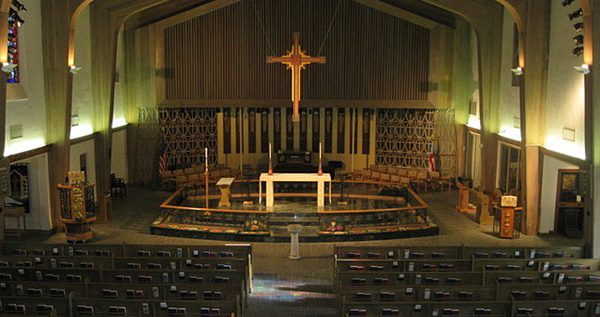
Image: All Saints Church, Fort Lauderda, FL, CC0, Link
Like Teaching Nonviolent Atonement on Facebook!
Previous Post

November 8, 2017
Why Richard Dawkins Needs Sunday School
Next Post
November 13, 2017 Sermon: The Virtue of Being Foolish
Browse Our Archives
Select a Category Atonement and Current Events Curriculum Faith and Families Interviews Jesus the Forgiving Victim Lent Montessori politics Reviews The Bible Explained Uncategorized Valentine's Day Wednesday Sermon Who is God?
Select a Month July 2020 November 2019 October 2019 September 2019 August 2019 July 2019 June 2019 May 2019 April 2019 March 2019 February 2019 January 2019 December 2018 November 2018 October 2018 September 2018 August 2018 July 2018 June 2018 May 2018 April 2018 March 2018 February 2018 January 2018 December 2017 November 2017 October 2017 September 2017 August 2017 July 2017 June 2017 May 2017 April 2017 March 2017 February 2017 January 2017 December 2016 November 2016 October 2016 September 2016 August 2016 June 2016 May 2016 April 2016 March 2016 February 2016 January 2016 December 2015 November 2015 October 2015 September 2015 August 2015 July 2015 June 2015 May 2015 April 2015 March 2015 February 2015 January 2015 December 2014 November 2014 October 2014 September 2014 August 2014 July 2014 June 2014 May 2014 April 2014 March 2014 January 2014 December 2013 September 2013 August 2013 July 2013
Follow Us!
TAKE THE
Religious Wisdom Quiz
What was the primary water source in Jerusalem?
Select your answer to see how you score.
Well Spring Rain collection River
Related posts from Teaching Nonviolent Atonement

Forgiveness in the Time of COVID-19 by Julia...


Reflections on Indigenous Wisdom For Healing A Wounded...

How Forgiveness Can Transform Our Violence and Build...
TRENDING AT PATHEOS Progressive Christian

What Being a Modern-Day Apostle Means to Me
In my last column, I discussed the ins and outs of modern-day...

Did Ancient China Once Worship the God of...
Across human history, a common thread weaves through the origins of the...

Love Your Neighbor – Including Earth-Kin: Lev. 19,...
God’s command to love your neighbor means acting in an ethical and...

Lead a Church Study of “Jesus and Lao...
Guest writer Jack Thomas (The Irreverent Reverend) reflects on leading his church...

Pastoral Wisdom for Responding to Sermon Pushback
Getting sermon pushback on your social justice sermon? Learn practical, Proverbs-based strategies...

Principles for Understanding the Apostolic Ministry Today
Whenever people discover that my formal ministry title is "apostle," as in...
view all Progressive Christian blogs
Ad-Free & Subscriber Log-In Subscription Support
- About Us
- 2026 Calendar
- Videos
- Podcasts
- Library of World Religions
- Faith In Media Tracker
- Advertise With Us
- Write for Us
- Privacy Policy
- Terms of Service
- Do Not Sell My Data
- Contact Us
- Radiant Digital
- Manage Newsletter Subscriptions
- Unsubscribe From Notifications
- Sitemap
Copyright 2008-2026, Patheos. All rights reserved.
Subscription Support Ad-Free & Subscriber Log-In
Follow Patheos