
BuddhistCatholicContemplativeEvangelicalGeneral ChristianHinduJewishLatter-day SaintMuslimNew VisionsProgressive Christian
Beliefs
- Buddhist
- Catholic
- Contemplative
- Evangelical
- General Christian
- Hindu
- Jewish
- Latter-day Saint
- More Voices
- Muslim
- New Visions
- Pagan
- Progressive Christian
Topics
- Religion News
- Food and Religion
- Sports and Religion
- Religious Art
- Religious Music and Entertainment
- Religious Events
- History and Religion
- Style and Religion
- Politics and Religion
- Women in Religion
- Recreation Outdoors and Religion
- Business Finance and Religion
- Careers Workplace and Religion
- Education and Religion
- Family Parenting and Religion
- Health Fitness and Religion
- Home and Religion
- Relationships and Religion
- Technology and Religion
- Travel and Religion
Columnists
- Buddhist Columnists
- Business Finance and Religion Columnists
- Careers Workplace and Religion Columnists
- Catholic Columnists
- Contemplative Columnists
- Education and Religion Columnists
- Evangelists Columnists
- Family Parenting and Religion Columnists
- General Christian Columnists
- Health Fitness and Religion Columnists
- Hindu Columnists
- History and Religion Columnists
- Home and Religion Columnists
- Jewish Columnists
- More Voices Columnists
- Latter Day Columnists
- Muslim Columnists
- New Visions Columnists
- Nonreligious Columnists
- Pagan Columnists
- Politics and Religion Columnists
- Progressive Columnists
- Recreation Outdoors and Religion Columnists
- Relationships and Religion Columnists
- Religion News Columnists
- Religious Art Columnists
- Religious Events Columnists
- Religious Music and Entertainment Columnists
- Sports and Religion Columnists
- Style and Religion Columnists
- Technology and Religion Columnists
- Travel and Religion Columnists
- Women in Religion Columnists
Resource Library
- 2026 Calendar
- Library of World Religions
- The 100 Most Holy Places on Earth
- Patheos Answers
- Podcasts
- Videos
- Faith Leaders Database
- Anglican Episcopalian
- Bahai
- Baptist
- Buddhism
- Christianity
- Confucianism
- Eastern Orthodoxy
- Hinduism
- Holiness and Pentecostal
- ISKCON
- Islam
- Judaism
- Lutheran
- Methodist
- The Church of Jesus Christ of Latter-day Saints
- New Age
- Paganism
- Presbytarian and Reformed
- Protestantism
- Religion Behind the Scenes
- Roman Catholic
- Scientology
- Shia Islam
- Sikhism
- Sufism
- Sunni Islam
- Taoism
- Zen
- See all religions
Research Tools
 Ad-Free & Subscriber Log-In Subscription Support
Ad-Free & Subscriber Log-In Subscription Support
Follow Patheos 

- Trending:
- Forgiveness
- |
- Marriage
- |
- Consciousness
- |
- Death Penalty
- |
- Election
- |
- Halloween
 Teaching Nonviolent Atonement
- Home
- Progressive Christian
- Sermon: Jesus, Who Rescues Us from the Wrath That Is Coming, Constantly Coming!
Sermon: Jesus, Who Rescues Us from the Wrath That Is Coming, Constantly Coming!
Last updated on: October 27, 2017 at 10:38 am by Tom Truby
Sermon: Jesus, Who Rescues Us from the Wrath That Is Coming, Constantly Coming! 2017-10-27T10:38:28-05:00 Tom Truby
Patheos Explore the world's faith through different perspectives on religion and spirituality! Patheos has the views of the prevalent religions and spiritualities of the world.
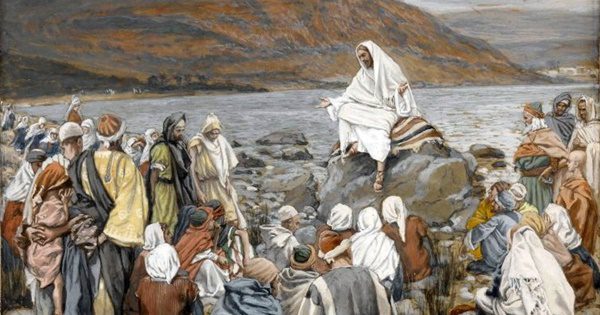
If we imitate Jesus we will move in a different direction than if we imitate Caesar. If we imitate Caesar we will become coercive, violent and out of touch with human weakness and vulnerability.
-Tom Truby
Pastors have a frequent question when they begin to discover mimetic theory. “That’s great. But how does it preach?”
Reverend Tom Truby shows that mimetic theory is a powerful tool that enables pastors to preach the Gospel in a way that is meaningful and refreshing to the modern world. Each week, Teaching Nonviolent Atonement will highlight his sermons as examples of preaching the Gospel through mimetic theory.
In this sermon, Tom explores our mimetic natures. Jesus invites us to follow him. He knows that, whether we realize it or not, we will follow someone. The question is, who will we follow?
Year A, Proper 24
October 22nd, 2017
Matthew 22:15-22 and 1Thessalonians 1:1-10
By Rev. Tom Truby
Jesus, Who Rescues Us from the Wrath That Is Coming, Constantly Coming!
As we begin today’s gospel text, Jesus has given his final response to the religious leaders explaining the foundation of his authority. Through story he suggests his authority is rooted in his impending crucifixion and resurrection. It comes from his willingness to expose the source of human culture founded on coercion and violence by submitting to it himself and suffering its full consequences on the cross.
At the same time he undoes all human kingdoms by forgiving those who use coercion and violence even as they use it. His resurrection, now days away as he has already made his entry into Holy Week, soon completes the communication by signaling that the power of life, God’s power, cannot be defeated even though humans resort to murder. The real God of history has been revealed and the pretender, the father of lies, and those in league with him, has been exposed. Jesus’ kingdom is rooted in the God of life and not Herod’s God of threat, coercion and death.
The Pharisees, who have not done so well in their attempt to silence Jesus, at this point change strategies. The text says, “Then the Pharisees went and plotted to entrap him in what he said.”
A delegation arrives that includes Pharisees and some Herodians. Herodians were high government officials from Herod’s administration. Ordinarily Pharisees and Herodians were enemies but apparently they sense a common threat in Jesus. When someone threatens a culture’s system of entitlement and exclusion both established religion and politics often react defensively. Both are often built on the same foundation of violence though they may portray themselves as in different camps.
They approach Jesus behind the duck-blind of sincerity. “Teacher, we know that you are sincere, and teach the way of God in accordance with truth and show deference to no one; for you do not regard people with partiality.”
While what they say is true, what do we make of that string of words coming from them? It drips with duplicity. Sometimes I think we underestimate the human capacity for deception.
Are they deliberately lying or do they have some way of convincing themselves their ends justify the means? Are they trying to flatter Jesus, hoping he will believe it safe to say more than he otherwise would? Do they almost believe him themselves but know they must repulse him to protect their privilege?
At another level, I wonder how they would approach Jesus as individuals rather than a group composed of natural enemies, a rivalrous crowd with the Pharisees keeping an eye on the Herodians and the Herodians suspiciously watching the Pharisees. Would their thinking change if they approached from outside the gravitational pull of group-think rooted in mutual self-interest?
Was Nicodemus among them? In the Gospel of John, Nicodemus, a very important Jewish leader, comes in the darkness and privacy of night to acknowledge that he believes Jesus.
They reveal their bait. “Tell us, then, what you think. Is it lawful to pay taxes to the emperor, or not?”
The trap is baited with flattery but Jesus sees through it. “Why are you putting me to the test, you hypocrites?” He knows they don’t believe in equality of all people before God; that’s a lie. He tells them he knows what they are up to and then accepts their challenge.
“Show me the coin used for the tax.” he commands. To pay this particular tax to Rome they had to use a special coin issued by the government. Interestingly, Jesus doesn’t have one, and so they bring one to him.
“Whose image is this and whose title,” He asks? They answer, “The emperor’s.” Then Jesus says, “Give therefore to the emperor the things that are the emperor’s, and to God the things that are God’s.” In essence he says Caesar made these coins, they bear his image and therefore belong to Caesar; give to Caesar what belongs to him. The Pharisees and even those from Herod’s administration know that humans are made in the image of God according to Jewish values and tradition. Being made in his image means they belong to God and will live in a way that conforms to God’s desire. God desires the good of all his people but they have ignored that desire and seek only their own well-being. In one sentence Jesus cuts through the fog of deception. They are amazed and go away.
Whose image shapes us? Are we made in God’s image or in the image of Caesar? If we give to God what is God’s, how does that change our behavior and values? Caesar makes claims on our money and we must comply, but Caesar can’t have our hearts.
In Paul’s opening words to the people of Thessalonica he says, “For we know, brothers and sisters beloved by God, that he has chosen you.” We didn’t choose God, God chose us and we are not available to Caesar.
Paul goes on, “You became imitators of us and of the Lord.” We are all imitators and that’s a good thing. Imitation is what we humans do; it’s unavoidable. We can imitate Caesar or we can imitate our Lord. Whose image will we choose? Let me bring science into this.
In 1992 Scientists in Parma, Italy stumbled on an important neurological discovery. They noticed that when a monkey saw a human grab a peanut, some of the monkey’s brain cells fired as though the monkey were grabbing it himself. They labeled these special cells that did this “mirror neurons” and discovered later that humans have more of these than any other creature.
Most scientists now think these mirror neurons make it possible for us to learn and feel with other humans. If that is true, then these neurons are very important for the transmission of culture. And it is also true that who we watch becomes critically important, for it determines who we become. That’s why Paul thinks it’s important that the Thessalonians become imitators of Paul and our Lord. Who they imitate will determine who they become.
If we imitate Jesus we will move in a different direction than if we imitate Caesar. If we imitate Caesar we will become coercive, violent and out of touch with human weakness and vulnerability.
The issue is who we copy. When we copy people, who are themselves copying people, it gets very confusing, messy and conflictual. But what happens when we copy someone who in-no- way is copying any other human? Instead, this One (capital O) is totally dedicated to copying God, a point Jesus makes over and over again. If we copy this One, we find ourselves pulled out of copying each other and gradually freed from the tyranny of our rivalry and violence. It is in this sense that we become free in Christ.
If we think of ourselves as imitating Jesus, whose image orients us? Can the image of an emperor on a coin be our model? Yes, but when it does we are not imitating Jesus. We have allowed the image of a human to form us, with all the consequences that evolve from that.
Paul, commending the people in Thessalonica says, “You turned to God from idols.” He didn’t just mean stone statues; he meant any other human or human-generated set of ideas that we make more important than God. So he commends the Thessalonians for turning to God from idols “to serve a living and true God, and to wait for his Son from heaven, whom he raised from the dead—Jesus, who rescues us from the wrath that is coming.”
And the wrath that is coming; it’s not God’s wrath; it’s human wrath. As we know and experience every day, human wrath just keeps coming, and coming. Every day we see new forms of it. Human wrath is what happens when humans make other humans their gods and cease serving the God in whose image we are all made. This is the wrath we live in the midst of, and it is in the midst of this, that we “wait for his Son from heaven, whom he raised from the dead—Jesus, who rescues us from the wrath that is coming,” constantly coming. Thanks be to God. Amen.
James Tissot [No restrictions or Public domain], via Wikimedia Commons

Stay in the loop! Like Teaching Nonviolent Atonement on Facebook!
Previous Post

October 25, 2017
#MeToo: Empathy, Hope, and Truth
Next Post
October 31, 2017 Violence Nevermore!
Browse Our Archives
Select a Category Atonement and Current Events Curriculum Faith and Families Interviews Jesus the Forgiving Victim Lent Montessori politics Reviews The Bible Explained Uncategorized Valentine's Day Wednesday Sermon Who is God?
Select a Month July 2020 November 2019 October 2019 September 2019 August 2019 July 2019 June 2019 May 2019 April 2019 March 2019 February 2019 January 2019 December 2018 November 2018 October 2018 September 2018 August 2018 July 2018 June 2018 May 2018 April 2018 March 2018 February 2018 January 2018 December 2017 November 2017 October 2017 September 2017 August 2017 July 2017 June 2017 May 2017 April 2017 March 2017 February 2017 January 2017 December 2016 November 2016 October 2016 September 2016 August 2016 June 2016 May 2016 April 2016 March 2016 February 2016 January 2016 December 2015 November 2015 October 2015 September 2015 August 2015 July 2015 June 2015 May 2015 April 2015 March 2015 February 2015 January 2015 December 2014 November 2014 October 2014 September 2014 August 2014 July 2014 June 2014 May 2014 April 2014 March 2014 January 2014 December 2013 September 2013 August 2013 July 2013
Follow Us!
TAKE THE
Religious Wisdom Quiz
Which letter wraps up with the reminder, "Let everything be done decently and in order"?
Select your answer to see how you score.
Hebrews 1 Timothy James 1 Corinthians
Related posts from Teaching Nonviolent Atonement

Forgiveness in the Time of COVID-19 by Julia...


Reflections on Indigenous Wisdom For Healing A Wounded...

How Forgiveness Can Transform Our Violence and Build...
TRENDING AT PATHEOS Progressive Christian

What Being a Modern-Day Apostle Means to Me
In my last column, I discussed the ins and outs of modern-day...

Did Ancient China Once Worship the God of...
Across human history, a common thread weaves through the origins of the...

Love Your Neighbor – Including Earth-Kin: Lev. 19,...
God’s command to love your neighbor means acting in an ethical and...

Lead a Church Study of “Jesus and Lao...
Guest writer Jack Thomas (The Irreverent Reverend) reflects on leading his church...

Pastoral Wisdom for Responding to Sermon Pushback
Getting sermon pushback on your social justice sermon? Learn practical, Proverbs-based strategies...

Principles for Understanding the Apostolic Ministry Today
Whenever people discover that my formal ministry title is "apostle," as in...
view all Progressive Christian blogs
Ad-Free & Subscriber Log-In Subscription Support
- About Us
- 2026 Calendar
- Videos
- Podcasts
- Library of World Religions
- Faith In Media Tracker
- Advertise With Us
- Write for Us
- Privacy Policy
- Terms of Service
- Do Not Sell My Data
- Contact Us
- Radiant Digital
- Manage Newsletter Subscriptions
- Unsubscribe From Notifications
- Sitemap
Copyright 2008-2026, Patheos. All rights reserved.
Subscription Support Ad-Free & Subscriber Log-In
Follow Patheos