
BuddhistCatholicContemplativeEvangelicalGeneral ChristianHinduJewishLatter-day SaintMuslimNew VisionsProgressive Christian
Beliefs
- Buddhist
- Catholic
- Contemplative
- Evangelical
- General Christian
- Hindu
- Jewish
- Latter-day Saint
- More Voices
- Muslim
- New Visions
- Pagan
- Progressive Christian
Topics
- Religion News
- Food and Religion
- Sports and Religion
- Religious Art
- Religious Music and Entertainment
- Religious Events
- History and Religion
- Style and Religion
- Politics and Religion
- Women in Religion
- Recreation Outdoors and Religion
- Business Finance and Religion
- Careers Workplace and Religion
- Education and Religion
- Family Parenting and Religion
- Health Fitness and Religion
- Home and Religion
- Relationships and Religion
- Technology and Religion
- Travel and Religion
Columnists
- Buddhist Columnists
- Business Finance and Religion Columnists
- Careers Workplace and Religion Columnists
- Catholic Columnists
- Contemplative Columnists
- Education and Religion Columnists
- Evangelists Columnists
- Family Parenting and Religion Columnists
- General Christian Columnists
- Health Fitness and Religion Columnists
- Hindu Columnists
- History and Religion Columnists
- Home and Religion Columnists
- Jewish Columnists
- More Voices Columnists
- Latter Day Columnists
- Muslim Columnists
- New Visions Columnists
- Nonreligious Columnists
- Pagan Columnists
- Politics and Religion Columnists
- Progressive Columnists
- Recreation Outdoors and Religion Columnists
- Relationships and Religion Columnists
- Religion News Columnists
- Religious Art Columnists
- Religious Events Columnists
- Religious Music and Entertainment Columnists
- Sports and Religion Columnists
- Style and Religion Columnists
- Technology and Religion Columnists
- Travel and Religion Columnists
- Women in Religion Columnists
Resource Library
- 2026 Calendar
- Library of World Religions
- The 100 Most Holy Places on Earth
- Patheos Answers
- Podcasts
- Videos
- Faith Leaders Database
- Anglican Episcopalian
- Bahai
- Baptist
- Buddhism
- Christianity
- Confucianism
- Eastern Orthodoxy
- Hinduism
- Holiness and Pentecostal
- ISKCON
- Islam
- Judaism
- Lutheran
- Methodist
- The Church of Jesus Christ of Latter-day Saints
- New Age
- Paganism
- Presbytarian and Reformed
- Protestantism
- Religion Behind the Scenes
- Roman Catholic
- Scientology
- Shia Islam
- Sikhism
- Sufism
- Sunni Islam
- Taoism
- Zen
- See all religions
Research Tools
 Ad-Free & Subscriber Log-In Subscription Support
Ad-Free & Subscriber Log-In Subscription Support
Follow Patheos 

- Trending:
- Forgiveness
- |
- Marriage
- |
- Consciousness
- |
- Death Penalty
- |
- Election
- |
- Halloween
 Teaching Nonviolent Atonement
- Home
- Progressive Christian
- What Trump Got Right About Charlottesville
What Trump Got Right About Charlottesville
Last updated on: August 21, 2017 at 9:07 am by Lindsey Paris-Lopez
What Trump Got Right About Charlottesville 2017-08-21T09:07:04-05:00 Lindsey Paris-Lopez
Patheos Explore the world's faith through different perspectives on religion and spirituality! Patheos has the views of the prevalent religions and spiritualities of the world.
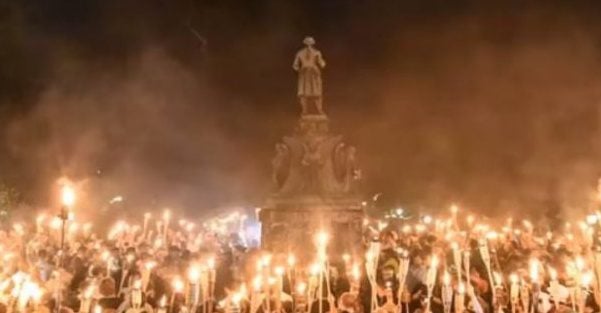
There have been times when President Trump has said true things, things that I believe need to be said, in service to a larger point that is the complete opposite of the point I wish to make. Tuesday afternoon’s remarks on Charlottesville, in which he doubled-down on his comments that “many sides” are responsible for the violence that occurred this past weekend, contained one of those kernels of truth in service to a lie. Allow me to explain.
Last Friday night in Charlottesville, VA, white supremacists from all over the country gathered around the statue of a man we are taught to revere as a champion of liberty. This is also a man who owned slaves and taught the inferiority of Africans, but we are still taught to honor him.
Thomas Jefferson, third president of the United States and founder of the University of Virginia, was an ironically appropriate gathering point for those who harbor racial hatred, if an “appropriate” gathering point for those who harbor racial hatred can be said to exist. His statue serves as a reminder of how deep racism runs in this country, how intrinsic it is to our culture. While monuments of confederate soldiers are joyfully toppled and memorials to confederate generals are removed, statues of Thomas Jefferson all around the nation will remain. And the fact that he represents liberty to many of us but slavery to others should help us reflect on how unequal our country is and has been from its inception.
So when President Trump said, “How about Thomas Jefferson? … Are we going to take down his statue? Because he was a major slave owner,” he was trying to argue against the removal of any historical statue, including the statue of Robert E. Lee. Yet he unintentionally made a much larger point about how racism is foundational to our country.
Last weekend’s rally – ostensibly in protest of the removal of a Robert E. Lee statue but more accurately a chilling display of belief in white superiority and a demonstration of animosity toward multiculturalism – began with a congregation of white supremacists not around Lee but around Jefferson. This makes sense, because while the racism that infects this country is symbolized in the Confederacy and its soldiers, including Lee, it did not begin there. Though it did not begin with Jefferson, either, as a Founding Father, president, and author of the Declaration of Independence, Thomas Jefferson has had more influence on the shaping of our American culture than most others. His racism shaped perceptions of African slaves and African Americans for generations.
Thomas Jefferson not only owned slaves but wrote extensively about the inferiority of Africans and people with black skin. He hypersexualized black males and females, emphasizing that their “sensations” overshadowed (or completely eclipsed) their reason. His highly respected opinions gave intellectual cover to racist lies, to say the least. In fact, in her work on racism in Christianity, What’s Faith Got to Do With It? Black Bodies, Christian Souls, Kelly Brown Douglas quotes Winthrop D. Jordan as saying, “Until well into the nineteenth century, Jefferson’s judgment on the matter [of black humanity]… stood as the strongest suggestion of [black] inferiority expressed by any native American.”
Thomas Jefferson and the other Founding Fathers are known not only for their design and implementation of our government, but for their profound insight regarding human nature. It is easy to imagine, then, how Jefferson’s misperceptions and lies about black people became standard wisdom among a nation of people taught to revere him. The harm of Jefferson’s warped perspective on this matter combined with the reach of his influence is impossible to understate.
I try to imagine learning about Thomas Jefferson from an African American perspective. A lesson might come across something like this: “He was a brilliant man with deep insight into humanity, who shaped our national values so that we revere liberty. But he thought your ancestors were inferior and thus justified owning them. He wrote lies about them, raped them, and justified their exploitation and brutalization for generations to come. Years after slavery ended, many people would continue to use his words to justify the treatment of African Americans as inferior. But, overall, America is indebted to his political and philosophical mind.”
What I’m trying to say is that if we are white, and we have been conditioned with the dominant cultural narrative about our history and values, then we need to be willing to see how the African American experience in this nation for generations has been the complete opposite of every ideal we claim to hold dear.
Thomas Jefferson is just the beginning. We don’t learn in history class, for example, that Independence Day is celebrated on July 4th because, as Kevin Alexander Gray says, “[I]t’s the day after the abolitionists, or the people against slavery, relented, and allowed the anti-slavery clause to be taken out of the Constitution.” We learn about Emancipation, but not enough is taught about how laws were immediately created to re-criminalize and thus re-enslave African Americans. We learn (but not enough) about the Civil Rights movement, but seldom do schools help children understand how years of being deprived basic rights and dignity makes the road to economic and social equality a steep uphill climb even when laws change. The active and brutal destruction of black progress by white hands, most notoriously with the burning of “Black Wall Street” in Tulsa, Oklahoma, is almost never taught. Neither is it widely acknowledged that the U.S. interstate system is responsible for destroying black communities and displacing black families.
In other words, a land of opportunity for some has been a land of exploitation and dehumanization of others. The privileges many of us enjoy have come at the expense of people who were oppressed and marginalized. And white fears of the worst within ourselves have been culturally projected onto black people to demonize them. Furthermore, the contributions of African Americans are under-represented even while monuments to those who wished to keep them enslaved litter the American landscape.
While African Americans, like everyone else, love the land and people in this country, they are able to see its ugly underside more clearly than most. This is what James Alison has called the “Intelligence of the Victim,” but what I would prefer to call, in this case, “The Intelligence of the Survivor,” because of the strength and resilience that African Americans have shown in the face of such an unequal history and blatant failure of our nation to live up to its professed values. The view from below power and privilege is 180 degrees opposite to that from above. Though pride and patriotism is drilled into all of us practically from birth, we need to open our eyes not just to our cultural blindspots, but against the mythical blinders that have wholly eclipsed the truth from our view.
Thomas Jefferson is a good place to start. He is a perfect symbol of how the American experience can be completely different for some than it is for others. I do not foresee his statues being removed, because he did have positive ideas that were foundational to this country. But the best of those ideas – the God-given equality of all people and the inherent right of liberty for all – need to be fully realized in practice. We must acknowledge where Jefferson’s interpretation and implementation of his own ideals fell short and correct them, unafraid to acknowledge and renounce those things that Jefferson got tragically wrong: namely, the full equality and dignity of black people.
By contrast, there are no redeeming qualities to justify the continued presence of Confederate monuments in any public national venue, with the possible exception of museums dedicated to depicting the horrors of slavery and war in their full, hideous truth. Far from honoring history, they keep us in denial to the horrors for which the Confederacy stood and gloss over the ugliness of slavery with a veneer of honor. Their continued presence can only serve a lie – either the lie of white supremacy or the lie that the Civil War’s primary cause was not slavery. Their removal would be an act of repentance. We can and must remember the worst of our history without honoring or glorifying it.
So we can take Donald Trump’s very true statement about Thomas Jefferson being a slave owner, use it as a reminder of the inequality embedded in our nation, and take it to a different conclusion. Rather than erase history, the removal of certain monuments can facilitate a more honest understanding of history. The violence in Charlottesville was made possible by ignorance and denial, facilitated in part by the continued presence of Confederate monuments. They should come down, statues of African American leaders and others reflecting our diverse culture should come up, and real history should be taught, to dispel the lie of white supremacy and move us closer to the equality for which we claim to stand, thus living into the best of Thomas Jefferson’s vision more fully than he could have ever imagined.
Image: Screenshot from Youtube: “White nationalists hold torch lit march through UVA campus,” by All InOne News.
Stay in the loop! Like Teaching Nonviolent Atonement on Facebook!
Previous Post

August 16, 2017
Sermon: The Disciples' Conclusion: Jesus Must Be God's Son!
Next Post
August 21, 2017 Sunglasses of Mercy: A Poem for the Eclipse
Browse Our Archives
Select a Category Atonement and Current Events Curriculum Faith and Families Interviews Jesus the Forgiving Victim Lent Montessori politics Reviews The Bible Explained Uncategorized Valentine's Day Wednesday Sermon Who is God?
Select a Month July 2020 November 2019 October 2019 September 2019 August 2019 July 2019 June 2019 May 2019 April 2019 March 2019 February 2019 January 2019 December 2018 November 2018 October 2018 September 2018 August 2018 July 2018 June 2018 May 2018 April 2018 March 2018 February 2018 January 2018 December 2017 November 2017 October 2017 September 2017 August 2017 July 2017 June 2017 May 2017 April 2017 March 2017 February 2017 January 2017 December 2016 November 2016 October 2016 September 2016 August 2016 June 2016 May 2016 April 2016 March 2016 February 2016 January 2016 December 2015 November 2015 October 2015 September 2015 August 2015 July 2015 June 2015 May 2015 April 2015 March 2015 February 2015 January 2015 December 2014 November 2014 October 2014 September 2014 August 2014 July 2014 June 2014 May 2014 April 2014 March 2014 January 2014 December 2013 September 2013 August 2013 July 2013
Follow Us!
TAKE THE
Religious Wisdom Quiz
What was the primary water source in Jerusalem?
Select your answer to see how you score.
Spring Well Rain collection River
Related posts from Teaching Nonviolent Atonement

Perfect Love Casts Out Fear, But Can It...
Racism: Survivors and Perpetrators Find Healing in Africa

The One Thing: My Dad, City Slickers, and...

TRENDING AT PATHEOS Progressive Christian

What Being a Modern-Day Apostle Means to Me
In my last column, I discussed the ins and outs of modern-day...

Did Ancient China Once Worship the God of...
Across human history, a common thread weaves through the origins of the...

Love Your Neighbor – Including Earth-Kin: Lev. 19,...
God’s command to love your neighbor means acting in an ethical and...

Lead a Church Study of “Jesus and Lao...
Guest writer Jack Thomas (The Irreverent Reverend) reflects on leading his church...

Pastoral Wisdom for Responding to Sermon Pushback
Getting sermon pushback on your social justice sermon? Learn practical, Proverbs-based strategies...

Principles for Understanding the Apostolic Ministry Today
Whenever people discover that my formal ministry title is "apostle," as in...
view all Progressive Christian blogs
Ad-Free & Subscriber Log-In Subscription Support
- About Us
- 2026 Calendar
- Videos
- Podcasts
- Library of World Religions
- Faith In Media Tracker
- Advertise With Us
- Write for Us
- Privacy Policy
- Terms of Service
- Do Not Sell My Data
- Contact Us
- Radiant Digital
- Manage Newsletter Subscriptions
- Unsubscribe From Notifications
- Sitemap
Copyright 2008-2026, Patheos. All rights reserved.
Subscription Support Ad-Free & Subscriber Log-In
Follow Patheos