
BuddhistCatholicContemplativeEvangelicalGeneral ChristianHinduJewishLatter-day SaintMuslimNew VisionsProgressive Christian
Beliefs
- Buddhist
- Catholic
- Contemplative
- Evangelical
- General Christian
- Hindu
- Jewish
- Latter-day Saint
- More Voices
- Muslim
- New Visions
- Pagan
- Progressive Christian
Topics
- Religion News
- Food and Religion
- Sports and Religion
- Religious Art
- Religious Music and Entertainment
- Religious Events
- History and Religion
- Style and Religion
- Politics and Religion
- Women in Religion
- Recreation Outdoors and Religion
- Business Finance and Religion
- Careers Workplace and Religion
- Education and Religion
- Family Parenting and Religion
- Health Fitness and Religion
- Home and Religion
- Relationships and Religion
- Technology and Religion
- Travel and Religion
Columnists
- Buddhist Columnists
- Business Finance and Religion Columnists
- Careers Workplace and Religion Columnists
- Catholic Columnists
- Contemplative Columnists
- Education and Religion Columnists
- Evangelists Columnists
- Family Parenting and Religion Columnists
- General Christian Columnists
- Health Fitness and Religion Columnists
- Hindu Columnists
- History and Religion Columnists
- Home and Religion Columnists
- Jewish Columnists
- More Voices Columnists
- Latter Day Columnists
- Muslim Columnists
- New Visions Columnists
- Nonreligious Columnists
- Pagan Columnists
- Politics and Religion Columnists
- Progressive Columnists
- Recreation Outdoors and Religion Columnists
- Relationships and Religion Columnists
- Religion News Columnists
- Religious Art Columnists
- Religious Events Columnists
- Religious Music and Entertainment Columnists
- Sports and Religion Columnists
- Style and Religion Columnists
- Technology and Religion Columnists
- Travel and Religion Columnists
- Women in Religion Columnists
Resource Library
- 2026 Calendar
- Library of World Religions
- The 100 Most Holy Places on Earth
- Patheos Answers
- Podcasts
- Videos
- Faith Leaders Database
- Anglican Episcopalian
- Bahai
- Baptist
- Buddhism
- Christianity
- Confucianism
- Eastern Orthodoxy
- Hinduism
- Holiness and Pentecostal
- ISKCON
- Islam
- Judaism
- Lutheran
- Methodist
- The Church of Jesus Christ of Latter-day Saints
- New Age
- Paganism
- Presbytarian and Reformed
- Protestantism
- Religion Behind the Scenes
- Roman Catholic
- Scientology
- Shia Islam
- Sikhism
- Sufism
- Sunni Islam
- Taoism
- Zen
- See all religions
Research Tools
 Ad-Free & Subscriber Log-In Subscription Support
Ad-Free & Subscriber Log-In Subscription Support
Follow Patheos 

- Trending:
- Forgiveness
- |
- Marriage
- |
- Consciousness
- |
- Death Penalty
- |
- Election
- |
- Halloween
 Teaching Nonviolent Atonement
- Home
- Progressive Christian
- Sermon: Words that Model
Sermon: Words that Model
Last updated on: August 23, 2017 at 5:54 pm by Tom Truby
Sermon: Words that Model 2017-08-23T17:54:55-05:00 Tom Truby
Patheos Explore the world's faith through different perspectives on religion and spirituality! Patheos has the views of the prevalent religions and spiritualities of the world.
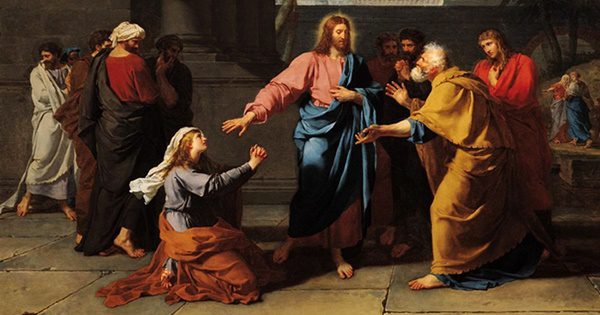
Pastors have a frequent question when they begin to discover mimetic theory. “That’s great. But how does it preach?”
Reverend Tom Truby shows that mimetic theory is a powerful tool that enables pastors to preach the Gospel in a way that is meaningful and refreshing to the modern world. Each week, Teaching Nonviolent Atonement will highlight his sermons as an example of preaching the Gospel through mimetic theory.
What is truth? Everyone says we live in a post-truth world, but how can we truthfully say that if we are post-truth? Mimetic theory helps us answer this question by claiming that truth is found when we look to victims of human culture. Rev. Tom Truby explores this concept in his latest sermon.
Year A, Proper 15
August 20th, 2017
Matthew 15:10-28
Words that Model
Part I What is the Truth?
“Jesus called the crowd near and said to them, ‘Listen and understand.’” The crowd leans in and forms a tighter circle. It’s like those ads where everyone comes closer listening for a stock market tip. Every ear is cocked in his direction. What is he about to say?
“It’s not what goes into the mouth that contaminates a person in God’s sight. It’s what comes out of the mouth that contaminates the person.” Eating caviar in a palace or lentil soup in a hut makes no difference to God. Enjoying steak barbequed on a grill or chopped up in a taco makes no difference to God. Eating pork or refusing to eat pork makes no difference either, but what comes out of our mouth does.
What comes out of our mouth reveals the commitments of our heart. Our words show the world where we are coming from. We’ve always known this. Have you ever been accused of “running off at the mouth?” I suppose that’s about irresponsible talk.
“Speaking with a forked tongue” made quite an impression on me as a child. I could picture words heading off in two directions after leaving such a tongue. These were words meant to deceive that had no commitment to truth. Their sender did not care about the recipient. In fact, the actual agenda of the sender was to manipulate and control the recipient, harnessing the recipient to the senders will. No respect for the other here; no core belief that the other is a valued child of God and a brother or sister. American Indians said the white men spoke with forked tongue. Were they speaking truth to power?
What is the truth? No one agrees on it these days. Most claim their own view as the truth and their neighbor’s view as false. Every group has its own truth we say. And someone outside that group says, well, you say that because you are a woman, or a white male, Hispanic or Muslim. It’s popular now to say truth is subjective and determined by our gender and skin color. I am probably getting too philosophical here but I do have a point I am heading toward.
What if truth were the victim at the bottom of the pile of rocks we humans have thrown? In my view that’s where truth starts and it was revealed at the crucifixion where everyone threw stones at Jesus so to speak. In doing that we did what we always do and built community through the exclusion and execution of one of our own. Joseph sold into slavery is an example. That’s the truth about humans, the thing hidden since the foundation of the world, Matthew quotes Jesus as saying in Matthew. Recognition of this is where truth begins and why the crucifixion and resurrection lie at the center of history. This event shows us the truth.
This suggests criteria for assessing what comes out of a persons’ mouth. How do you tell what is contaminated and what isn’t? Do the words that come out a person’s mouth act like stones adding to the pile that covers the victim or do the words remove stones already there, bringing us closer to the truth beneath them? Let me try to illustrate with some history.
When I was a child and read the history of the United States very little mention was made of slavery. The text did not reveal how offensive it is for one human being to own another and to treat them as possessions subject to being used or sold at the master’s whim. Nor did the text reveal that the economic prosperity of the United States was, in part, based on forced labor. Those with slaves didn’t have to pay salaries and provide anything but the most minimal benefits. Nor did the text mention that with the repeal of slavery a new form of subjugation was introduced to our country. We passed laws, called Jim Crow laws that gave legal sanction to one race over another. None of this was in our official record of our history and yet it was true. We ignored the corpse at the bottom of the pile of stones we ourselves threw.
This smoldering discussion about us continues and has burst into flame since the events at Charlottesville. As a general principle the words that come from our mouth contaminate the world if they add to the layer of lies hiding the truth. This is what Jesus meant when he said, “It’s not what goes into the mouth that contaminates a person in God’s sight. It’s what comes out of the mouth that contaminates the person.”
Part II Sometimes truth offends!
“Then the disciples came and said to him, ‘Do you know that the Pharisees were offended by what you just said?’” Perhaps the Pharisees have an unacknowledged desire to hide the truth. They are like the textbooks that don’t take slavery seriously and barely mention it. Perhaps they are like contemporary culture that often fails to take the power of guns, germs and steel into account in their recitation of history and wind up with the self-serving myth that white people of European extraction are innately superior.
To tell the truth is to offend those whose identity and sense of superiority is built on a lie. Do you think Jesus was surprised that the Pharisees had taken offense?
Jesus responds to the disciples with another parable. “Every plant that my heavenly Father didn’t plant will be pulled.” Kingdoms based on falsehood won’t last. They are destined to fail because the truth will eventually be exposed. But Jesus adds; don’t you get involved in pulling those plants, thinking that this story tells you to do that. “Leave the Pharisees alone. They are blind people who are guides to blind people.”
When leaders don’t have a place to begin in determining truth they are blind guides and often lead their followers toward an abyss that neither leader nor follower can see. This is why Jesus “called the crowd near and said to them, ‘Listen and understand.’” There is urgency to his message.
All of this goes over Peter’s head and so Peter asks Jesus to explain. Jesus replies, “Don’t you understand yet? Don’t you know that everything that goes into the mouth enters the stomach and goes out into the sewer?” Jesus is both very explicit and delicately circumspect. Were they looking for some lofty spiritual answer—something a little closer to heaven and not so tied to the earth? Jesus ties the spiritual and the earthy so closely that even we moderns are a little uncomfortable.
We are now ready to hear Jesus’ next words. “But what goes out of the mouth comes from the heart. And that’s what contaminates a person in God’s sight.’” Jesus here is as earthy as a Marine drill sergeant yet a little more subtle. In my fallen mind and vivid imagination I can’t help but imagine what had formerly been going down the sewer as now coming out of a person’s mouth. We have common cultural ways of saying this. Words are revelatory. They reveal the heart and sometimes our prejudices.
Jesus goes on, “Out of the heart come evil thoughts, murders, adultery, sexual sins, thefts, false testimonies, and insults. These contaminate a person in God’s sight.”
Part III A model for us to follow.
“From there, Jesus went to the regions of Tyre and Sidon.” These are cities outside Jewish jurisdiction; territories filled with unclean people. “A Canaanite woman from those territories came out and shouted, ‘Show me mercy, Son of David. My daughter is suffering terribly from demon possession.’”
This woman has at least four strikes against her. She is Canaanite, the ancient enemy of the Jews; she is a woman, that counts against her; she is an assertive woman, can’t have that, and her daughter suffers from mental illness. She doesn’t deserve mercy; she doesn’t even deserve to be noticed. She is one of those we can safely ignore and Jesus does. The text says, “But he didn’t respond to her at all.”
Never think that followers don’t pick up on their leader’s example. Pretty soon, “his disciples came and urged him, ‘Send her away; she keeps shouting out after us.’” Jesus seems to respond with agreement. “I’ve been sent only to the lost sheep, the people of Israel,’” he says. With this the persistent woman “knelt before him and said, ‘Lord help me.’”
“He replied, ‘It is not good to take the children’s bread and toss it to dogs.’”
If her heart were anything but pure she would have taken offense at Jesus and evil words would have sprung from her heart. But she didn’t. Instead humble words, sincere words stripped of all venom, emerged.
“She said, ‘Yes, Lord. But even the dogs eat the crumbs that fall off their masters’ table.’” This unclean woman, even when provoked, delivers words that reveal a clean heart. She becomes our model. This is how you do it even when you are insulted. “It’s not what goes into the mouth that contaminates a person in God’s sight. It’s what comes out of the mouth that contaminates the person.”
“Jesus answered, ‘Woman, you have great faith. It will be just as you wish.’ And right then her daughter was healed.” Amen.
Previous Post

August 22, 2017
The Emojis Reveal the Truth About Christian Salvation
Next Post
August 24, 2017 How To Be a True Force for Peace
Browse Our Archives
Select a Category Atonement and Current Events Curriculum Faith and Families Interviews Jesus the Forgiving Victim Lent Montessori politics Reviews The Bible Explained Uncategorized Valentine's Day Wednesday Sermon Who is God?
Select a Month July 2020 November 2019 October 2019 September 2019 August 2019 July 2019 June 2019 May 2019 April 2019 March 2019 February 2019 January 2019 December 2018 November 2018 October 2018 September 2018 August 2018 July 2018 June 2018 May 2018 April 2018 March 2018 February 2018 January 2018 December 2017 November 2017 October 2017 September 2017 August 2017 July 2017 June 2017 May 2017 April 2017 March 2017 February 2017 January 2017 December 2016 November 2016 October 2016 September 2016 August 2016 June 2016 May 2016 April 2016 March 2016 February 2016 January 2016 December 2015 November 2015 October 2015 September 2015 August 2015 July 2015 June 2015 May 2015 April 2015 March 2015 February 2015 January 2015 December 2014 November 2014 October 2014 September 2014 August 2014 July 2014 June 2014 May 2014 April 2014 March 2014 January 2014 December 2013 September 2013 August 2013 July 2013
Follow Us!
TAKE THE
Religious Wisdom Quiz
What is the first line of the Bible?
Select your answer to see how you score.
Hear, O Israel. The Lord is my shepherd. In the beginning God created the heavens and the earth. Let there be light
Related posts from Teaching Nonviolent Atonement
Sermon: The Eleventh Commandment

Being Careful to Live Wisely: Faith and Climate...


Let Light Shine Out of Darkness
TRENDING AT PATHEOS Progressive Christian

What Being a Modern-Day Apostle Means to Me
In my last column, I discussed the ins and outs of modern-day...

Did Ancient China Once Worship the God of...
Across human history, a common thread weaves through the origins of the...

Love Your Neighbor – Including Earth-Kin: Lev. 19,...
God’s command to love your neighbor means acting in an ethical and...

Lead a Church Study of “Jesus and Lao...
Guest writer Jack Thomas (The Irreverent Reverend) reflects on leading his church...

Pastoral Wisdom for Responding to Sermon Pushback
Getting sermon pushback on your social justice sermon? Learn practical, Proverbs-based strategies...

Principles for Understanding the Apostolic Ministry Today
Whenever people discover that my formal ministry title is "apostle," as in...
view all Progressive Christian blogs
Ad-Free & Subscriber Log-In Subscription Support
- About Us
- 2026 Calendar
- Videos
- Podcasts
- Library of World Religions
- Faith In Media Tracker
- Advertise With Us
- Write for Us
- Privacy Policy
- Terms of Service
- Do Not Sell My Data
- Contact Us
- Radiant Digital
- Manage Newsletter Subscriptions
- Unsubscribe From Notifications
- Sitemap
Copyright 2008-2026, Patheos. All rights reserved.
Subscription Support Ad-Free & Subscriber Log-In
Follow Patheos