
BuddhistCatholicContemplativeEvangelicalGeneral ChristianHinduJewishLatter-day SaintMuslimNew VisionsProgressive Christian
Beliefs
- Buddhist
- Catholic
- Contemplative
- Evangelical
- General Christian
- Hindu
- Jewish
- Latter-day Saint
- More Voices
- Muslim
- New Visions
- Pagan
- Progressive Christian
Topics
- Religion News
- Food and Religion
- Sports and Religion
- Religious Art
- Religious Music and Entertainment
- Religious Events
- History and Religion
- Style and Religion
- Politics and Religion
- Women in Religion
- Recreation Outdoors and Religion
- Business Finance and Religion
- Careers Workplace and Religion
- Education and Religion
- Family Parenting and Religion
- Health Fitness and Religion
- Home and Religion
- Relationships and Religion
- Technology and Religion
- Travel and Religion
Columnists
- Buddhist Columnists
- Business Finance and Religion Columnists
- Careers Workplace and Religion Columnists
- Catholic Columnists
- Contemplative Columnists
- Education and Religion Columnists
- Evangelists Columnists
- Family Parenting and Religion Columnists
- General Christian Columnists
- Health Fitness and Religion Columnists
- Hindu Columnists
- History and Religion Columnists
- Home and Religion Columnists
- Jewish Columnists
- More Voices Columnists
- Latter Day Columnists
- Muslim Columnists
- New Visions Columnists
- Nonreligious Columnists
- Pagan Columnists
- Politics and Religion Columnists
- Progressive Columnists
- Recreation Outdoors and Religion Columnists
- Relationships and Religion Columnists
- Religion News Columnists
- Religious Art Columnists
- Religious Events Columnists
- Religious Music and Entertainment Columnists
- Sports and Religion Columnists
- Style and Religion Columnists
- Technology and Religion Columnists
- Travel and Religion Columnists
- Women in Religion Columnists
Resource Library
- 2026 Calendar
- Library of World Religions
- The 100 Most Holy Places on Earth
- Patheos Answers
- Podcasts
- Videos
- Faith Leaders Database
- Anglican Episcopalian
- Bahai
- Baptist
- Buddhism
- Christianity
- Confucianism
- Eastern Orthodoxy
- Hinduism
- Holiness and Pentecostal
- ISKCON
- Islam
- Judaism
- Lutheran
- Methodist
- The Church of Jesus Christ of Latter-day Saints
- New Age
- Paganism
- Presbytarian and Reformed
- Protestantism
- Religion Behind the Scenes
- Roman Catholic
- Scientology
- Shia Islam
- Sikhism
- Sufism
- Sunni Islam
- Taoism
- Zen
- See all religions
Research Tools
 Ad-Free & Subscriber Log-In Subscription Support
Ad-Free & Subscriber Log-In Subscription Support
Follow Patheos 

- Trending:
- Forgiveness
- |
- Marriage
- |
- Consciousness
- |
- Death Penalty
- |
- Election
- |
- Halloween
 Teaching Nonviolent Atonement
- Home
- Progressive Christian
- Sermon: The Disciples’ Conclusion: Jesus Must Be God’s Son!
Sermon: The Disciples’ Conclusion: Jesus Must Be God’s Son!
Last updated on: August 16, 2017 at 5:22 pm by Tom Truby
Sermon: The Disciples’ Conclusion: Jesus Must Be God’s Son! 2017-08-16T17:22:22-05:00 Tom Truby
Patheos Explore the world's faith through different perspectives on religion and spirituality! Patheos has the views of the prevalent religions and spiritualities of the world.
 Pastors have a frequent question when they begin to discover mimetic theory. “That’s great. But how does it preach?”
Reverend Tom Truby shows that mimetic theory is a powerful tool that enables pastors to preach the Gospel in a way that is meaningful and refreshing to the modern world. Each week, Teaching Nonviolent Atonement will highlight his sermons as an example of preaching the Gospel through mimetic theory.
Mimetic theory teaches that we are highly influenced by the people and culture around us. The is especially true when it comes to emotions like fear. Fear is mimetic; it spreads like a contagion. In this sermon, Tom shows how Jesus comes to us, like he came to the disciples lost in the storms of the sea, and says, “Be encouraged. Do not be afraid.”
Year A, Proper 14
August 13th, 2017
Matthew 14:22-33
The Disciples’ Conclusion: Jesus Must Be God’s Son!
Did Jesus know a storm would be coming when he made his disciples get into a boat or was he just desperate to have some alone time? He still hasn’t worked through his grief and thought through the meaning of John the Baptist’s death. He put that aside while he responded to the needs of the crowd who gathered in the wilderness to hear him.
Why would he need time by himself? For that matter, why do we need time by ourselves, time to pray, time to think, to feel, to face our emptiness or to bring our emptiness to God? I think we need time alone because we often can’t think straight when we are with others. All humans emit a gravitational pull, a relational influence, a force field that impacts the thoughts and feelings of those around them. Maybe some of us are less influenced than others but all of us are influenced.
Maybe that’s why we value the open spaces so much. It’s easier in them to get away from the crowd and think our own thoughts and feel our own feelings. Pastors and priests are urged to take frequent retreats so that they won’t lose touch with the quiet voice of God in the energy field of their parish and family. All humans are very social, even the antisocial ones are pivoting against other humans.
For the past couple of hundred years it has become popular in the west to think of ourselves as primarily individuals and to undervalue the power of our relationships. For example, we think our desires; what we want to do and have and be comes from some reservoir in the middle of our chest or brain or gut and we have just got to find our way in there to discover it. So people have to “find themselves” and the bachelorette has to follow her inner feelings and trust them as she decides on the perfect man for her. If I were her I would be spending time by myself and praying. I would be asking God, who is outside our whole mimetic mess, for help in discerning what to do next.
This idea that we have the secret knowledge somewhere in us and it has nothing to do with the pull others have on us, René Girard calls “the romantic lie.” This is why Jesus must get by himself to think his own thoughts, to hear what the quiet voice of the Spirit has to say, to tune into the non-invasive, non-coercive, non-violent presence of God. He knows John’s death has deeply disturbed him but he hasn’t had the time or opportunity to process it. He needs to be by himself, outside the force field of the disciples and the crowds, and he needs to pray.
So “Jesus made the disciples get into the boat and go ahead to the other side of the lake while he dismissed the crowds. When he sent them away, he went up onto a mountain by himself to pray.” On the mountain he is beyond the gravitational pull of the disciples who will want to pull him in one direction and the crowds who will want to pull him in another. What does God want him to do? He is looking for direction that has a wider base than the competition of competing claims. This direction is always God’s will for God is each and all.
As the Biblical story unfolds, “Evening came and he was alone.” I suspect things were coming clear for him, he was feeling better, a way forward was opening.
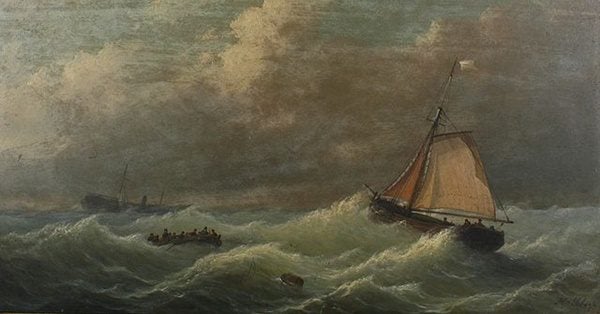
While Jesus was working this out, the disciples were in the midst of a storm on the Sea of Galilee. “The boat, fighting a strong headwind, was being battered by the waves and was already far away from land.”
Matthew is telling us a story. He is not sharing concepts or philosophical abstractions. He is using an action story so that we can feel with it.
Have you ever felt like you were in a small boat on a raging sea? The wind howls, the air is filled with driven water, soaking your cloths and chilling you to the bone. In darkness you bail frantically as you feel the water rising, threatening to swamp the tiny craft that separates you from chaos and death. The wind fights you as you go against it and you have gone too far to turn back. You and your little group feel alone and lost.
Could this story be a foreshadowing of how the disciples will feel when Jesus is on the cross and in the grave and they are still alive and in hiding? Could this be what they will go through before he makes his appearance after his resurrection? The parallels are interesting.
Jesus has ordered them to go to the other side since what he must do only he can do and he must it do alone. The crucifixion is like the storm that has erupted on the lake. The power of evil threatens their fragile boat and appears overwhelming. The storm howls with hatred and words like “crucify him.” Its violence stings their faces and fills their boat with dread. They do all they can but it’s not enough. They find themselves alone in their fragile boat they call their lives as their world descends into chaos. They seem to be going against the winds of history, of reality, of powerful peoples will.
We have conjectured that Jesus, on the mountain, has just realized what John’s death means for him. Jesus will offer his life to the human violence that killed John the Baptist, only this time, Jesus’ death will reveal the source of human violence and a way away from it. It’s clear nowthat crucifixion is the only thing that can communicate the depth of the human problem and the depth of God’s love in response to it.
But Matthew’s foreshadowing story does not end here. “Very early in the morning,” (did you hear that, it’s like on the Day of Resurrection), “Very early in the morning he came to his disciples, walking on the lake.” Is walking on the lake like the resurrected Jesus returning from the dead? He’s walking on death itself as though it were solid ground? What does this mean?
“When the disciples saw him walking on the lake, they were terrified and said, ‘It’s a ghost!’ They were so frightened they screamed.”
Ghosts are menacing, they come to haunt us, to remind us of what we have done to those who are now dead. The disciples see something they don’t understand coming toward them and they project their fear onto that figure and scream.
Is this how the disciples felt when Jesus returned to them after his crucifixion? Was he like a ghost accusing them of desertion, betrayal, disloyalty, cowardice and murder for letting it happen? Even Peter who said he would never betray Jesus did. They all failed and now Jesus was surely returning to punish them. But he didn’t. Instead he said “Don’t be afraid.”
“Just then (as they were screaming in terror) Jesus spoke to them, ‘Be encouraged. It’s me. Don’t be afraid.’” At root this is always his message. He allowed himself to die at our hands so that he could meaningfully say this to us. Even though we killed him still he tells us to “fear not.” He knows that revenge, retaliation, getting back or getting even do not even exist in God’s vocabulary of love. So with this as the frame we read the rest of the story.
27 Just then Jesus spoke to them, “Be encouraged! It’s me. Don’t be afraid.”
28 Peter replied, “Lord, if it’s you, order me to come to you on the water.”
29 And Jesus said, “Come.”
Then Peter got out of the boat and was walking on the water toward Jesus. 30 But when Peter saw the strong wind, he became frightened. As he began to sink, he shouted, “Lord, rescue me!”
31 Jesus immediately reached out and grabbed him, saying, “You man of weak faith! Why did you begin to have doubts?” 32 When they got into the boat, the wind settled down.
33 Then those in the boat worshipped Jesus and said, “You must be God’s Son!”
Image: Wikimedia, public domain.

Stay in the loop! Like Teaching Nonviolent Atonement on Facebook!
Previous Post

August 15, 2017
Jesus, Justice, and Charlottesville
Next Post
August 17, 2017 What Trump Got Right About Charlottesville
Browse Our Archives
Select a Category Atonement and Current Events Curriculum Faith and Families Interviews Jesus the Forgiving Victim Lent Montessori politics Reviews The Bible Explained Uncategorized Valentine's Day Wednesday Sermon Who is God?
Select a Month July 2020 November 2019 October 2019 September 2019 August 2019 July 2019 June 2019 May 2019 April 2019 March 2019 February 2019 January 2019 December 2018 November 2018 October 2018 September 2018 August 2018 July 2018 June 2018 May 2018 April 2018 March 2018 February 2018 January 2018 December 2017 November 2017 October 2017 September 2017 August 2017 July 2017 June 2017 May 2017 April 2017 March 2017 February 2017 January 2017 December 2016 November 2016 October 2016 September 2016 August 2016 June 2016 May 2016 April 2016 March 2016 February 2016 January 2016 December 2015 November 2015 October 2015 September 2015 August 2015 July 2015 June 2015 May 2015 April 2015 March 2015 February 2015 January 2015 December 2014 November 2014 October 2014 September 2014 August 2014 July 2014 June 2014 May 2014 April 2014 March 2014 January 2014 December 2013 September 2013 August 2013 July 2013
Follow Us!
TAKE THE
Religious Wisdom Quiz
In the Parable of the Talents, what did the faithful servants receive?
Select your answer to see how you score.
Riches More responsibility Punishment Nothing
Related posts from Teaching Nonviolent Atonement

Forgiveness in the Time of COVID-19 by Julia...

Reflections on Indigenous Wisdom For Healing A Wounded...

How Forgiveness Can Transform Our Violence and Build...

Jesus Unmasked: God's Economy and How to Cheat...
TRENDING AT PATHEOS Progressive Christian

What Being a Modern-Day Apostle Means to Me
In my last column, I discussed the ins and outs of modern-day...

Did Ancient China Once Worship the God of...
Across human history, a common thread weaves through the origins of the...

Love Your Neighbor – Including Earth-Kin: Lev. 19,...
God’s command to love your neighbor means acting in an ethical and...

Lead a Church Study of “Jesus and Lao...
Guest writer Jack Thomas (The Irreverent Reverend) reflects on leading his church...

Pastoral Wisdom for Responding to Sermon Pushback
Getting sermon pushback on your social justice sermon? Learn practical, Proverbs-based strategies...

Principles for Understanding the Apostolic Ministry Today
Whenever people discover that my formal ministry title is "apostle," as in...
view all Progressive Christian blogs
Ad-Free & Subscriber Log-In Subscription Support
- About Us
- 2026 Calendar
- Videos
- Podcasts
- Library of World Religions
- Faith In Media Tracker
- Advertise With Us
- Write for Us
- Privacy Policy
- Terms of Service
- Do Not Sell My Data
- Contact Us
- Radiant Digital
- Manage Newsletter Subscriptions
- Unsubscribe From Notifications
- Sitemap
Copyright 2008-2026, Patheos. All rights reserved.
Subscription Support Ad-Free & Subscriber Log-In
Follow Patheos