
BuddhistCatholicContemplativeEvangelicalGeneral ChristianHinduJewishLatter-day SaintMuslimNew VisionsProgressive Christian
Beliefs
- Buddhist
- Catholic
- Contemplative
- Evangelical
- General Christian
- Hindu
- Jewish
- Latter-day Saint
- More Voices
- Muslim
- New Visions
- Pagan
- Progressive Christian
Topics
- Religion News
- Food and Religion
- Sports and Religion
- Religious Art
- Religious Music and Entertainment
- Religious Events
- History and Religion
- Style and Religion
- Politics and Religion
- Women in Religion
- Recreation Outdoors and Religion
- Business Finance and Religion
- Careers Workplace and Religion
- Education and Religion
- Family Parenting and Religion
- Health Fitness and Religion
- Home and Religion
- Relationships and Religion
- Technology and Religion
- Travel and Religion
Columnists
- Buddhist Columnists
- Business Finance and Religion Columnists
- Careers Workplace and Religion Columnists
- Catholic Columnists
- Contemplative Columnists
- Education and Religion Columnists
- Evangelists Columnists
- Family Parenting and Religion Columnists
- General Christian Columnists
- Health Fitness and Religion Columnists
- Hindu Columnists
- History and Religion Columnists
- Home and Religion Columnists
- Jewish Columnists
- More Voices Columnists
- Latter Day Columnists
- Muslim Columnists
- New Visions Columnists
- Nonreligious Columnists
- Pagan Columnists
- Politics and Religion Columnists
- Progressive Columnists
- Recreation Outdoors and Religion Columnists
- Relationships and Religion Columnists
- Religion News Columnists
- Religious Art Columnists
- Religious Events Columnists
- Religious Music and Entertainment Columnists
- Sports and Religion Columnists
- Style and Religion Columnists
- Technology and Religion Columnists
- Travel and Religion Columnists
- Women in Religion Columnists
Resource Library
- 2026 Calendar
- Library of World Religions
- The 100 Most Holy Places on Earth
- Patheos Answers
- Podcasts
- Videos
- Faith Leaders Database
- Anglican Episcopalian
- Bahai
- Baptist
- Buddhism
- Christianity
- Confucianism
- Eastern Orthodoxy
- Hinduism
- Holiness and Pentecostal
- ISKCON
- Islam
- Judaism
- Lutheran
- Methodist
- The Church of Jesus Christ of Latter-day Saints
- New Age
- Paganism
- Presbytarian and Reformed
- Protestantism
- Religion Behind the Scenes
- Roman Catholic
- Scientology
- Shia Islam
- Sikhism
- Sufism
- Sunni Islam
- Taoism
- Zen
- See all religions
Research Tools
 Ad-Free & Subscriber Log-In Subscription Support
Ad-Free & Subscriber Log-In Subscription Support
Follow Patheos 

- Trending:
- Forgiveness
- |
- Marriage
- |
- Consciousness
- |
- Death Penalty
- |
- Election
- |
- Halloween
 Teaching Nonviolent Atonement
- Home
- Progressive Christian
- Sermon: From Dead gods to the Living God
Sermon: From Dead gods to the Living God
Last updated on: August 30, 2017 at 2:55 pm by Tom Truby
Sermon: From Dead gods to the Living God 2017-08-30T14:55:49-05:00 Tom Truby
Patheos Explore the world's faith through different perspectives on religion and spirituality! Patheos has the views of the prevalent religions and spiritualities of the world.
 Pastors have a frequent question when they begin to discover mimetic theory. “That’s great. But how does it preach?”
Reverends Tom and Laura Truby show that mimetic theory is a powerful tool that enables pastors to preach the Gospel in a way that is meaningful and refreshing to the modern world. Each week, Teaching Nonviolent Atonement will highlight their sermons as an example of preaching the Gospel through mimetic theory.
In this sermon, mimetic theory explains how the gods were created from the dead corpse of a human victim. Death and murder created the false gods. With this insight, Tom and Laura help us make sense of Peter’s declaration that Jesus is the Christ, the Son of the Living God. The false gods were born from death and they lead us to death and violence. The true God, the Living God concretely revealed in Jesus, leads us to affirm life and nonviolent love.
Year A, Proper 16, Pentecost 12
Dr. Tom and Rev. Laura Truby
August 27, 2017
Matthew 16:13-20
From Dead gods to the Living God
Matthew is a concise writer. Every word has meaning. When Matthew writes, “Now when Jesus came to the area of Caesarea Philippi”, I want to know where it is and why Jesus chose this place to ask the key question of his disciples.
The city of Caesarea Philippi, 35 miles north of the Sea of Galilee and half way to Damascus, lies at the foot of Mt. Hermon, a mountain cluster (like the Steens Mountain in Oregon) that separates Syria from Lebanon. The mountain rises to a height of 9,232 feet making its snowcapped peak 1000 feet taller than Mt. St. Helen and 2000 feet shorter than Mt. Hood. Being the tallest mountain in the region, it looms over the Holy Land like Mt. Hood looms over Oregon. The waters from its slope supply the Sea of Galilee, the Jordon River and the Dead Sea. It’s the perfect place for Jesus to ask the disciples who people think he is.
And there is more. Caesarea Philippi, named after Caesar Augustus, was home to many pagan temples, the most prominent of which was Pan, the half goat, half human whose statue had pornographic dimensions. No good Jew would set foot in this city and yet this was where Jesus asked his question. Could it be his question is deeper than religion; more profound than good and evil, and meant for all people; even pagans who search for God in strange practices?
“’Who do people say the Human One is?’ Jesus asks. They reply, ‘Some say John the Baptist, others Elijah, and still others Jeremiah or one of the other prophets.’” All their answers explain Jesus with reference to someone else they have known or been told about. In each case they tie Jesus to a person and period in history and yet Jesus calls himself the Human One; singular, untied to any person, unique.
In their answer the disciples make no reference to anyone outside the Jewish tradition. It doesn’t occur to them that Jesus may be asking in the context of the Gentile world for a reason. Who do the people of Caesarea Philippi say I am? The disciples haven’t thought about that. Like systemic racism built into a culture, it doesn’t occur to them as an issue. They overlook the people of Caesarea Philippi. They don’t count.
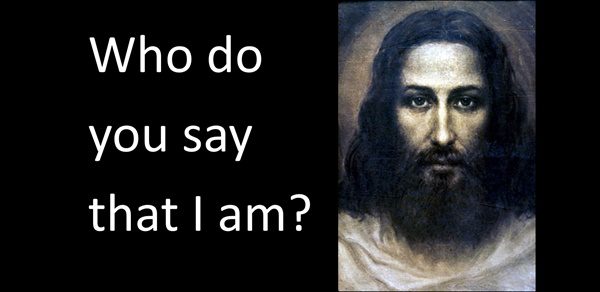
“What about you? Who do you say that I am?” Simon Peter responds, “You are the Christ, the Son of the living God.” Jesus replied, “Happy are you, Simon son of Jonah, because no human has shown this to you.”
Simon son of Jonah! Why does Jesus refer to Peter as “Simon son of Jonah”? Remember Jonah and the whale. Jonah was God’s reluctant prophet who tried to escape his mission to Nineveh by going in the opposite direction. But it didn’t work; Jonah got swallowed by a whale, brought back and spit so that he would continue with God’s mission. After that experience, Jonah decided to go to Nineveh but his hate toward Nineveh was so deep he hopes he will fail so that he can see Nineveh destroyed before his eyes. When Nineveh repented Jonah pouted. In spite of himself he becomes a prophet of God’s universal grace. Doesn’t that capture Peter’s story? He is given a gospel for all people but he fights it thinking it’s only for his own people. Simon son of Jonah, how true! Like us all, Peter is the son of reluctant forgiveness. We humans don’t start with forgiveness; we start with rivalry and revenge, but God starts with forgiveness. He even loves the people of Nineveh and Caesarea Philippi.
“No human has shown this to you. Rather my Father who is in heaven has shown you.” Simon has had a flash of insight that Jesus said came from God. It didn’t come from fellow humans, caught as we all are in mimesis. It had to come from God. Peter on his own isn’t capable of seeing this, nor is any human. Peter’s insight comes from another place, a place outside rivalry and violence, a place Jesus calls heaven.
When Peter refers to “the living God” he puts the living God in contrast to a dead god and confesses more than he realizes. Most anthropologists, including Girard, see the gods and religion as a product of human imagination; humans writ large but modeled in our own image. In Girard’s thinking, it works like this: Human culture, precarious because of rivalry, needs a way to keep peace so as to not destroy itself. We discovered, quite by accident, that when we unite to exclude or eliminate someone who does not have the power to resist us, the result is a sudden, pervasive and powerful calm. The calm as we stare at the body we have destroyed is so powerful we decide we have killed a god, for how else can we account for the calm? We then divinize the one we killed. But we deceive ourselves. The entity we idolize is actually a cadaver beneath the rocks we threw. This god is not living but quite dead.
But Peter, in his insight from God, sees Jesus as the Christ, the Son of the living God. The living God, who is in relation to us, sees our human problem and sends Jesus to deliver us. Jesus does this by allowing himself to become the target of our violence, experiencing it to its fullness, and then returns to forgive us and assure us that we still reside in God’s love. The Son of the living God does this to show us the way away from the gods of death to which we have indentured ourselves.
With Peter’s confession, Jesus gives him a new name. He needs a new name because he has a new identity; he is operating under new management. He is a different person now, run by a new administration; an administration characterized by forgiveness, mercy and compassion. “I tell you that you are Peter.” he says. “And I will build my church on this rock.” Peter means rock. Peter’s God-given insight on Jesus makes him solid. His solidness depends on this insight at that moment; not his character or brilliance; for after all, he is still the son of Jonah too.
“The gates of the underworld won’t be able to stand against it” Jesus said. Caesarea Philippi was built below a large cliff called the “rock of the gods” where many shrines had been built. A cave containing a stream flowed from the base of the cliff and local mythology said that cave was where Baal, one of the gods, entered and left the underworld.
There is a sense in which we live in the underworld and the gates to it are our rivalry and violence now seeming to break out everywhere. But a new way that defeats our patterns has opened up. Its message of suffering love and forgiveness are so powerful, even “The gates of the underworld won’t be able to stand against it.” Forgiveness and suffering love are the keys. Jesus calls humans out of a community based on persecution into a community based on forgiveness and suffering love.
“I’ll give you the keys of the kingdom of heaven”, Jesus says. These keys open the door to an expansive and expanding world of love that extends through time and space. Those who live with an awareness of the kingdom of heaven know the world is held in being by God’s love and that this love will not diminish. Those of us living in Oregon had a visceral experience of God holding us in being during the solar eclipse when the air became noticeably colder during the moments the sun’s rays were blocked by the moon. In those moments we realized our dependence on a radiance coming from beyond ourselves.
“Anything you fasten on earth will be fastened in heaven. Anything you loosen on earth will be loosened in heaven,” Jesus said. Now Heaven and earth are connected. They are linked. No dualism here; no tearing in two. Living in this kingdom frees us from all tearing-in-two.
“Then he ordered the disciples not to tell anybody that he was the Christ.” Peter and the disciples have had a flash of insight that comes from God but they can’t really understand it yet. It will be years before they even begin to understand. If they try to talk about it now, they will get it wrong. Best to keep quiet and let it simmer. Amen.
Stay in the loop! Like Teaching Nonviolent Atonement on Facebook!
Image: Adapted from Flickr, Waiting for the Word, Head of Christ. artist: Ariel Agemian, Creative Commons License.
Next Post

August 31, 2017 Trump Pardons Arpaio – Are We at the “Bonhoeffer Moment”
Browse Our Archives
Select a Category Atonement and Current Events Curriculum Faith and Families Interviews Jesus the Forgiving Victim Lent Montessori politics Reviews The Bible Explained Uncategorized Valentine's Day Wednesday Sermon Who is God?
Select a Month July 2020 November 2019 October 2019 September 2019 August 2019 July 2019 June 2019 May 2019 April 2019 March 2019 February 2019 January 2019 December 2018 November 2018 October 2018 September 2018 August 2018 July 2018 June 2018 May 2018 April 2018 March 2018 February 2018 January 2018 December 2017 November 2017 October 2017 September 2017 August 2017 July 2017 June 2017 May 2017 April 2017 March 2017 February 2017 January 2017 December 2016 November 2016 October 2016 September 2016 August 2016 June 2016 May 2016 April 2016 March 2016 February 2016 January 2016 December 2015 November 2015 October 2015 September 2015 August 2015 July 2015 June 2015 May 2015 April 2015 March 2015 February 2015 January 2015 December 2014 November 2014 October 2014 September 2014 August 2014 July 2014 June 2014 May 2014 April 2014 March 2014 January 2014 December 2013 September 2013 August 2013 July 2013
Follow Us!
TAKE THE
Religious Wisdom Quiz
Who suggested throwing Moses into the Nile as a baby?
Select your answer to see how you score.
Miriam Pharaoh A Hebrew midwife Pharaoh's daughter
Related posts from Teaching Nonviolent Atonement

How Forgiveness Can Transform Our Violence and Build...

The Chosen One Chooses Love Over Fear [VIDEO]

How My Atheist Father Helps Me Appreciate The...

The Unity of All Things: How to Be...
TRENDING AT PATHEOS Progressive Christian

What Being a Modern-Day Apostle Means to Me
In my last column, I discussed the ins and outs of modern-day...

Did Ancient China Once Worship the God of...
Across human history, a common thread weaves through the origins of the...

Love Your Neighbor – Including Earth-Kin: Lev. 19,...
God’s command to love your neighbor means acting in an ethical and...

Lead a Church Study of “Jesus and Lao...
Guest writer Jack Thomas (The Irreverent Reverend) reflects on leading his church...

Pastoral Wisdom for Responding to Sermon Pushback
Getting sermon pushback on your social justice sermon? Learn practical, Proverbs-based strategies...

Principles for Understanding the Apostolic Ministry Today
Whenever people discover that my formal ministry title is "apostle," as in...
view all Progressive Christian blogs
Ad-Free & Subscriber Log-In Subscription Support
- About Us
- 2026 Calendar
- Videos
- Podcasts
- Library of World Religions
- Faith In Media Tracker
- Advertise With Us
- Write for Us
- Privacy Policy
- Terms of Service
- Do Not Sell My Data
- Contact Us
- Radiant Digital
- Manage Newsletter Subscriptions
- Unsubscribe From Notifications
- Sitemap
Copyright 2008-2026, Patheos. All rights reserved.
Subscription Support Ad-Free & Subscriber Log-In
Follow Patheos