
BuddhistCatholicContemplativeEvangelicalGeneral ChristianHinduJewishLatter-day SaintMuslimNew VisionsProgressive Christian
Beliefs
- Buddhist
- Catholic
- Contemplative
- Evangelical
- General Christian
- Hindu
- Jewish
- Latter-day Saint
- More Voices
- Muslim
- New Visions
- Pagan
- Progressive Christian
Topics
- Religion News
- Food and Religion
- Sports and Religion
- Religious Art
- Religious Music and Entertainment
- Religious Events
- History and Religion
- Style and Religion
- Politics and Religion
- Women in Religion
- Recreation Outdoors and Religion
- Business Finance and Religion
- Careers Workplace and Religion
- Education and Religion
- Family Parenting and Religion
- Health Fitness and Religion
- Home and Religion
- Relationships and Religion
- Technology and Religion
- Travel and Religion
Columnists
- Buddhist Columnists
- Business Finance and Religion Columnists
- Careers Workplace and Religion Columnists
- Catholic Columnists
- Contemplative Columnists
- Education and Religion Columnists
- Evangelists Columnists
- Family Parenting and Religion Columnists
- General Christian Columnists
- Health Fitness and Religion Columnists
- Hindu Columnists
- History and Religion Columnists
- Home and Religion Columnists
- Jewish Columnists
- More Voices Columnists
- Latter Day Columnists
- Muslim Columnists
- New Visions Columnists
- Nonreligious Columnists
- Pagan Columnists
- Politics and Religion Columnists
- Progressive Columnists
- Recreation Outdoors and Religion Columnists
- Relationships and Religion Columnists
- Religion News Columnists
- Religious Art Columnists
- Religious Events Columnists
- Religious Music and Entertainment Columnists
- Sports and Religion Columnists
- Style and Religion Columnists
- Technology and Religion Columnists
- Travel and Religion Columnists
- Women in Religion Columnists
Resource Library
- 2026 Calendar
- Library of World Religions
- The 100 Most Holy Places on Earth
- Patheos Answers
- Podcasts
- Videos
- Faith Leaders Database
- Anglican Episcopalian
- Bahai
- Baptist
- Buddhism
- Christianity
- Confucianism
- Eastern Orthodoxy
- Hinduism
- Holiness and Pentecostal
- ISKCON
- Islam
- Judaism
- Lutheran
- Methodist
- The Church of Jesus Christ of Latter-day Saints
- New Age
- Paganism
- Presbytarian and Reformed
- Protestantism
- Religion Behind the Scenes
- Roman Catholic
- Scientology
- Shia Islam
- Sikhism
- Sufism
- Sunni Islam
- Taoism
- Zen
- See all religions
Research Tools
 Ad-Free & Subscriber Log-In Subscription Support
Ad-Free & Subscriber Log-In Subscription Support
Follow Patheos 

- Trending:
- Forgiveness
- |
- Marriage
- |
- Consciousness
- |
- Death Penalty
- |
- Election
- |
- Halloween
 Teaching Nonviolent Atonement
- Home
- Progressive Christian
- Sermon: The Love Flow of Trinity
Sermon: The Love Flow of Trinity
Last updated on: June 14, 2017 at 2:48 pm by Tom Truby
Sermon: The Love Flow of Trinity 2017-06-14T14:48:50-05:00 Tom Truby
Patheos Explore the world's faith through different perspectives on religion and spirituality! Patheos has the views of the prevalent religions and spiritualities of the world.
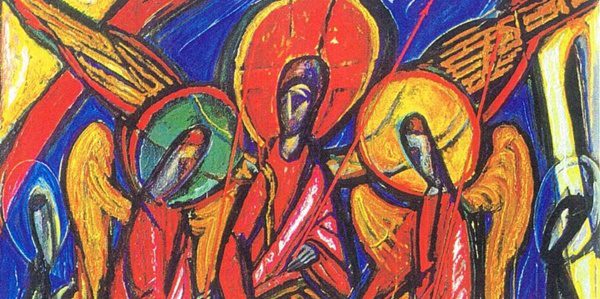 Year A, Trinity Sunday
June 11, 2017
By Tom Truby
The creation story in Genesis stands in sharp contrast to almost all other creation stories. Usually creation is pictured as coming from the conflict, discord and the rivalry of the gods who are contending with one another. Often, the people who tell the story see themselves as the dismembered remains of a slain body. But not the Genesis story. In the Hebrew genius, creation is out of nothing except God’s initiative. The story is warm, positive and relational. Each thing is created and different from what came before and all contribute to the unity of the whole.
For example, on the fifth day “God said, ‘Let the waters swarm with living things, and let birds fly above the earth up in the dome of the sky.” God created the great sea animals and all the tiny living things what swarm in the waters, each according to its kind, and all the winged birds, each according to its kind.” I am moved as I think of the differences, complexity and variety of creation. God saw how good it was. Then God blessed them: ‘be fertile and multiply and fill the waters in the seas, and let the birds multiply on the earth.” It makes we want to go out and appreciate nature; bird watch, visit an aquarium, walk in the woods or be silent at twilight in the desert. Humans too often struggle and tear down. God creates and looks on what he creates as “good.” Here there is peaceful summertime contentment.
Finally, on the sixth day God says “Let us make humanity in our image to resemble us so that they may take charge of the fish of the sea, the birds of the sky, the livestock, all the earth and all the crawling things on earth.” The tip-off on the Trinity is “Let us make humanity in our image to resemble us.” In Genesis God is plural rather than singular. How can that be? It’s a mystery meant to baffle our individualism. Who are we really? Are we just individual bubbles floating in space bumping into other bubbles also floating? Maybe we are more than that, just as God seems to be more than that. Maybe we are parts of each other, networks of relationships like galaxies, molecules and communities linked together by the attractive power of love.
“God created humanity in God’s own image, in divine image God created them, male and female God created them.” God created us to be a picture of his relational three-ness. He is the dance of relationship where each part is attuning to the other parts; responding, enjoying, being shaped by and shaping the rest of the whole. They are all for one and one for all. It is a mystery only because we have lost touch with how to live it. To invite this effervescent triangle into who we are changes everything and makes relationship central. Suddenly we are more alive and free than we have ever been before.
On Thursday Allen Alda, of the old TV Mash series, was being interviewed by Charlie Rose on Public Television. Alda, who must be in his late 70’s now, has dedicated the last twenty years of his life to developing a school of improvisation for doctors, scientists and business leaders who want to learn how to communicate. Allen Alda did this out of his desire to make the world a more human, livable and creative place. He said even brilliant ideas do the world no good if they are just rolling around in someone’s head unable to get out.
Improvisation teaches us to deeply listen to the other person so that we can open channels for the other to be able to listen to us. Relationship opens the way for truth; in a way, relationship is truth. It is built into the character of God. When Alda was on stage he didn’t so much speak his lines out of memory as he said what came to mind when the other actor spoke. They fed off each other, creating an experience that was more than the sum of the parts. The dialogue was fresh and fascinating as the audience saw their relationship sparkle in front of them. The give and take was fresh and lively. It’s as real as the Trinity and a mystery as to how it works.
As Allen Alda and Charlie Rose talked about real relationship they unconsciously modeled it. Their eyes sparkled, their exchanges built on each other, and new truths kept popping out of each of them, enlivening them both. I want to communicate like that too. I think God wants us to all communicate like that. I could see there was no rivalry between them; they were not trying to outdo each other. All they wanted was to explore truth, understood to be beyond them both. God shows us the importance of relationship by making it the expression of himself.
The passage from Genesis on this Trinity Sunday concludes with, “This is the account of the heavens and the earth when they were created.”
In today’s lesson from the end of the Gospel of Matthew, Jesus instructs his disciples to “go and make disciples of all nations, baptizing them in the name of the Father and of the Son and of the Holy Spirit.” I think of God as the creator of all of us and of all creation. Like any loving father God wants what is best for all his children.
But what if his children don’t want what’s best for each other or for the earth. They want only what they think is best for themselves. They keep being in rivalry and trying to best their neighbor rather than want what’s best for all. How will God show them how to not be in rivalry? He will send them his Son who is in absolute accord with his father, so close they are a part of each other. Then we have a model to pattern after who is different from all our peers because he is not in rivalry with God. We can imitate the Son rather than our neighbor and escape our entrapment of rivaling God.
Dying to rivalry is part of what baptism means. In baptism the baptized one or even the baptized nation ceases to be in rivalry to its neighbor, dies to its desire to think of its self as first, the best and most important one or nation and chooses to want what is best for all. We can do this by desiring the desire of the Father, as modeled by Jesus the Son.
The Spirit, according to Matthew, is that part of God that teaches us to obey what God commands of us. Namely to love all creation, including all humans, and to die to wanting only what we think is best for only us. This love invites us to be like the Father and Jesus who always want what is best for all. All three are a part of God but play a different role in God’s economy. With the Spirit’s coming, what is best for all is now inside us and will never leave us until Jesus’ return when all of this will become the ocean we swim in.
The Trinity lives in absolute trust. The Father trusts Jesus, the Son; Jesus trusts the Father, and both trust the Holy Spirit. The Persons of the Trinity are always listening to each other and affecting each other. The Persons of the Trinity hold nothing back from one another. They invite us into their non-rivalrous life that stands in deep contrast to the human way of divide and conquer.
What is love? The answer is shown in the Trinity: each influences, defers to and honors the other. As we say “yes” to God’s desire, we find ourselves discovering a freedom we have never known. We find ourselves participating in the love flow of Trinity.
Thanks be to God. Amen.
Image: By Alek Rapoport (Author) [GFDL (http://www.gnu.org/copyleft/fdl.html) or CC BY-SA 3.0 (http://creativecommons.org/licenses/by-sa/3.0)], via Wikimedia Commons
Stay in the loop! Like Teaching Nonviolent Atonement on Facebook!
Previous Post

June 13, 2017
Islamist Militants Carry Out Terror, Not Jihad
Next Post
June 15, 2017 Man Who Attacked GOP Was a Product of American Logic of Violence
Browse Our Archives
Select a Category Atonement and Current Events Curriculum Faith and Families Interviews Jesus the Forgiving Victim Lent Montessori politics Reviews The Bible Explained Uncategorized Valentine's Day Wednesday Sermon Who is God?
Select a Month July 2020 November 2019 October 2019 September 2019 August 2019 July 2019 June 2019 May 2019 April 2019 March 2019 February 2019 January 2019 December 2018 November 2018 October 2018 September 2018 August 2018 July 2018 June 2018 May 2018 April 2018 March 2018 February 2018 January 2018 December 2017 November 2017 October 2017 September 2017 August 2017 July 2017 June 2017 May 2017 April 2017 March 2017 February 2017 January 2017 December 2016 November 2016 October 2016 September 2016 August 2016 June 2016 May 2016 April 2016 March 2016 February 2016 January 2016 December 2015 November 2015 October 2015 September 2015 August 2015 July 2015 June 2015 May 2015 April 2015 March 2015 February 2015 January 2015 December 2014 November 2014 October 2014 September 2014 August 2014 July 2014 June 2014 May 2014 April 2014 March 2014 January 2014 December 2013 September 2013 August 2013 July 2013
Follow Us!
TAKE THE
Religious Wisdom Quiz
This chapter in Psalms declares the blessed man who meditates on God's law day and night is like a tree planted by streams. What is its number?
Select your answer to see how you score.
Psalm 119 Psalm 1 Psalm 23 Psalm 100
Related posts from Teaching Nonviolent Atonement

Forgiveness in the Time of COVID-19 by Julia...


Jesus Unmasked: On Being Lost And Found: Sheep,...

Jesus Unmasked: Humility Is Not A Competition [Video]
TRENDING AT PATHEOS Progressive Christian

What Being a Modern-Day Apostle Means to Me
In my last column, I discussed the ins and outs of modern-day...

Did Ancient China Once Worship the God of...
Across human history, a common thread weaves through the origins of the...

Love Your Neighbor – Including Earth-Kin: Lev. 19,...
God’s command to love your neighbor means acting in an ethical and...

Lead a Church Study of “Jesus and Lao...
Guest writer Jack Thomas (The Irreverent Reverend) reflects on leading his church...

Pastoral Wisdom for Responding to Sermon Pushback
Getting sermon pushback on your social justice sermon? Learn practical, Proverbs-based strategies...

Principles for Understanding the Apostolic Ministry Today
Whenever people discover that my formal ministry title is "apostle," as in...
view all Progressive Christian blogs
Ad-Free & Subscriber Log-In Subscription Support
- About Us
- 2026 Calendar
- Videos
- Podcasts
- Library of World Religions
- Faith In Media Tracker
- Advertise With Us
- Write for Us
- Privacy Policy
- Terms of Service
- Do Not Sell My Data
- Contact Us
- Radiant Digital
- Manage Newsletter Subscriptions
- Unsubscribe From Notifications
- Sitemap
Copyright 2008-2026, Patheos. All rights reserved.
Subscription Support Ad-Free & Subscriber Log-In
Follow Patheos