
BuddhistCatholicContemplativeEvangelicalGeneral ChristianHinduJewishLatter-day SaintMuslimNew VisionsProgressive Christian
Beliefs
- Buddhist
- Catholic
- Contemplative
- Evangelical
- General Christian
- Hindu
- Jewish
- Latter-day Saint
- More Voices
- Muslim
- New Visions
- Pagan
- Progressive Christian
Topics
- Religion News
- Food and Religion
- Sports and Religion
- Religious Art
- Religious Music and Entertainment
- Religious Events
- History and Religion
- Style and Religion
- Politics and Religion
- Women in Religion
- Recreation Outdoors and Religion
- Business Finance and Religion
- Careers Workplace and Religion
- Education and Religion
- Family Parenting and Religion
- Health Fitness and Religion
- Home and Religion
- Relationships and Religion
- Technology and Religion
- Travel and Religion
Columnists
- Buddhist Columnists
- Business Finance and Religion Columnists
- Careers Workplace and Religion Columnists
- Catholic Columnists
- Contemplative Columnists
- Education and Religion Columnists
- Evangelists Columnists
- Family Parenting and Religion Columnists
- General Christian Columnists
- Health Fitness and Religion Columnists
- Hindu Columnists
- History and Religion Columnists
- Home and Religion Columnists
- Jewish Columnists
- More Voices Columnists
- Latter Day Columnists
- Muslim Columnists
- New Visions Columnists
- Nonreligious Columnists
- Pagan Columnists
- Politics and Religion Columnists
- Progressive Columnists
- Recreation Outdoors and Religion Columnists
- Relationships and Religion Columnists
- Religion News Columnists
- Religious Art Columnists
- Religious Events Columnists
- Religious Music and Entertainment Columnists
- Sports and Religion Columnists
- Style and Religion Columnists
- Technology and Religion Columnists
- Travel and Religion Columnists
- Women in Religion Columnists
Resource Library
- 2026 Calendar
- Library of World Religions
- The 100 Most Holy Places on Earth
- Patheos Answers
- Podcasts
- Videos
- Faith Leaders Database
- Anglican Episcopalian
- Bahai
- Baptist
- Buddhism
- Christianity
- Confucianism
- Eastern Orthodoxy
- Hinduism
- Holiness and Pentecostal
- ISKCON
- Islam
- Judaism
- Lutheran
- Methodist
- The Church of Jesus Christ of Latter-day Saints
- New Age
- Paganism
- Presbytarian and Reformed
- Protestantism
- Religion Behind the Scenes
- Roman Catholic
- Scientology
- Shia Islam
- Sikhism
- Sufism
- Sunni Islam
- Taoism
- Zen
- See all religions
Research Tools
 Ad-Free & Subscriber Log-In Subscription Support
Ad-Free & Subscriber Log-In Subscription Support
Follow Patheos 

- Trending:
- Forgiveness
- |
- Marriage
- |
- Consciousness
- |
- Death Penalty
- |
- Election
- |
- Halloween
 Teaching Nonviolent Atonement
- Home
- Progressive Christian
- God the Shepherd Is Un-ambivalently For Us
God the Shepherd Is Un-ambivalently For Us
Last updated on: May 11, 2017 at 12:46 pm by Tom Truby
God the Shepherd Is Un-ambivalently For Us 2017-05-11T12:46:36-05:00 Tom Truby
Patheos Explore the world's faith through different perspectives on religion and spirituality! Patheos has the views of the prevalent religions and spiritualities of the world.
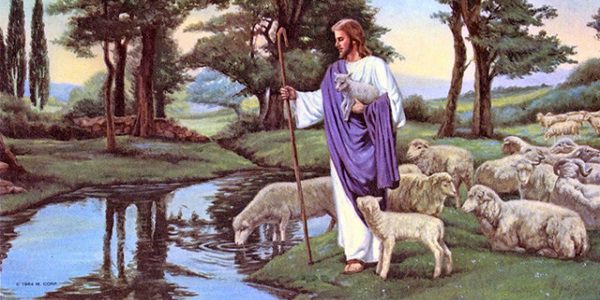 Year A, 4th Sunday of Easter
John 10:1-10
By Rev. Tom Truby
God the Shepherd Is Un-ambivalently For Us
There is only one legitimate way into the sheep pen; through the gate. Whoever climbs over the wall is a thief and an outlaw. We know that Jesus is the gate but can we take the metaphor any deeper? And what do the wall-climbers do that make them so dangerous?
Let’s start with the wall. The wall was constructed to protect sheep from predation. Anyone climbing over it wants to get something for themselves at the sheep’s expense. They don’t care about the sheep. They want to exploit them.
To climb over the wall is to have a hidden agenda in approaching the sheep. Rivalry could be their reason for jumping the fence. Such a thief is trying to steal what does not belong to them. Maybe the thief wants unqualified admiration, the other’s well-earned social position in the community, special skills the other has or maybe it’s the other’s very being they wish to steal. They are in rivalry with the sheep and want to fleece them to aggrandize themselves. Strange as it sounds, they believe the sheep have something they are missing and must have, so they try to steal it from the sheep.
The thief is an outlaw for he operates outside God’s desire. God is for us but these thieves are not. The only legitimate way into the sheep pen is through wanting what’s best for the sheep. Jesus is very sure of this. He begins his statement with “I assure you…”
The shepherd enters through the gate because he is the only one who really cares about the sheep “un-ambivalently.” There is no dark side to his care, no hidden agenda, and no rivalry. He is totally for them.
“Un-ambivalent” is a very important word to me. We humans almost always have a hidden agenda in our relationships whether we know it or not, even in our closest relationships. We can’t get to absolute purity where we are totally for the other. We can move in that direction but we don’t ever totally get there and I think it’s best to just admit that. It keeps us self-reflective and humble for we always must consider the possibility of self-delusion. But the shepherd who is Jesus is pure in his intentions. He is absolutely for us and has proven it by being willing to die on the cross. So the gate is Jesus’ willingness to be un-ambivalently for us and he is the only one qualified to use that gate.
“The guard at the gate opens the gate for him.” Does that make God the gate keeper? The guard seems to know the shepherd. They share the same desire for keeping the sheep safe. Do you suppose the gate keeper and the shepherd are related? The guard opens the gate for the shepherd. Is this a metaphor for God sending us his son? I find it a comforting thought.
“The sheep listen to his voice.” Those who are willing to be led listen to his voice. They are O.K. with being sheep rather than goats who chart their own course, needing no one. Of course, the irony is that those who think they are following their own star are really directed by voices outside their vision. Maybe the voice is off-stage or hidden in the past. This voice may have been acquired very early in life and no longer adaptive to the present situation. This is one of the areas in which René Girard has helped us see more clearly.
“He calls his own sheep by name and leads them out.” When I was a little boy I used to wonder who my future wife would be. When I asked my mother she told me God has someone planned for me. At that moment images of unattractive girls would pop into my head. I sure hope it’s not that girl over in Iowa who is so homely, I thought to myself. I wasn’t sure I wanted God to choose; God might not have an eye for who is attractive.
But he calls his sheep by name. If the shepherd is really for me, he is going to be interested in what I, in my particularity, like. My “selfness”, my uniqueness, my individuality is not going to be ignored. To be a follower of this shepherd does not mean you become like all the other sheep. This shepherd knows each one’s unique voice and honors it. I find all of this very comforting and true as I reflect on my own life. “He calls his own sheep by name and leads them out.”
Notice how he goes before them leading the way. They choose in their freedom to follow him. They are not driven by sheep dogs biting at their heel; their direction determined by those they fear. There is no fear involved in this scene. They follow their shepherd because they want to, because they find him attractive, because they trust him and believe he is leading them to new and richly nurturing ground.
They follow him because they know his voice. His voice is a comfort to them and they feel safe. When our granddaughters were very small they were afraid of me because my voice was deeper, louder and less gentle than the voice of their parents or grandmother. I was a stranger to them and they would run away from me. I learned to soften my voice for their sake.
Children, in their vulnerability, are very aware of harshness. They can tell you who is mean and who they are afraid of. Last Sunday I asked our young disciples what they thought Jesus was like. The first thing they said was Jesus was gentle.
This section of John ends with the narrator saying, “Those who heard Jesus use this analogy (about the sheep pen and the shepherd) didn’t understand what he was saying.” I suspect it was too far from their lived experience. In their experience most leaders fleece them, use them, lie to them, force them to do things they don’t want to do and always speak with harsh voices. They can’t imagine someone being for them with no hidden agenda.
“So Jesus spoke again” and this time he was more explicit. “I assure you that I am the gate of the sheep,” he said. We humans have hemmed ourselves in and find ourselves trapped in desolate places. We have lost our freedom to our fears and our violence. Jesus has come to be the gate out of our entrapment. Belief in Jesus as the one who is for us, as the one who is not in rivalry with us, and as the one who leads us to life, empowers him to be our gate.
Those who came before Jesus didn’t really care about the sheep. They all had hidden agendas. They were robbers and outlaws. I wonder if Jesus is thinking of Rome and empire; of temple taxes and the corrupt religious bureaucracy that only added to the people’s burden. The sheep who follow Jesus don’t listen to strange and harsh voices.
“I am the gate,” he says. “Whoever enters through me will be saved.” I used to think he was talking about heaven and being saved beyond our death. Now I think he is talking about much more. Jesus is the gate to a world with no “over-against-ness.” With no “us and them” where all are saved who desire it and no one excluded. All have access to life sustenance and can go in and out freely. In Jesus the world is finally whole and all are embraced. This has always been God’s intention, the reason he sent Jesus to live among us and the full demonstration of his being for us all. Jesus put it this way, “I came so that they could have life—indeed, so that they could live life to the fullest.” Amen.
Previous Post

May 10, 2017
Beyond Certainty and Doubt: A Better Conversation on Climate Change
Browse Our Archives
Select a Category Atonement and Current Events Curriculum Faith and Families Interviews Jesus the Forgiving Victim Lent Montessori politics Reviews The Bible Explained Uncategorized Valentine's Day Wednesday Sermon Who is God?
Select a Month July 2020 November 2019 October 2019 September 2019 August 2019 July 2019 June 2019 May 2019 April 2019 March 2019 February 2019 January 2019 December 2018 November 2018 October 2018 September 2018 August 2018 July 2018 June 2018 May 2018 April 2018 March 2018 February 2018 January 2018 December 2017 November 2017 October 2017 September 2017 August 2017 July 2017 June 2017 May 2017 April 2017 March 2017 February 2017 January 2017 December 2016 November 2016 October 2016 September 2016 August 2016 June 2016 May 2016 April 2016 March 2016 February 2016 January 2016 December 2015 November 2015 October 2015 September 2015 August 2015 July 2015 June 2015 May 2015 April 2015 March 2015 February 2015 January 2015 December 2014 November 2014 October 2014 September 2014 August 2014 July 2014 June 2014 May 2014 April 2014 March 2014 January 2014 December 2013 September 2013 August 2013 July 2013
Follow Us!
TAKE THE
Religious Wisdom Quiz
With only 300 men, torches, and clay jars, I defeated an army as numerous as locusts. Who am I?
Select your answer to see how you score.
Samson Gideon Barak Jephthah
Related posts from Teaching Nonviolent Atonement

Forgiveness in the Time of COVID-19 by Julia...

Reflections on Indigenous Wisdom For Healing A Wounded...

How Forgiveness Can Transform Our Violence and Build...

Jesus Unmasked: God's Economy and How to Cheat...
TRENDING AT PATHEOS Progressive Christian

What Being a Modern-Day Apostle Means to Me
In my last column, I discussed the ins and outs of modern-day...

Did Ancient China Once Worship the God of...
Across human history, a common thread weaves through the origins of the...

Love Your Neighbor – Including Earth-Kin: Lev. 19,...
God’s command to love your neighbor means acting in an ethical and...

Lead a Church Study of “Jesus and Lao...
Guest writer Jack Thomas (The Irreverent Reverend) reflects on leading his church...

Pastoral Wisdom for Responding to Sermon Pushback
Getting sermon pushback on your social justice sermon? Learn practical, Proverbs-based strategies...

Principles for Understanding the Apostolic Ministry Today
Whenever people discover that my formal ministry title is "apostle," as in...
view all Progressive Christian blogs
Ad-Free & Subscriber Log-In Subscription Support
- About Us
- 2026 Calendar
- Videos
- Podcasts
- Library of World Religions
- Faith In Media Tracker
- Advertise With Us
- Write for Us
- Privacy Policy
- Terms of Service
- Do Not Sell My Data
- Contact Us
- Radiant Digital
- Manage Newsletter Subscriptions
- Unsubscribe From Notifications
- Sitemap
Copyright 2008-2026, Patheos. All rights reserved.
Subscription Support Ad-Free & Subscriber Log-In
Follow Patheos