
BuddhistCatholicContemplativeEvangelicalGeneral ChristianHinduJewishLatter-day SaintMuslimNew VisionsProgressive Christian
Beliefs
- Buddhist
- Catholic
- Contemplative
- Evangelical
- General Christian
- Hindu
- Jewish
- Latter-day Saint
- More Voices
- Muslim
- New Visions
- Pagan
- Progressive Christian
Topics
- Religion News
- Food and Religion
- Sports and Religion
- Religious Art
- Religious Music and Entertainment
- Religious Events
- History and Religion
- Style and Religion
- Politics and Religion
- Women in Religion
- Recreation Outdoors and Religion
- Business Finance and Religion
- Careers Workplace and Religion
- Education and Religion
- Family Parenting and Religion
- Health Fitness and Religion
- Home and Religion
- Relationships and Religion
- Technology and Religion
- Travel and Religion
Columnists
- Buddhist Columnists
- Business Finance and Religion Columnists
- Careers Workplace and Religion Columnists
- Catholic Columnists
- Contemplative Columnists
- Education and Religion Columnists
- Evangelists Columnists
- Family Parenting and Religion Columnists
- General Christian Columnists
- Health Fitness and Religion Columnists
- Hindu Columnists
- History and Religion Columnists
- Home and Religion Columnists
- Jewish Columnists
- More Voices Columnists
- Latter Day Columnists
- Muslim Columnists
- New Visions Columnists
- Nonreligious Columnists
- Pagan Columnists
- Politics and Religion Columnists
- Progressive Columnists
- Recreation Outdoors and Religion Columnists
- Relationships and Religion Columnists
- Religion News Columnists
- Religious Art Columnists
- Religious Events Columnists
- Religious Music and Entertainment Columnists
- Sports and Religion Columnists
- Style and Religion Columnists
- Technology and Religion Columnists
- Travel and Religion Columnists
- Women in Religion Columnists
Resource Library
- 2026 Calendar
- Library of World Religions
- The 100 Most Holy Places on Earth
- Patheos Answers
- Podcasts
- Videos
- Faith Leaders Database
- Anglican Episcopalian
- Bahai
- Baptist
- Buddhism
- Christianity
- Confucianism
- Eastern Orthodoxy
- Hinduism
- Holiness and Pentecostal
- ISKCON
- Islam
- Judaism
- Lutheran
- Methodist
- The Church of Jesus Christ of Latter-day Saints
- New Age
- Paganism
- Presbytarian and Reformed
- Protestantism
- Religion Behind the Scenes
- Roman Catholic
- Scientology
- Shia Islam
- Sikhism
- Sufism
- Sunni Islam
- Taoism
- Zen
- See all religions
Research Tools
 Ad-Free & Subscriber Log-In Subscription Support
Ad-Free & Subscriber Log-In Subscription Support
Follow Patheos 

- Trending:
- Forgiveness
- |
- Marriage
- |
- Consciousness
- |
- Death Penalty
- |
- Election
- |
- Halloween
 Teaching Nonviolent Atonement
- Home
- Progressive Christian
- Wednesday Sermon: “Lazarus, Come Out!”
Wednesday Sermon: “Lazarus, Come Out!”
Last updated on: April 5, 2017 at 2:01 pm by Tom Truby
Wednesday Sermon: “Lazarus, Come Out!” 2017-04-05T14:01:36-05:00 Tom Truby
Patheos Explore the world's faith through different perspectives on religion and spirituality! Patheos has the views of the prevalent religions and spiritualities of the world.
 Pastors have a frequent question when they begin to discover mimetic theory. “That’s great. But how does it preach?”
Reverend Tom Truby shows that mimetic theory is a powerful tool that enables pastors to preach the Gospel in a way that is meaningful and refreshing to the modern world. Each Wednesday, Teaching Nonviolent Atonement will highlight his sermons as an example of preaching the Gospel through mimetic theory.
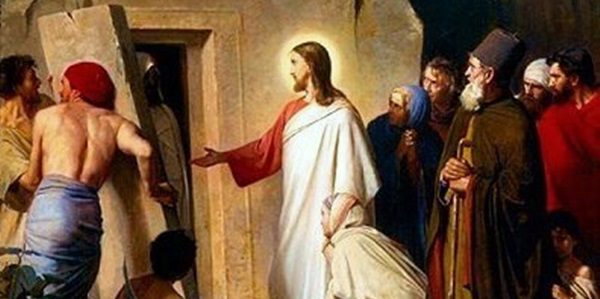
In this sermon, Tom explores Jesus raising Lazarus from death to life. Jesus knows that this act is a challenge to cultural ways of death, and that it will lead to his own death. Tom writes, “Humans attempt to manage divisions through the mechanism of blame, rejection, and exclusion. Jesus has to allow himself to get caught in this cruel machinery if he is to reveal it so we can see it too.” That revelation leads us to hope for a better world.
Year-A Fifth – Sunday in Lent
April 2, 2017
John 11:1-45
“Lazarus, Come Out!”
A man is ill. He lives in a village two miles from Jerusalem, the capital city. His name is Lazarus and his two sisters are Mary and Martha. They are followers of Jesus and they are all close friend. But now Lazarus is seriously ill. The sisters send an urgent message to Jesus who is some distance away. The message reads, “Lord, the one whom you love is ill.” Jesus, come quickly with your healing touch, before it is too late!
Instead of coming immediately Jesus lingers saying, “This illness isn’t fatal. It’s for the glory of God so that God’s Son can be glorified through it.”
It is two days later now and Jesus announces his intention to go to Judea. The disciples try to talk Jesus out of going. “Rabbi, the Jewish opposition wants to stone you, but you want to go back.” Why would you go there; they want to kill you?
Jesus responds, “Aren’t there twelve hours in the day? Whoever walks in the day doesn’t stumble because they see the light of the world. But whoever walks in the night does stumble because the light isn’t in them.”
The disciples are tempting Jesus to deviate from the path God has set before him. The light is God’s Spirit guiding him. To live in it, Jesus must do what God sent him to do when God sends him to do it. Now is the time. The cosmos is set.
What Jesus tells them seems strange: “Our friend Lazarus has fallen asleep, but I am going there to awaken him.” He doesn’t want them to worry about Lazarus! The disciples persist in their attempt to dissuade Jesus. “Lord, if he has fallen asleep, he will be all right.” Why are we going to Judea, that death trap, to wake somebody who has overslept?
Jesus now discloses that Lazarus is dead and they are going to Judea so that the disciples may believe. He is absolutely firm in his resolve. Thomas, that “somber realist,” said to the other disciples, “Let us go too so we may die with him.” I detect a note of sarcasm in his voice. But Laura, my wife, thinks he wants to be strong.
The entourage arrives in Bethany. Lazarus has been in the tomb four days! That means he was already dead when Jesus got the message. Martha comes to meet Jesus and wonders why he didn’t come sooner. They have a conversation about resurrection but Martha doesn’t get it. She leaves Jesus standing there and “goes back and calls her sister Mary, and tells her privately, ‘The Teacher is here and is calling for you.’” Jesus hadn’t actually called for Mary. Maybe she was angry with Jesus and didn’t want to talk to him.
Mary says the same thing Martha said but she says it while kneeling at his feet. “Lord, if you had been here, my brother would not have died.” I get a different feel from Mary. She asks the same question but without pointing the finger of blame. She, too, wants to know why, but the question comes from a place of trust. Their relationship is still intact even though she is as sad as Martha about her brother’s death.
Mary and the people who had followed her out to meet Jesus begin to cry. At this point Jesus becomes deeply disturbed. Why? Was it because he knew what he had to do to bring us to an awareness of God’s resurrection power – and what it would cost him?
Jesus has to work his grief and decide he will do what needs to be done. John doesn’t have a temptation story like the Synoptic Gospels but this is John’s temptation story. Jesus knew if he brought Lazarus to life, it would lead to his own death. In John’s gospel the two are linked.
Jesus resolves to do it and says, “Where have you laid him?” Those around him say, “Lord, come and see.” Aren’t those the same words Jesus used when he called his first disciples? Now God is calling Jesus to come and see where faithfulness will take him. Jesus weeps! Is this the Fourth Gospel’s form of the tears shed in the Garden of Gethsemane?
The religious leaders misinterpret his tears. They can’t see that his tears look forward to what he must soon suffer. Jesus is feeling the weight of all the violence, injustice, innocent suffering and false accusations the world has generated through history. The religious leaders think his tears grow out of his sympathy for his friend or his regret for not arriving sooner. We know they are far more than that; they are tears for the whole world.
Even in their description of Jesus’ behavior, the divisions and the tensions between the leaders appear. “‘The Jews said, ‘See how much he loved him!’” But some of them said, ‘He healed the eyes of the man born blind. Couldn’t he have kept Lazarus from dying?’” I wonder if they mirror the attitude of the two sisters. These are the tensions that make Jesus’ journey to the cross necessary. Humans attempt to manage divisions through the mechanism of blame, rejection and exclusion. Jesus has to allow himself to get caught in this cruel machinery if he is to reveal it so we can see it too.
Waves of awareness seem to be washing over Jesus. Again greatly disturbed he comes to the tomb and says, “Lazarus, come out.” In bringing Lazarus to life, Jesus knows he is condemning himself to death. Hadn’t Jesus said that he would raise Lazarus so that the Son of God may be glorified through it? In John’s Gospel, the glorification of Jesus is the crucifixion and resurrection together. That’s where the Son of Humanity is lifted up.
Jesus, the Word of God made flesh, said to the power of the grave, “Unbind him and let him go.” Bruce Prewer, an Australian pastor and writer, wrote a poem entitled “Lazarus, Come Out!” It captures how Jesus calls us all out of our death entanglements.
Lazarus, come out!
Come out from the career crypt
where frenetic ambition
leaves you no time
for family, prayer or contrition.
Lazarus, come out!
Walk from the burial chamber
that is your mega dollar home
with its security system
and prison-like grills in chrome.
Lazarus, come out!
Escape from the tomb
of academic games you’ve won,
where you dissect many creeds
but trust and follow none.
Lazarus, come out!
Rush from the crematorium
of contemporary lust
that burns you up
and turns your life to dust.
Lazarus, come out!
Break from the pretty tomb
of fashion, where you rob
your own true self
to blend with the shallow mob.
Lazarus, come out!
Forsake the religious coffin
where the pious pray
for a better world
yet don’t live it day by day.
Lazarus, come out!
Come out of the white-washed grave
of voluble churchly word
and pious self-serving.
Follow again the living Lord. Amen.
Image: Carl Heinrich Bloch [Public domain], via Wikimedia Commons.

Stay in the loop! Like Teaching Nonviolent Atonement on Facebook!
Previous Post

April 4, 2017
How Beauty and the Beast is Making Better Christians
Next Post
April 7, 2017 Outrage, Disgust, and Donald Trump - A Conversation with Dr. Martha Reineke
Browse Our Archives
Select a Category Atonement and Current Events Curriculum Faith and Families Interviews Jesus the Forgiving Victim Lent Montessori politics Reviews The Bible Explained Uncategorized Valentine's Day Wednesday Sermon Who is God?
Select a Month July 2020 November 2019 October 2019 September 2019 August 2019 July 2019 June 2019 May 2019 April 2019 March 2019 February 2019 January 2019 December 2018 November 2018 October 2018 September 2018 August 2018 July 2018 June 2018 May 2018 April 2018 March 2018 February 2018 January 2018 December 2017 November 2017 October 2017 September 2017 August 2017 July 2017 June 2017 May 2017 April 2017 March 2017 February 2017 January 2017 December 2016 November 2016 October 2016 September 2016 August 2016 June 2016 May 2016 April 2016 March 2016 February 2016 January 2016 December 2015 November 2015 October 2015 September 2015 August 2015 July 2015 June 2015 May 2015 April 2015 March 2015 February 2015 January 2015 December 2014 November 2014 October 2014 September 2014 August 2014 July 2014 June 2014 May 2014 April 2014 March 2014 January 2014 December 2013 September 2013 August 2013 July 2013
Follow Us!
TAKE THE
Religious Wisdom Quiz
What is the correct sequence of the fruit of the Spirit as listed in Galatians?
Select your answer to see how you score.
Love, peace, joy, kindness, forbearance, faithfulness, goodness, self-control, gentleness Love, joy, peace, forbearance, kindness, goodness, faithfulness, gentleness, self-control Love, joy, peace, kindness, goodness, forbearance, faithfulness, self-control, gentleness Joy, love, peace, goodness, kindness, faithfulness, forbearance, gentleness, self-control
Related posts from Teaching Nonviolent Atonement

Forgiveness in the Time of COVID-19 by Julia...

Reflections on Indigenous Wisdom For Healing A Wounded...

How Forgiveness Can Transform Our Violence and Build...

Jesus Unmasked: God's Economy and How to Cheat...
TRENDING AT PATHEOS Progressive Christian

What Being a Modern-Day Apostle Means to Me
In my last column, I discussed the ins and outs of modern-day...

Did Ancient China Once Worship the God of...
Across human history, a common thread weaves through the origins of the...

Love Your Neighbor – Including Earth-Kin: Lev. 19,...
God’s command to love your neighbor means acting in an ethical and...

Lead a Church Study of “Jesus and Lao...
Guest writer Jack Thomas (The Irreverent Reverend) reflects on leading his church...

Pastoral Wisdom for Responding to Sermon Pushback
Getting sermon pushback on your social justice sermon? Learn practical, Proverbs-based strategies...

Principles for Understanding the Apostolic Ministry Today
Whenever people discover that my formal ministry title is "apostle," as in...
view all Progressive Christian blogs
Ad-Free & Subscriber Log-In Subscription Support
- About Us
- 2026 Calendar
- Videos
- Podcasts
- Library of World Religions
- Faith In Media Tracker
- Advertise With Us
- Write for Us
- Privacy Policy
- Terms of Service
- Do Not Sell My Data
- Contact Us
- Radiant Digital
- Manage Newsletter Subscriptions
- Unsubscribe From Notifications
- Sitemap
Copyright 2008-2026, Patheos. All rights reserved.
Subscription Support Ad-Free & Subscriber Log-In
Follow Patheos