
BuddhistCatholicContemplativeEvangelicalGeneral ChristianHinduJewishLatter-day SaintMuslimNew VisionsProgressive Christian
Beliefs
- Buddhist
- Catholic
- Contemplative
- Evangelical
- General Christian
- Hindu
- Jewish
- Latter-day Saint
- More Voices
- Muslim
- New Visions
- Pagan
- Progressive Christian
Topics
- Religion News
- Food and Religion
- Sports and Religion
- Religious Art
- Religious Music and Entertainment
- Religious Events
- History and Religion
- Style and Religion
- Politics and Religion
- Women in Religion
- Recreation Outdoors and Religion
- Business Finance and Religion
- Careers Workplace and Religion
- Education and Religion
- Family Parenting and Religion
- Health Fitness and Religion
- Home and Religion
- Relationships and Religion
- Technology and Religion
- Travel and Religion
Columnists
- Buddhist Columnists
- Business Finance and Religion Columnists
- Careers Workplace and Religion Columnists
- Catholic Columnists
- Contemplative Columnists
- Education and Religion Columnists
- Evangelists Columnists
- Family Parenting and Religion Columnists
- General Christian Columnists
- Health Fitness and Religion Columnists
- Hindu Columnists
- History and Religion Columnists
- Home and Religion Columnists
- Jewish Columnists
- More Voices Columnists
- Latter Day Columnists
- Muslim Columnists
- New Visions Columnists
- Nonreligious Columnists
- Pagan Columnists
- Politics and Religion Columnists
- Progressive Columnists
- Recreation Outdoors and Religion Columnists
- Relationships and Religion Columnists
- Religion News Columnists
- Religious Art Columnists
- Religious Events Columnists
- Religious Music and Entertainment Columnists
- Sports and Religion Columnists
- Style and Religion Columnists
- Technology and Religion Columnists
- Travel and Religion Columnists
- Women in Religion Columnists
Resource Library
- 2026 Calendar
- Library of World Religions
- The 100 Most Holy Places on Earth
- Patheos Answers
- Podcasts
- Videos
- Faith Leaders Database
- Anglican Episcopalian
- Bahai
- Baptist
- Buddhism
- Christianity
- Confucianism
- Eastern Orthodoxy
- Hinduism
- Holiness and Pentecostal
- ISKCON
- Islam
- Judaism
- Lutheran
- Methodist
- The Church of Jesus Christ of Latter-day Saints
- New Age
- Paganism
- Presbytarian and Reformed
- Protestantism
- Religion Behind the Scenes
- Roman Catholic
- Scientology
- Shia Islam
- Sikhism
- Sufism
- Sunni Islam
- Taoism
- Zen
- See all religions
Research Tools
 Ad-Free & Subscriber Log-In Subscription Support
Ad-Free & Subscriber Log-In Subscription Support
Follow Patheos 

- Trending:
- Forgiveness
- |
- Marriage
- |
- Consciousness
- |
- Death Penalty
- |
- Election
- |
- Halloween
 Teaching Nonviolent Atonement
- Home
- Progressive Christian
- Wednesday Sermon: How to Know Who Your Neighbor Is
Wednesday Sermon: How to Know Who Your Neighbor Is
Last updated on: April 12, 2017 at 11:12 am by Tom Truby
Wednesday Sermon: How to Know Who Your Neighbor Is 2017-04-12T11:12:52-05:00 Tom Truby
Patheos Explore the world's faith through different perspectives on religion and spirituality! Patheos has the views of the prevalent religions and spiritualities of the world.
 Pastors have a frequent question when they begin to discover mimetic theory. “That’s great. But how does it preach?”
Reverend Tom Truby shows that mimetic theory is a powerful tool that enables pastors to preach the Gospel in a way that is meaningful and refreshing to the modern world. Each Wednesday, Teaching Nonviolent Atonement will highlight his sermons as an example of preaching the Gospel through mimetic theory.
Jesus tought us to love our neighbors, but who is our neighbor? In this sermon, Tom tells how Jesus expanded our definition of “neighbor.” He then lifts up stories about members of his congregation who have inspired him by living into Jesus’ teaching. May we be inspired, too.
April 4th, 2017
By Thomas L. Truby
Scripture: Luke 10:25-37
Thoughts on How to Know Who Our Neighbor Is
For the last two or three months I have been reading a book entitled The Rivers North of the Future: the Testament of Ivan Illich by David Cayley. It’s a very deep book; over my head in many ways, but strangely, I have felt called to it. The first time I read it, it was just a blur of words. I have just finished reading it a second time and I may read it once more.
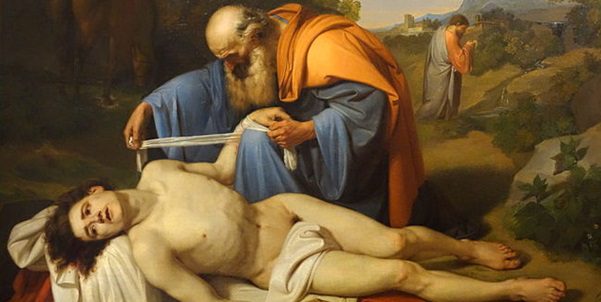
The book explores the thought of Ivan Illich, a priest and scholar who died in 2002. He based his thinking on the story of The Good Samaritan in Luke.
You know the story.
Now I have always assumed this story tells us we all “ought” to care for the hurting other and do this individually and through our institutions. We have believed churches “ought” to do this and those that didn’t should feel guilty. But Illich argues that when we view it that way we distort the story and kill the spirit.
He has a different way of looking at the story that I find quit refreshing. I am hoping I can bring his way to life this morning so that we can feel its vitality. The whole of it begins with the question, “Who is our neighbor?” You remember that was the question the lawyer asked prompting Jesus’ story.
Here is my first observation gleaned from Illich’s thought: Our neighbors are those we run into on our journey of life. We are just going along, minding our business, doing our thing and there they are in the ditch in distress. We weren’t looking for them; they just appeared as we traveled along.
In our church every Sunday we have what we call our “Moment for Mission.” It’s a time we talk about how we have been able to be a blessing to others or received a blessing from others. It’s a kind of spiritual travel log for those we meet as we live. Let me give you some examples.
- Michael talked about his wife Jennifer who wasn’t in church Sunday because she needed to stay home with her mother who is suffering from dementia. Jennifer, a retired nurse, has recently assumed care for her mother who can no longer take care of herself and has moved from Texas to here. Michael said his mother-in-law was getting a level of care exceeding the best she would receive in any facility.
- Suzie said her girls where coming back. We all knew what she meant. Suzie didn’t seek these little girls, they aren’t even blood relatives, they just appeared in the ditch all emotionally beat up and in need. While they were with us, we as a church knew they would have a hard life and then they left. Now they will be coming back for a time.
- Michael told the story of a tractor mechanic who turned up beaten in the ditch. He had been working on this large tractor and hit the starter to reposition the pistons. The tractor started and ran over him leaving him badly injured. Michael was having coffee when he learned about it at the café where the injured man’s wife is a waitress. Michael said the whole community will have to respond by helping this family pay its considerable and mounting medical bills.
- This winter I used the story of Daryl Davis as told in the film “Accidental Courtesy,” about an African American jazz pianist, who encountered a high ranking member of the Ku Klux Klan and befriended him to illustrate how people drop into our life and become the source of our mission. They change us and those we encounter. Contingency, accident, God’s will. We are just traveling along and there they are in the ditch.
Here is my second observation on who our neighbor is: Our neighbor is the one for whom we feel compassion. Our guts twist when we see them in pain; that’s the literal meaning of the Greek term here for compassion.
- When my wife hears a child cry and she observes that the child is crying because the parent doesn’t know how to parent, she is moved with compassion. She often responds by soothing the child or subtly giving the parent a tip on parenting. The impulse is so strong she almost can’t help herself. Her gut twists in compassion for that child.
- Recently I find my gut twisting over the plight of the African Americans in our culture. I can feel with them at such a deep level. I can’t help it. I find myself wanting to learn all I can about their situation and its causes. I have seen the movies, “Moonlight,” “Hidden Figures,” “Fences,” “Loving,” and “I Am Not Your Negro” by James Baldwin and shed tears in each. I got the book “Tears We Cannot Stop: A Sermon to White America” by Michael Eric Dyson on tape and listened to the whole thing. It forced me to see the wounded condition of my sibling in the ditch. My gut twists over institutional racism in America. I want to cross the divide and get to know those who live on the other side. This feels like a desire generated from beyond me. Maybe it’s my calling from God right now.
We all have different populations who move us. Each of our guts twists in response to a different other. For some it’s the elderly, for others it’s the young. For some it’s the ignored people in poverty or Native Americans on reservations or the homeless. We can’t be moved by them all—it’s too much; we can’t take it. And it’s not that we all have to be moved by the same thing.
Our church has a wide spectrum of persons to whom we feel called. Some of us feel the call primarily from our own family, others to the local community and still others from the national and international wounded stranger we feel for in the ditch.
And here’s the thing, we are free to go to anyone who calls us. This is the new freedom that Christ has put before us. We can choose to love anyone we choose. There are no boundaries. The Incarnation, God’s choosing to be human, makes all flesh worthy of our choice. We don’t have to live or love within the strictures of our own community. We are free! Jesus didn’t confine his love. He loved all the wrong people according to the dictates of his own community.
Now for a third observation: When our gut twists as we see the other in distress; that is God’s call to us. We need that call from God through the other. We need that call to know what to do with ourselves. Our meaning comes from responding to the distress of the other. That other can be from our family, from the community, or from the world. It can even be from the trees, the earth, and the waters of mother earth; from God’s creation. It’s the other in distress that calls us. Have you noticed how many young people have heard a call from God for the environment? They are studying environmental science, forestry, oceanography, biology and how violence impacts the earth.
A Muslim girl from the West Bank of Palestine, a resident of Hebron, came to our church this winter. We asked her what she wanted to do with her life. Become a surgeon, she said, so she could patch up the wounded. Her gut had twisted when she saw the wounded and dying in the streets of her town after street battles and bombings and so she decided to be a surgeon. She said that if Palestine were to find peace, God willing, she would go to other parts of the world where people were suffering from war and offer her services. God has called this Muslim through the suffering of her brothers and sisters on the streets of Hebron.
Now for my fourth and final observation: When the Samaritan discovered the wounded Jew he didn’t refer him to an institution. He washed his wounds with wine, applied oil to them, loaded him up onto his own animal and took him to an inn. He paid the inn keeper for his lodging and promised to complete payment when he returned. He got personally involved. He did this even though Jews and Samaritans were enemies, and had different religious beliefs and cultures. Institutions often dull the personal touch and the spirit of mercy and love frequently get drained from them before they even meet the people they are there to take care of.
When Jennifer nurses her mother, far more is happening than the administration of good nursing care. She is getting the best care in the world because it is spirit-infused with love.
The church is a group of people who live this way as much as we are able. Each of us feels called to something different and we meet periodically to support each other and encourage each other to continue as the mystical body of Christ. The church is not an institution that acts like an institution competing with other institutions to change the world. It is an assemblage of people who themselves have been found in the ditch and called out of it as part of our healing. This assemblage shares a vocation, a personal call, a desire to love those for whom we feel compassion as we journey out in life. We are people who live in the world but are not of the world. We have breathed in the breath of Christ and now find ourselves sharing that breath as we encounter our brothers and sisters. Amen.
Image: The Good Samaritan by Luigi Sciallero. Public Domain

Stay in the loop! Like Teaching Nonviolent Atonement on Facebook!
Previous Post

April 11, 2017
Syria’s Beautiful Babies: How to Confront Trump’s Hypocrisy
Next Post
April 13, 2017 Washing Judas' Feet
Browse Our Archives
Select a Category Atonement and Current Events Curriculum Faith and Families Interviews Jesus the Forgiving Victim Lent Montessori politics Reviews The Bible Explained Uncategorized Valentine's Day Wednesday Sermon Who is God?
Select a Month July 2020 November 2019 October 2019 September 2019 August 2019 July 2019 June 2019 May 2019 April 2019 March 2019 February 2019 January 2019 December 2018 November 2018 October 2018 September 2018 August 2018 July 2018 June 2018 May 2018 April 2018 March 2018 February 2018 January 2018 December 2017 November 2017 October 2017 September 2017 August 2017 July 2017 June 2017 May 2017 April 2017 March 2017 February 2017 January 2017 December 2016 November 2016 October 2016 September 2016 August 2016 June 2016 May 2016 April 2016 March 2016 February 2016 January 2016 December 2015 November 2015 October 2015 September 2015 August 2015 July 2015 June 2015 May 2015 April 2015 March 2015 February 2015 January 2015 December 2014 November 2014 October 2014 September 2014 August 2014 July 2014 June 2014 May 2014 April 2014 March 2014 January 2014 December 2013 September 2013 August 2013 July 2013
Follow Us!
TAKE THE
Religious Wisdom Quiz
What is the first line of the Bible?
Select your answer to see how you score.
Hear, O Israel. The Lord is my shepherd. In the beginning God created the heavens and the earth. Let there be light
Related posts from Teaching Nonviolent Atonement
Sermon: The Eleventh Commandment

Being Careful to Live Wisely: Faith and Climate...


Let Light Shine Out of Darkness
TRENDING AT PATHEOS Progressive Christian

What Being a Modern-Day Apostle Means to Me
In my last column, I discussed the ins and outs of modern-day...

Did Ancient China Once Worship the God of...
Across human history, a common thread weaves through the origins of the...

Love Your Neighbor – Including Earth-Kin: Lev. 19,...
God’s command to love your neighbor means acting in an ethical and...

Lead a Church Study of “Jesus and Lao...
Guest writer Jack Thomas (The Irreverent Reverend) reflects on leading his church...

Pastoral Wisdom for Responding to Sermon Pushback
Getting sermon pushback on your social justice sermon? Learn practical, Proverbs-based strategies...

Principles for Understanding the Apostolic Ministry Today
Whenever people discover that my formal ministry title is "apostle," as in...
view all Progressive Christian blogs
Ad-Free & Subscriber Log-In Subscription Support
- About Us
- 2026 Calendar
- Videos
- Podcasts
- Library of World Religions
- Faith In Media Tracker
- Advertise With Us
- Write for Us
- Privacy Policy
- Terms of Service
- Do Not Sell My Data
- Contact Us
- Radiant Digital
- Manage Newsletter Subscriptions
- Unsubscribe From Notifications
- Sitemap
Copyright 2008-2026, Patheos. All rights reserved.
Subscription Support Ad-Free & Subscriber Log-In
Follow Patheos