
BuddhistCatholicContemplativeEvangelicalGeneral ChristianHinduJewishLatter-day SaintMuslimNew VisionsProgressive Christian
Beliefs
- Buddhist
- Catholic
- Contemplative
- Evangelical
- General Christian
- Hindu
- Jewish
- Latter-day Saint
- More Voices
- Muslim
- New Visions
- Pagan
- Progressive Christian
Topics
- Religion News
- Food and Religion
- Sports and Religion
- Religious Art
- Religious Music and Entertainment
- Religious Events
- History and Religion
- Style and Religion
- Politics and Religion
- Women in Religion
- Recreation Outdoors and Religion
- Business Finance and Religion
- Careers Workplace and Religion
- Education and Religion
- Family Parenting and Religion
- Health Fitness and Religion
- Home and Religion
- Relationships and Religion
- Technology and Religion
- Travel and Religion
Columnists
- Buddhist Columnists
- Business Finance and Religion Columnists
- Careers Workplace and Religion Columnists
- Catholic Columnists
- Contemplative Columnists
- Education and Religion Columnists
- Evangelists Columnists
- Family Parenting and Religion Columnists
- General Christian Columnists
- Health Fitness and Religion Columnists
- Hindu Columnists
- History and Religion Columnists
- Home and Religion Columnists
- Jewish Columnists
- More Voices Columnists
- Latter Day Columnists
- Muslim Columnists
- New Visions Columnists
- Nonreligious Columnists
- Pagan Columnists
- Politics and Religion Columnists
- Progressive Columnists
- Recreation Outdoors and Religion Columnists
- Relationships and Religion Columnists
- Religion News Columnists
- Religious Art Columnists
- Religious Events Columnists
- Religious Music and Entertainment Columnists
- Sports and Religion Columnists
- Style and Religion Columnists
- Technology and Religion Columnists
- Travel and Religion Columnists
- Women in Religion Columnists
Resource Library
- 2026 Calendar
- Library of World Religions
- The 100 Most Holy Places on Earth
- Patheos Answers
- Podcasts
- Videos
- Faith Leaders Database
- Anglican Episcopalian
- Bahai
- Baptist
- Buddhism
- Christianity
- Confucianism
- Eastern Orthodoxy
- Hinduism
- Holiness and Pentecostal
- ISKCON
- Islam
- Judaism
- Lutheran
- Methodist
- The Church of Jesus Christ of Latter-day Saints
- New Age
- Paganism
- Presbytarian and Reformed
- Protestantism
- Religion Behind the Scenes
- Roman Catholic
- Scientology
- Shia Islam
- Sikhism
- Sufism
- Sunni Islam
- Taoism
- Zen
- See all religions
Research Tools
 Ad-Free & Subscriber Log-In Subscription Support
Ad-Free & Subscriber Log-In Subscription Support
Follow Patheos 

- Trending:
- Forgiveness
- |
- Marriage
- |
- Consciousness
- |
- Death Penalty
- |
- Election
- |
- Halloween
 Teaching Nonviolent Atonement
- Home
- Progressive Christian
- Making a Fool of Satan: Wisdom From the Cross – A Recorded Webinar
Making a Fool of Satan: Wisdom From the Cross – A Recorded Webinar
Last updated on: April 14, 2017 at 2:19 pm by Adam Ericksen
Making a Fool of Satan: Wisdom From the Cross – A Recorded Webinar 2017-04-14T14:19:10-05:00 Adam Ericksen
Patheos Explore the world's faith through different perspectives on religion and spirituality! Patheos has the views of the prevalent religions and spiritualities of the world.
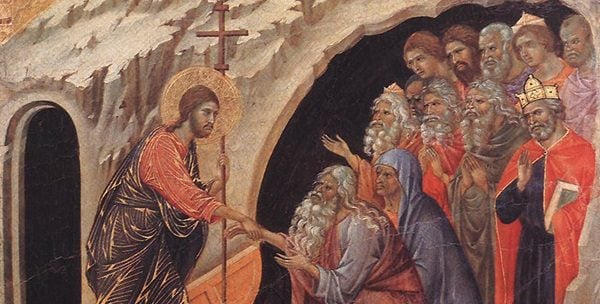 It’s Good Friday! The day Christians throughout the world celebrate the Atonement made on the cross. But what does Atonement mean? And how was it accomplished?
In this episode of the RavenCast, Suzanne Ross and the Rev. Adam Ericksen discuss the history of Atonement theories and what the Atonement means for us today.
Stay up to date on the RavenCast by liking the RavenFoundation Facebook page!
Video
MP3
Show Notes
N.T. Wright claims that Jesus did not give us a theory of Atonement to explain his death. Instead, he gave us a meal. We might say that Jesus gave us a life of Atonement.
In old English, Atonement literally meant, “at-onement.” We were meant to be at one with God, humanity, and creation. Jesus reveals what that at-onement looks like in his life, death, and resurrection. It’s a nonviolent love that seeks reconciliation. As Paul put it in 2 Corinthians 5:19, “In Christ, God was reconciling the world to himself, not counting their trespasses against them, and entrusting us to the ministry of reconciliation.”
Atonement is about reconciliation. God reconciles the world, not by counting our sins against us, but by inviting all people, including people like Judas, to the table to share in a meal.
A key formula in understanding the Atonement is from John Duns Scotus, a 13th century theologian. According to Richard Rohr, Duns Scotus believed that, “Jesus did not come to change the mind of God about humanity (it did not need changing)! Jesus came to the mind of humanity about God.”
Mimetic Theory
Atonement theories generally emphasize a cosmic struggle between God and Satan, or satisfying God’s honor or wrath.
Mimetic theory helps us see that the problem at the cross was not God’s wrath. Rather, the problem at the cross was the human tendency towards violence and scapegoating. We generally find a sense of unity, or at-onement, by uniting against a common enemy. Or a scapegoat. James Alison claims that there as an angry divinity at the cross, and it was humanity.
Satan is the Accuser. The cross reveals how easily we get caught up in the satanic mechanism of accusation. God responds not by mimicking our accusations, but by modeling forgiveness. Jesus prays, “Father, forgive them, for they know not what they do.” As Duns Scotus claimed in the 13th century, this was to change our minds about God. God is the Forgiver, not the Avenger, and invites us to live into that spirit of forgiveness.
Penal Substitutionary Atonement – A Modern Heresy
Penal Substitutionary Atonement is not the traditional Atonement theory. It is an early modern heresy created in the 16th century. It claims that God is infinitely holy and infinitely just and infinitely wrathful at human sin. God’s infinite wrath against humanity was channeled against God’s Son, Jesus. This is a modern heresy because traditional Atonement theories do not say that Jesus saves us from God’s wrath.
Ransom Theory – The Traditional Theory of Atonement
Traditional Atonement theories, such as Ransom theory and Christus Victor, claim that Jesus atones for human sin by either ransoming us from Satan, or by conquering Satan in a cosmic war.
For example, Irenaeus (2nd century) claimed that after the fall of Adam and Eve, humans belonged to Satan. He stated, “For at the first Adam became a vessel in his (Satan’s) possession, whom he did also hold under his power, that is, by bringing sin on him iniquitously, and under color of immortality entailing death upon him.” Andrew Sung Park explains in his book, The Triune Atonement, that Irenaeus believed, “Adam’s fall made all of us captives of Satan, and Jesus gave himself as our ransom to free us.”
Gregory of Nyssa (4th century) used a metaphor of Jesus acting like bait that hooked the Enemy like a ravenous fish. Once inside the Enemy, the light of God shines within the darkness, destroying the Enemy. Who is the enemy? Gregory was a bit ambiguous. It could have been Satan or death, but it certainly wasn’t God. Andrew Sung Park states that Gregory’s metaphor, “… pictures God as a fisher hooking the devil with the bait of Jesus’s body” (The Triune Atonement, 6).
Christus Victor – Another Traditional Theory of Atonement
Gustaf Aulen published Christus Victor in 1930. It depicts Christ as a military leader in a cosmic war against the powers of Satan, death, and the powers of evil. We see this in Revelation chapter 19. He saw many in the early church promoting a view that Christ conquered Satan on the cross. It shares many themes with the Ransom theory, but emphasizing Christ conquering Satan, as opposed to paying a debt to Satan.
Athanasius, the Cappadocians, and Atonement – Why Did God Become Human?
Beyond Ransom theory and Christus Victor, many in the early church believed God became human in Jesus so that humans might become divine, or one with God. David Bentley Hart writes in his book The Story of Christianity, that 4th century theologians such as Athanasius, the Cappadocians, and many others accepted the formula that, “God became man that man might become God.”
This is view of God is not a God that is all powerful and can do whatever God wants to do. Rather, this is a view of God that is like Jesus. Whenever Jesus talks about his death as a ransom, he talks about himself as coming not to be served by others, but to serve others. That’s what God is like, and Jesus invites us to be like God in serving one another.
Anslem and Atonement– Why Did God Become Human?
Anselm (11th century) answered the question “Why did God become man?” differently. His theory, described in his book Why God Became Man, is known as Satisfaction Theory. Anselm thought the idea that God had to pay a ransom to Satan or to death was beneath God. Instead, he theorized that Jesus did pay the ransom to God. God’s infinite honor was insulted by finite human sin. Only someone on the same level as God could pay the debt owed by human sin. So, God became man in Jesus to satisfy God’s honor. Anselm did not emphasize God’s wrath. That emphasis came later with John Calvin, who added wrath to Anselm’s theory.
Moral Influence Theory
Peter Abelard (11th-12th century) also claimed that Jesus did not deliver us from the devil. Rather, he emphasized that Jesus models for us the way of love in the world. Jesus taught God’s love and modeled God’s love, even love that would go to the cross. Abelard’s key verse in understanding the death of Jesus was, “Greater love hath no man that this, that a man should lay down his life for his friends.”
Interestingly, Abelard argued against the idea that God demanded the death of an innocent person to satisfy God’s honor or wrath. In Readings in the History of Christian Theology, Volume 1, William Placher quotes Abelard,
In what manner have we been made more righteous through the death of the Son of God than we were before, so that we ought to be delivered from punishment? … Indeed, how cruel and wicked it seems that anyone should demand the blood of an innocent person as the price for anything, or that it should in any way please him that an innocent man should be slain—still less that God should consider the death of his Son so agreeable that by it he should be reconciled to the whole world!
Rather, for Abelard, the Atonement was God’s way of modeling love for us and to influence us to share that love with others.
Why Does Atonement Matter Today? Nonviolent Love and the Apocalypse
On the cross, Jesus takes away violence as a method for Christians. Why? Because God is nonviolent love. Jesus says we must now live by the spirit of forgiveness and love. But for the most part, Christians seem to have more faith in violence than we do in Jesus Christ.
René Girard warns in his book Things Hidden Since the Foundation of the World, that we live in an objectively apocalyptic era because we have nuclear weapons. If there is an apocalyptic end to the world, it won’t be because of divine violence, it will be because of human violence. The time has come for us to lay down our weapons, or we will annihilate one another. There is hope that God is inviting atheists and people of all religions into the way of nonviolent love. But ultimately our hope is in God, who, as Paul stated 2000 years ago, “is reconciling the world to himself, not counting their sins against them, and entrusting us to the ministry of reconciliation.”
Books for Going Deeper!
James Alison, Jesus the Forgiving Victim
Brad Jersak, Her Gates Will Never Be Shut
Michael Hardin, The Jesus Driven Life
Matthew Distefano, All Set Free, From the Blood of Abel, A Journey with Two Mystics
Image: Duccio [Public domain], via Wikimedia Commons

Stay in the loop! Like Teaching Nonviolent Atonement on Facebook!
Previous Post

April 14, 2017
On Good Friday, Abolish the Death Penalty
Next Post
April 17, 2017 Live Webinar: Dr. Benjamin L Corey Discusses the Resurrection
Browse Our Archives
Select a Category Atonement and Current Events Curriculum Faith and Families Interviews Jesus the Forgiving Victim Lent Montessori politics Reviews The Bible Explained Uncategorized Valentine's Day Wednesday Sermon Who is God?
Select a Month July 2020 November 2019 October 2019 September 2019 August 2019 July 2019 June 2019 May 2019 April 2019 March 2019 February 2019 January 2019 December 2018 November 2018 October 2018 September 2018 August 2018 July 2018 June 2018 May 2018 April 2018 March 2018 February 2018 January 2018 December 2017 November 2017 October 2017 September 2017 August 2017 July 2017 June 2017 May 2017 April 2017 March 2017 February 2017 January 2017 December 2016 November 2016 October 2016 September 2016 August 2016 June 2016 May 2016 April 2016 March 2016 February 2016 January 2016 December 2015 November 2015 October 2015 September 2015 August 2015 July 2015 June 2015 May 2015 April 2015 March 2015 February 2015 January 2015 December 2014 November 2014 October 2014 September 2014 August 2014 July 2014 June 2014 May 2014 April 2014 March 2014 January 2014 December 2013 September 2013 August 2013 July 2013
Follow Us!
TAKE THE
Religious Wisdom Quiz
What did God put in Isaiah's mouth in his vision to cleanse his lips?
Select your answer to see how you score.
Oil A scroll Honey A burning coal
Related posts from Teaching Nonviolent Atonement

Forgiveness in the Time of COVID-19 by Julia...

New Subscriber Extras Starting September 17!

Brandan Robertson Interview – True Inclusion on the...

The Rachael Keefe Interview: Mental Wellness, Suicide Prevention,...
TRENDING AT PATHEOS Progressive Christian

What Being a Modern-Day Apostle Means to Me
In my last column, I discussed the ins and outs of modern-day...

Did Ancient China Once Worship the God of...
Across human history, a common thread weaves through the origins of the...

Love Your Neighbor – Including Earth-Kin: Lev. 19,...
God’s command to love your neighbor means acting in an ethical and...

Lead a Church Study of “Jesus and Lao...
Guest writer Jack Thomas (The Irreverent Reverend) reflects on leading his church...

Pastoral Wisdom for Responding to Sermon Pushback
Getting sermon pushback on your social justice sermon? Learn practical, Proverbs-based strategies...

Principles for Understanding the Apostolic Ministry Today
Whenever people discover that my formal ministry title is "apostle," as in...
view all Progressive Christian blogs
Ad-Free & Subscriber Log-In Subscription Support
- About Us
- 2026 Calendar
- Videos
- Podcasts
- Library of World Religions
- Faith In Media Tracker
- Advertise With Us
- Write for Us
- Privacy Policy
- Terms of Service
- Do Not Sell My Data
- Contact Us
- Radiant Digital
- Manage Newsletter Subscriptions
- Unsubscribe From Notifications
- Sitemap
Copyright 2008-2026, Patheos. All rights reserved.
Subscription Support Ad-Free & Subscriber Log-In
Follow Patheos