
BuddhistCatholicContemplativeEvangelicalGeneral ChristianHinduJewishLatter-day SaintMuslimNew VisionsProgressive Christian
Beliefs
- Buddhist
- Catholic
- Contemplative
- Evangelical
- General Christian
- Hindu
- Jewish
- Latter-day Saint
- More Voices
- Muslim
- New Visions
- Pagan
- Progressive Christian
Topics
- Religion News
- Food and Religion
- Sports and Religion
- Religious Art
- Religious Music and Entertainment
- Religious Events
- History and Religion
- Style and Religion
- Politics and Religion
- Women in Religion
- Recreation Outdoors and Religion
- Business Finance and Religion
- Careers Workplace and Religion
- Education and Religion
- Family Parenting and Religion
- Health Fitness and Religion
- Home and Religion
- Relationships and Religion
- Technology and Religion
- Travel and Religion
Columnists
- Buddhist Columnists
- Business Finance and Religion Columnists
- Careers Workplace and Religion Columnists
- Catholic Columnists
- Contemplative Columnists
- Education and Religion Columnists
- Evangelists Columnists
- Family Parenting and Religion Columnists
- General Christian Columnists
- Health Fitness and Religion Columnists
- Hindu Columnists
- History and Religion Columnists
- Home and Religion Columnists
- Jewish Columnists
- More Voices Columnists
- Latter Day Columnists
- Muslim Columnists
- New Visions Columnists
- Nonreligious Columnists
- Pagan Columnists
- Politics and Religion Columnists
- Progressive Columnists
- Recreation Outdoors and Religion Columnists
- Relationships and Religion Columnists
- Religion News Columnists
- Religious Art Columnists
- Religious Events Columnists
- Religious Music and Entertainment Columnists
- Sports and Religion Columnists
- Style and Religion Columnists
- Technology and Religion Columnists
- Travel and Religion Columnists
- Women in Religion Columnists
Resource Library
- 2026 Calendar
- Library of World Religions
- The 100 Most Holy Places on Earth
- Patheos Answers
- Podcasts
- Videos
- Faith Leaders Database
- Anglican Episcopalian
- Bahai
- Baptist
- Buddhism
- Christianity
- Confucianism
- Eastern Orthodoxy
- Hinduism
- Holiness and Pentecostal
- ISKCON
- Islam
- Judaism
- Lutheran
- Methodist
- The Church of Jesus Christ of Latter-day Saints
- New Age
- Paganism
- Presbytarian and Reformed
- Protestantism
- Religion Behind the Scenes
- Roman Catholic
- Scientology
- Shia Islam
- Sikhism
- Sufism
- Sunni Islam
- Taoism
- Zen
- See all religions
Research Tools
 Ad-Free & Subscriber Log-In Subscription Support
Ad-Free & Subscriber Log-In Subscription Support
Follow Patheos 

- Trending:
- Forgiveness
- |
- Marriage
- |
- Consciousness
- |
- Death Penalty
- |
- Election
- |
- Halloween
 Teaching Nonviolent Atonement
- Home
- Progressive Christian
- Appreciating Autism with Our Friend Julia on Sesame Street
Appreciating Autism with Our Friend Julia on Sesame Street
Last updated on: April 24, 2017 at 12:08 pm by Lindsey Paris-Lopez
Appreciating Autism with Our Friend Julia on Sesame Street 2017-04-24T12:08:27-05:00 Lindsey Paris-Lopez
Patheos Explore the world's faith through different perspectives on religion and spirituality! Patheos has the views of the prevalent religions and spiritualities of the world.
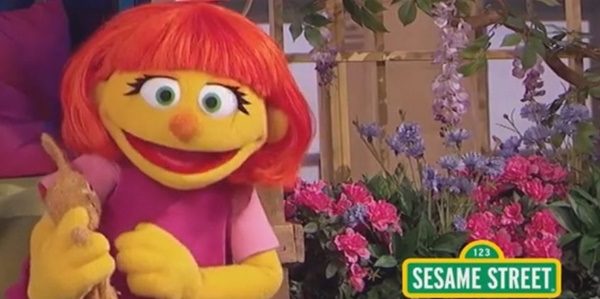 In a world desperate for compassion, there is thankfully a place where friendship is valued as life’s greatest treasure, and special care is taken to make sure everyone is included and valued for her or his unique gifts. Can you tell me how to get, how to get to Sesame Street?
Sesame Street may not be the “real world,” but its wisdom, diffused through the magic of public television, makes the real world a kinder place. This was certainly the case last Monday, when Sesame Street debuted its first awesomely autistic Muppet, Julia.
It is Autism Awareness Month, but people on the spectrum are acutely aware that “awareness” isn’t enough. “Awareness” can carry a negative connotation, giving the impression that autism is like a cancer to watch out for or pity. But autism isn’t a disease with a cure waiting to be found; it’s an atypical wiring of the brain. A world built for neurotypical people can be difficult for a person with autism to navigate, presenting various sensory, social, intellectual and emotional challenges. Thus, it is appropriate to call autism a disability. However, people with autism can and do bless the world with unique perspectives and gifts. If the world could understand and accommodate autism along with other differences in abilities, it would be more open and beautiful for all its people living to their fullest potential. Through Julia, Sesame Street is helping to transform our world not only by raising autism awareness, but moreover by promoting autism appreciation.
Julia is a bright-eyed, fiery-haired Muppet. We first encounter her with Elmo and Abby Caddaby as they all paint pictures under the supervision of Alan, the friendly human owner of Sesame Street’s Hooper’s Store. While Abby and Elmo finger paint, Julia shudders at the thought of getting her hands all gooey, opting for a paintbrush instead. This sensitivity to textures is the first of several traits she displays that are common, but by no means universal, among autistic individuals. She also flaps her hands and bounces when excited, uses few words and repeats the words of others, takes time answering questions (sometimes needing them repeated), and becomes anxious and upset over the loud noise of a siren.
Although Julia’s atypical communication style and high sensitivity levels may make life a little more difficult for her, she also displays unique gifts. Her painting is beautiful and highly detailed, and her level of excitement when she is happy indicates that she relishes the joys of life. Those who know someone on the spectrum may recognize some or all of these traits, but autism can present itself in a variety of ways, and Sesame Street takes care to emphasize that this is what autism looks like for Julia. After all, as Dr. Stephen Shore says, “When you’ve met one person with autism, you’ve met one person with autism.”
The purpose of the episode is not merely to introduce an autistic character, however, but to show how people with differing abilities can become friends. Sesame Street gently demonstrates the patience and empathy that make up the building blocks of any healthy relationship. It deftly navigates the misimpressions neurotypical children might have when they encounter an autistic person for the first time and shows that a little understanding goes a long way toward making a lifelong friend. When Big Bird first encounters Julia, he mistakes her unresponsiveness to him as a personal dismissal. He must learn that she takes her time answering, particularly when she’s deep in concentration on another activity. While he notices that she does things differently, he soon comes to realize that Julia’s way to play can be a lot of fun!
I don’t think I could explain the subtle details and successes of this episode any better than Dylan Matthews – a blogger who is himself on the spectrum – did in his review for Vox. Suffice it to say that not only will autistic children benefit from such positive representation in media, and not only will neurotypical children learn a lot from this episode, but a culture of empathy is taking root on Sesame Street and branching out into the wider world.
And I am excited and hopeful for this better world that Sesame Street is helping to create by listening to people with autism and taking their stories and desires to mind in their portrayal of Julia. We need neurodiverse perspectives, because right now, we live in a world saturated with ableism. As “The Art of Autism” blogger Leanne Libas asserts, the biggest problems people with autism face are misunderstandings and stigmas from society. From overt bullying to subtle condescension to well-intentioned but ultimately detrimental attempts to “normalize,” the neurotypical community often relates to people on the autism spectrum in a deliberately or inadvertently harmful manner.
As mimetic theory teaches us, our relationships are integral to our humanity, and when relationships are characterized by misunderstanding, rejection, or hostility, no one involved can live into the fullness of his or her unique humanity. Society as a whole suffers when different peoples are marginalized and the beauty of their perspectives, talents and personalities are shunned. None of us can live into our full potential until all of us can. None of us yet know how much more beautiful, compassionate, joyful and magnificent the world will be when people on the autism spectrum are appreciated for who they are, and none of us know who we will be when our brothers and sisters are able to be who they are. But in their celebration of neurodiversity and friendship, Sesame Street is shining a light on our journey of discovery.
Welcome to Sesame Street, Julia, and welcome to our hearts.
Image: Screenshot from Youtube: “Sesame Street: Meet Julia (Full Clip | 10 Min)” by Sesame Street.
Stay in the loop! Like Teaching Nonviolent Atonement on Facebook!
Previous Post

April 21, 2017
Benjamin L. Corey Webinar – Jesus: The Nonviolent Resurrection
Next Post
April 25, 2017 Theatre Reveals the Truth – Webinar with Playwright Christopher Shinn
Browse Our Archives
Select a Category Atonement and Current Events Curriculum Faith and Families Interviews Jesus the Forgiving Victim Lent Montessori politics Reviews The Bible Explained Uncategorized Valentine's Day Wednesday Sermon Who is God?
Select a Month July 2020 November 2019 October 2019 September 2019 August 2019 July 2019 June 2019 May 2019 April 2019 March 2019 February 2019 January 2019 December 2018 November 2018 October 2018 September 2018 August 2018 July 2018 June 2018 May 2018 April 2018 March 2018 February 2018 January 2018 December 2017 November 2017 October 2017 September 2017 August 2017 July 2017 June 2017 May 2017 April 2017 March 2017 February 2017 January 2017 December 2016 November 2016 October 2016 September 2016 August 2016 June 2016 May 2016 April 2016 March 2016 February 2016 January 2016 December 2015 November 2015 October 2015 September 2015 August 2015 July 2015 June 2015 May 2015 April 2015 March 2015 February 2015 January 2015 December 2014 November 2014 October 2014 September 2014 August 2014 July 2014 June 2014 May 2014 April 2014 March 2014 January 2014 December 2013 September 2013 August 2013 July 2013
Follow Us!
TAKE THE
Religious Wisdom Quiz
What does the Greek word 'Kurios' mean?
Select your answer to see how you score.
Lord King Redeemer Messiah
Related posts from Teaching Nonviolent Atonement

How My Atheist Father Helps Me Appreciate The...

Bert And Ernie Need Not Be Officially Gay....

Gratitude For My Muslim Friends On "Love A...
How Friendships Survive Disagreements: An Interview with Cesáreo...
TRENDING AT PATHEOS Progressive Christian

What Being a Modern-Day Apostle Means to Me
In my last column, I discussed the ins and outs of modern-day...

Did Ancient China Once Worship the God of...
Across human history, a common thread weaves through the origins of the...

Love Your Neighbor – Including Earth-Kin: Lev. 19,...
God’s command to love your neighbor means acting in an ethical and...

Lead a Church Study of “Jesus and Lao...
Guest writer Jack Thomas (The Irreverent Reverend) reflects on leading his church...

Pastoral Wisdom for Responding to Sermon Pushback
Getting sermon pushback on your social justice sermon? Learn practical, Proverbs-based strategies...

Principles for Understanding the Apostolic Ministry Today
Whenever people discover that my formal ministry title is "apostle," as in...
view all Progressive Christian blogs
Ad-Free & Subscriber Log-In Subscription Support
- About Us
- 2026 Calendar
- Videos
- Podcasts
- Library of World Religions
- Faith In Media Tracker
- Advertise With Us
- Write for Us
- Privacy Policy
- Terms of Service
- Do Not Sell My Data
- Contact Us
- Radiant Digital
- Manage Newsletter Subscriptions
- Unsubscribe From Notifications
- Sitemap
Copyright 2008-2026, Patheos. All rights reserved.
Subscription Support Ad-Free & Subscriber Log-In
Follow Patheos