
BuddhistCatholicContemplativeEvangelicalGeneral ChristianHinduJewishLatter-day SaintMuslimNew VisionsProgressive Christian
Beliefs
- Buddhist
- Catholic
- Contemplative
- Evangelical
- General Christian
- Hindu
- Jewish
- Latter-day Saint
- More Voices
- Muslim
- New Visions
- Pagan
- Progressive Christian
Topics
- Religion News
- Food and Religion
- Sports and Religion
- Religious Art
- Religious Music and Entertainment
- Religious Events
- History and Religion
- Style and Religion
- Politics and Religion
- Women in Religion
- Recreation Outdoors and Religion
- Business Finance and Religion
- Careers Workplace and Religion
- Education and Religion
- Family Parenting and Religion
- Health Fitness and Religion
- Home and Religion
- Relationships and Religion
- Technology and Religion
- Travel and Religion
Columnists
- Buddhist Columnists
- Business Finance and Religion Columnists
- Careers Workplace and Religion Columnists
- Catholic Columnists
- Contemplative Columnists
- Education and Religion Columnists
- Evangelists Columnists
- Family Parenting and Religion Columnists
- General Christian Columnists
- Health Fitness and Religion Columnists
- Hindu Columnists
- History and Religion Columnists
- Home and Religion Columnists
- Jewish Columnists
- More Voices Columnists
- Latter Day Columnists
- Muslim Columnists
- New Visions Columnists
- Nonreligious Columnists
- Pagan Columnists
- Politics and Religion Columnists
- Progressive Columnists
- Recreation Outdoors and Religion Columnists
- Relationships and Religion Columnists
- Religion News Columnists
- Religious Art Columnists
- Religious Events Columnists
- Religious Music and Entertainment Columnists
- Sports and Religion Columnists
- Style and Religion Columnists
- Technology and Religion Columnists
- Travel and Religion Columnists
- Women in Religion Columnists
Resource Library
- 2026 Calendar
- Library of World Religions
- The 100 Most Holy Places on Earth
- Patheos Answers
- Podcasts
- Videos
- Faith Leaders Database
- Anglican Episcopalian
- Bahai
- Baptist
- Buddhism
- Christianity
- Confucianism
- Eastern Orthodoxy
- Hinduism
- Holiness and Pentecostal
- ISKCON
- Islam
- Judaism
- Lutheran
- Methodist
- The Church of Jesus Christ of Latter-day Saints
- New Age
- Paganism
- Presbytarian and Reformed
- Protestantism
- Religion Behind the Scenes
- Roman Catholic
- Scientology
- Shia Islam
- Sikhism
- Sufism
- Sunni Islam
- Taoism
- Zen
- See all religions
Research Tools
 Ad-Free & Subscriber Log-In Subscription Support
Ad-Free & Subscriber Log-In Subscription Support
Follow Patheos 

- Trending:
- Forgiveness
- |
- Marriage
- |
- Consciousness
- |
- Death Penalty
- |
- Election
- |
- Halloween
 Teaching Nonviolent Atonement
- Home
- Progressive Christian
- Wednesday Sermon: The Grace of Letting Go and Starting Again
Wednesday Sermon: The Grace of Letting Go and Starting Again
Last updated on: March 15, 2017 at 4:06 pm by Tom Truby
Wednesday Sermon: The Grace of Letting Go and Starting Again 2017-03-15T16:06:54-05:00 Tom Truby
Patheos Explore the world's faith through different perspectives on religion and spirituality! Patheos has the views of the prevalent religions and spiritualities of the world.
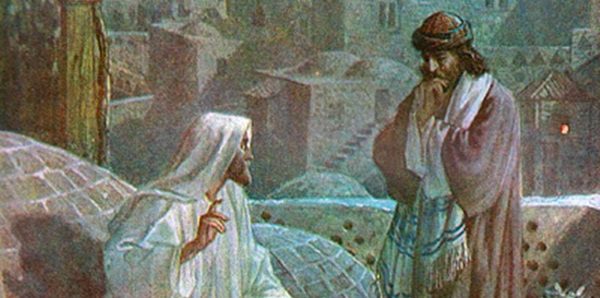 Pastors have a frequent question when they begin to discover mimetic theory. “That’s great. But how does it preach?”
Reverend Tom Truby shows that mimetic theory is a powerful tool that enables pastors to preach the Gospel in a way that is meaningful and refreshing to the modern world. Each Wednesday, Teaching Nonviolent Atonement will highlight his sermons as an example of preaching the Gospel through mimetic theory.
In this sermon, Tom explores the story of Jesus’ encounter with a great religious teacher named Nicodemus. Jesus told Nicodemus he must be born of the Spirit, but what does that mean? It means moving beyond dualistic thinking. Tom writes, “To be born of the Spirit means to begin thinking the way God thinks, and that means, no more ‘us-and-them.'” Read on to find out more about this transformative view of God and of being human!
Year A, Lent 2
March 12th, 2017
John 3:1-17
By Thomas L. Truby
The Grace of Letting Go and Starting Again
“There was a Pharisee named Nicodemus, a Jewish leader. He came to Jesus at night.” Things were falling apart for Nicodemus and he wants to get a grip. He comes at night because he doesn’t want people to see him like this. He is a leader after all and he doesn’t want them to know he is not so sure of himself anymore.
Nicodemus has built up a persona, a personality, a public face. This is who he is to all his friends, family and peers. But he has begun to question his construction. Has he built a trap for himself? If he has, how can he escape it? Jesus, knowing how we humans work, senses his turmoil as Nicodemus approaches in the dark.
Jesus answers Nicodemus’ question before Nicodemus can articulate it, though I don’t think he would be able to frame it anyway. He is in too much chaos for that. His feelings, his thoughts, his world swirl in shifting fog. He feels like Genesis chapter one where the cosmos was without form and void. He used to feel put together but now his world is coming apart. He’s looking for help.
He approaches Jesus and says, “Rabbi, we know that you are a teacher who has come from God, for no one could do these miraculous signs that you do unless God is with him.” Something is deeply wrong and needs to be fixed. He is hoping Jesus can help him patch it back together. He doesn’t even know how to pray about it. When I am in that place I find myself praying “Lord, have mercy on me a sinner.” It’s the only thing that brings me any comfort.
Nicodemus is looking for God’s kingdom, that place of peace where you can settle down and feel whole with the restlessness gone. But Jesus tells him he can’t get there without being reborn from above. He has to allow his current world to disintegrate, to die, to be deconstructed before he will be able to see God’s kingdom and live in God’s reality.
This is too much for Nicodemus and he switches to a literal interpretation. “How is it possible for an adult to be born?” Nicodemus asks. That’s a good question. His next sentence takes a darker and slightly mocking tone as he states, “It’s impossible to enter the mother’s womb for a second time and be born, isn’t it?” Jesus, you’re asking me to let go of my old world, and start over again. I don’t like that idea and I am going to resist you. In fact, Nicodemus is just a little angry about it.
Jesus, un-rattled by this calmly replies, “I assure you, unless someone is born of water, and the Spirit, it is impossible to enter God’s kingdom. Whatever is born of flesh is flesh, and whatever is born of the Spirit is spirit.” All of us were born of the flesh when we were born of water. Believe me, our midwife daughter knows we are born of water and we know our bodies are mostly water. So you have to be human first, born as we all are. I say this to confirm that being born of water has nothing to do with baptism.
After being born of water something else has to happen to see God’s kingdom. We have to be born of the Spirit and that’s a whole different thing. To be born of the Spirit means to begin thinking the way God thinks and that means no more “us-and-them.”
Did you see Naseem Rakha’s editorial in Friday’s Oregonian? (Naseem Rakha, the author of “The Crying Tree” has spoken in our church.) The title to her editorial is “Our planet had no borders until human fears carved them” and in bold print she writes “For me, the art of being human is the art of understanding the falsehood in the word “other.” She wasn’t born knowing that. That’s insight that comes from being born from above.
Paul Neuchterlein believes “Jesus is trying to teach Nicodemus non-dual thinking of the Spirit. When we are born from above, we are born to the perspective of the oneness of God and humanity. If God is our heavenly parent, then all people are brothers and sisters. God loved the world so that he sent the Son to begin the undoing of us-and-them.” Or, as John Kerry once said, “There is no over there anymore. Everywhere is in the same place.”
Nicodemus must have looked mystified, so Jesus said, don’t be surprised that you must be born of the Spirit. “God’s Spirit blows wherever it wishes. You hear its sound, but you don’t know where it comes from or where it is going. It’s the same with everyone who is born of the Spirit.”
The Spirit is out of our control. It goes wherever it wishes. Maybe our control is the problem. We create divisions and inhibit the Spirit with our attempt to be in control of our neighbor and God. Yet every person born of the Spirit must go through times of being out of control. It’s required for any birth, especially the birth from above.
Nicodemus has come to Jesus hoping Jesus will help him hang on to his old world but Jesus tells him he will have to let go and start over if he wants to see God’s kingdom. God’s kingdom is the realm you enter when you relinquish your attempts at control and allow yourself to depend on God’s grace alone. Then you don’t need to divide the world into “us-and-them.”
I am reminded of Girard’s description of the great novels of Western literature. He says they are all accounts of conversion where their authors begin with themselves as the center of their own universe and then gradually relinquish this position. The story is their account of their struggle with their own reluctance to give it up. In the end they relinquish all and discover themselves to have been held in mercy and love all along. The process is like being born again. In describing it Girard says (my memory here. may not be exact) “the earth quaked, the mountains shook and a mouse was born.” All that fuss and fury to discover you were loved at a cosmic level all along.
Nicodemus asks “How are these things possible?” Jesus responds “you are a teacher of Israel and you don’t know these things?” Teachers of Israel were supposed to know how to trust God so they can teach their people. But Nicodemus doesn’t. All he can hear is a cacophony of voices with none that make sense.
Sensing his lostness, his having no voice to listen to, not even his own; Jesus replies with great gentleness. “I assure you that we speak about what we know and testify about what we have seen, but you don’t receive our testimony.” Our voice is a voice you can safely listen to. It’s a voice you can trust. We have seen the things we report to you. It’s solid. You can trust it but “You don’t receive our testimony” and that leaves you in the dark. Jesus is pleading with Nicodemus to listen to him but senses his resistance.
If I have told you about the importance of trusting me while you live your common life here on this earth and you have difficulty believing, how will you believe me when I tell you about heavenly things; that is life lived beyond us-versus-them; that’s a whole new world?
“No one has gone up to heaven except the one who came down from heaven, the Human One.” I love the term “the Human One.” John, the writer of this gospel, sees Jesus as “the Human One” who came down from heaven, that place God lives, and shows us what God looks like. If you want to see an image, a graphic, a picture of God that Jesus reveals let this image dwell in your mind.
“Just as Moses lifted up the snake in the wilderness, so must the Human One be lifted up so that everyone who believes in him will have eternal life.” We see the fullest revelation of God when we see Jesus on a cross lifted up before us all. He is up there not to judge the world but to rescue it. Amen.
Stay in the loop! Like Teaching Nonviolent Atonement on Facebook!
Image: By William Brassey Hole – http://www.truthbook.com/index.cfm?linkID=749, Public Domain, https://en.wikipedia.org/wiki/Nicodemus#/media/File:William_Brassey_Hole_Nicodemus.jpg

Next Post
March 17, 2017 Saint Patrick, Druids, and the Snakes: The Truth is in the Middle
Browse Our Archives
Select a Category Atonement and Current Events Curriculum Faith and Families Interviews Jesus the Forgiving Victim Lent Montessori politics Reviews The Bible Explained Uncategorized Valentine's Day Wednesday Sermon Who is God?
Select a Month July 2020 November 2019 October 2019 September 2019 August 2019 July 2019 June 2019 May 2019 April 2019 March 2019 February 2019 January 2019 December 2018 November 2018 October 2018 September 2018 August 2018 July 2018 June 2018 May 2018 April 2018 March 2018 February 2018 January 2018 December 2017 November 2017 October 2017 September 2017 August 2017 July 2017 June 2017 May 2017 April 2017 March 2017 February 2017 January 2017 December 2016 November 2016 October 2016 September 2016 August 2016 June 2016 May 2016 April 2016 March 2016 February 2016 January 2016 December 2015 November 2015 October 2015 September 2015 August 2015 July 2015 June 2015 May 2015 April 2015 March 2015 February 2015 January 2015 December 2014 November 2014 October 2014 September 2014 August 2014 July 2014 June 2014 May 2014 April 2014 March 2014 January 2014 December 2013 September 2013 August 2013 July 2013
Follow Us!
TAKE THE
Religious Wisdom Quiz
Who's sight was restored by Ananias in Damascus?
Select your answer to see how you score.
King Saul Pontius Pilate Paul of Tarsus Saul of Tarsus
Related posts from Teaching Nonviolent Atonement
Sermon: The Eleventh Commandment

Being Careful to Live Wisely: Faith and Climate...


Let Light Shine Out of Darkness
TRENDING AT PATHEOS Progressive Christian

What Being a Modern-Day Apostle Means to Me
In my last column, I discussed the ins and outs of modern-day...

Did Ancient China Once Worship the God of...
Across human history, a common thread weaves through the origins of the...

Love Your Neighbor – Including Earth-Kin: Lev. 19,...
God’s command to love your neighbor means acting in an ethical and...

Lead a Church Study of “Jesus and Lao...
Guest writer Jack Thomas (The Irreverent Reverend) reflects on leading his church...

Pastoral Wisdom for Responding to Sermon Pushback
Getting sermon pushback on your social justice sermon? Learn practical, Proverbs-based strategies...

Principles for Understanding the Apostolic Ministry Today
Whenever people discover that my formal ministry title is "apostle," as in...
view all Progressive Christian blogs
Ad-Free & Subscriber Log-In Subscription Support
- About Us
- 2026 Calendar
- Videos
- Podcasts
- Library of World Religions
- Faith In Media Tracker
- Advertise With Us
- Write for Us
- Privacy Policy
- Terms of Service
- Do Not Sell My Data
- Contact Us
- Radiant Digital
- Manage Newsletter Subscriptions
- Unsubscribe From Notifications
- Sitemap
Copyright 2008-2026, Patheos. All rights reserved.
Subscription Support Ad-Free & Subscriber Log-In
Follow Patheos