
BuddhistCatholicContemplativeEvangelicalGeneral ChristianHinduJewishLatter-day SaintMuslimNew VisionsProgressive Christian
Beliefs
- Buddhist
- Catholic
- Contemplative
- Evangelical
- General Christian
- Hindu
- Jewish
- Latter-day Saint
- More Voices
- Muslim
- New Visions
- Pagan
- Progressive Christian
Topics
- Religion News
- Food and Religion
- Sports and Religion
- Religious Art
- Religious Music and Entertainment
- Religious Events
- History and Religion
- Style and Religion
- Politics and Religion
- Women in Religion
- Recreation Outdoors and Religion
- Business Finance and Religion
- Careers Workplace and Religion
- Education and Religion
- Family Parenting and Religion
- Health Fitness and Religion
- Home and Religion
- Relationships and Religion
- Technology and Religion
- Travel and Religion
Columnists
- Buddhist Columnists
- Business Finance and Religion Columnists
- Careers Workplace and Religion Columnists
- Catholic Columnists
- Contemplative Columnists
- Education and Religion Columnists
- Evangelists Columnists
- Family Parenting and Religion Columnists
- General Christian Columnists
- Health Fitness and Religion Columnists
- Hindu Columnists
- History and Religion Columnists
- Home and Religion Columnists
- Jewish Columnists
- More Voices Columnists
- Latter Day Columnists
- Muslim Columnists
- New Visions Columnists
- Nonreligious Columnists
- Pagan Columnists
- Politics and Religion Columnists
- Progressive Columnists
- Recreation Outdoors and Religion Columnists
- Relationships and Religion Columnists
- Religion News Columnists
- Religious Art Columnists
- Religious Events Columnists
- Religious Music and Entertainment Columnists
- Sports and Religion Columnists
- Style and Religion Columnists
- Technology and Religion Columnists
- Travel and Religion Columnists
- Women in Religion Columnists
Resource Library
- 2026 Calendar
- Library of World Religions
- The 100 Most Holy Places on Earth
- Patheos Answers
- Podcasts
- Videos
- Faith Leaders Database
- Anglican Episcopalian
- Bahai
- Baptist
- Buddhism
- Christianity
- Confucianism
- Eastern Orthodoxy
- Hinduism
- Holiness and Pentecostal
- ISKCON
- Islam
- Judaism
- Lutheran
- Methodist
- The Church of Jesus Christ of Latter-day Saints
- New Age
- Paganism
- Presbytarian and Reformed
- Protestantism
- Religion Behind the Scenes
- Roman Catholic
- Scientology
- Shia Islam
- Sikhism
- Sufism
- Sunni Islam
- Taoism
- Zen
- See all religions
Research Tools
 Ad-Free & Subscriber Log-In Subscription Support
Ad-Free & Subscriber Log-In Subscription Support
Follow Patheos 

- Trending:
- Forgiveness
- |
- Marriage
- |
- Consciousness
- |
- Death Penalty
- |
- Election
- |
- Halloween
 Teaching Nonviolent Atonement
- Home
- Progressive Christian
- Wednesday Sermon: Daytime Sight Made Possible
Wednesday Sermon: Daytime Sight Made Possible
Last updated on: March 29, 2017 at 9:59 am by Tom Truby
Wednesday Sermon: Daytime Sight Made Possible 2017-03-29T09:59:09-05:00 Tom Truby
Patheos Explore the world's faith through different perspectives on religion and spirituality! Patheos has the views of the prevalent religions and spiritualities of the world.
 Pastors have a frequent question when they begin to discover mimetic theory. “That’s great. But how does it preach?”
Reverend Tom Truby shows that mimetic theory is a powerful tool that enables pastors to preach the Gospel in a way that is meaningful and refreshing to the modern world. Each Wednesday, Teaching Nonviolent Atonement will highlight his sermons as an example of preaching the Gospel through mimetic theory.
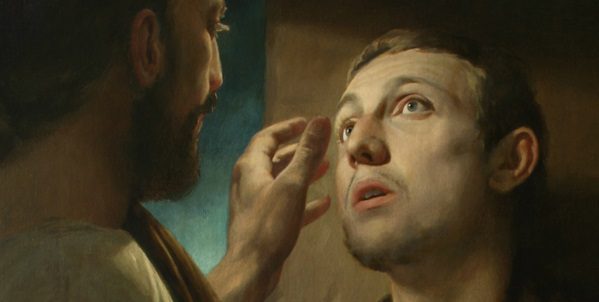
In this sermon, Tom explains the story of a man who was born blind. Was he born blind as a punishment from God? It’s a question that centers around scapegoating. Jesus reframes the question to reveal that God doesn’t desire scapegoating, but healing of relationships. Join Tom as he explores this fundamental story of Christian faith!
Year A, Lent 4, March 26th, 2017
John 9:1-41
Daytime Sight Made Possible
Part I. The Window of Time
Jesus and his disciples are walking along and they see a man born blind from birth. The disciples ask Jesus who sinned that he was born blind, this man or his parents. They think blindness is a result of sin and those blind are being punished. They think those who are poor, disabled, held back and unfortunate are being punished and it’s from God. It’s built into the nature of things. Jesus has a limited amount of time to show humanity that God doesn’t do that sort of thing. God wants our healing. He wants it for us all. We are the ones who do the punishing.
Jesus tells them no one sinned. This man is blind to show us God’s mighty works and so Jesus mixes his spit with the original clay of creation and fixes what is missing. He fills in the blind eye. Now the man can see. Jesus completes creation by filling in the holes. From now on it will be possible to see that God loves us all, no exceptions. It’s the work of him who sent me, he says. Jesus wants us to see this before the window of time closes and his light is put out at the crucifixion. We are in the fourth Sunday of Lent. It’s getting close.
Part II. The Witch Hunt
Up until now the action has been between Jesus and his disciples and focused on this blind man getting healed. But now the neighbors get involved. They have been talking about the man they knew was blind from birth. He had become quite controversial. “Some said, the man had been healed, but others said it wasn’t him at all but someone who just looked like him.”
The healed man kept saying it was him, but can you trust someone who once was a beggar? Besides, because he was born blind he is being punished for sin. Why would God heal the very one being punished? There is something wrong with this picture and they are going to get to the bottom of it.
“So they ask him, ‘How are you now able to see?’” He tells them his story. Their investigation continues. “They asked, ‘Where is this man?’” He doesn’t know.
“Then they led the man who had been born blind to the Pharisees.” Now we discover Jesus had made the mud and smeared it on the man’s eyes on a Sabbath day. If Jesus is from God why would he break God’s rules? This scandalizes them and they too ask how he is able to see.
The Pharisees all agree that healing this man, however Jesus did it, was an evil act. When a person is being punished by God like this man, you don’t intervene and take away the punishment. Besides, his being healed on the Sabbath shows that Jesus is an imposter. It never occurs to them to question their beliefs.
Curiously, even their surface unity contains sub-currents of discord. Some said “This man isn’t from God, because he breaks the Sabbath Law,’ while others said “How can a sinner do miraculous signs like these?” Even in rejecting Jesus they are polarized. They have a problem with division and rivalry. Does this remind you of what is going on in Congress?
Groups divided search for someone to blame and throw out so as to bring unity. They send the tension their rivalry generates into an outsider. It’s the classic scapegoating move.
“So they were divided. Some of the Pharisees questioned the man who had been born blind again: ‘what do you have to say about him, since he healed your eyes?’” There it is; the mechanism at work. They are hoping this outsider will say something incriminating so they can throw him out and restore their unity.
The man replies, “He is a prophet.” That’s safe and gives no grounds for rejection. All they can do is reject his statement and move on to his parents, still searching for “the sinner” on whom they can pin responsibility. This happens at a level deeper than their awareness but we see it because this is the very mechanism the cross revealed.
The original question, “who sinned, this man or his parents,” still drives the story. The religious leaders are still looking for “the sinner” they think God was punishing with this man’s blindness. They want to make sure that God’s purposes have not been frustrated by Jesus. They are quite sure they are God’s administrators and if Jesus somehow messed up God’s plan, they want to set it right again. They never question their assumptions. Will the real sinner please stand up so that we can cast you out!
His parents sense the danger to themselves and say “We know he is our son. We know he was born blind. But we don’t know how he now sees, and we don’t know who healed his eyes. Ask him. He is old enough to speak for himself.” They know who healed him but don’t want to say. If someone is going to be blamed and thrown out, let it be him not us. In a sense, they sacrifice their own son. This is a witch hunt and they don’t want to be its target.
Again the evil eye focuses on the man born blind. The religious leaders place him under oath and tell him what they want to hear. “We know this man is a sinner” they say, corroborate our view and you will be released from suspicion. The man proves uncooperative.
“I don’t know whether he’s a sinner. Here’s what I do know: I was blind and now I see.” Since he hadn’t answered the way they wanted, their interrogation continues. “What did he do to you? How did he heal your eyes?”
All those years of being blind, of being different, excluded and on the edge had given this brave soul a commitment to integrity. He wasn’t about to be coerced into saying what he knew was not true. He even has the courage to express irritation with these witch hunters. “I already told you, and you don’t listen. Why do you want to hear it again? Do you want to become his disciple too?”
His smart reply gets under their skin and they retort, “You are his disciple, but we are Moses’ disciple. We know that God spoke to Moses, but we don’t know where this man is from.” How true! The Son of God comes and we experience him as a stranger, an alien and a threat. Soon they will get rid of him.
The man with healed eyes who now sees perfectly replies, “This is incredible! You don’t know where he is from, yet he healed my eyes!” They abandon logic and resort to irrational accusation. “’You were born completely in sin! How is it that you dare to teach us?’ Then they expelled him.” They have expelled the man who sees clearly.
Part III The Wrap Up
Jesus has a special love for those who are expelled. When he heard they had expelled the man, Jesus went looking for him. Jesus didn’t want him to feel isolated and subhuman. The world wants its victims to feel they are lesser than others, that’s why they are in prison, in the ghetto, in poverty, in trouble—but not Jesus. Jesus seeks them out.
“’Do you believe in the Human One,’ Jesus asks. He answered, ‘Who is he, sir? I want to believe in him.’” The man is open and eager to hear more. It’s like that when we bring the gospel to those our culture has thrown out.
“Jesus said, ‘You have seen him. In fact, he is the one speaking to you!’”
“The man said, ‘Lord, I believe.’ And he worshipped Jesus.
Those who are expelled can see clearly when someone shows them how the world works through exclusion. When someone helps them see, they lose their blindness and sense of being subhuman. They begin to see. It’s “the dividers” who are blind because they don’t see the fundamental humanity of us all. Jesus’ judgement reveals the truth and those expelled hear good news. The ones who thought they saw all along and considered themselves qualified to divide and expel; they are the ones who are blind.
“Some Pharisees who were with him heard what he said and asked, ‘Surely we aren’t blind, are we?’” May our eyes be opened. Amen
Stay in the loop! Like Teaching Nonviolent Atonement on Facebook!
Image: By Andrey Mironov (Own work), Creative Commons License, Via Wikimedia Commons.

Previous Post

March 27, 2017
Judaism, Atonement, and God's Nonviolence - The RavenCast
Browse Our Archives
Select a Category Atonement and Current Events Curriculum Faith and Families Interviews Jesus the Forgiving Victim Lent Montessori politics Reviews The Bible Explained Uncategorized Valentine's Day Wednesday Sermon Who is God?
Select a Month July 2020 November 2019 October 2019 September 2019 August 2019 July 2019 June 2019 May 2019 April 2019 March 2019 February 2019 January 2019 December 2018 November 2018 October 2018 September 2018 August 2018 July 2018 June 2018 May 2018 April 2018 March 2018 February 2018 January 2018 December 2017 November 2017 October 2017 September 2017 August 2017 July 2017 June 2017 May 2017 April 2017 March 2017 February 2017 January 2017 December 2016 November 2016 October 2016 September 2016 August 2016 June 2016 May 2016 April 2016 March 2016 February 2016 January 2016 December 2015 November 2015 October 2015 September 2015 August 2015 July 2015 June 2015 May 2015 April 2015 March 2015 February 2015 January 2015 December 2014 November 2014 October 2014 September 2014 August 2014 July 2014 June 2014 May 2014 April 2014 March 2014 January 2014 December 2013 September 2013 August 2013 July 2013
Follow Us!
TAKE THE
Religious Wisdom Quiz
What does Romans say about the mind governed by the flesh versus the mind governed by the Spirit?
Select your answer to see how you score.
The mind governed by the flesh is death, but the mind governed by the Spirit is life and peace The flesh seeks itself, but the Spirit seeks God The flesh leads to sin, but the Spirit leads to righteousness The flesh is weak, but the Spirit is strong
Related posts from Teaching Nonviolent Atonement

Forgiveness in the Time of COVID-19 by Julia...

Reflections on Indigenous Wisdom For Healing A Wounded...

How Forgiveness Can Transform Our Violence and Build...

Jesus Unmasked: God's Economy and How to Cheat...
TRENDING AT PATHEOS Progressive Christian

What Being a Modern-Day Apostle Means to Me
In my last column, I discussed the ins and outs of modern-day...

Did Ancient China Once Worship the God of...
Across human history, a common thread weaves through the origins of the...

Love Your Neighbor – Including Earth-Kin: Lev. 19,...
God’s command to love your neighbor means acting in an ethical and...

Lead a Church Study of “Jesus and Lao...
Guest writer Jack Thomas (The Irreverent Reverend) reflects on leading his church...

Pastoral Wisdom for Responding to Sermon Pushback
Getting sermon pushback on your social justice sermon? Learn practical, Proverbs-based strategies...

Principles for Understanding the Apostolic Ministry Today
Whenever people discover that my formal ministry title is "apostle," as in...
view all Progressive Christian blogs
Ad-Free & Subscriber Log-In Subscription Support
- About Us
- 2026 Calendar
- Videos
- Podcasts
- Library of World Religions
- Faith In Media Tracker
- Advertise With Us
- Write for Us
- Privacy Policy
- Terms of Service
- Do Not Sell My Data
- Contact Us
- Radiant Digital
- Manage Newsletter Subscriptions
- Unsubscribe From Notifications
- Sitemap
Copyright 2008-2026, Patheos. All rights reserved.
Subscription Support Ad-Free & Subscriber Log-In
Follow Patheos