
BuddhistCatholicContemplativeEvangelicalGeneral ChristianHinduJewishLatter-day SaintMuslimNew VisionsProgressive Christian
Beliefs
- Buddhist
- Catholic
- Contemplative
- Evangelical
- General Christian
- Hindu
- Jewish
- Latter-day Saint
- More Voices
- Muslim
- New Visions
- Pagan
- Progressive Christian
Topics
- Religion News
- Food and Religion
- Sports and Religion
- Religious Art
- Religious Music and Entertainment
- Religious Events
- History and Religion
- Style and Religion
- Politics and Religion
- Women in Religion
- Recreation Outdoors and Religion
- Business Finance and Religion
- Careers Workplace and Religion
- Education and Religion
- Family Parenting and Religion
- Health Fitness and Religion
- Home and Religion
- Relationships and Religion
- Technology and Religion
- Travel and Religion
Columnists
- Buddhist Columnists
- Business Finance and Religion Columnists
- Careers Workplace and Religion Columnists
- Catholic Columnists
- Contemplative Columnists
- Education and Religion Columnists
- Evangelists Columnists
- Family Parenting and Religion Columnists
- General Christian Columnists
- Health Fitness and Religion Columnists
- Hindu Columnists
- History and Religion Columnists
- Home and Religion Columnists
- Jewish Columnists
- More Voices Columnists
- Latter Day Columnists
- Muslim Columnists
- New Visions Columnists
- Nonreligious Columnists
- Pagan Columnists
- Politics and Religion Columnists
- Progressive Columnists
- Recreation Outdoors and Religion Columnists
- Relationships and Religion Columnists
- Religion News Columnists
- Religious Art Columnists
- Religious Events Columnists
- Religious Music and Entertainment Columnists
- Sports and Religion Columnists
- Style and Religion Columnists
- Technology and Religion Columnists
- Travel and Religion Columnists
- Women in Religion Columnists
Resource Library
- 2026 Calendar
- Library of World Religions
- The 100 Most Holy Places on Earth
- Patheos Answers
- Podcasts
- Videos
- Faith Leaders Database
- Anglican Episcopalian
- Bahai
- Baptist
- Buddhism
- Christianity
- Confucianism
- Eastern Orthodoxy
- Hinduism
- Holiness and Pentecostal
- ISKCON
- Islam
- Judaism
- Lutheran
- Methodist
- The Church of Jesus Christ of Latter-day Saints
- New Age
- Paganism
- Presbytarian and Reformed
- Protestantism
- Religion Behind the Scenes
- Roman Catholic
- Scientology
- Shia Islam
- Sikhism
- Sufism
- Sunni Islam
- Taoism
- Zen
- See all religions
Research Tools
 Ad-Free & Subscriber Log-In Subscription Support
Ad-Free & Subscriber Log-In Subscription Support
Follow Patheos 

- Trending:
- Forgiveness
- |
- Marriage
- |
- Consciousness
- |
- Death Penalty
- |
- Election
- |
- Halloween
 Teaching Nonviolent Atonement
- Home
- Progressive Christian
- 7 Biblical Reasons for Churches to Be Open and Affirming
7 Biblical Reasons for Churches to Be Open and Affirming
Last updated on: February 21, 2017 at 12:35 pm by Adam Ericksen
7 Biblical Reasons for Churches to Be Open and Affirming 2017-02-21T12:35:35-05:00 Adam Ericksen
Patheos Explore the world's faith through different perspectives on religion and spirituality! Patheos has the views of the prevalent religions and spiritualities of the world.
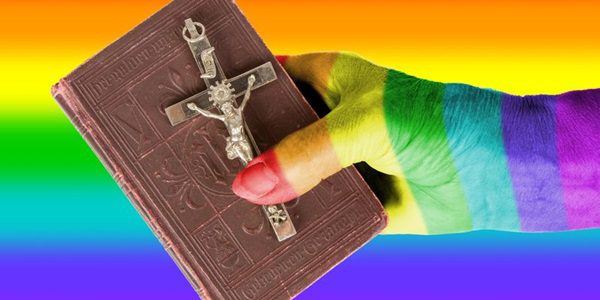 My church’s Facebook page has a picture at the top. It proudly displays members of our congregation at a gay pride parade. They smile as they hold a banner with a rainbow colored heart with the words, “Love YES! Equality YES!”
We want people in our neighborhood to know that we are an Open and Affirming congregation. We proclaim the fact that God loves you, just as you are. You don’t have to become something you are not to earn God’s love. As we like to say in the United Church of Christ, “No matter who you are or where you are on life’s journey, you are welcome here.” We believe that especially during these times of political turmoil, Christians should be on the forefront of protecting LGBTQ rights.
Our church has had some push back, especially on our Facebook page. One visitor to the page recently made a familiar challenge to our position. He stated that we don’t take the Bible seriously because we simply ignore those parts that talk about homosexuality.
Actually, we take the Bible very seriously. But what does the Bible really say about homosexuality? Here are 7 Biblical reasons for churches to be Open and Affirming:
- Leviticus always comes up in this conversation. That book is primarily about how to conduct proper ritual worship. In ancient Israel, one of the biggest problems was the worship of foreign gods. We know that some worshippers of Baal and other gods practiced temple prostitution, including same-gender temple prostitution. That form of worship worked its way into ancient Israel. That’s what Leviticus is against. It’s not against committed same-gender relationships. Besides, I really like bacon and shrimp. And it’s impractical for me not to wear polyester…
- Many people cite Sodom and Gomorrah as God’s condemnation of homosexuality. But the Bible provides a different reason for the fall of these two cities. Sodom and Gomorrah fell because they fostered abusive relationships and injustice. As Ezekiel 16:48-50 states, they were destroyed because they were arrogant, overfed, and didn’t help the needy.
- Some people who believe the Bible condemns same sex relationships point to Romans 1 as their proof text. However, it’s more likely Paul was referring to similar issues that the Levitical priest had with impurities of ritual worship. But let’s just take the literary context. Paul writes that people first exchanged the glory of the immortal God for images made to look like human beings. They worshiped created things and then God gave them up to their passions. First comes idolatry then comes Paul’s list. Again, Paul’s main concern is worshiping created things. But what if the idolatry never happens? What if people in committed same sex relationships don’t worship created things, but worship the eternal God? Roman’s 1 isn’t about those relationships. Also, people frequently read Romans 1 and don’t ever read Romans 2, which is about not judging people for doing what happens in Romans 1, because, according to Paul, in judging them we do the same things. Whatever Paul meant in Romans 1, his point in Romans 2 is that it isn’t our place to judge others for it. Paul simply wants us to stop judging one another.
- For an explicit rejection of the human pattern of condemning one another, read Acts 10. I’ll give a summary – Peter was praying on a roof and fell into a trance. He saw a sheet come down from the sky that was full of birds and other “unclean” animals. God said, “Kill and eat.” Peter said, “By no means, Lord, for I have never eaten anything that is profane or unclean.” In other words, Peter said, “Do you want me to just ignore what the Bible says about those unclean animals?!” Peter was confused, but soon realized the message wasn’t really about animals or food. It was about human beings. After his vision, Peter was led to baptize a Gentile. Before he baptized the Gentile, Peter stated to those around him, “You yourselves know that it is unlawful to associate with or visit a Gentile, but God has shown me that I should not call anyone profane or unclean” (Acts 10:28). Here we are, 2000 years later, and we are still using the “law” to accuse people of being unclean. God told Peter to stop doing that. We should stop, too. For more on this, read Jame’s Alison’s book, Jesus the Forgiving Victim, pages 317-327.
- Paul wrote in Galatians 3:28 that, “There is no longer Jew or Greek, there is no longer slave or free, there is no longer male and female; for all of you are one in Christ Jesus.” That passage isn’t about sexuality. But it is about the major identity barriers of Paul’s day. They were identities that led to an “us against them” mentality. Paul stated that in Christ, we can no longer structure our identity in a way that leads us over and against anyone else. Why was Paul so insistent about this? Because he knew that this human tendency to scapegoat was the very thing that led people to kill Jesus.
- Jesus references sexuality briefly, but he never says anything specifically about homosexuality. If it were something so important to him, the Gospel writers would have said something about it. It wasn’t an important issue for Jesus, so it wasn’t an important issue for the Gospel writers, and so it isn’t an important issue for us.
- Jesus never used the term “homosexuality” because, historically, the term wasn’t coined until the 19th century. And so, in the original Hebrew and Greek, you will never find the word “homosexuality” in the Bible because the word didn’t exist 2000+ years ago. Modern translations that use that term project a modern word onto the Bible. Why? I don’t know, but I’m always suspicious when they do, because the word simply didn’t exist.
Those are my seven points. Do you have more? Let me know in the comment section below.
If you are interested in exploring further, I recommend David Gushee’s book Changing Our Mind. Gushee is a leading evangelical ethicist who explains these and other biblical passages in more detail.
Stay in the loop! Like Teaching Nonviolnet Atonement on Facebook!
Image:Copyright: michaklootwijk / 123RF Stock Photo
Previous Post

February 20, 2017
"Love Your Enemies": Expanding Our Hearts Through Compassion
Next Post
February 22, 2017 Wednesday Sermon: Announcing a New Freedom!
Browse Our Archives
Select a Category Atonement and Current Events Curriculum Faith and Families Interviews Jesus the Forgiving Victim Lent Montessori politics Reviews The Bible Explained Uncategorized Valentine's Day Wednesday Sermon Who is God?
Select a Month July 2020 November 2019 October 2019 September 2019 August 2019 July 2019 June 2019 May 2019 April 2019 March 2019 February 2019 January 2019 December 2018 November 2018 October 2018 September 2018 August 2018 July 2018 June 2018 May 2018 April 2018 March 2018 February 2018 January 2018 December 2017 November 2017 October 2017 September 2017 August 2017 July 2017 June 2017 May 2017 April 2017 March 2017 February 2017 January 2017 December 2016 November 2016 October 2016 September 2016 August 2016 June 2016 May 2016 April 2016 March 2016 February 2016 January 2016 December 2015 November 2015 October 2015 September 2015 August 2015 July 2015 June 2015 May 2015 April 2015 March 2015 February 2015 January 2015 December 2014 November 2014 October 2014 September 2014 August 2014 July 2014 June 2014 May 2014 April 2014 March 2014 January 2014 December 2013 September 2013 August 2013 July 2013
Follow Us!
TAKE THE
Religious Wisdom Quiz
Who stopped the sun from setting during a battle?
Select your answer to see how you score.
Samuel Joshua Moses Elijah
Related posts from Teaching Nonviolent Atonement

How Forgiveness Can Transform Our Violence and Build...

The Chosen One Chooses Love Over Fear [VIDEO]

Jesus Unmasked: Jesus Brings the Fire!

God Doesn’t Smite Anyone - Reflections on Sodom,...
TRENDING AT PATHEOS Progressive Christian

What Being a Modern-Day Apostle Means to Me
In my last column, I discussed the ins and outs of modern-day...

Did Ancient China Once Worship the God of...
Across human history, a common thread weaves through the origins of the...

Love Your Neighbor – Including Earth-Kin: Lev. 19,...
God’s command to love your neighbor means acting in an ethical and...

Lead a Church Study of “Jesus and Lao...
Guest writer Jack Thomas (The Irreverent Reverend) reflects on leading his church...

Pastoral Wisdom for Responding to Sermon Pushback
Getting sermon pushback on your social justice sermon? Learn practical, Proverbs-based strategies...

Principles for Understanding the Apostolic Ministry Today
Whenever people discover that my formal ministry title is "apostle," as in...
view all Progressive Christian blogs
Ad-Free & Subscriber Log-In Subscription Support
- About Us
- 2026 Calendar
- Videos
- Podcasts
- Library of World Religions
- Faith In Media Tracker
- Advertise With Us
- Write for Us
- Privacy Policy
- Terms of Service
- Do Not Sell My Data
- Contact Us
- Radiant Digital
- Manage Newsletter Subscriptions
- Unsubscribe From Notifications
- Sitemap
Copyright 2008-2026, Patheos. All rights reserved.
Subscription Support Ad-Free & Subscriber Log-In
Follow Patheos