
BuddhistCatholicContemplativeEvangelicalGeneral ChristianHinduJewishLatter-day SaintMuslimNew VisionsProgressive Christian
Beliefs
- Buddhist
- Catholic
- Contemplative
- Evangelical
- General Christian
- Hindu
- Jewish
- Latter-day Saint
- More Voices
- Muslim
- New Visions
- Pagan
- Progressive Christian
Topics
- Religion News
- Food and Religion
- Sports and Religion
- Religious Art
- Religious Music and Entertainment
- Religious Events
- History and Religion
- Style and Religion
- Politics and Religion
- Women in Religion
- Recreation Outdoors and Religion
- Business Finance and Religion
- Careers Workplace and Religion
- Education and Religion
- Family Parenting and Religion
- Health Fitness and Religion
- Home and Religion
- Relationships and Religion
- Technology and Religion
- Travel and Religion
Columnists
- Buddhist Columnists
- Business Finance and Religion Columnists
- Careers Workplace and Religion Columnists
- Catholic Columnists
- Contemplative Columnists
- Education and Religion Columnists
- Evangelists Columnists
- Family Parenting and Religion Columnists
- General Christian Columnists
- Health Fitness and Religion Columnists
- Hindu Columnists
- History and Religion Columnists
- Home and Religion Columnists
- Jewish Columnists
- More Voices Columnists
- Latter Day Columnists
- Muslim Columnists
- New Visions Columnists
- Nonreligious Columnists
- Pagan Columnists
- Politics and Religion Columnists
- Progressive Columnists
- Recreation Outdoors and Religion Columnists
- Relationships and Religion Columnists
- Religion News Columnists
- Religious Art Columnists
- Religious Events Columnists
- Religious Music and Entertainment Columnists
- Sports and Religion Columnists
- Style and Religion Columnists
- Technology and Religion Columnists
- Travel and Religion Columnists
- Women in Religion Columnists
Resource Library
- 2026 Calendar
- Library of World Religions
- The 100 Most Holy Places on Earth
- Patheos Answers
- Podcasts
- Videos
- Faith Leaders Database
- Anglican Episcopalian
- Bahai
- Baptist
- Buddhism
- Christianity
- Confucianism
- Eastern Orthodoxy
- Hinduism
- Holiness and Pentecostal
- ISKCON
- Islam
- Judaism
- Lutheran
- Methodist
- The Church of Jesus Christ of Latter-day Saints
- New Age
- Paganism
- Presbytarian and Reformed
- Protestantism
- Religion Behind the Scenes
- Roman Catholic
- Scientology
- Shia Islam
- Sikhism
- Sufism
- Sunni Islam
- Taoism
- Zen
- See all religions
Research Tools
 Ad-Free & Subscriber Log-In Subscription Support
Ad-Free & Subscriber Log-In Subscription Support
Follow Patheos 

- Trending:
- Forgiveness
- |
- Marriage
- |
- Consciousness
- |
- Death Penalty
- |
- Election
- |
- Halloween
 Teaching Nonviolent Atonement
- Home
- Progressive Christian
- Wednesday Sermon: Caught in the Net of Love
Wednesday Sermon: Caught in the Net of Love
Last updated on: January 25, 2017 at 6:15 pm by Tom Truby
Wednesday Sermon: Caught in the Net of Love 2017-01-25T18:15:15-05:00 Tom Truby
Patheos Explore the world's faith through different perspectives on religion and spirituality! Patheos has the views of the prevalent religions and spiritualities of the world.
 Pastors have a frequent question when they begin to discover mimetic theory. “That’s great. But how does it preach?”
Reverend Tom Truby shows that mimetic theory is a powerful tool that enables pastors to preach the Gospel in a way that is meaningful and refreshing to the modern world. Each Wednesday, Teaching Nonviolent Atonement will highlight his sermons as an example of preaching the Gospel through mimetic theory.
In this sermon Tom discusses the beginning of Jesus’ ministry. Jesus lived in the Roman Empire, which was based on “divide and control.” Tom explains that Jesus wasn’t about dividing the world into “us and them.” Rather, the kingdom of God “removes division and asks its participants to do what is best for the other; particularly the poor, the sick, the stranger and those in prison.”
Year A, 3rd Sunday After the Epiphany
January 22nd, 2017
By Thomas L. Truby
Matthew 4:12-23
Caught in the Net of Love
The arrest of John the Baptist impacted Jesus. When word of it came, Jesus left Nazareth, up in the hills, and moved to Capernaum, a very prosperous crossroads town on the shores of The Sea of Galilee. Geographically, it is quite a dramatic shift. He moves from a poverty-stricken village a long way from nowhere to a robust, multi-ethnic fishing and travel center on the coast of the big lake.
Some versions say “Jesus withdrew to Galilee,” a more vivid rendering than “he went to Galilee” that we just read. The New Interpreter’s Commentary believes that “withdrew” is a better translation because it captures Jesus’ response to threats. Jesus doesn’t aggressively react to ominous news with loud proclamations or dire predictions. No, he withdraws to another place; he takes decisive action but this action is initially inward and always non- violent. With this move he lays a foundation for what he intends to do next.
Now let’s bring this into dialogue with where we are in our history. We don’t know what the inauguration on Friday meant for us. Some of us our hopeful and some of us are fearful. We all suspect it’s significant. If we follow Jesus’ example in responding to extraordinary news, of which there has been plenty of late, we quietly withdraw, set our foundations in a new place and prepare to be a light in our land of deep darkness, no matter if we view that darkness from the left or the right. Matthew brings in a hopeful note by quoting Isaiah who said “The people who lived in the dark have seen a great light, and a light has come upon those who lived in the region and in shadow of death.”
We at Clarkes Church have seen this light and it wasn’t Obama and it won’t be President Trump. Another light has appeared for us and it illumines the darkness of our world and gives us hope. This hope is for the whole world and precedes all religion. Matthew is clear that Jesus’ ministry begins in Galilee of the Gentiles where there are Jews but Gentiles are in the majority. These gentiles are the people who see the great light.
Like the wise men coming from the east who symbolize the presence of the whole world at his birth, Jesus moves to Capernaum in Galilee of the Gentiles to begin his work. This thing Jesus is doing is not just for us, it’s for us all. His ministry will not be about divide and control. It will begin with the proclamation of the kingdom of God that removes division and asks its participants to do what’s best for the other; particularly the poor, the sick, the stranger and those in prison. Jesus is announcing the arrival of a new kingdom that from now on will rule the earth whether the earth recognizes it or not. A new era has begun.
“From that time Jesus began to announce, ‘Change your hearts and lives! Here comes the kingdom of heaven!’” This is Jesus’ response to the tragic news of the imprisonment of John who had been the peoples hope. “Change your hearts and lives” is something people can do in their helplessness, rage, fear, frustration and bewilderment. Don’t focus on CNN and what they describe. Focus on what you need to do to “change your hearts and lives.” This is the time for introspection and action. Why now; because “here comes the kingdom of heaven!” Jesus is opening up an alternative that in the end will prevail and asks us to live it now. Plus, things that jolt us now can be opportunities to begin anew. They get us out of our habitual ruts and make it possible to forge new trails.
Remember, the kingdom of Heaven is not something you wait for, die to attain, reserved only for the sweet by and by. No, the Kingdom of Heaven is that experience which comes to us from outside our rivalrous world and is available to us when we respond to God’s gentle call. It’s where we let go of defining ourselves over against the other; convincing ourselves that we are more worthy than our neighbor who is different from us or perhaps less worthy. The Kingdom of Heaven knows we are all children of God and God loves us all.
I want to share a personal story that I hope shows the kingdom working. I went to have my hair cut this week carrying one of my complex books, this one describing how western culture can only be understood as a perversion of Christianity. I don’t know that I will get anything out of this book as it is above my intellectual pay scale but I wanted to give it a try. My barber was a petite, very pretty young woman who asked me what I was reading. “Oh,” I said, “it’s a very deep book that I am hoping will help me understand our crazy world.” She said, “I love to read too. I like to read deep books that make me think differently about things. What kind of things do you read,” she asked? Again, I wondered what to say. I didn’t want to pull intellectual rank on her and make her feel dumb. I guess the spirit must have been at work in me. I said “I read a lot about racism and white privilege. It’s hard to see it in ourselves but I am hoping to get better at seeing the world through the eyes of the other person.” “I know,” she said, “my family adopted a five year old girl who was three quarters African American. In little ways people treat her differently than the rest of us. She has a 3.5 grade point average and has applied to eight universities and been turned down by all eight. My other sister has a lower grade point average and was accepted by the first one.”
I was impressed with her openness and curiosity. “Are you going to college,” I asked, revealing my prejudice. “No,” she said, “I just finished hair dressing school. If I went to college I would just end up with a lot of debt and I don’t know what I would study any way.” “Ah,” I said, “so you are developing a trade.” “Yes,” she said. I felt good about that for her. She had found a way to serve people and make a living and so had I. We were different but both serving and that was fine.
“Do you go to church,” she asked. “Yes,” I said, “I am a United Methodist. Do you go to church?” “Yes,” she replied. “I go to New Hope Community Church.” I told her about Teri Gant whose funeral was happening later that day at New Hope Community Church. (She was the founder and director of our local homeless shelter.) She had heard of her. I never told her I was a pastor. I was afraid she would be intimidated and no longer speak to me as an equal. I was finding the conversation very satisfying. I think it was grounded in the Kingdom of Heaven because we were being real with each other. It happened while both of us were still living; she, 22 and a hair dresser; me, 70, with a doctorate in practical theology.
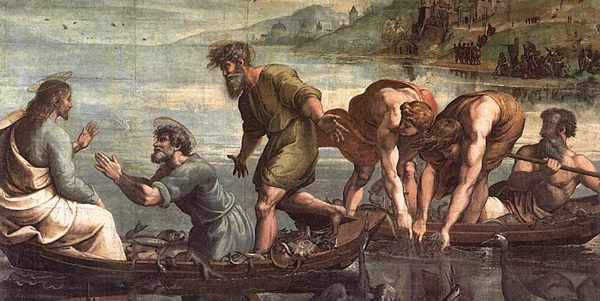
“As Jesus walked alongside the Galilee Sea, he saw two brothers, Simon, who is called Peter, and Andrew, throwing fishing nets into the sea, because they were fishermen. ‘Come, follow me,’ he said, ‘and I’ll show you how to fish for people.’”
How do we fish for people? Could it be fishing for people is being real with them. Not claiming higher ground and being willing to expose the fact of our shared humanness with the other no matter who they are. We all want to be caught in the net of love and that can only happen when we see the other as human just like us. That’s why I love it when people who are very different from us show up in our little church. Shared humanness is really the way of the kingdom. Those who see themselves as living in Jesus’ Kingdom work to find unity and points of connection. They even work to find it with their enemies.
“’Come, follow me,’ he said….Right away, they left their nets and followed him.” Amen.
Image: By Raphael – Own work, Public Domain, https://commons.wikimedia.org/w/index.php?curid=1718094
Stay in the loop! Like Teaching Nonviolent Atonement on Facebook!
Previous Post

January 23, 2017
The Truth about Alternative Facts in the Trump Administration
Next Post
January 26, 2017 The Women's March, Part 1: Solidarity Without Enmity
Browse Our Archives
Select a Category Atonement and Current Events Curriculum Faith and Families Interviews Jesus the Forgiving Victim Lent Montessori politics Reviews The Bible Explained Uncategorized Valentine's Day Wednesday Sermon Who is God?
Select a Month July 2020 November 2019 October 2019 September 2019 August 2019 July 2019 June 2019 May 2019 April 2019 March 2019 February 2019 January 2019 December 2018 November 2018 October 2018 September 2018 August 2018 July 2018 June 2018 May 2018 April 2018 March 2018 February 2018 January 2018 December 2017 November 2017 October 2017 September 2017 August 2017 July 2017 June 2017 May 2017 April 2017 March 2017 February 2017 January 2017 December 2016 November 2016 October 2016 September 2016 August 2016 June 2016 May 2016 April 2016 March 2016 February 2016 January 2016 December 2015 November 2015 October 2015 September 2015 August 2015 July 2015 June 2015 May 2015 April 2015 March 2015 February 2015 January 2015 December 2014 November 2014 October 2014 September 2014 August 2014 July 2014 June 2014 May 2014 April 2014 March 2014 January 2014 December 2013 September 2013 August 2013 July 2013
Follow Us!
TAKE THE
Religious Wisdom Quiz
What is the correct sequence of the fruit of the Spirit as listed in Galatians?
Select your answer to see how you score.
Love, peace, joy, kindness, forbearance, faithfulness, goodness, self-control, gentleness Love, joy, peace, forbearance, kindness, goodness, faithfulness, gentleness, self-control Love, joy, peace, kindness, goodness, forbearance, faithfulness, self-control, gentleness Joy, love, peace, goodness, kindness, faithfulness, forbearance, gentleness, self-control
Related posts from Teaching Nonviolent Atonement

Forgiveness in the Time of COVID-19 by Julia...

Reflections on Indigenous Wisdom For Healing A Wounded...

How Forgiveness Can Transform Our Violence and Build...

Jesus Unmasked: God's Economy and How to Cheat...
TRENDING AT PATHEOS Progressive Christian

What Being a Modern-Day Apostle Means to Me
In my last column, I discussed the ins and outs of modern-day...

Did Ancient China Once Worship the God of...
Across human history, a common thread weaves through the origins of the...

Love Your Neighbor – Including Earth-Kin: Lev. 19,...
God’s command to love your neighbor means acting in an ethical and...

Lead a Church Study of “Jesus and Lao...
Guest writer Jack Thomas (The Irreverent Reverend) reflects on leading his church...

Pastoral Wisdom for Responding to Sermon Pushback
Getting sermon pushback on your social justice sermon? Learn practical, Proverbs-based strategies...

Principles for Understanding the Apostolic Ministry Today
Whenever people discover that my formal ministry title is "apostle," as in...
view all Progressive Christian blogs
Ad-Free & Subscriber Log-In Subscription Support
- About Us
- 2026 Calendar
- Videos
- Podcasts
- Library of World Religions
- Faith In Media Tracker
- Advertise With Us
- Write for Us
- Privacy Policy
- Terms of Service
- Do Not Sell My Data
- Contact Us
- Radiant Digital
- Manage Newsletter Subscriptions
- Unsubscribe From Notifications
- Sitemap
Copyright 2008-2026, Patheos. All rights reserved.
Subscription Support Ad-Free & Subscriber Log-In
Follow Patheos