
BuddhistCatholicContemplativeEvangelicalGeneral ChristianHinduJewishLatter-day SaintMuslimNew VisionsProgressive Christian
Beliefs
- Buddhist
- Catholic
- Contemplative
- Evangelical
- General Christian
- Hindu
- Jewish
- Latter-day Saint
- More Voices
- Muslim
- New Visions
- Pagan
- Progressive Christian
Topics
- Religion News
- Food and Religion
- Sports and Religion
- Religious Art
- Religious Music and Entertainment
- Religious Events
- History and Religion
- Style and Religion
- Politics and Religion
- Women in Religion
- Recreation Outdoors and Religion
- Business Finance and Religion
- Careers Workplace and Religion
- Education and Religion
- Family Parenting and Religion
- Health Fitness and Religion
- Home and Religion
- Relationships and Religion
- Technology and Religion
- Travel and Religion
Columnists
- Buddhist Columnists
- Business Finance and Religion Columnists
- Careers Workplace and Religion Columnists
- Catholic Columnists
- Contemplative Columnists
- Education and Religion Columnists
- Evangelists Columnists
- Family Parenting and Religion Columnists
- General Christian Columnists
- Health Fitness and Religion Columnists
- Hindu Columnists
- History and Religion Columnists
- Home and Religion Columnists
- Jewish Columnists
- More Voices Columnists
- Latter Day Columnists
- Muslim Columnists
- New Visions Columnists
- Nonreligious Columnists
- Pagan Columnists
- Politics and Religion Columnists
- Progressive Columnists
- Recreation Outdoors and Religion Columnists
- Relationships and Religion Columnists
- Religion News Columnists
- Religious Art Columnists
- Religious Events Columnists
- Religious Music and Entertainment Columnists
- Sports and Religion Columnists
- Style and Religion Columnists
- Technology and Religion Columnists
- Travel and Religion Columnists
- Women in Religion Columnists
Resource Library
- 2026 Calendar
- Library of World Religions
- The 100 Most Holy Places on Earth
- Patheos Answers
- Podcasts
- Videos
- Faith Leaders Database
- Anglican Episcopalian
- Bahai
- Baptist
- Buddhism
- Christianity
- Confucianism
- Eastern Orthodoxy
- Hinduism
- Holiness and Pentecostal
- ISKCON
- Islam
- Judaism
- Lutheran
- Methodist
- The Church of Jesus Christ of Latter-day Saints
- New Age
- Paganism
- Presbytarian and Reformed
- Protestantism
- Religion Behind the Scenes
- Roman Catholic
- Scientology
- Shia Islam
- Sikhism
- Sufism
- Sunni Islam
- Taoism
- Zen
- See all religions
Research Tools
 Ad-Free & Subscriber Log-In Subscription Support
Ad-Free & Subscriber Log-In Subscription Support
Follow Patheos 

- Trending:
- Forgiveness
- |
- Marriage
- |
- Consciousness
- |
- Death Penalty
- |
- Election
- |
- Halloween
 Teaching Nonviolent Atonement
- Home
- Progressive Christian
- Interview with Safi Kaskas: Islam, Peace, and Violence
Interview with Safi Kaskas: Islam, Peace, and Violence
Last updated on: December 6, 2016 at 12:15 am by Adam Ericksen
Interview with Safi Kaskas: Islam, Peace, and Violence 2016-12-06T00:15:14-05:00 Adam Ericksen
Patheos Explore the world's faith through different perspectives on religion and spirituality! Patheos has the views of the prevalent religions and spiritualities of the world.
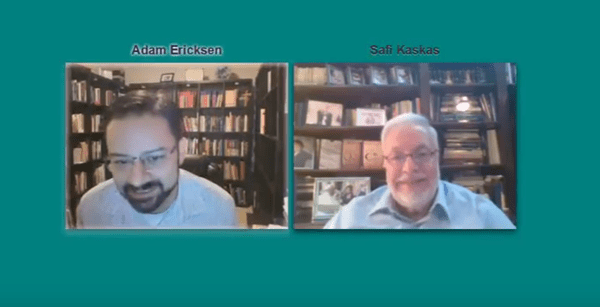 I recently sat down with Safi Kaskas to discuss Islam, Peace, and Violence. We had an inspiring conversation, which you can watch below. Safi is an American Muslim strategic management executive with a wealth of knowledge about Islam. As a co-founder of East-West University in Chicago, he’s a big proponent of education. Safi travels the globe to deliver talks about Islam in the modern world. He has spoken multiple times at the U.S. National Prayer Breakfast and serves on the board of the peacemaking organization Bridges to Common Ground.
Safi has translated the Qur’an twice. His first translation is called The Qur’an: A Contemporary Understanding. His second translation, written with a Christian friend, is called The Qur’an – with References to the Bible: A Contemporary Understanding. This is the first translation of the Qur’an that has references to the Bible. Interestingly, Safi found 3,000 biblical references in the Qur’an.
Video
MP3
Show Notes with Safi Kaskas
Praying the Sunset Prayer
Just before the interview began, Safi prayed the Sunset Prayer. It was 6:00 pm in Saudi Arabia. Safi describes ablution – wash his face, arms, and neck – before the prayer.
Safi’s Mission
Safi’s mission is not to spread Islam, but to spread reconciliation. If someone wants to follow the example of Muhammad, that’s fine. But conversion is not important for Safi. That’s between individuals and the Creator. That’s the freedom we have to choose. The Qur’an forbids forced conversion. The essence of the Qur’an is freedom.
What About Islam Inspires You?
Safi is not inspired by a particular message. He’s inspired by his Creator. The message guides us to the best way to be a good servant. The Creator gives us consciousness to think, reason, and realize he is there. We will either choose to worship him, or not to worship him. The problem is that if I don’t worship him, we will worship ourselves.
The essential message of the Qur’an is the same as in the Torah and throughout the Bible and Abrahamic religions. The main theme is that either we please the Creator by serving others, or we serve our own ego by stepping upon and abusing others, not serving them. The Qur’an, Jesus, the Torah all teach that if we want to serve God we need to serve others.
How Not to Be a Victim
Serving others is how Safi chooses not to be a victim to those who hate or disparage Islam. He doesn’t let them scapegoat him because the Creator is much bigger. To know that we have a purpose on earth, which is not to be a victim, but to serve points us to a higher purpose. For Safi, that higher purpose is attempting to bring peace to conflict.
The Arabs scapegoat what they perceive as enemies. We like to blame the other. But in the US, that’s not going to solve problems. If we fall into that game, some may feel relieved by defeating a perceived enemy, but the problem will still be there. That problem is that they don’t actually believe in the Constitution of the United States. If they really want to be Americans, they have to know that citizenship is not easy. We have to live up to the Constitution.
Safi chose to be in the United States and be an American because we have what people desire. We have a great Constitution and freedom. People die throughout the world because they don’t have the freedoms we have in the United States. So many people throughout the world don’t have that freedom.
On the Election
Whether or not our candidate wins, we must accept the results. There’s no sense in crying over the results. This is democracy. If I don’t agree with a particular candidate, we need to work harder for the next election. The United States, in all of our diversity, needs to unify.
The Constitution and Sharia
Sharia is nothing we need to worry about. First, Muslims are no more than 1% of the population. That percent cannot force its will over 99%. But, more important, Sharia isn’t implemented anywhere. Sharia is how a Muslims lives their lives. Sharia is how individuals get closer to God. Sharia is not in the Qur’an, it’s not part of the Sunna. It came later on by a scholar who tried to help Muslims live their lives closer to God. Sharia is time and place sensitive. Any Muslim that doesn’t know that Sharia is time and place sensitive, doesn’t know what Sharia is. The only thing that is not time and space sensitive, the only thing that is forever, is God. Everything else changes. The teachings in the Qur’an are time and place sensitive.
Muslims in America
Muslims are doctors, lawyers, engineers, teachers, businessmen – they are in every field. When Safi came to the US, he didn’t have much money, but he worked hard and was welcomed by his neighbors. Safi became successful in business because his neighbors welcomed him. Nobody was scared of him. They opened their homes and churches to him. If it wasn’t for the love of neighbors, he wouldn’t have made it.
Questions in the Chat Room
What is the Difference Between Sunni and Shia?
Some say Islam isn’t a Religion But a Political Movement Seeking Domination…
When the Prophet Muhammad was alive, he was invited by the people in Yathrib/Medina to lead them. When Muhammad died, he did not have a successor. Some thought his son in law, Ali, should be their new leader, others thought someone else should lead. Ali wasn’t the successor until the fourth successor was named. From then on, there was a split in Islam between the Sunnis and Shia. The Shia became an underground movement and created an ideology that only a decendent of the Prophet should be the leader. From then on, Islam became an empire. They went to conquer other places. But the Qur’an insists that we aren’t allowed to fight unless in the case of self-defense.
Iran became a Shia state and is in rivalry with many other states. Both sides believe in the oneness of God, they believe in the Qur’an, and they believe Muhammad is his messenger. Their issues aren’t religious, they are political.
Adam stated that its a projection when Americans accuse Islam of trying to take over the world, since we are the ones who have military bases all over the world.
Safi said that when Muslims seek an empire, they lose their spirituality. It becomes political.
The Word “Islam”
In his translations, Safi says Islam shouldn’t be translated as a noun. It should be a verb. The Qur’an teaches that the only religion acceptable to God is Islam. It that’s a noun, then its exclusive. But if you translate it as the first Muslims hear it, it wasn’t about identifying one religion over another. It meant those who submit to God. Whatever religion you are, if you believe in one God, Safi considers you a Muslim – one who submits to God and serves others.
Islam and Violence
The Qur’an urges Muslims to fight only in self-defense. Islam even started as a nonviolent movement for 13 years. His followers were killed and excluded. At that time they did not have permission to fight back. They were called to be patient. Muhammad sent many Muslims to a Christian king to live peacefully in his kingdom.
Muhammad was asked to go to Yathrib/Medina to lead the state. The Meccans continue to chase him in Medina. Muhammad had to run a state. This is when fighting was allowed, but only in defense. Permission to fight is granted only to the oppressed. Whenever people criticize the Qur’an for being violent, they take the verses out of context. They omit the ending of those verses, which always end with a phrase “If they cease hostilities, you must cease hostilities” and “If they ask for peace, you must give them peace.”
Stay in the loop! Like Teaching Nonviolent Atonement on Facebook!
Previous Post

December 2, 2016
Islamic Mercy, White Supremacy, and Radical Forgiveness
Next Post
December 5, 2016 Christian Rebels: Jesus, Politics, and a World Without Hate
Browse Our Archives
Select a Category Atonement and Current Events Curriculum Faith and Families Interviews Jesus the Forgiving Victim Lent Montessori politics Reviews The Bible Explained Uncategorized Valentine's Day Wednesday Sermon Who is God?
Select a Month July 2020 November 2019 October 2019 September 2019 August 2019 July 2019 June 2019 May 2019 April 2019 March 2019 February 2019 January 2019 December 2018 November 2018 October 2018 September 2018 August 2018 July 2018 June 2018 May 2018 April 2018 March 2018 February 2018 January 2018 December 2017 November 2017 October 2017 September 2017 August 2017 July 2017 June 2017 May 2017 April 2017 March 2017 February 2017 January 2017 December 2016 November 2016 October 2016 September 2016 August 2016 June 2016 May 2016 April 2016 March 2016 February 2016 January 2016 December 2015 November 2015 October 2015 September 2015 August 2015 July 2015 June 2015 May 2015 April 2015 March 2015 February 2015 January 2015 December 2014 November 2014 October 2014 September 2014 August 2014 July 2014 June 2014 May 2014 April 2014 March 2014 January 2014 December 2013 September 2013 August 2013 July 2013
Follow Us!
TAKE THE
Religious Wisdom Quiz
What religious movement emphasizes unity among all Christians globally?
Select your answer to see how you score.
Pietism Adventism Ecumenism Monasticism
Related posts from Teaching Nonviolent Atonement

Toxic Christianity: 3 Things We Can Do That...

The Secret of Life: An Interview with Audrey...

Forgiveness in the Time of COVID-19 by Julia...

TRENDING AT PATHEOS Progressive Christian

What Being a Modern-Day Apostle Means to Me
In my last column, I discussed the ins and outs of modern-day...

Did Ancient China Once Worship the God of...
Across human history, a common thread weaves through the origins of the...

Love Your Neighbor – Including Earth-Kin: Lev. 19,...
God’s command to love your neighbor means acting in an ethical and...

Lead a Church Study of “Jesus and Lao...
Guest writer Jack Thomas (The Irreverent Reverend) reflects on leading his church...

Pastoral Wisdom for Responding to Sermon Pushback
Getting sermon pushback on your social justice sermon? Learn practical, Proverbs-based strategies...

Principles for Understanding the Apostolic Ministry Today
Whenever people discover that my formal ministry title is "apostle," as in...
view all Progressive Christian blogs
Ad-Free & Subscriber Log-In Subscription Support
- About Us
- 2026 Calendar
- Videos
- Podcasts
- Library of World Religions
- Faith In Media Tracker
- Advertise With Us
- Write for Us
- Privacy Policy
- Terms of Service
- Do Not Sell My Data
- Contact Us
- Radiant Digital
- Manage Newsletter Subscriptions
- Unsubscribe From Notifications
- Sitemap
Copyright 2008-2026, Patheos. All rights reserved.
Subscription Support Ad-Free & Subscriber Log-In
Follow Patheos