
BuddhistCatholicContemplativeEvangelicalGeneral ChristianHinduJewishLatter-day SaintMuslimNew VisionsProgressive Christian
Beliefs
- Buddhist
- Catholic
- Contemplative
- Evangelical
- General Christian
- Hindu
- Jewish
- Latter-day Saint
- More Voices
- Muslim
- New Visions
- Pagan
- Progressive Christian
Topics
- Religion News
- Food and Religion
- Sports and Religion
- Religious Art
- Religious Music and Entertainment
- Religious Events
- History and Religion
- Style and Religion
- Politics and Religion
- Women in Religion
- Recreation Outdoors and Religion
- Business Finance and Religion
- Careers Workplace and Religion
- Education and Religion
- Family Parenting and Religion
- Health Fitness and Religion
- Home and Religion
- Relationships and Religion
- Technology and Religion
- Travel and Religion
Columnists
- Buddhist Columnists
- Business Finance and Religion Columnists
- Careers Workplace and Religion Columnists
- Catholic Columnists
- Contemplative Columnists
- Education and Religion Columnists
- Evangelists Columnists
- Family Parenting and Religion Columnists
- General Christian Columnists
- Health Fitness and Religion Columnists
- Hindu Columnists
- History and Religion Columnists
- Home and Religion Columnists
- Jewish Columnists
- More Voices Columnists
- Latter Day Columnists
- Muslim Columnists
- New Visions Columnists
- Nonreligious Columnists
- Pagan Columnists
- Politics and Religion Columnists
- Progressive Columnists
- Recreation Outdoors and Religion Columnists
- Relationships and Religion Columnists
- Religion News Columnists
- Religious Art Columnists
- Religious Events Columnists
- Religious Music and Entertainment Columnists
- Sports and Religion Columnists
- Style and Religion Columnists
- Technology and Religion Columnists
- Travel and Religion Columnists
- Women in Religion Columnists
Resource Library
- 2026 Calendar
- Library of World Religions
- The 100 Most Holy Places on Earth
- Patheos Answers
- Podcasts
- Videos
- Faith Leaders Database
- Anglican Episcopalian
- Bahai
- Baptist
- Buddhism
- Christianity
- Confucianism
- Eastern Orthodoxy
- Hinduism
- Holiness and Pentecostal
- ISKCON
- Islam
- Judaism
- Lutheran
- Methodist
- The Church of Jesus Christ of Latter-day Saints
- New Age
- Paganism
- Presbytarian and Reformed
- Protestantism
- Religion Behind the Scenes
- Roman Catholic
- Scientology
- Shia Islam
- Sikhism
- Sufism
- Sunni Islam
- Taoism
- Zen
- See all religions
Research Tools
 Ad-Free & Subscriber Log-In Subscription Support
Ad-Free & Subscriber Log-In Subscription Support
Follow Patheos 

- Trending:
- Forgiveness
- |
- Marriage
- |
- Consciousness
- |
- Death Penalty
- |
- Election
- |
- Halloween
 Teaching Nonviolent Atonement
- Home
- Progressive Christian
- Wednesday Sermon: Zacchaeus and Cataract Distortions
Wednesday Sermon: Zacchaeus and Cataract Distortions
Last updated on: November 2, 2016 at 1:23 pm by Tom Truby
Wednesday Sermon: Zacchaeus and Cataract Distortions 2016-11-02T13:23:18-05:00 Tom Truby
Patheos Explore the world's faith through different perspectives on religion and spirituality! Patheos has the views of the prevalent religions and spiritualities of the world.
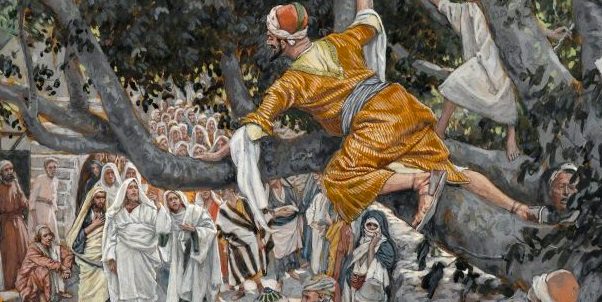 Pastors have a frequent question when they begin to discover mimetic theory. “That’s great. But how does it preach?”
Reverend Tom Truby shows that mimetic theory is a powerful tool that enables pastors to preach the Gospel in a way that is meaningful and refreshing to the modern world. Each Wednesday, Teaching Nonviolent Atonement will highlight his sermon as an example of preaching the Gospel through mimetic theory.
In this sermon, Tom explores the story of Zacchaeus, who climbed a tree to get a better view of Jesus. As he saw Jesus better, Zacchaeus encountered salvation by discovering that “God loves us all and doesn’t construct enemy lists; that’s all our doing and only shows how lost we are. But the good news is that the Human One came to seek and save the lost and the lost include us all.”
Year C, 24th Sunday after Pentecost, Proper 26
October 30th, 2016
Thomas L. Truby
Luke 19:1-10
Cataract Distortions
Zacchaeus was a chief administrator of a whole cadre of hated collaborators with the enemy. They collected the money that was then used to oppress them by a brutal and unstoppable army of foreigners. Zacchaeus’s wealth was skimmed off the earning of the other tax collectors who were in direct connection to the people. He would be like a Wall Street banker living several stories above the people on the street.
The irony is that while living above them all, in normal life he dwelt below them, being a short man. When he was among them he could see nothing and lost all perspective.
Being curious about Jesus, what he looked like, how many people followed him and how he related to the different folks around him, he climbed a tree so that he could observe. He must have been a very good observer of relationships to have risen as so far. He wanted to see for himself, make his own assessment and not depend on the reports from people around him. His social isolation had already giving him a perspective different from the crowds. In other words he wanted to see the patterns of relations Jesus stimulated as he moved through the village. Who did Jesus notice and who did he ignore? Who were drawn to him and who recoiled in his presence? How much fear dulled the eyes of those who looked upon him and did he elicit fear in how he presented himself.
Not wanting people to know he planned to observe Jesus from the cover of a tree, he ran ahead of the crowd and crawled up. He was like a deer hunter in a shelter observing but not himself being seen. Maybe he didn’t want people to know he was curious about Jesus. People in his position were supposed to have it made. Their hearts weren’t supposed to ache from loneliness and lack of connection.
“When Jesus came to that spot, he looked up and said, ‘Zacchaeus, come down at once.’” We have reached the dramatic apex to today’s story. Zacchaeus, a man used to giving orders, and a man whose orders had dramatic impact on others’ lives, is told to immediately come down. Is he about to be redressed by someone with more authority than he? Will he be fired or shamed? As a tax collector he knows he doesn’t occupy the moral high ground. His heart must have plummeted to the pit of his stomach as he looked into the commanding eyes of the person below him.
And then Jesus offered his next sentence. The one that reversed the negative spin the tax collector’s guilty conscience had set in motion. “I must stay in your home today!” Jesus said. He is not about to shame him, Jesus wants to come to his home and visit him! What could this mean? The chief tax collector knows everyone hates him and yet Jesus wants to come to his home.
Jesus is taking a position different from everyone in this political parade. Intense political crowds are fickle and Jesus’ actions had just exposed Jesus to a shift in their mood. They could all turn against them and stone both Jesus and the man in the tree. Jesus is risking his life for this tax collector and Zacchaeus knows it.
Jesus’ actions in going against the crowd must have impacted the observant Zacchaeus. Deciding it’s safe to leave his tree shelter and place himself in the trust of Jesus, he comes down.
“Everyone who saw this grumbled, saying, “He has gone to be the guest of a sinner.’” Notice, everyone who saw this grumbled. There was not a one who did not. All were in agreement that Jesus was doing a bad thing. Somehow Jesus was able to counter every single person there and act in a way contrary to all their wishes. I find this absolutely amazing. I don’t know how he was able to do it. It was an act in anticipation of what he will again do in Jerusalem. And in Jerusalem it will cost him his life.
In their minds Jesus was a man of God and therefore pure. In their minds Zacchaeus had collaborated with their enemy and therefore was impure—a sinner. Sinners were to be separate from God, God hated sinners; how could Jesus go his house. It was a scandal, an outrage, a betrayal of God and a betrayal of all they had built their lives on. They could make no sense of it and so they grumbled.
I suspect most in that crowd, if not all, decided there and then that Jesus was not their man. They would not be voting for him anytime soon. Whereas before they had been enthusiastic or undecided, now they knew what they would do. His actions had showed them he did not know the God of Abraham.
And then something strange happened that thrust them back into muddled thought. “Zacchaeus stopped and said to the Lord, ‘Look, Lord, I give half of my possessions to the poor. And if I have cheated anyone, I will repay them four times as much.’” Zacchaeus had changed! They had not thought of that. They had written him off and excluded him from their community. But now he was demonstrating behavior totally outside their frame of reference. In fact, they had been secure in their “goodness” because they had been secure in his “badness.” But now Zacchaeus was doing good things. It messed with their world. It was very unsettling. While Jesus’ going to Zacchaeus’ house may have been good news for Zacchaeus, it wasn’t necessarily good news for them. It threw their world up for grabs.
To make sure that everyone who saw this and grumbled couldn’t go back and invent some spin that changed what had happened into its opposite, Jesus planted a fiery torch in their way that could not be removed. “Today, salvation has come to this household for he too is a Son of Abraham,” he said. If the crowd wanted to be Jesus’ followers, they would have to stretch themselves to include this person they had considered unclean. They would have to include this person they had thought of as their enemy. And it was more than just Zacchaeus; their love would have to include all those they had always thought of as enemies—even the collaborators with Rome, even those who had become very rich due to their collaboration. It was a tall order. Living in love and forgiveness is not easy.
I think of Standing Rock in North Dakota in reference to this. Do we consider our Native American brothers and sisters our enemies? Do we indulge in fantasies of revenge on the riot police charged with removing them? If we are followers of Jesus our perspective must embrace them both. Perhaps naming violence itself as the problem delineates the path.
Then Jesus added one more sentence that shook the world. He said, “The Human One came to seek and save the lost.” The Human One gives us the measure and model for what being a human looks like. Anything short of Jesus is a distortion and we all have distorted vision. Even Paul looked through a glass darkly. All of us have cataract-induced distortions. The more we allow Jesus to form us, the clearer we will see for he is the Human One.
“The Human One came to seek and save the lost.” We thought it was Zacchaeus and his sort that was lost and they are, but now we discover that we are lost too. Not lost and subject to eternal damnation but lost in our distorted relationships with each other and therefore lost in our connection with God. God loves us all and doesn’t construct enemy lists; that’s all our doing and only shows how lost we are. But the good news is that the Human One came to seek and save the lost and the lost include us all. He came to show us we are all included. Amen.
Image: James Tissot [No restrictions or Public domain], via Wikimedia Commons

Previous Post

October 28, 2016
Faith and Families: Zacchaeus
Next Post
November 3, 2016 From Standing Rock to Syria: No More Wars for Oil!
Browse Our Archives
Select a Category Atonement and Current Events Curriculum Faith and Families Interviews Jesus the Forgiving Victim Lent Montessori politics Reviews The Bible Explained Uncategorized Valentine's Day Wednesday Sermon Who is God?
Select a Month July 2020 November 2019 October 2019 September 2019 August 2019 July 2019 June 2019 May 2019 April 2019 March 2019 February 2019 January 2019 December 2018 November 2018 October 2018 September 2018 August 2018 July 2018 June 2018 May 2018 April 2018 March 2018 February 2018 January 2018 December 2017 November 2017 October 2017 September 2017 August 2017 July 2017 June 2017 May 2017 April 2017 March 2017 February 2017 January 2017 December 2016 November 2016 October 2016 September 2016 August 2016 June 2016 May 2016 April 2016 March 2016 February 2016 January 2016 December 2015 November 2015 October 2015 September 2015 August 2015 July 2015 June 2015 May 2015 April 2015 March 2015 February 2015 January 2015 December 2014 November 2014 October 2014 September 2014 August 2014 July 2014 June 2014 May 2014 April 2014 March 2014 January 2014 December 2013 September 2013 August 2013 July 2013
Follow Us!
TAKE THE
Religious Wisdom Quiz
How many apostles did Jesus have?
Select your answer to see how you score.
11 4 14 12
Related posts from Teaching Nonviolent Atonement
Sermon: The Eleventh Commandment

Being Careful to Live Wisely: Faith and Climate...


Let Light Shine Out of Darkness
TRENDING AT PATHEOS Progressive Christian

Why Christians Have a Sacred Duty to Vote:...
The Bible offers strong support for the sacred duty to vote. Here...

What Being a Modern-Day Apostle Means to Me
In my last column, I discussed the ins and outs of modern-day...

Did Ancient China Once Worship the God of...
Across human history, a common thread weaves through the origins of the...

Love Your Neighbor – Including Earth-Kin: Lev. 19,...
God’s command to love your neighbor means acting in an ethical and...

Lead a Church Study of “Jesus and Lao...
Guest writer Jack Thomas (The Irreverent Reverend) reflects on leading his church...

Principles for Understanding the Apostolic Ministry Today
Whenever people discover that my formal ministry title is "apostle," as in...
view all Progressive Christian blogs
Ad-Free & Subscriber Log-In Subscription Support
- About Us
- 2026 Calendar
- Videos
- Podcasts
- Library of World Religions
- Faith In Media Tracker
- Advertise With Us
- Write for Us
- Privacy Policy
- Terms of Service
- Do Not Sell My Data
- Contact Us
- Radiant Digital
- Manage Newsletter Subscriptions
- Unsubscribe From Notifications
- Sitemap
Copyright 2008-2026, Patheos. All rights reserved.
Subscription Support Ad-Free & Subscriber Log-In
Follow Patheos