
BuddhistCatholicContemplativeEvangelicalGeneral ChristianHinduJewishLatter-day SaintMuslimNew VisionsProgressive Christian
Beliefs
- Buddhist
- Catholic
- Contemplative
- Evangelical
- General Christian
- Hindu
- Jewish
- Latter-day Saint
- More Voices
- Muslim
- New Visions
- Pagan
- Progressive Christian
Topics
- Religion News
- Food and Religion
- Sports and Religion
- Religious Art
- Religious Music and Entertainment
- Religious Events
- History and Religion
- Style and Religion
- Politics and Religion
- Women in Religion
- Recreation Outdoors and Religion
- Business Finance and Religion
- Careers Workplace and Religion
- Education and Religion
- Family Parenting and Religion
- Health Fitness and Religion
- Home and Religion
- Relationships and Religion
- Technology and Religion
- Travel and Religion
Columnists
- Buddhist Columnists
- Business Finance and Religion Columnists
- Careers Workplace and Religion Columnists
- Catholic Columnists
- Contemplative Columnists
- Education and Religion Columnists
- Evangelists Columnists
- Family Parenting and Religion Columnists
- General Christian Columnists
- Health Fitness and Religion Columnists
- Hindu Columnists
- History and Religion Columnists
- Home and Religion Columnists
- Jewish Columnists
- More Voices Columnists
- Latter Day Columnists
- Muslim Columnists
- New Visions Columnists
- Nonreligious Columnists
- Pagan Columnists
- Politics and Religion Columnists
- Progressive Columnists
- Recreation Outdoors and Religion Columnists
- Relationships and Religion Columnists
- Religion News Columnists
- Religious Art Columnists
- Religious Events Columnists
- Religious Music and Entertainment Columnists
- Sports and Religion Columnists
- Style and Religion Columnists
- Technology and Religion Columnists
- Travel and Religion Columnists
- Women in Religion Columnists
Resource Library
- 2026 Calendar
- Library of World Religions
- The 100 Most Holy Places on Earth
- Patheos Answers
- Podcasts
- Videos
- Faith Leaders Database
- Anglican Episcopalian
- Bahai
- Baptist
- Buddhism
- Christianity
- Confucianism
- Eastern Orthodoxy
- Hinduism
- Holiness and Pentecostal
- ISKCON
- Islam
- Judaism
- Lutheran
- Methodist
- The Church of Jesus Christ of Latter-day Saints
- New Age
- Paganism
- Presbytarian and Reformed
- Protestantism
- Religion Behind the Scenes
- Roman Catholic
- Scientology
- Shia Islam
- Sikhism
- Sufism
- Sunni Islam
- Taoism
- Zen
- See all religions
Research Tools
 Ad-Free & Subscriber Log-In Subscription Support
Ad-Free & Subscriber Log-In Subscription Support
Follow Patheos 

- Trending:
- Forgiveness
- |
- Marriage
- |
- Consciousness
- |
- Death Penalty
- |
- Election
- |
- Halloween
 Teaching Nonviolent Atonement
- Home
- Progressive Christian
- Wednesday Sermon: One Embraced a New Way of Living!
Wednesday Sermon: One Embraced a New Way of Living!
Last updated on: October 12, 2016 at 2:08 pm by Tom Truby
Wednesday Sermon: One Embraced a New Way of Living! 2016-10-12T14:08:04-05:00 Tom Truby
Patheos Explore the world's faith through different perspectives on religion and spirituality! Patheos has the views of the prevalent religions and spiritualities of the world.
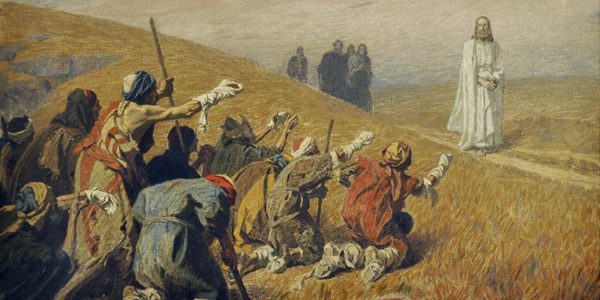 Pastors have a frequent question when they begin to discover mimetic theory. “That’s great. But how does it preach?”
Reverends Tom and Laura Truby show that mimetic theory is a powerful tool that enables pastors to preach the Gospel in a way that is meaningful and refreshing to the modern world. Each Wednesday, Teaching Nonviolent Atonement will highlight their sermons as an example of preaching the Gospel through mimetic theory.
In this sermon, Tom and Laura discusses Jesus healing 10 lepers. One, a Samaritan, came back to give thanks to God. This Samaritan understood something about Jesus that the others didn’t. As Tom and Laura state, Jesus created “a new and exciting world where all exist by grace and none are excluded.” Once we witness that new world, we implicitly respond like the Samaritan by returning to give thanks.
Year C, Pentecost 21, Proper 23
October 9, 2016
Luke 17:11-19
Thomas L. and Laura C. Truby
One Embraced a New Way of Living!
Jesus and his disciples are heading south toward Jerusalem and are currently between Samaria and Galilee. It’s no man’s land, the space between, the area where people gather who have no other place to go. They live there because they are not welcome in either Galilee or Samaria.
At least ten lepers live in this in-between place. Their connection with one another is their common exclusion from their families and the wider community. They are largely alone, unsupported, and tempted to think that no one, not even God, cares about them. They are the “out” of a religion built on some being “in” because others are “out.”
Respectfully “Keeping their distance, they call out, ‘Jesus, Master, have mercy on us!’” They know people don’t want to get close to them lest they catch their disease and be cast out themselves. The lepers hope Jesus will not be put off, too.
When Jesus sees them he says, “Go and show yourselves to the priests.” That’s all he says. He doesn’t touch them or heal them. He just tells them report to their priests who will pronounce them clean. He uses the plural “priests” because they are composed of both Samaritan and Jewish Lepers and the two religions have different priests, though Luke doesn’t reveal this until the end of the story. The priests will certify them as clean and therefore eligible to rejoin their religious community. It won’t be the new community that Jesus brings. It will be the old one defined by pure and impure.
Will they trust Jesus enough to start for the priests even when there is no evidence to support their cure? Even here trust is a choice.
In the gospel story just before this, the apostles asked Jesus to increase their faith. Jesus responded saying if they had the tiniest amount of faith they could ask a mulberry tree to move into the sea and take root and it would. The point seems to be that you don’t need more faith you just need to exercise the faith you have and you will be surprised at what God can do. The ten lepers exercise the bit of faith they already have and away they go.
“And as they went, they were made clean.” This happens to all ten lepers. Their ethnicity doesn’t matter. They had faith the size of a mustard seed and the mulberry tree did uproot itself and re-root in the sea. What they had not dared dream could happen, happened. The mercy they had requested comes to them as they go forward.
Could this be the Good News of the Gospel—that all of us have been cleansed of that which separates us from each other and God? This cleansing comes from God’s side in the form of Jesus going to Jerusalem and showing us we are forgiven. Jesus takes what we do to each other on himself so that we can see it and can see that violence is coming from humans not God. God is about love and forgiveness. We are the ones who put our violence on God—in Jesus humans did it literally. Could the mulberry tree’s move from land to sea be the movement from “you get what you deserve,” the way humans usually think, to “you have been blessed to live in a sea of grace,” the new way of living that Jesus announces with everything he does?
At this point the story reveals its focus. “Then one of them, when he saw that he was healed, turned back, praising God with a loud voice.” One turned back. He saw what had happened and turned back. Could it be that becoming whole is seeing the blessing and feeling moved to thank the One who has blessed you? It’s a new way of seeing that shifts the focus and one of the ten got it.
This former leper sees that what has happened is something different. The others returned to a world based on boundaries that separate good from bad, well from sick, and the “in” from the “out”. But in coming back, this one left that world and entered a new and exciting world where all exist by grace and none are excluded. It’s a new world.
Our text says, “He fell on his face at Jesus’ feet and thanked him.” His falling down before Jesus was a result of his new way of seeing. From his position he looks up to Jesus and sees everything with Jesus in the foreground. This is the perspective that gets it right. Paul said, “For me to live is Christ.” One former leper sees that Jesus brings a new way of living, a way where we each dwell in the sea of grace.
When we see everything with Jesus in the foreground we discover that God is nothing but forgiveness, gentleness, blessing, benevolence, compassion, and tenderness. Our response to all of this, once we get it, can only be gratitude and openness to life! Gratitude is not something we try to manufacture; it’s something we can’t help but feel. This is huge! Jesus shows God to us, not just a Christian God, or a Samaritan God or a Jewish God, but a God for all people.
The other nine former lepers trudged toward the priests still operating in a world of fear and punishment where “we get what we deserve” and it’s about keeping the rules. They worry over mistakes they might make and carry an anxious demeanor. Their prayers begin with a distant “Holy God” they must please rather than the intimacy of “Our Father” who they know loves them.
Even though their healing was a gift they all received and quite the opposite of “you get what you deserve,” the old world was the one to which they are resolutely returning. They are healed of leprosy but not whole. Now they feel assured of being “in” because others are still out. The only difference is that it no longer is them. They are returning to a world of tit for tat. They are going back to their old God who judges and is chronically cross.
Now we are ready to notice a bit of information Luke has withheld until this very moment. The one who returned was a Samaritan. The Samaritan’s and the Jews hated each other. How is it that the one the other nine lepers look down on turns out to be the only one exuding gratitude? Did the others believe they deserved to be healed because they thought they were better than this Samaritan and so couldn’t praise God? What Jesus points to in this healing is bigger than religion; it’s a new understanding of God.
When the other nine noticed the Samaritan had turned back they probably thought, “Well, he is a Samaritan, he didn’t get healed. That’s why he is turning back.” Their world remained too small and still divided between those who are in and those who are out. Their exclusionary attitude blinded them to the truth and made it impossible for them to follow the Samaritan’s lead.
When the Samaritan returned to Jesus, “Jesus asked, ‘Were not ten made clean? But the other nine, where are they?’” All ten had been healed but nine of them hadn’t seen the immensity of what Jesus was doing. In amazement Jesus exclaimed, “Was none of them found to return and give praise to God except this foreigner? Then he said to him, ‘Get up and go on your way; your faith has made you well.’” All of them were healed but this one, the foreigner, was made well. He alone saw that God loved all people and his healing wasn’t because he was special, it was because God is a lover and healed them all. The Samaritan is the one who escaped a way of death that leaves humans joyless and embraced a way of living that gives life endlessly. Amen.
Image: Gebhard Fugel [Public domain], via Wikimedia Commons.
Stay in the loop! Like Teaching Nonviolent Atonement on Facebook!


Browse Our Archives
Select a Category Atonement and Current Events Curriculum Faith and Families Interviews Jesus the Forgiving Victim Lent Montessori politics Reviews The Bible Explained Uncategorized Valentine's Day Wednesday Sermon Who is God?
Select a Month July 2020 November 2019 October 2019 September 2019 August 2019 July 2019 June 2019 May 2019 April 2019 March 2019 February 2019 January 2019 December 2018 November 2018 October 2018 September 2018 August 2018 July 2018 June 2018 May 2018 April 2018 March 2018 February 2018 January 2018 December 2017 November 2017 October 2017 September 2017 August 2017 July 2017 June 2017 May 2017 April 2017 March 2017 February 2017 January 2017 December 2016 November 2016 October 2016 September 2016 August 2016 June 2016 May 2016 April 2016 March 2016 February 2016 January 2016 December 2015 November 2015 October 2015 September 2015 August 2015 July 2015 June 2015 May 2015 April 2015 March 2015 February 2015 January 2015 December 2014 November 2014 October 2014 September 2014 August 2014 July 2014 June 2014 May 2014 April 2014 March 2014 January 2014 December 2013 September 2013 August 2013 July 2013
Follow Us!
TAKE THE
Religious Wisdom Quiz
Who pleaded with Joseph for Benjamin's release?
Select your answer to see how you score.
Reuben Judah Naphtali Levi
Related posts from Teaching Nonviolent Atonement

Forgiveness in the Time of COVID-19 by Julia...

Reflections on Indigenous Wisdom For Healing A Wounded...

How Forgiveness Can Transform Our Violence and Build...

Jesus Unmasked: God's Economy and How to Cheat...
TRENDING AT PATHEOS Progressive Christian

What Being a Modern-Day Apostle Means to Me
In my last column, I discussed the ins and outs of modern-day...

Did Ancient China Once Worship the God of...
Across human history, a common thread weaves through the origins of the...

Love Your Neighbor – Including Earth-Kin: Lev. 19,...
God’s command to love your neighbor means acting in an ethical and...

Lead a Church Study of “Jesus and Lao...
Guest writer Jack Thomas (The Irreverent Reverend) reflects on leading his church...

Pastoral Wisdom for Responding to Sermon Pushback
Getting sermon pushback on your social justice sermon? Learn practical, Proverbs-based strategies...

Principles for Understanding the Apostolic Ministry Today
Whenever people discover that my formal ministry title is "apostle," as in...
view all Progressive Christian blogs
Ad-Free & Subscriber Log-In Subscription Support
- About Us
- 2026 Calendar
- Videos
- Podcasts
- Library of World Religions
- Faith In Media Tracker
- Advertise With Us
- Write for Us
- Privacy Policy
- Terms of Service
- Do Not Sell My Data
- Contact Us
- Radiant Digital
- Manage Newsletter Subscriptions
- Unsubscribe From Notifications
- Sitemap
Copyright 2008-2026, Patheos. All rights reserved.
Subscription Support Ad-Free & Subscriber Log-In
Follow Patheos